From Surf Wiki (app.surf) — the open knowledge base
McMansion
Large mass-produced dwelling
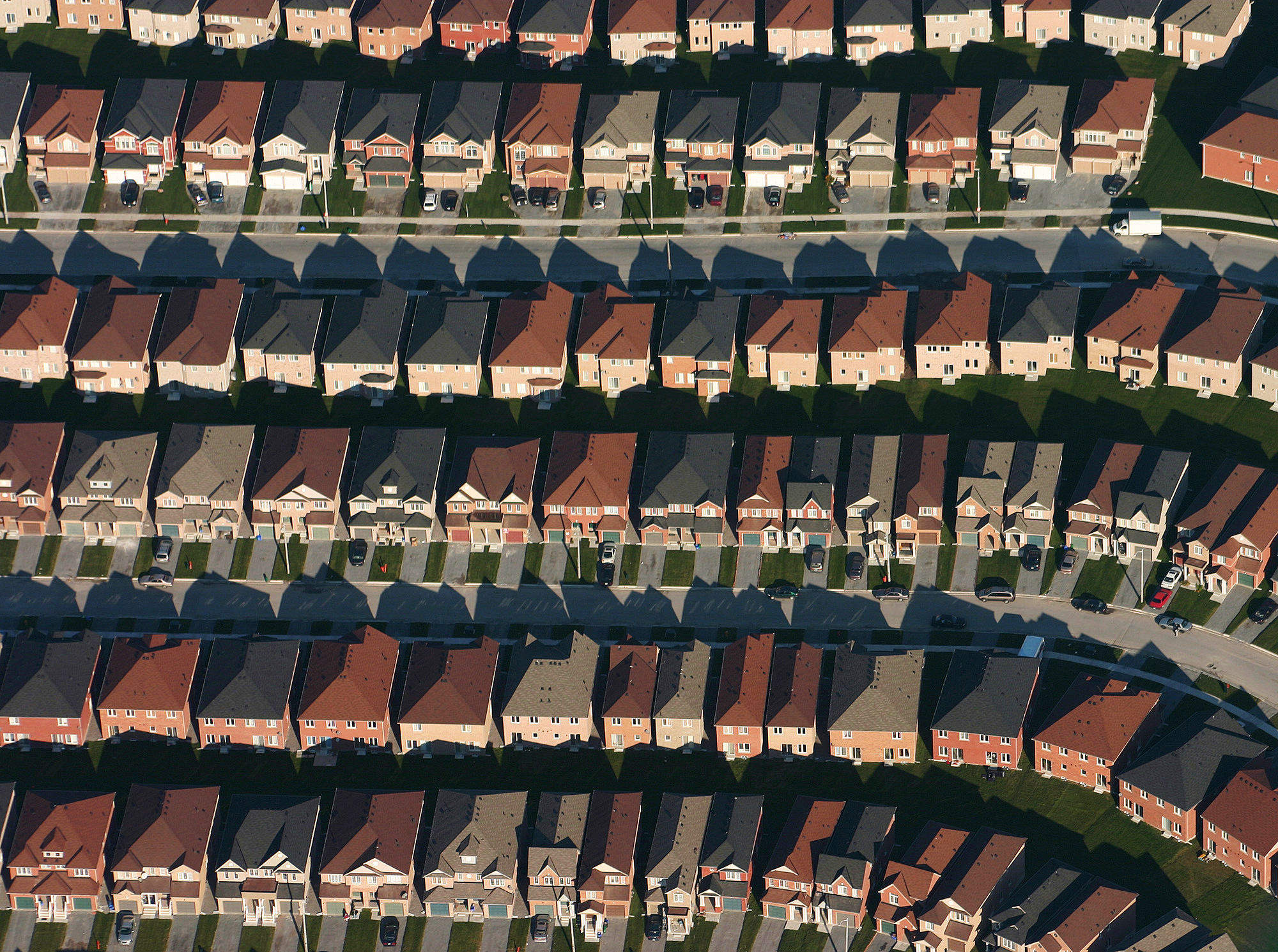
Large mass-produced dwelling
McMansion is a term for a large house in a suburban community, typically marketed to the middle class in developed countries. Architectural historian Virginia Savage McAlester, who gave a first description of the common features which define this building style, coined the more neutral term Millennium Mansion. An example of a McWord, "McMansion" associates the generic quality of these luxury houses with that of mass-produced fast food by evoking McDonald's, an American restaurant chain. The neologism "McMansion" seems to have been coined sometime in the early 1980s. It appeared in the Los Angeles Times in 1990 and The New York Times in 1998. Other terms used to describe "McMansions" include "Persian palace", "Garage Mahal", "starter castle", and "Hummer house". Marketing parlance often uses the term "tract mansions" or executive homes.
Description
The term "McMansion" generally denotes a multi-story house that either has no clear architectural style, or prizes superficial appearance and sheer size over quality, often both.
One real-estate writer explains a successful formula typically found in McMansions: "symmetrical structures on clear-cut lots with Palladian windows centered over the main entry, and brick or stone enhancing the driveway entrance, plus multiple chimneys, dormers, pilasters, and columns—and inside, the master suite with dressing rooms and bath-spa, great rooms, breakfast and dining rooms, showplace kitchen, and extra high and wide garages for multiple cars and SUVs."
These houses also typically have 3000 sqft or more of floor area, ceilings 9 to 10 feet (2.5 to 3m) high or higher, a two-story portico, a two-story front door hall (often containing a large chandelier), a garage with room for three or more cars, many bedrooms (with some having five or more), many bathrooms, extensive crown molding and related features, and lavish—if superficial—interior features.
As noted above, a McMansion replacing a smaller house in a community of smaller-sized houses will cover a much larger portion of the lot than the previous house; in the other usage, McMansions are built en masse in homogeneous communities by a single developer.
Origins
.jpg)
Beginning in California in the 1980s, the larger home concept was intended to fill a gap between the more modest suburban tract housing and the upscale, often custom, houses found in gated, waterfront, or golf course communities. Such communities were developed as subdivisions, or pre-existing neighborhoods were transformed by building on empty lots or replacing torn-down structures. The larger houses proved popular and demand increased dramatically, particularly in light of new land-management laws that were enacted in the 1980s and 1990s.
Efforts to economize may have led to a decline in quality for many of these new houses, prompting the coinage of the disparaging term. Because these houses emphasize instant gratification, they are almost never designed with energy efficiency, environmental sustainability, maintainability, or longevity in mind.
In a development that runs counter to the previous boom in construction of McMansions, a 2009 report suggested that the Great Recession (2008–2012) has stabilized new house sizes in the United States. However, as the economy recovered, home sizes returned to their upward trend.
Throughout the 2010s, the McMansion style started to fall out of favor, during which the McModern, a newer style of single-family home, began to appear in urban neighborhoods of North America. Unlike McMansions' excessive ornamentation and arbitrary architectural style, McModerns emulate modernist architectural styles and are more popular with Millennials.
Attributes
Location
In a city, traditional upscale custom houses are mostly found in the most affluent residential neighbourhoods (commonly regarded as "Millionaires' Mile"), which are typically gated, waterfront, ravine, or golf course communities, all of which have some of the highest residential property taxes in the city. Most of these communities are usually well-established, and the real estate prices tend to be high but stable. The houses themselves feature architectural preferences in general accordance with the surrounding neighborhood.
By contrast, McMansions are typically constructed further from the city center than suburban tract housing. In addition, the land that McMansions are built on is often zoned as agricultural or re-zoned to residential from agricultural, and is often outside of the city proper limits, as both of these result in lower property taxes. These areas may be in demand by buyers who desire a bigger house than the tract house, but are unwilling to pay for (or lack the means to afford) houses in the city's traditional upscale neighborhoods. Due to this demographic, which is more susceptible to boom and bust economic cycles, prices of McMansions tend to be much more volatile and are often fueled by speculation.
Another reason why McMansions are generally found in outlying suburban areas is that lots in older neighborhoods are often much smaller and not conducive to such residences. McMansions are usually much larger than older houses and constructed among other large houses by a subdivider on speculation; they generally are built en masse by a development company to be marketed as premium real estate, but offer few custom features. The construction of what seems to be too large a house on an existing lot can draw the ire of neighbors and other local residents. In 2006, for example, a recently built house in Kirkland, Washington – an affluent suburb on Seattle's Eastside – stood so close to an adjoining property that, in the words of the chair of the city's Neighborhood Association, "you can read the lettering on the canned vegetables in the house next door."
Design

McMansions often mix a variety of different architectural styles and elements, combining quoins, steeply sloped roofs, multiple roof lines, complicated massing, and pronounced dormers, to produce an appearance that may be considered unpleasant, jumbled, or messy.
The builder may have attempted expensive effects with cheap materials, skimped on details, or hidden defects with cladding:
Frequently, priority in McMansion construction is given to the interior layout. Vaulted ceilings, the master suite, bay windows, and the expansive foyer are emphasized with less regard for how these interior spaces will shape the overall envelope of the structure. In particular, designing individual windows for their effect in individual rooms can cause the exterior to feature numerous windows with an asymmetrical or misaligned layout, in multiple conflicting sizes and styles. It has been claimed that this gives the exterior appearance an "amorphous" or "bloated" quality.
Some neighborhoods, where most or all the houses have the same layout and design with minor differences, such as siding or shutter color, are often called "cookie-cutter" neighborhoods.
Economics
From the perspective of a housebuilder, luxury houses of 3,000 sqft or more are more profitable than smaller houses. Multiple communities, like in California and Virginia, have few residential lots available, which inclines builders who acquire them to build luxury housing. In 2014, 32% of the new houses being built had 3,000 sqft or more of floor space, and the average size of a new construction had increased to over 2,600 sqft.
Worldwide
McMansions have seen rising popularity in China, where there have been replicas of famous buildings such as the White House and the Palace of Versailles.
Criticism
Disdain for the McMansion stems from perceptions that these houses look and feel inappropriate (either by themselves or for a given neighborhood), are wasteful due to their inefficient land usage from suburban sprawl and single-family zoning and the large amounts of materials and utilities needed to construct them, and increase commute times significantly. Some go even further, saying that these houses give an impression that their owners lack taste or refinement or are pretentious, or that they show a general discordance in architectural preferences.
In Australia, a central reason McMansions have received a cold reception, is that the archetypal Australian house is generally a single story, red brick house or a bungalow, and because many McMansions use cement render materials perceived as giving an extremely exaggerated appearance. One observer notes that when older and modest houses are often bought as teardowns and McMansions constructed on the vacant land, many instances have occurred where "a poor house stands side by side with a good house."
The blog McMansion Hell, by Kate Wagner, has been critiquing McMansions since June 2016.
Notes
Sources
References
References
- Book Review: Search for Environmental View of Design, Review of 'Out of Place: Restoring Identity to the Regional Landscape', by Michael Hough Yale University Press. Los Angeles Times, July 17, 1990. "What character their history and ecology might offer is being strip-mined to make way for anonymous residential projects, monolithic office towers, climate-controlled retail complexes of questionable design and awkward transportation systems—all in the abused name of progress. We are talking here of the march of mini-malls and 'McMansions.{{' "
- (September 19, 1998). "Interiors; Getting Smart About Art of Living Small". LA Times.
- Cheever, Benjamin. (August 27, 1998). "Close to Home; Life in a Crater Will Do, For Now". The New York Times.
- Goldin, Greg. (2006-06-17). "In Defense of the Persian Palace". LA Times.
- Filter, Alicia. (2006-04-20). "McMansions: Super-sized homes cause a super-sized backlash". Illinois Business Law Journal.
- Stephen A. Mouzon, Susan M. Henderson. ''Traditional Construction Patterns.'' McGraw-Hill Professional, 2004. "(1) Victorian door and side lights on vaguely classical McMansion, (2) Victorian door and side lights on vaguely Georgian McMansion, (3) possibly an Oriental moon gate door on a vaguely classical house..." Pages 144 and 190.
- "McMansion Hell 101".
- Not including the basement. Used as a working definition by the [[Environmental Design Research Association]] in a 2006 report. This represents a floorspace "30 percent larger than the average new house and larger than 80 percent of houses" according to the 2000 Census. ''EDRA37: beyond conflict : proceedings of the 37th Annual Conference of the Environmental Design Research Association, May 3–7, 2006, Atlanta, Georgia.'' Page 254.
- Zelinsky, Wilbur. (2011). "Not Yet a Placeless Land: Tracking an Evolving American Geography". Univ of Massachusetts Press.
- Stone, Madeline. "Americans could be killing the McMansion for good".
- Fletcher, June. (2009-06-29). "McMansions Out of Favor, for Now". Wall Street Journal.
- (2016-06-03). "Homes Keep Getting Bigger, Even as Families Get Smaller". The New York Times.
- Wagner, Kate. (June 30, 2017). "The rise of the McModern". Curbed.
- Garfield, Leanna. (August 7, 2017). "Millennials are ditching the cookie-cutter McMansion for the 'McModern'". Business Insider.
- Miles Jaffe. ''The Hamptons Dictionary: The Essential Guide to Class Warfare.'' Constellation, 2008. Page 82.
- Fiona Allon. ''Renovation nation: our obsession with home.'' UNSW Press, 2008. Page 151.
- Cecelia Techi. ''Exposés and excess: muckraking in America, 1900–2000.'' University of Pennsylvania Press, 2004. Pages 33–34.
- Chiu, Lisa. (2006-06-08). "Big homes on small lots crowd Kirkland neighbors". The Seattle Times.
- From ''Metropolitan Home'', Volume 24 (1992): "This is no McMansion. Every door is perfectly placed, every proportion is exactly right."
- (2012-05-02). "Why do cookie-cutter neighborhoods exist?".
- (August 3, 2015). "The Recovery Is Super-Sizing Houses". The Atlantic.
- Sebag-Montefiore, Clarissa. (2014-04-25). "Why China's rich want to live in McMansions and fake châteaux". Financial Times.
- Steinmetz, Photographs by George. (2014-09-19). "Let a Hundred McMansions Bloom". The New York Times.
- Davison, Graeme. "The Past & Future of the Australian Suburb." ''Australian Planner'' (Dec. 1994): 63–69.
- (3 October 2016). "The Literal Hell of McMansions".
- "Kate Wagner Profile and Activity – Curbed".
This article was imported from Wikipedia and is available under the Creative Commons Attribution-ShareAlike 4.0 License. Content has been adapted to SurfDoc format. Original contributors can be found on the article history page.
Ask Mako anything about McMansion — get instant answers, deeper analysis, and related topics.
Research with MakoFree with your Surf account
Create a free account to save articles, ask Mako questions, and organize your research.
Sign up freeThis content may have been generated or modified by AI. CloudSurf Software LLC is not responsible for the accuracy, completeness, or reliability of AI-generated content. Always verify important information from primary sources.
Report