From Surf Wiki (app.surf) — the open knowledge base
McIntosh County, Georgia
County in Georgia, United States
County in Georgia, United States
| Field | Value | |
|---|---|---|
| county | McIntosh County | |
| state | Georgia | |
| seal | [[File:McIntoshCountyGAseal.png | 90px]] |
| founded | ||
| seat wl | Darien | |
| largest city wl | Darien | |
| area_total_sq_mi | 574 | |
| area_land_sq_mi | 424 | |
| area_water_sq_mi | 150 | |
| area percentage | 26.1% | |
| census yr | 2020 | |
| pop | 10975 | |
| density_sq_mi | 26 | |
| time zone | Eastern | |
| district | 1st | |
| ex image | GA Darien West HD courthouse01.jpg | |
| ex image cap | McIntosh County Courthouse in Darien | |
| website | ||
| named for | Lachlan McIntosh |
McIntosh County is a county located in the U.S. state of Georgia. As of the 2020 census, the population was 10,975, a drop of 23.4 percent since the 2010 census. The county seat is Darien.
McIntosh County is included in the Brunswick, GA Metropolitan Statistical Area.
History
Colonial and Revolutionary period
Main article: San Miguel de Gualdape, Spanish Florida, Province of Carolina, Province of South Carolina, Province of Georgia
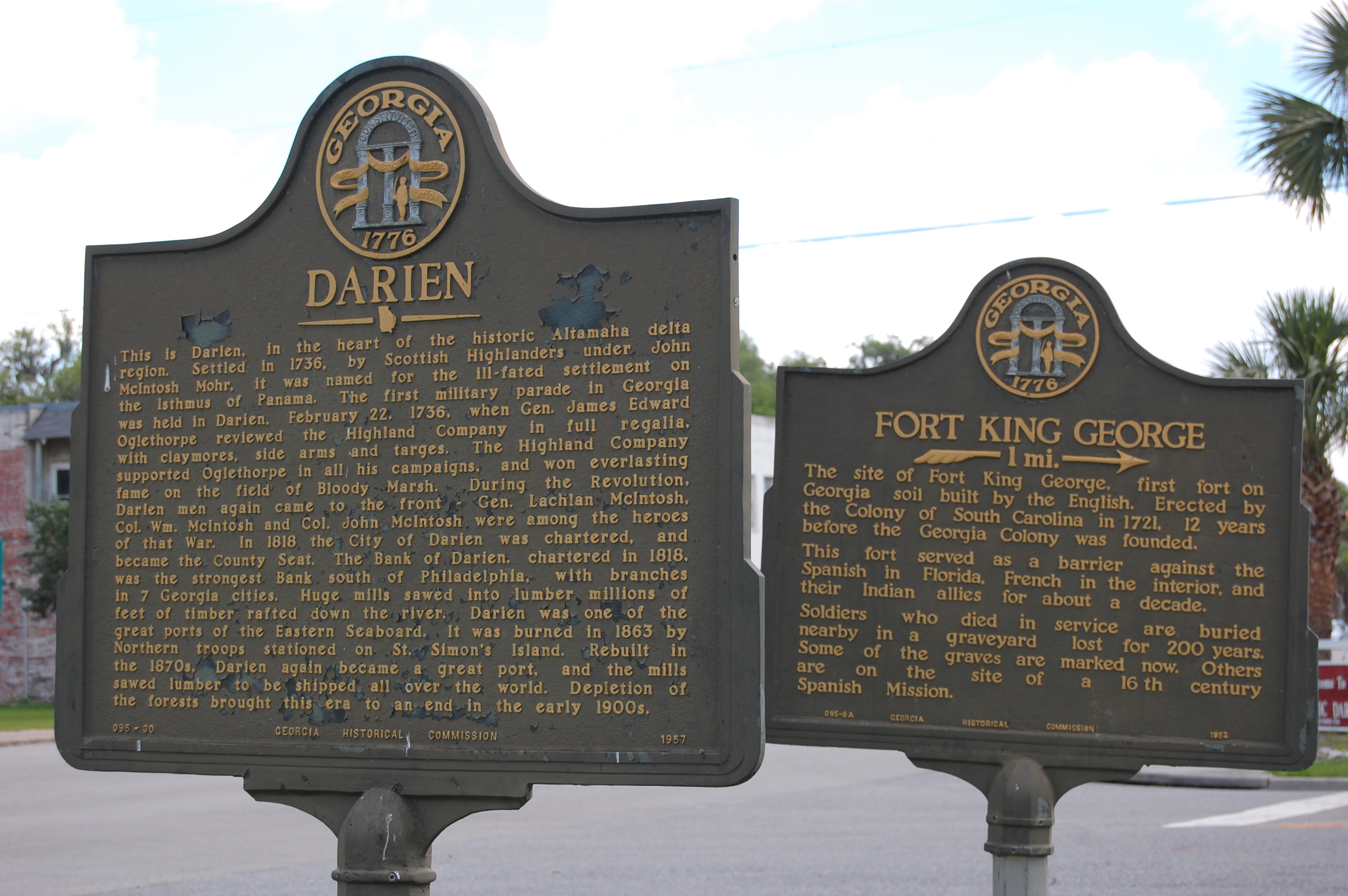
The area which was formally named McIntosh County was originally settled by the British in 1721 with the construction of Fort King George, which was part of a set of forts built as a buffer between the British colonies to the north and Spanish Florida to the south, under the direction of General James Oglethorpe. New Inverness (later named Darien) was founded in 1736 by Scottish Highlanders who were enticed to move to Georgia by General Oglethorpe. In 1760, the British built Fort Barrington on the north side of the Altamaha River about 12 mi northwest of present-day Darien. It was used for decades as a transportation and communication center up and down coastal Georgia. The County split off from Liberty County in 1793.
The new county was named McIntosh for its most famous family, which included Lachlan McIntosh, who was a general in the Continental Army. The McIntosh clan in Darien dates back to 1736.
Civil War period
Main article: Georgia in the American Civil War
Few Georgia counties suffered during the Civil War as much as McIntosh County. The agricultural loss of the plantations was devastating. Even the lumber industry was destroyed, along with the once-thriving seaport town of Darien, Georgia which was the result of the burning of Darien in the "total war" tactics of James Montgomery in June 1863.
Capture of 26 old men

After the burning of Darien in 1863 under the command of U.S. Army Col. James Montgomery, the area was left mostly defenseless. A group of civilians, generally too old for military service, were the only defense against looting by the U.S. military from the naval blockade boats. The men were meeting at Ebenezer Church on the night of August 3, 1864. A spy told the U.S. military about the meeting. U.S. troops surrounded the church and opened fire. The 26 men were captured, marched to near Darien (about 10 miles away), put on ships and sent to prisons in the north.
Reconstruction
Main article: Georgia during Reconstruction

From the end of the Civil war to Georgia's 1907 disenfranchisement laws, McIntosh County was a base of black political power in the state. "Tunis Campbell was the highest-ranking and most influential African American politician in nineteenth-century Georgia", according to the New Georgia Encyclopedia. In March 1865, Tunis G. Campbell Sr. was put in supervision of land claims at the Freedmen's Bureau for a group of Georgia barrier islands, including Sapelo in McIntosh County. After the land in question was returned to plantation owners by President Andrew Johnson, “Campbell quickly purchased 1,250 acres at Belle Ville in McIntosh County and there established an association of black landowners to divide parcels and profit from the land.”
After the military registration carried out in early 1867, 600 black people and 307 white people were on the voter rolls in McIntosh.
In late 1867, Campbell was elected as one of two delegates from the second senatorial district – Liberty, McIntosh, and Tattnall counties – to Georgia's constitutional convention.
In April 1868, Campbell was elected as the state senator for the second district, and his son Tunis G. Campbell Jr. was elected as state representative for McIntosh County. While both Campbells were among the black legislators expelled later in 1868, they were able to return to office in 1871; Campbell Sr. left office in 1872, while Campbell Jr. served until 1874.
Campbell Sr. also served as the Vice President of the Georgia Republican Party. As an elected official, “Campbell [Sr.] organized a black power structure in McIntosh County that protected freed people from white abuses, whether against their bodies or in labor negotiations,” and he was rumored to be protected by a 300-person militia. In fact, that power structure lasted for decades, as evidenced by the fact that the county had three black representatives from 1875 to 1907: Amos R. Rodgers (1878–79), Lectured Crawford (1886–7, 1890–1, 1900–1), and William H. Rogers (1902–07).
Civil rights period
Despite its large number of black residents, McIntosh County politics continued to be dominated by whites well into the 1970s, even following the federal civil rights legislation of the previous decade. In September 1975, the Georgia Legal Services Program, on behalf of the local NAACP, filed suit in United States District Court, alleging that women and blacks were systematically excluded from grand juries responsible for appointing members to the McIntosh County Board of Education. The following May, plaintiffs and county officials reached an agreement providing for random jury selection.
In 1977, the NAACP filed separate suits against McIntosh County and the City of Darien, alleging improper districting for county and city commission seats. The county settled out of court, agreeing to redraw its commission boundaries to include a black-majority district. The NAACP lost its suit against the city, but this decision was remanded and reversed in 1979 by the United States Court of Appeals for the Fifth Circuit.
Praying for Sheetrock: A Work of Nonfiction () by Melissa Fay Greene narrates the events surrounding the civil rights movement in McIntosh County, particularly the death of Sheriff Thomas H. Poppell and the 1978 election of black rights activist Thurnell Alston as county commissioner.
Geography
According to the U.S. Census Bureau, the county has a total area of 574 sqmi, of which 424 sqmi is land and 150 sqmi (26.1%) is water.
The vast majority of McIntosh County is located in the Ogeechee Coastal sub-basin of the larger Ogeechee basin. The entire southwestern border of the county is located in the Altamaha River sub-basin of the basin by the same name.
Adjacent counties
- Liberty County (north)
- Glynn County (south)
- Wayne County (west)
- Long County (northwest)
National protected areas
- Blackbeard Island National Wildlife Refuge
- Harris Neck National Wildlife Refuge
- Wolf Island National Wildlife Refuge
Islands
- Sapelo Island
- Blackbeard Island
- Four Mile Island
- Creighton Island
- Wolf Island
- Black Island
- Hird Island
- Little Sapelo Island
- Wahoo Island
Communities
City
- Darien (county seat)
Census-designated place
- Crescent
- Eulonia
Unincorporated communities
- Townsend
- Valona
Demographics
|align-fn=center 1790-1880 1890-1910 1920-1930 1930-1940 1940-1950 1960-1980 1980-2000 2010
| Race | Num. | Perc. |
|---|---|---|
| White (non-Hispanic) | 7,060 | 64.33% |
| Black or African American (non-Hispanic) | 3,176 | 28.94% |
| Native American | 32 | 0.29% |
| Asian | 43 | 0.39% |
| Other/Mixed | 433 | 3.95% |
| Hispanic or Latino | 231 | 2.1% |
2020 census
As of the 2020 census, the county had a population of 10,975, 4,681 households, and 4,065 families. The median age was 50.2 years. 17.6% of residents were under the age of 18 and 25.4% of residents were 65 years of age or older. For every 100 females there were 93.2 males, and for every 100 females age 18 and over there were 91.0 males age 18 and over. 0.0% of residents lived in urban areas, while 100.0% lived in rural areas.
The racial makeup of the county was 65.1% White, 29.1% Black or African American, 0.3% American Indian and Alaska Native, 0.4% Asian, 0.0% Native Hawaiian and Pacific Islander, 0.6% from some other race, and 4.4% from two or more races. Hispanic or Latino residents of any race comprised 2.1% of the population.
Of the 4,681 households in the county, 24.1% had children under the age of 18 living with them and 29.6% had a female householder with no spouse or partner present. About 28.3% of all households were made up of individuals and 13.6% had someone living alone who was 65 years of age or older.
There were 6,615 housing units, of which 29.2% were vacant. Among occupied housing units, 77.2% were owner-occupied and 22.8% were renter-occupied. The homeowner vacancy rate was 2.2% and the rental vacancy rate was 14.2%.
Transportation
Major highways
- (Interstate 95)
- (Business Loop 95)
- (The Wiregrass Trail)
- (decommissioned)
- (unsigned designation for I-95)
Traffic signals
McIntosh County is noteworthy for being the only county in its area having no cycled traffic lights. There are two flashing lights in the county, however. One is at the four-way stop intersection of US-17 and GA-99 in Eulonia, and the other is at the intersection of US-17 and First Street in downtown Darien. There have been discussions in Darien of placing a traffic signal at the intersection of GA-251 and US-17, as well as at the Interstate 95 exit ramps on GA-251, as traffic flow has increased in Darien in recent years. However, no definite plans have been made in regards to potential future traffic signals.
Railroads
McIntosh County is also one of just a handful of counties in Georgia that no longer has an active railroad. The short-lived Georgia Coast and Piedmont Railroad once ran along present-day SR 99 and SR 57 but was removed by 1919. The more recent Seaboard Coast Line Railroad ran north to south along the western part of the county, through Townsend for most of the twentieth century. However, the track from Riceboro in Liberty County to Seals in Camden County was removed by CSX in the late 1980s, leaving McIntosh County without any railroad track. Evidence of the railroad corridor can still be seen in many areas, though.
Politics
As of the 2020s, McIntosh County is a Republican stronghold, voting 64% for Donald Trump in 2024. A Democratic stronghold in the 20th century, McIntosh County has now more recently leaned Republican, backing Donald Trump by the most it has ever supported a GOP presidential candidate.
For elections to the United States House of Representatives, McIntosh County is part of Georgia's 1st congressional district, currently represented by Buddy Carter. For elections to the Georgia State Senate, McIntosh County is part of District 3. For elections to the Georgia House of Representatives, McIntosh County is part of district 167.
Notable people
- Thomas Spalding (March 25, 1774 – January 5, 1851) United States Representative
- John McIntosh Kell (1823 - October 5, 1900) Executive Officer of the CSS Alabama
- Charles S. Thomas (December 6, 1849 – June 24, 1934) United States Senator for Colorado
- Arthur Conley (January 4, 1946 – November 17, 2003) soul singer
- Allen Bailey (March 25, 1989 – ) Defensive end for Kansas City Chiefs
References
References
- "Census - Geography Profile: McIntosh County, Georgia". [[United States Census Bureau]].
- "Find a County". National Association of Counties.
- Highroad Guide to the Georgia Coast and Okefenokee By Richard J. Lenz page 179
- "History of McIntosh County, Georgia".
- William R. Mitchell Jr.. (August 2, 1972). ["National Register of Historic Places Inventory/Nomination: Fort Barrington"]({{NRHP url). [[National Park Service]].
- (July 28, 2008). "The Raid on Darien, Georgia".
- Duncan, Russell. (1992). "Blue-Eyed Child of Fortune: The Civil War Letters of Colonel Robert Gould Shaw". The University of Georgia Press.
- "Capture of 23 Old Men in 1864 095-33 - McIntosh County, GA - Georgia Historical Markers on Waymarking.com".
- "The Smallest Church in America".
- (February 21, 2018). "Tunis Campbell (1812-1891)". Georgia Humanities.
- (May 6, 1868). "Election Returns". Stockton & Co..
- (May 5, 1868). "Election Returns". Boughton, Barnes & Moore.
- (November 19, 1867). "United States Congressional serial set, Volume 1346". Headquarters Third Military District.
- (June 25, 1868). "United States Congressional serial set, Volume 1362". Headquarters Third Military District.
- "Georgia's Official Register, 1957-1958". Longino & Porter.
- Shepard, Kris. (2001). "Rationing Justice: Poverty Lawyers and Poor People in the Deep South". Louisiana State University Press.
- Circuit., United States Court of Appeals, Fifth. (October 19, 1979). "605 F2d 753 McIntosh County Branch of the Naacp v. City of Darien".
- Mitgang, Herbert. (November 20, 1991). "Books of The Times; Changing Race Relations In a Georgia County". The New York Times.
- (February 12, 2011). "US Gazetteer files: 2010, 2000, and 1990". [[United States Census Bureau]].
- "Georgia Soil and Water Conservation Commission Interactive Mapping Experience". Georgia Soil and Water Conservation Commission.
- "County Population Totals and Components of Change: 2020-2024". United States Census Bureau.
- "Decennial Census of Population and Housing by Decades". United States Census Bureau.
- (1880). "1880 Census Population by Counties 1790-1800". United States Census Bureau.
- (1910). "1910 Census of Population - Georgia". United States Census Bureau.
- (1930). "1930 Census of Population - Georgia". United States Census Bureau.
- (1940). "1940 Census of Population - Georgia". United States Census Bureau.
- (1950). "1950 Census of Population - Georgia -". United States Census Bureau.
- (1980). "1980 Census of Population - Number of Inhabitants - Georgia". United States Census Bureau.
- (2000). "2000 Census of Population - Population and Housing Unit Counts - Georgia". United States Census Bureau.
- "State & County QuickFacts". United States Census Bureau.
- "Explore Census Data".
- (2021). "2020 Decennial Census Demographic Profile (DP1)".
- (2023). "2020 Decennial Census Demographic and Housing Characteristics (DHC)".
- (2021). "2020 Decennial Census Redistricting Data (Public Law 94-171)".
- "Abandoned Rails: Ludowici to Collins".
- Leip, David. "Dave Leip's Atlas of U.S. Presidential Elections".
- (November 5, 2022). "2022 Senate Election (Official Returns)".
- "Georgia General Assembly".
- "Georgia General Assembly".
This article was imported from Wikipedia and is available under the Creative Commons Attribution-ShareAlike 4.0 License. Content has been adapted to SurfDoc format. Original contributors can be found on the article history page.
Ask Mako anything about McIntosh County, Georgia — get instant answers, deeper analysis, and related topics.
Research with MakoFree with your Surf account
Create a free account to save articles, ask Mako questions, and organize your research.
Sign up freeThis content may have been generated or modified by AI. CloudSurf Software LLC is not responsible for the accuracy, completeness, or reliability of AI-generated content. Always verify important information from primary sources.
Report