From Surf Wiki (app.surf) — the open knowledge base
McDonnell Douglas A-12 Avenger II
Proposed carrier-based strike aircraft
.jpg)
Proposed carrier-based strike aircraft
| Field | Value |
|---|---|
| name | A-12 Avenger II |
| image | File:A-12 Avenger II concept art.jpg |
| caption | Artist's impression of the A-12 in flight |
| type | All-weather naval stealth bomber |
| manufacturer | McDonnell Douglas and General Dynamics |
| status | Canceled |
| primary_user | United States Navy |
| more_users | United States Marine Corps |
| number_built | 0; mockup only |
The General Dynamics/McDonnell Douglas A-12 Avenger II was a proposed American attack aircraft from General Dynamics and McDonnell Douglas. It was to be an all-weather, carrier-based stealth bomber replacement for the Grumman A-6 Intruder in the United States Navy and Marine Corps. Its Avenger II name was taken from the Grumman TBF Avenger of World War II.
The development of the A-12 was troubled by cost overruns and several delays, causing questions of the program's ability to deliver upon its objectives; these doubts led to the development program's cancellation in 1991. The manner of its cancellation was contested through litigation until a settlement was reached in January 2014.
Design and development
Advanced Tactical Aircraft program
The United States Navy began the Advanced Tactical Aircraft (ATA) program in 1983. The program was to develop and field a replacement for the A-6 Intruder by 1994. Stealth technology developed for the United States Air Force would be used heavily in the program. Concept design contracts were awarded to the industry teams of McDonnell Douglas/General Dynamics, and Northrop/Grumman/Vought in November 1984. The teams were awarded contracts for further concept development in 1986.
The General Dynamics/McDonnell Douglas team was selected as the winner on 13 January 1988; the rival team led by Grumman surprisingly failed to submit a final bid. The A-12 was named Avenger II in homage to the World War II-era Navy torpedo-bomber Grumman TBF Avenger.
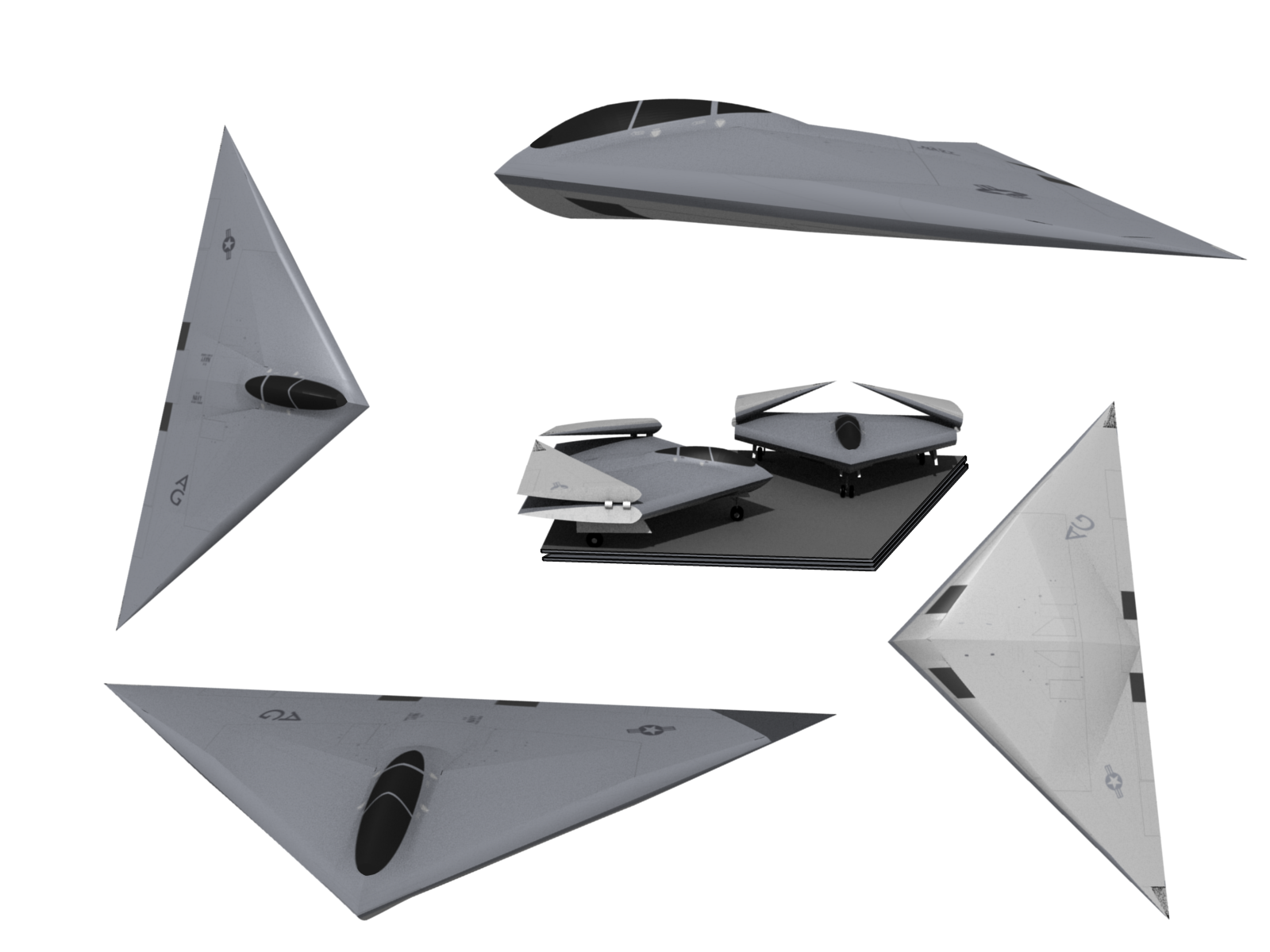
The Navy initially sought to buy 620 A-12s and Marines wanted 238. In addition, the Air Force briefly considered ordering some 400 of an A-12 derivative. The A-12 was promoted as a possible replacement for the Air Force's General Dynamics F-111 Aardvark, and for the United Kingdom's Panavia Tornado fighter-bombers. The craft was a flying wing design in the shape of an isosceles triangle, with the cockpit situated near the apex of the triangle. The A-12 gained the nickname "Flying Dorito".
The aircraft was to be powered by two General Electric F412-D5F2 turbofan engines, each producing about 13000 lbf of thrust. It was designed to carry precision guided weapons internally, The A-12 was to have a weapons load of 5160 lb.
Beginning in early 1990 General Dynamics and McDonnell Douglas revealed delays and projected cost increases. Due to late requirement changes to the aircraft impacting the composite design, aircraft weight had increased to 30% over design specification. This was unwelcome for an airplane that needed to operate efficiently and effectively from an aircraft carrier. In December 1990 plans were made for 14 Navy aircraft carriers to be equipped with a wing of 20 A-12s each.
A government report released in November 1990 documented serious problems with the A-12 development program. In December 1990 Secretary of Defense Dick Cheney told the Navy to justify the program and deliver reasons why it should not be canceled. The response given by the Navy and the contractors failed to persuade the Secretary of Defense, as he canceled the program in the following month, on 7 January 1991, for breach of contract.
The government felt the contractors could not complete the program and instructed them to repay most of the $2 billion that had been spent on A-12 development. McDonnell Douglas and General Dynamics disputed this in Federal Claims court. The reasons and causes for the cancellation have been debated and have been an issue of controversy.
Aftermath
After the cancellation of the A-12, the Navy initiated a new attack aircraft program, the Advanced Attack (A-X), to replace the A-6 Intruder; A-X would shortly become the Advanced Attack/Fighter (A/F-X) due to added fighter capabilities to eventually replace the F-14 Tomcat as well. Meanwhile, the Navy also elected to purchase the F/A-18E/F Super Hornet as an interim for A/F-X, and the Super Hornet uses the General Electric F414 turbofan engine, which is a modified variant of the upgraded F404 version developed for the A-12. A/F-X would be canceled in the 1993 Bottom Up Review, leaving the Super Hornet as the mainstay of the Navy's tactical air power. The full-size A-12 mockup was revealed to the public at the Naval Air Station Joint Reserve Base Fort Worth in June 1996. The cancellation of the A-12 is seen as one of the major losses in the 1990s that weakened McDonnell Douglas and led to its merger with rival Boeing in 1997. After years of being in storage at the Lockheed Martin Aeronautics (formerly General Dynamics) facility in Fort Worth, Texas, the mockup was transported to Veterans Memorial Air Park (later renamed Fort Worth Aviation Museum) adjacent to Meacham Airport in north Fort Worth in June2013.
The manner in which the program was canceled led to years of litigation between the contractors and the Department of Defense over breach of contract (General Dynamics Corp. v. United States). On 1 June 2009, the U.S. Court of Appeals for the Federal Circuit ruled that the U.S. Navy was justified in canceling the contract. The ruling also required the two contractors to repay the U.S. government US$1.35 billion, plus interest charges of US$1.45 billion. Boeing, which had merged with McDonnell Douglas, and General Dynamics vowed to appeal the ruling. In September 2010, the U.S. Supreme Court said it would hear the two companies' arguments, that the government canceled the project improperly and that the use of the state secrets privilege by the U.S. prevented them from mounting an effective defense. In May 2011, the Supreme Court set aside the Appeals Court decision and returned the case to federal circuit court. In January 2014, the case was settled with Boeing and General Dynamics agreeing to pay $200 million each to the U.S. Navy.
Specifications (A-12 Avenger II)

|prime units?=kts General characteristics -- |max takeoff weight lb=80000 |max takeoff weight note= Powerplant -- |eng1 kn-ab= |eng1 lbf-ab= Performance -- |never exceed speed kts= |never exceed speed note= |minimum control speed kts= |minimum control speed note= |wing loading lb/sqft=61 |fuel consumption lb/mi= |thrust/weight=0.325
Armament -- :* 2× AIM-120 AMRAAM air-to-air missiles :* 2× AGM-88 HARM air-to-ground missiles :* Unguided or precision-guided bombs
References
;Citations
;Bibliography
- Boyne, Walter J. Air Warfare: An International Encyclopedia, Volume 1. Santa Barbara, California: ABC-CLIO, 2002. .
- Jenkins, Dennis R. Grumman A-6 Intruder – WarbirdTech Volume 33. North Branch, Minnesota: Specialty Press, 2002. .
- Mahnken, Thomas G. Technology and the American Way of War. New York: Columbia University Press, 2008. .
- Polmar, Norman., and Robert Stan Norris. The U.S. Nuclear Arsenal: A History of Weapons and Delivery Systems Since 1945. Annapolis, Maryland: Naval Institute Press, 2009. .
- Richardson, Doug. Stealth Warplanes. Osceola, WI: Zenith Imprint, 2001. .
- Richeson, Jim. "Coming Soon to a Carrier Near You: Avenger". Naval Aviation News, December 1990. pp. 14–19.
- Senior, Tim. The Air Forces Book of the F/A-18 Hornet. Osceola, Wisconsin: Zenith Imprint, 2003. .
- Stevenson, James P. The $5 Billion Misunderstanding: the Collapse of the Navy's A-12 Stealth Bomber Program. Annapolis, Maryland: Naval Institute Press, 2001. .
- Thomason, Tommy H. Strike from the Sea: U.S. Navy Attack Aircraft from Skyraider to Super Hornet, 1948 – present. North Branch, Minnesota: Specialty Press, 2009. .
- Yenne, Bill. Weapons of the 21st Century. New York; Avenel, New Jersey: Crescent Books, 1993. .
References
- Stevenson 2001, p. 35.
- [http://www.jsf.mil/history/his_prejast.htm "Advanced Tactical Aircraft (ATA) 1983–1991".] {{Webarchive. link. (6 December 2019 ''jsf.mil''. Retrieved 23 February 2011.)
- The General Dynamics/McDonnell Douglas team was awarded a development contract and the ATA aircraft was designated ''A-12''. The first flight was initially planned for December 1990.Jenkins 2002, p. 95.
- Richeson 1990, p. 14.
- Mahnken 2008, p. 166.
- Richardson 2001, p. 110.
- Jenkins 2002, pp. 96–97.
- Suciu, Peter. (November 19, 2024). "A-12 Avenger II: 'Flying Dorito' $5,000,000,000 Bomber That Never Flew".
- Thomason 2009, p. 184.
- Technical difficulties with the complexity of the radar system to be used also caused costs to increase; by one estimate the A-12 was to consume up to 70% of the Navy's budget for aircraft. After delays, its critical design review was successfully completed in October 1990 and the maiden flight was rescheduled to early 1992.Thomason 2009 1993, p. 185.
- Richeson 1990, pp. 15–16.
- [http://www.cdi.org/adm/723/transcript.html "Lifting the Veil of Military Secrecy".] {{webarchive. link. (28 June 2011 ''America's Defense Monitor'', 20 February 1994. Retrieved 26 February 2011.)
- Jenkins 2002, pp. 95–96.
- Cohen, Eliot A. [http://www.foreignaffairs.com/articles/57484/eliot-a-cohen/the-5-billion-misunderstanding-the-collapse-of-the-navys-a-12-st ''"Review of'': 'The $5 Billion Misunderstanding: The Collapse of the Navy's A-12 Stealth Bomber Program'"]. ''Journal of Foreign Affairs''. January/February 2002. Retrieved 1 March 2011.
- Senior 2003, p. 44.
- (1998). "Advanced Tactical Fighter to F-22 Raptor: Origins of the 21st Century Air Dominance Fighter". American Institute of Aeronautics and Astronautics.
- Jenkins 2002, p. 96.
- Boyne 2002, pp. 404–405.
- (October 2013). "New Name - New Look". FWAM Monthly.
- Bob Booth special. Fort Worth Star-Telegram, 28 June 2013.
- Borak, Donna [https://www.sandiegouniontribune.com/sdut-us-navy-aircraft-boeing-general-dynamics-060209-2009jun02-story.html "Court upholds Navy cancellation of A-12 aircraft"]. Associated Press via The San Diego Union-Tribune, 2 June 2009. Retrieved 20 October 2019.
- (2 June 2009). "Court upholds Navy cancellation of A-12 aircraft". The Wichita Eagle.
- Liptak, Adam. [https://www.nytimes.com/2010/09/29/us/29scotus.html "Supreme Court Takes Cases on Corporations' Rights"]. ''[[The New York Times]]'', 28 September 2010. Retrieved 28 September 2010.
- Weisgerber, Marcus. [https://archive.today/20120727232415/http://www.defensenews.com/story.php?i=6595000&c=AME&s=TOP "Supreme Court Overturns A-12 Ruling Against Contractors"]. ''Defense News'', 23 May 2011.
- [https://www.reuters.com/article/boeing-generaldynamics-settlement-idUSL2N0KX2M720140124 "UPDATE 1-Boeing, General Dynamics reach $400 mln A-12 settlement with U.S. Navy".] Reuters, 23 January 2014.
This article was imported from Wikipedia and is available under the Creative Commons Attribution-ShareAlike 4.0 License. Content has been adapted to SurfDoc format. Original contributors can be found on the article history page.
Ask Mako anything about McDonnell Douglas A-12 Avenger II — get instant answers, deeper analysis, and related topics.
Research with MakoFree with your Surf account
Create a free account to save articles, ask Mako questions, and organize your research.
Sign up freeThis content may have been generated or modified by AI. CloudSurf Software LLC is not responsible for the accuracy, completeness, or reliability of AI-generated content. Always verify important information from primary sources.
Report