From Surf Wiki (app.surf) — the open knowledge base
MBTA Commuter Rail
Greater Boston commuter rail system

Greater Boston commuter rail system
| Field | Value |
|---|---|
| name | MBTA Commuter Rail |
| image | MBTA Providence Line train 864 departing Ruggles July 2025 1.jpg |
| caption | A Providence/Stoughton Line train at Ruggles in 2025 |
| imagesize | 300px |
| alt | A diesel locomotive pushing a passenger train out of an urban station |
| owner | Massachusetts Bay Transportation Authority (MBTA) |
| locale | Eastern Massachusetts and central Rhode Island |
| transit_type | Commuter rail |
| lines | 12 |
| stations | 143 active; 5 currently closed |
| daily_ridership | () |
| annual_ridership | () |
| website | |
| began_operation | |
| operator | Keolis Commuter Services |
| marks | MBTX |
| vehicles | 110 diesel locomotives, 475 coaches |
| system_length | 429 mi |
| track_gauge | |
| minimum_radius_of_curvature | |
| average_speed | |
| top_speed | 79 mph |
| map | {{switcher |
| from1 | Newburyport/Rockport Line.map |
| from2 | Haverhill Line.map |
| from3 | Lowell Line.map |
| from4 | Fitchburg Line.map |
| from5 | Framingham/Worcester Line.map |
| from6 | Needham Line.map |
| from7 | Franklin/Foxboro Line.map |
| from8 | Fairmount Line.map |
| from9 | Providence/Stoughton Line.map |
| from10 | Fall River/New Bedford Line.map |
| from11 | Kingston Line.map |
| from12 | Greenbush Line.map |
| map_name | MBTA Commuter Rail system maps |
|{{maplink-road |Show interactive map |[[File:MBTA Commuter Rail Map.svg|300px|frameless]] |Show static map |Show route diagram--
The MBTA Commuter Rail system serves as the commuter rail arm of the Massachusetts Bay Transportation Authority's (MBTA's) transportation coverage of Greater Boston in the United States. Trains run over 429 mi of track on 12 lines to 143 stations. It is operated under contract by Keolis.
In , the system had a ridership of , or about per weekday as of , making it the fifth-busiest commuter rail system in the U.S., behind the three New York-area systems and the Chicago-area system. The lines' characteristic purple-trimmed coaches operate as far south as North Kingstown, Rhode Island, and as far north as Newburyport and as far west as Fitchburg, both in Massachusetts.
Trains originate at two major terminals in Boston – South Station and North Station. The only connection between the two halves of the system is the non-revenue Grand Junction Branch. The North–South Rail Link is a proposed tunnel between North Station and South Station to allow through-running service.
Service
Lines
The system consists of twelve lines – four of which have branches – radiating from downtown Boston. Eight "southside" lines terminate at South Station, with four (Framingham/Worcester, Needham, Franklin/Foxboro, and Providence/Stoughton) also running through Back Bay station. Four "northside" lines terminate at North Station. The lines vary in length from the 9.2 mile Fairmount Line to the 62.9 mile Providence/Stoughton Line, with typical lengths in the 25-40 mile range. The system has 429 mi of revenue trackage and covers roughly the eastern third of Massachusetts plus central Rhode Island.
| Line | Boston terminal | Outer terminal(s) | Stations | Length | url=https://cdn.mbta.com/sites/default/files/2022-10/GM%20Report%20to%20Board%2010.27.2022.pdf | title=GM Report | page=6 | first=Steve | last=Poftak | date=October 27, 2022 | publisher=Massachusetts Bay Transportation Authority}} |
|---|---|---|---|---|---|---|---|---|---|---|---|
| Greenbush Line | South Station | 10 | 27.6 miles | 2,691 | |||||||
| Kingston Line | South Station | ||||||||||
| (indefinitely closed) | 11 (1 closed) | 35.1 miles – Kingston | |||||||||
| 35.6 miles – Plymouth | 4,171 | ||||||||||
| Fall River/New Bedford Line | South Station | ||||||||||
| 15 | 56.6 miles – Fall River | ||||||||||
| 60.0 miles – New Bedford | 5,261 | ||||||||||
| Fairmount Line | South Station | 9 | 9.2 miles | 2,843 | |||||||
| Providence/Stoughton Line | South Station | ||||||||||
| 18 | 62.9 miles – Wickford Junction | ||||||||||
| 18.9 miles – Stoughton | 17,648 | ||||||||||
| Franklin/Foxboro Line | South Station | ||||||||||
| 18 (1 closed) | 30.3 miles – Forge Park/495 | ||||||||||
| 22.6 miles – Foxboro | 8,771 | ||||||||||
| Needham Line | South Station | 12 | 13.7 miles | 4,881 | |||||||
| Framingham/Worcester Line | South Station | 18 | 44.2 miles | 10,606 | |||||||
| Fitchburg Line | North Station | 19 (1 closed) | 53.7 miles | 4,829 | |||||||
| Lowell Line | North Station | 9 (1 closed) | 25.5 miles | 6,485 | |||||||
| Haverhill Line | North Station | 15 | 32.9 miles | 5,806 | |||||||
| Newburyport/Rockport Line | North Station | ||||||||||
| 19 (1 closed) | 36.2 miles – Newburyport | ||||||||||
| 35.3 miles – Rockport | 11,333 |
Most lines do not share trackage outside the Boston terminal areas, with several exceptions. The Providence/Stoughton Line and Franklin/Foxboro Line both use the Northeast Corridor between and South Station, with the Needham Line also sharing the tracks between and South Station. The Fall River/New Bedford Line, Kingston Line, and Greenbush Line all use the Old Colony mainline between South Station and Braintree. The Haverhill Line and Newburyport/Rockport Line share tracks between North Station and near . Private companies also operate freight service over much of the system (see ).
Stations
, there are 143 active stations – 56 northside and 87 southside. Five additional stations (, , , , and ) are indefinitely closed due to service cuts during the COVID-19 pandemic. Several other stations are planned. South Station, North Station, and Back Bay all have MBTA subway and Amtrak connections; nine other stations have subway connections, and six others have Amtrak connections.
Stations range in size from small platforms like to the sprawling downtown terminals. Most stations outside downtown Boston have one or two side platforms or a single island platform. Standard MBTA platforms are about 800 feet long – enough for a nine-car train – and a minimum of 12 feet wide for side platforms and 22 feet wide for island platforms. 122 active stations are accessible, including all terminals and all stations with rapid transit connections; 21 are not.
Operations
The MBTA Commuter Rail system is operated by Keolis Commuter Services – a subsidiary of French company Keolis – under contract to the MBTA. The MBTA owns all passenger equipment and most stations. Most trackage is also owned by the MBTA. The Massachusetts Department of Transportation (parent agency of the MBTA) owns several portions of the Framingham/Worcester Line as well as the Grand Junction Branch, which is used for non-revenue equipment moves between the northside and southside lines. Pan Am Southern owns the section of the Fitchburg Line between and Wachusett, while Amtrak owns the section of the Northeast Corridor (used by the Providence/Stoughton Line) in Rhode Island.
Most lines operate on regular headways, though some have additional service at peak hours. Service levels vary by lines: the Greenbush and Kingston lines have 13 round trips on weekdays, while the Providence/Stoughton Line has 37.
All MBTA commuter rail service is provided by push-pull trains powered by diesel locomotives (see ). Maximum speed for trains is 79 mph, though some lines have lower limits. The entire system is signalled and operates with Positive Train Control using the Advanced Civil Speed Enforcement System. All lines have cab signals for automatic train control. The MBTA is a member of the Northeast Operating Rules Advisory Committee (NORAC) and uses its operating rules. Most portions of the system operate under NORAC rules 261 and 562, which allow bidirectional train movements on every track (such as an express train passing a local train in the same direction). Most lines are either double track, or single track with passing sidings; portions of the Northeast Corridor have three or four tracks.
Freight service

Freight service is operated over most of the MBTA Commuter Rail system by several private railroads. CSX Transportation operates freight on most southside lines, of which the outer portion of the Worcester Line has the most freight traffic. Massachusetts Coastal Railroad operates south of Middleborough on the Fall River/New Bedford Line. The Fore River Railroad operates between Braintree Yard and East Braintree on the Old Colony mainline and the Greenbush Line. The Providence and Worcester Railroad shares tracks with Providence/Stoughton Line trains between Providence and Wickford Junction; it uses a freight-only track between Providence and Central Falls. No freight operates on the Needham Line, the Northeast Corridor between Readville and Back Bay, the Old Colony mainline between Boston and the Greenbush Line junction in Braintree, the Kingston Line, and most of the Greenbush Line.
CSX also operates on most northside lines; prior to its 2022 purchase by CSX, Pan Am Railways operated over these lines. The Berkshire and Eastern Railroad (formerly Pan Am Southern) operates over the Fitchburg Line west of Ayer. Their combined Freight Main Line between Mechanicville, New York, and Mattawamkeag, Maine, shares tracks with sections of the Fitchburg, Lowell, and Haverhill lines. No freight service is operated over the Newburyport/Rockport Line north of .
Weight limits and loading gauge vary across the system. The full Framingham/Worcester line is rated for car weights of 315000 lb, sections of lines that are part of the Freight Main Line for 286000 lb, and other lines for lower weights. The western portion of the Framingham/Worcester Line and the southern section of the Providence/Stoughton line can accommodate cars up to 20 ft (AAR Plate H or Plate K). The Fitchburg Line west of Ayer can accommodate cars up to 19 ft (AAR Plate J), while most of the other northside lines can accommodate up to 17 ft (AAR Plate F). The inner Fitchburg and Newburyport/Rockport Lines, and the southside except for the outer Framingham/Worcester Line, have height restrictions smaller than Plate F.
Fares
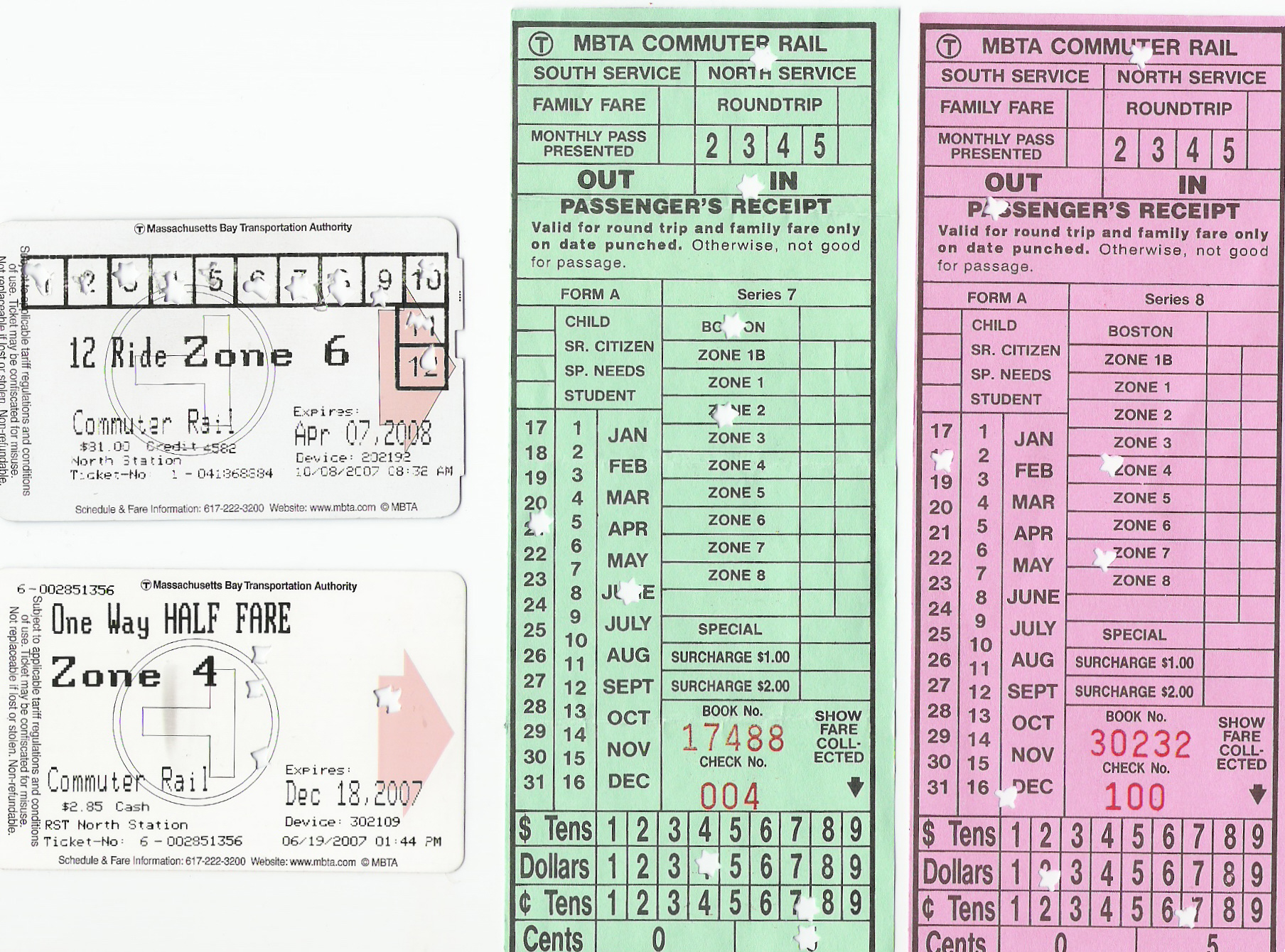
MBTA Commuter Rail uses a zone fare system, with fares increasing with distance. Zone 1A includes the downtown terminals and other inner core stations up to about 5 miles from downtown. Ten additional zones, numbered 1 through 10, extend outwards from Boston. Each zone is about 5 miles, with most outer terminals in zones 6 through 8. Only two stations use further zones: in Zone 9, and in Zone 10. Zone 1A fares are identical to MBTA subway fares (though subway passes on CharlieCards are not accepted, except for Fairmount Line stations that have CharlieCard validator machines). , one-way fares within Zone 1A are $2.40, while fares between further zones and Zone 1A range from $6.50 for Zone 1 to $13.25 for Zone 10. Trips that do not enter Zone 1A have less expensive interzone fares; , these range from $2.75 for travel within a single zone to $7.25 for travel between Zone 1 and Zone 10.
Fares can be purchased on the MBTA mTicket app, at automatic vending machines located at major stations, from businesses near some stations, or from conductors on board trains. Discounted passes include monthly passes (with or without free transfer to other MBTA services), "flex passes" valid for five 24-hour periods, and $10 passes offering unlimited travel on a single weekend. As with other MBTA services, discounted fares and passes are available for several groups including disabled passengers, passengers over age 65, and students attending certain schools. Foxboro special event services and the CapeFlyer have separate fares; regular MBTA fares and passes are not valid. Fare gates have been installed at North Station and South Station, with plans for installation at Back Bay and Ruggles. The second-generation MBTA fare collection system will standardize fare media across modes, including commuter rail.
History
Early history

Eight intercity mainlines radiating from Boston opened between 1834 and 1855: the Boston and Worcester Railroad (B&W) in 1834–35, Boston and Providence Railroad (B&P) in 1834–35, Boston and Lowell Railroad (B&L) in 1835, Eastern Railroad in 1838–1840, Fitchburg Railroad in 1843–45, Boston and Maine Railroad (B&M) in 1845, Old Colony Railroad and Fall River Railroad in 1845–46, and Norfolk County Railroad in 1849–55. Commuter rail service allowing suburban residents to work in Boston began with the B&W in 1834; by the 1860s, commuting was possible on the eight mainlines and a number of branch lines. Mergers prior to the 1880s were primarily acquisitions of branch lines and consolidations with connecting lines: the B&A merged with the Western Railroad in 1874 to become the Boston and Albany Railroad (B&A), the Fall River Railroad and several other lines merged into the Old Colony Railroad, and the Norfolk County Railroad eventually became part of the New York and New England Railroad (NY&NE). The narrow gauge Boston, Revere Beach and Lynn Railroad (BRB&L) opened in 1875, competing with the inner portion of the Eastern Railroad. Unlike the other lines, it never built rails into downtown Boston, and instead relied on a ferry connection from East Boston.
The B&M obtained control of the Eastern in 1883, the B&L in 1887, and the Fitchburg in 1900, giving it a near-monopoly on rail service north of Boston. North Union Station was built in 1893 to provide a union station for northside service; it was replaced by North Station in 1928. The Old Colony obtained control of the B&P in 1888; the New York, New Haven and Hartford Railroad acquired the Old Colony in 1893 to obtain access to Boston. The New Haven also acquired the New England Railroad (successor to the NY&NE) in 1898. South Station opened in 1899 as a union station for the southside lines (New Haven and B&A). The New York Central and Hudson River Railroad – which later became the New York Central) (NYC) – leased the B&A in 1900; this brought all Boston commuter service save the BRB&L under the control of three large multi-state railroads. | image-width=1300 | image-left=-625 | image-top=-150 The three railroads all planned electrification of some suburban lines in the early 20th century. The New Haven tested electrification on small parts of the Old Colony system, but never followed through on its plans to electrify South Station and the inner section of the ex-B&P. Despite a study to electrify the mainline to plus the Highland branch, the NYC only electrified the short Lower Falls Branch. Quadruple-tracking and electrification of part of the ex-Eastern Railroad was planned by the B&M around 1910 when it was briefly under control of the New Haven, but this fell through when they separated. Service levels on the three major railroads peaked around 1910 and began to decline from streetcar and later auto competition in the 1910s. The independent BRB&L electrified its mainline and single branch line in 1928 and increased service to near-rapid transit levels. Two Old Colony branches were converted to an extension of Boston Elevated Railway (BERy) rapid transit in the 1920s.
Service levels declined more significantly during the 1930s; the 88 stations case resulted in the New Haven closing dozens of suburban stations and several lines in 1938. The BRB&L ceased all operations in 1940. Ridership increased during World War II but decreased soon afterwards, prompting further cuts. The railroads converted from steam to diesel in the 1950s. All three purchased substantial fleets of Budd Rail Diesel Cars, which lowered operating costs – but not enough to save most branch lines. A 1945–47 state report proposed suburban extensions of the rapid transit system, largely using railroad rights-of-way, with the expectation that most commuter rail service would be cut back to the rapid transit terminals or abandoned entirely. Prompted by the report, part of the BRB&L was reactivated as rapid transit in 1952–54 by BERy successor Metropolitan Transit Authority (MTA), and the Highland branch was converted to a rapid streetcar line in 1958–59.
Consolidation under MBTA control
The three railroads all made major cuts to suburban service in 1958–1960 as commuters began using new expressways. The B&M became unprofitable in 1958 and moved to shed its money-losing passenger operations. The New Haven experimentally increased Old Colony Division service for several years in the 1950s, but new management soon sought to reduce costs. Service to and was cut in 1958; a one-year state subsidy was given for the remaining Old Colony service, which ended in 1959 after the Southeast Expressway opened. The inner portion of the B&A was reduced from four to two tracks in 1959 for construction of the Massachusetts Turnpike, with several inner stations closed; all local stops west of Framingham were closed in 1960. The New Haven filed for bankruptcy for the last time in 1961. Faced with the imminent threat of losing what service remained, public opinion began to support subsidies for commuter rail.
The state Mass Transportation Commission (MTC), formed in 1959 to coordinate transportation and land use, held a series of experiments to determine how fares and service levels affected ridership. This included a trial on the MTA bus network, as well as a $4 million test from January 1963 to March 1964 on New Haven and B&M lines. (The NYC, uninterested in its commuter service, declined to participate.) The MTC found that higher frequency was most important to attract additional ridership; lower fares would attract additional riders, while even higher fares would not result in the services becoming profitable. At the recommendation of the MTC, the Massachusetts Bay Transportation Authority (MBTA) was created on August 3, 1964, with a 78-municipality funding and service district. The MBTA was to build rapid transit extensions (as planned in 1947) along some lines, with the others to be subsidized or allowed to be discontinued. Most remaining lines ran to points outside the funding district; those outlying municipalities were expected to reach their own subsidy agreements with the railroads.

On December 14, 1964, the MBTA reached a subsidy agreement with the B&M. The agreement only covered in-district services; on January 4, 1965, the B&M discontinued interstate service except for single commuter round trips from Dover and Concord, New Hampshire; Portsmouth service was cut back to a single round trip. Subsidies began for six lines on January 18; all out-of-district service to , , , , and was discontinued except for the single Dover, Concord, and Newburyport round trips. Agreements were reached to restore most out-of-district service; after delays due to a lawsuit by the competing Eastern Massachusetts Street Railway, full service returned to , Lowell, Ipswich, and Rockport on June 28. In 1969, the B&M averaged 24,000 weekday passengers, with a yearly deficit of $3.2 million (equivalent to million in ). The single daily trip on the Central Mass Branch ended on January 26, 1971.

On July 28, 1965, the MBTA signed an agreement with the New Haven Railroad to purchase 11 miles of the former Old Colony mainline from Fort Point Channel to South Braintree in order to construct a new rapid transit line along the corridor. The line was expected to be completed within two years. The agreement also provided for the MBTA to subsidize commuter service on the railroad's remaining commuter rail lines for $1.2 million (equivalent to million in ) annually. Subsidies for the Needham, Millis, Dedham, and Franklin lines began on April 24, 1966, as the New Haven had Interstate Commerce Commission (ICC) permission to discontinue them otherwise. Three out-of-district stations were cut, while Franklin subsidized its station. The Millis and Dedham lines were discontinued on April 21, 1967. Amtrak took over most intercity passenger service in the US on May 1, 1971, including New York–Boston trains.
The state agreed in December 1971 to purchase 145 miles of Penn Central rights of way to prevent them being sold off in bankruptcy. The MBTA purchased the lines effective January 27, 1973. They included almost all the lines with passenger service: the Attleboro Line and Stoughton Branch, Franklin Branch, Needham Branch, and the –Framingham portion of the Worcester Main Line. (The inner section of that line was already owned by the Massachusetts Turnpike Authority.) The purchase also included several freight-only or abandoned lines, including the Old Colony mainline between Braintree and Brockton. Subsidies began for the Framingham Line in January 1973, for and stations in June 1973, and all Providence/Stoughton Line service on September 28, 1976. The MBTA purchased the B&M Western Route between Somerville and Wilmington Junction in September 1973 for construction of the Haymarket North Extension.
From 1967 to 1973, a series of state appropriations covered 90–100% of outside-of-district subsidy. This was reduced to 50% in January 1974, substantially increasing the cost of these municipalities. State subsidies were increased back to 75% in June 1976 to prevent further cuts.
Combined operations

Rapid transit extension was slower than expected; by 1971, the only extension in service was the first portion of the Red Line Braintree Branch on the Old Colony mainline.
Federal subsidies allowed MBTA subsidies to Penn Central to remain the same until March 1977, when a large increase was expected. Since it owned the tracks and equipment, the MBTA bid out the operating contract, which was won by the B&M. The B&M began operating the southside lines on March 15, 1977; for the first time, all Boston commuter service was operated by one entity. Although all operation was subsidized by this time, a small number of cuts took place. The lightly used Lexington Branch closed after a snowstorm on January 10, 1977. Declining subsidies from Rhode Island resulted in off-peak service being cut back to in April 1979, with peak service cut on February 20, 1981. Woburn Branch service ended on January 30, 1981, amid state budget cuts.
However, the energy crises of the 1970s and the formation of regional transit authorities prompted some expansions and improvements. $70 million in reconstruction work (equivalent to million in ) on the Franklin Line and several northside lines, partially funded by the Urban Mass Transportation Administration, began in 1977 under the Commuter Rail Improvement Program. Service to Haverhill resumed on December 17, 1979, and to and on January 13, 1980. Federally-funded experimental service to Nashua, Manchester, and Concord, New Hampshire ran from January 28, 1980, to March 1, 1981. Little-used stations continued to be closed until the 1980s, but several infill stations were opened, including in 1981, in 1982, in 1984, and in 1985. The MBTA also began replacing the aging Rail Diesel Cars and other equipment; 18 EMD F40PH diesel locomotives and 60 passenger cars arrived between 1978 and 1980.
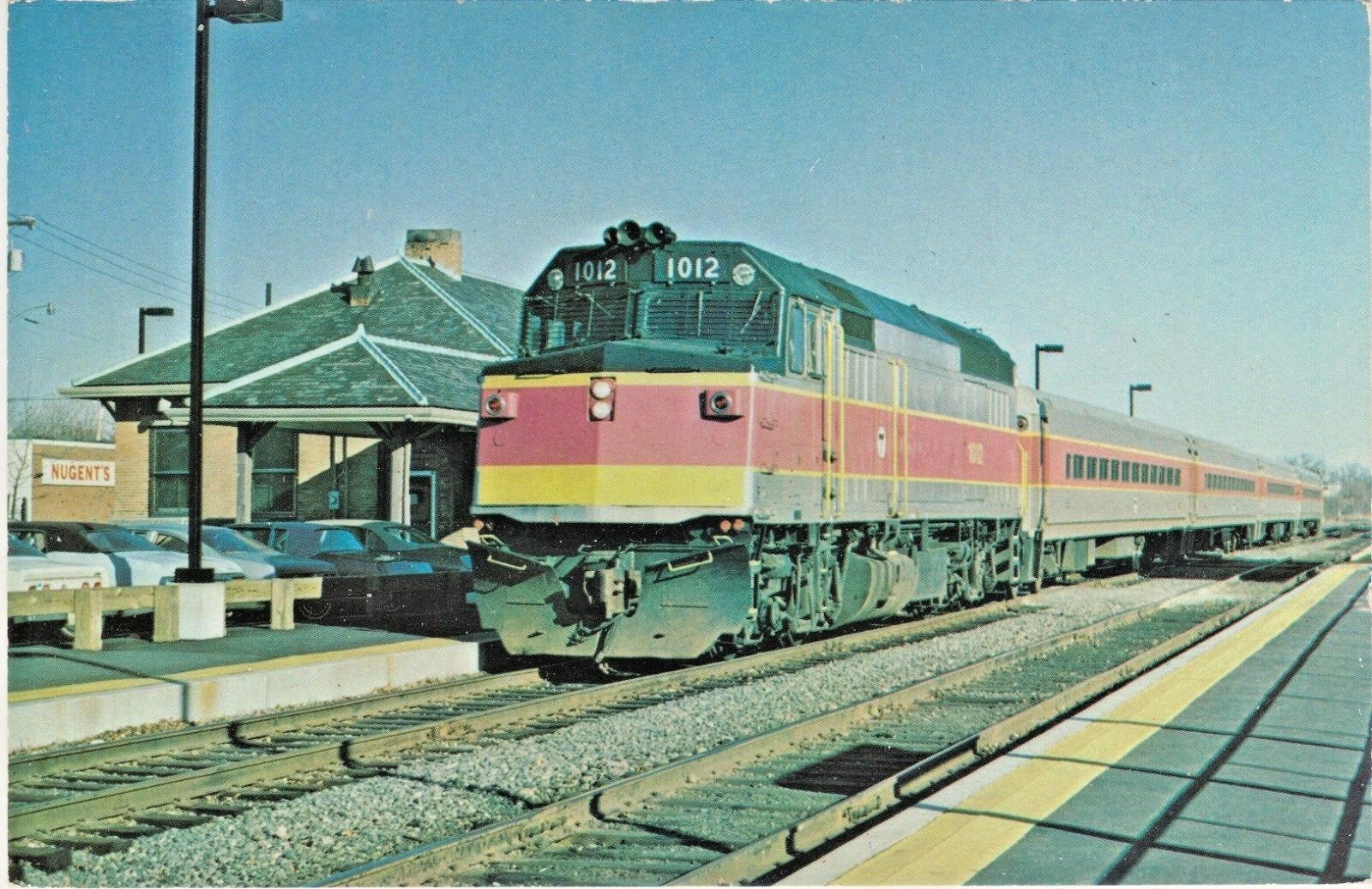
Several major disruptions occurred in the mid-1980s. On January 20, 1984, a fire destroyed the wooden approach trestles to the North Station drawbridges. The four northside lines used temporary terminals with rapid transit connections while the trestles were rebuilt. Another bridge fire between Beverly and Salem on November 16, 1984, isolated part of the Ipswich/Rockport Line from the rest of the system.
Guilford Transportation Industries purchased the B&M in 1983. This did not initially affect commuter rail operations. Guilford's attempts to regain profitability, which included reducing employee headcount and pay, soon soured labor relations. This resulted in two strikes by Guilford employees; the first shut down the commuter rail system from March 21 to May 12, 1986. Local media was critical of Guilford during the strike; the company did not bid for a renewal of the commuter rail operating contract, which expired at the end of 1986. Amtrak won the contract for commuter rail operations and took over the system on January 1, 1987. Gardner service was cut back to Fitchburg at that time due to a dispute between Amtrak, Guilford, and the MBTA.
Expansions
The late 1980s saw the beginning of substantial expansion of the system. The Southwest Corridor project was completed in 1987 with a new below-ground alignment for commuter rail, Amtrak, and Orange Line trains. Back Bay and stations were completely rebuilt as transfer stations, and opened to serve the growing Longwood Medical Area. The Needham Line, closed since 1979 for construction, was reopened. The Attleboro and Franklin lines had been diverted over the previously freight-only Dorchester Branch during construction; after they returned to the Southwest Corridor, a shuttle service was retained as the Fairmount Line. The Franklin Line was extended to in 1988; infill stations in that era included in 1988 to serve Boston Red Sox games at Fenway Park, and in 1990.
Massachusetts had state accessibility laws since 1977 – prior to 1990 federal legislation. At times, the MBTA clashed with state regulators: several stations including West Natick and Chelsea were built without accessible platforms despite state rules; the latter resulted in fines from the Massachusetts Architectural Access Board (MAAB). The opening of South Attleboro was delayed by the MAAB because of the MBTA's refusal to build full-length high-level platforms. South Station was made accessible in the late 1980s, Back Bay during the Southwest Corridor project, and North Station in the early 1990s, providing accessibility at the main downtown Boston stations.
In 1991, the state agreed to build a set of transit projects as part of the settlement of a lawsuit by the Conservation Law Foundation (CLF) over auto emissions from the Central Artery/Tunnel Project (Big Dig). Among these project were extensions of the Framingham Line to Worcester and the Ipswich/Rockport Line to Newburyport, restoration of the Old Colony Lines (Middleborough/Lakeville Line and Plymouth/Kingston Line), and addition of 20,000 park and ride spaces outside the urban core. Peak-hour service to Worcester began in 1994, followed by off-peak and weekend service; four intermediate stations were added in 2000 and 2002. Service on the Old Colony Lines began in 1997. and opened in 1998.
Two tenders were submitted in 2003, one from GTI and another from the newly formed Massachusetts Bay Commuter Railroad Company (MBCR), a partnership between Connex (later Veolia), Bombardier Transportation and Alternate Concepts, Inc. MBCR won the contract, and took over the MBTA Commuter Rail operation from Amtrak in July 2003. The MBCR contract originally expired in July 2008 but had an additional five-year option; it was later extended three years to July 2011 and then another two to July 2013. After concerns about on-time performance, the 2011 extension increased the fine for late trains from $100 to $300. MBCR The MBTA considered running the service directly rather than contracting it out, but this "public option" was rejected in 2012. In August 2012, MBCR and Keolis were the two bidders for the contract. On January 8, 2014, the MBTA awarded Keolis the contract for $2.68 billion over eight years, with the possibility of two two-year extensions that could bring the total price to $4.3 billion. Keolis took over the operations on July 1, 2014. Keolis lost $29.3 million in its first year of operation. In June 2020, the MBTA extended the contract through at least 2025.
Free Wi-Fi internet service was piloted in January 2008 on the Worcester Line, where 45 coaches were fitted with routers which connected to cellular data networks. This was the first Wi-Fi available on a commuter rail service in the United States. The program was considered successful; in December 2008, the MBTA announced that Wi-Fi would be available on all trains by mid-2009. In July 2014, the MBTA announced that a private company would be building a new network by 2016 to replace the 2008-built network. The MBTA would not pay for the new network; the company would have a two-tier model with a fee for higher bandwidth. The MBTA canceled the plan in August 2017 due to local opposition to the erection of 320 monopoles, each 70 feet tall, as well as the need to focus on more critical projects like the Green Line Extension. By that time, the 2008-built system was largely unusable to the decommissioning of 3G networks. Mobile ticketing was introduced on the northside lines on November 12, 2012, and on the southside lines on November 28.
Positive Train Control was implemented on the entire system per a federal mandate, which required installation by the end of 2018 with the possibility of a two-year extension. Construction began in 2017. Most of the southside lines already had cab signals for automatic train control (ATC) prior to PTC implementation, but the northside lines did not. Cab signals on the southside were completed in 2020. Temporary bus replacements for several lines took place between 2017 and 2022 during PTC and ATC construction and testing. PTC implementation, including cab signals on the northside, was completed in January 2025.
- The Greenbush Line opened in 2007.
- The Riverside-Framingham section was sold to the MBTA in 1976 as part of their larger acquisition of PC commuter assets, but the section past Framingham remained in Conrail control. After several years of construction and negotiations, ownership of the line was transferred to the commonwealth on October 4, 2012, with increased service on the outer section of the line beginning several weeks later.
- As Big Dig mitigation, MBTA rebuilt existing stations and added 4 new stations along the Fairmount Line. The first of these, Talbot Avenue, opened on November 12, 2012, followed by Newmarket and Four Corners/Geneva on July 1, 2013. Blue Hill Avenue station was opened on February 25, 2019, after many delays.
- Service along the Providence/Stoughton Line was extended further south to T. F. Green Airport in Warwick, Rhode Island in December 2010 and to Wickford Junction in North Kingston in April 2012. This represents the first commuter service in Rhode Island south of Providence since 1981.
- In 2013, the CapeFLYER service began running from South Station to Hyannis on summer weekends – the first direct service from Boston to Cape Cod since 1959. Though officially a Cape Cod Regional Transit Authority service, the CapeFLYER uses MBTA equipment.
- A 4-mile extension of the Fitchburg Line to Wachusett station opened on September 30, 2016.
COVID-19 pandemic
Weekday service was substantially cut on March 17, 2020, due to reduced ridership during the COVID-19 pandemic. On June 22, service was increased to 85% of normal weekday levels. Changes effective November 2 reduced peak service and increased off-peak service, providing more consistent midday headways on some lines; Foxboro pilot service was suspended. In November 2020, as part of service cuts during the pandemic, the MBTA proposed to close six low-ridership stations. On December 14, the MBTA Board voted to enact a more limited set of cuts, including indefinitely closing five stations. That day, temporary reduced schedules were again put into place, with four of the five stations (, , , and ) not served.
On January 23, 2021, reduced schedules based on the December 14 vote went into place, with no weekend service on seven lines. Service changes on April 5, 2021, increased midday service on most lines as part of a transition to a regional rail model. Weekend service on the seven lines resumed on July 3, 2021. Ridership dropped substantially during the COVID-19 pandemic, with daily boardings just 12,800 during the first quarter of 2021. Ridership rose to 47,100 average weekday boardings in the first quarter of 2022, and 85,000 (69% of 2018 ridership) in October 2022. The service was made permanent effective October 2, 2023. Silver Hill station reopened on November 18, 2024.
In April 2024, the MBTA extended the Keolis contract by one year to June 30, 2027, at which time a successor contract will take effect. In December 2024, the MBTA indicated that the next contract might be split into separate contracts for train maintenance, infrastructure maintenance, operations, and dispatching. The MBTA announced three shortlisted firms, including a consortium of Keolis and Alstom, in December 2025. The agency issued a request for proposals at that time, with the intention of selecting the next operator by the end of 2026.
The South Coast Rail project extended service to the South Coast cities of Taunton, Fall River, and New Bedford. A full planning process was held from 1990 until its suspension in 2002. Planning restarted in 2007, with environmental documentation completed in August 2013. Plans were modified into two phases in 2017 due to an increase in costs. Phase I construction to run diesel service as an extension of the Middleborough/Lakeville Line via the Middleboro Secondary took place from 2020 to 2024. Service began on March 24, 2025.
Rolling stock

All MBTA commuter rail service is provided by push-pull trains powered by diesel locomotives with a cab car on the opposite end. The locomotive is usually on the end facing away from Boston so that diesel exhaust does not enter the passenger concourses at North Station and South Station. Trains typically have four to eight coaches (with six the most common) and seat between 400 and 1,400 passengers. Approximately 62 trainsets are needed for weekday service.
The primary heavy maintenance facility is the MBTA Commuter Rail Maintenance Facility, located in the Inner Belt District in Somerville. It is also used for midday and overnight storage of trains on the northside lines. Southampton Street Yard and the Readville Interim Layover facility are used for light maintenance and layover service. Various other layover facilities are used for midday and overnight storage; most are located near the outer ends of the lines. Some maintenance and storage of MBTA equipment is contracted out to the Seaview Transportation Company in North Kingstown, Rhode Island.
Several additional yards are under construction or planned. Two layovers are under construction for South Coast Rail, with service planned for mid-2025, and the Haverhill Line layover at is proposed for relocation later in the 2020s. A new midday layover yard at the former Beacon Park Yard is planned to be constructed by 2032 as part of the realignment of I-90. A large midday and overnight layover yard, which would support expanded service including regional rail and electrification, is planned at Widett Circle near South Station. The MBTA also plans to construct a southside maintenance and layover facility at , replacing the existing layover yard there, as the Grand Junction Branch will be closed for several years during the I-90 project.
Locomotive fleet
, the MBTA owned 109 locomotives. Of these, 87 were in active passenger service. Eleven were undergoing rebuild, six awaiting repairs, and five retired or out of service. All passenger locomotives are equipped with head end power. Rebuilding of 37 F40PH-2C and F40PHM-2C locomotives to F40PH-3C class by MotivePower (MPI) began in 2017; other older locomotives are also being rebuilt by MPI or in-house.
| Year built | Builder | Model | Numbers | Number active | Notes | Image | ||||||||
|---|---|---|---|---|---|---|---|---|---|---|---|---|---|---|
| 1973–1975 | GMD | GP40MC | 1115–1139 | 17 | Originally built as GP40-2LW for Canadian National Railways; rebuilt by AMF for passenger service in 1997. Most are being rebuilt in-house. | [[File:MBTA GP40MC leading Fitchburg Line train 1427 October 2025.jpg | 100x100px]] | |||||||
| 1987–1988 | EMD | F40PH-3C | 1050–1075 | 23 | Originally built as F40PH-2C. Rebuilt by MPI in 2001–2003, and again by MPI as F40PH-3C in 2019–present. | [[File:MBTA F40PH-3C 1054 at Readville September 2025.jpg | 100x100px]] | |||||||
| 1991–1993 | Morrison–Knudsen | 1025–1036 | 10 | Originally built as F40PHM-2C. Rebuilt by MPI in 2003–2004, and again by MPI as F40PH-3C in 2019–present. | [[File:MBTA Fairmount Line train 1671 at Readville April 2025.jpg | 100x100px]] | ||||||||
| 2009 | MPI | MP36PH-3C | 010-011 | 0 | url=http://www.boston.com/news/local/breaking_news/2011/02/mbta_unveils_fi.html | title=MBTA unveils first new locomotive in 23 years | last=Finucane | first=Martin | date=February 7, 2011 | newspaper=The Boston Globe | archive-date=February 16, 2012 | archive-url=https://web.archive.org/web/20120216192116/http://www.boston.com/news/local/breaking_news/2011/02/mbta_unveils_fi.html}} Being overhauled by MPI. | [[File:MBTA 010 in Hyannis, June 2013.JPG | 100px]] |
| 2013–2014 | MPI | HSP46 | 2000–2039 | 40 | To be overhauled by Wabtec by March 2032. | [[File:MBTA 2001 at CRMF, October 2013.jpg | 100px]] | |||||||
| 2009 | NRE | NRE 3GS21B | 3248–3249 | 0 | Work locomotives – not used for passenger service | [[File:MBTA3gs21b at Boston.JPG | 100px]] |
Coach fleet
, the MBTA owned 552 coaches. Of these, 448 were in active service, three being repaired or overhauled, and 101 stored pending disposition or reuse. Coaches whose designations start with BTC (Blind Trailer Coach) are conventional coaches, while those starting with CTC (Control Trailer Coach) are cab cars. Coaches acquired before 1990 were single-level cars with 88 to 127 seats; those since are bilevel cars with 173 to 185 seats. Three converted coaches — a bike car and two cafe cars — are reserved for the CapeFLYER.
The agency issued a $279 million contract (total project cost of $345 million) for 80 additional Rotem bilevel coaches in September 2019, with delivery expected from September 2022 to June 2024. The contract was later modified to 83 coaches, of which 43 are cab cars. In May 2024, the MBTA exercised an option order for 41 additional trailer coaches at a cost of $203 million, with deliveries to begin in mid-2026. An $165 million option for 39 additional coaches (29 trailers and 10 cab cars), which would allow the retirement of all remaining single-level equipment, was exercised in November 2024 with deliveries to begin in 2027.
| Year built | Builder | Model | Numbers | Number active | Seats | Notes | Image | |
|---|---|---|---|---|---|---|---|---|
| 1978–79 | Pullman | BTC-1C | 200–202, 204–214, 216–258 | 30 | 114 | leaf debris from tracks]]. | [[File:MBTA 240 at West Natick station, May 2017.JPG | 100px]] |
| 1987 | Bombardier | BTC-1A | 350–389 | 40 | 127 | [[File:MBTA 387 at Wedgemere station, December 2023.JPG | 100px]] | |
| 1987–88 | MBB | BTC-3 | 500–542 | 5 | 86 | 533–542 were converted from CTC-3 in 2019–2022. 525 and 529 were converted to non-revenue office cars in 2024. | [[File:MBTA 507 in dead line, April 2014.JPG | 100px]] |
| CTC-3 | 1500–1533 | 0 | 96 | [[File:Train entering Waverley MBTA Station, Belmont MA.jpg | 100px]] | |||
| 1989–90 | Bombardier | BTC-1B | 600–653 | 49 | 122 | [[File:Outbound train arrives at North Wilmington station August 2021.jpg | 100px]] | |
| CTC-1B | 1600–1652 | 20 | 122 | Cab controllers have been deactivated in coaches 1600–1624 for use as blind coaches. No cars of this group are still in active service as control trailer coaches. | [[File:MBTA cab car 1633 at Rockport.JPG | 100px]] | ||
| 1990–91 | Kawasaki | BTC-4 | 700–749 | 50 | 185 | All units were overhauled by Alstom in 2014–2019. | [[File:MBTA 746 at Endicott station, November 2015.JPG | 100px]] |
| CTC-4 | 1700–1724 | 24 | 175 | All active units were overhauled by Alstom in 2014–2019. | [[File:MBTA 1705 at Ruggles station, July 2021.jpg | 100px]] | ||
| 1997–1998 | Kawasaki | BTC-4A | 750–766 | 17 | 182 | All units were overhauled by Alstom in 2019–2021. | [[File:BTC-4A coaches on the CapeFLYER.JPG | 100px]] |
| 2001–2002 | Kawasaki | BTC-4B | 767–781 | 15 | 182 | All units were overhauled by Alstom in 2019–2021. | [[File:MBTA 775 at East Braintree Weymouth Landing station, January 2017.JPG | 100px]] |
| 2005–2006 | Kawasaki | BTC-4C | 900–932 | 33 | 178 | [[File:MBTA 915 in Hyannis Yard, June 2013.JPG | 100px]] | |
| 2012–2014 | Hyundai Rotem | BTC-4D | 800–846 | 47 | 179 | [[File:MBTA 829 at Norwood Depot, July 2021.jpg | 100px]] | |
| CTC-5 | 1800–1827 | 28 | 173 | [[File:MBTA 1824 at South Station, May 2017.jpg | 100px]] | |||
| 2022–2024 | Hyundai Rotem | BTC-4D | 847–886 | 40 | 179 | [[File:Photo op train at Freetown station, December 2022.jpg | 100px]] | |
| CTC-5 | 1828–1870 | 43 | 173 | [[File:MBTA 1834 at Fall River Depot 2.jpg | 100x100px]] | |||
| 2026–2027 | Hyundai Rotem | BTC-4D | 0 | 179 | 70 on order. Deliveries will start in 2026 | |||
| CTC-5 | 0 | 173 | 10 on order. Deliveries will start in 2027 |
Retired equipment

As the MBTA assumed control of the commuter rail during the 1970s, it inherited various equipment from predecessor railroads. The 1976 purchase of B&M and Penn Central equipment included 94 Budd Rail Diesel Cars (RDCs) – 86 from the B&M and eight from Penn Central – plus 116 Penn Central coaches and 25 Penn Central E8 and GP9 diesel locomotives. Although the MBTA purchased some new equipment in 1978–1980, large locomotive and coach fleets were not purchased until the late 1980s, so the first decade of combined operations used a variety of secondhand equipment in addition to that acquired in 1976:
- Four ALCO PA locomotives leased from the Delaware and Hudson Railway in 1978
- 48 coaches leased from GO Transit in 1978–1980. 51 coaches (some of which were in the previous group) were leased in 1984–85.
- 19 EMD GP7 locomotives leased from the B&M in 1978–1982
- 24 RDCs acquired or leased from MARC, SEPTA, and New Jersey Transit between 1983 and 1987
- 11 EMD GP9 locomotives acquired from the Burlington Northern Railroad and SEMTA in 1983–1986
- One EMD SW9 locomotive acquired from the Seaboard Coast Line Railroad in 1984 Most of the secondhand and inherited equipment was retired between 1979 and 1989. 33 ex-B&M RDCs were converted to locomotive-hauled coaches (designated BTC-2 and CTC-2) in 1980 and 1982; they were retired by 1989. This left all MBTA service operated by locomotives and coaches purchased new by the MBTA. At several points since, the MBTA or its contract operator has temporarily leased locomotives when needed. Some passenger equipment acquired new by the MBTA has been retired:
- 18 EMD F40PH locomotives (1000–1017), built 1978–1980 and last ran in 2015
- 19 EMD FP10 locomotives (1100–1114 and 1150–1153), rebuilt 1979 from Gulf, Mobile and Ohio Railroad locomotives and last ran in 1991
Capital projects
The following improvement projects are actively being pursued by the MBTA and are at various stages of construction, planning, or funding.
Regional Rail Modernization Program

The Regional Rail Modernization Program is a phased initiative by the MBTA to transition the commuter rail system from diesel-powered, peak-oriented service to an electrified regional rail network with frequent all-day service. The program was formally initiated in early 2025 following several years of planning, with initial phases focused on near-term improvements to existing diesel operations.
Regional rail concepts were first proposed in the late 2010s after the cancellation of the Indigo Line project (a proposed hybrid rail network) in 2015. Between 2018 and 2019, the MBTA conducted the Rail Vision study to evaluate regional rail alternatives, drawing on domestic and international examples. In 2019, the concept was formally endorsed by the now-defunct Fiscal and Management Control Board, and the MBTA engaged Network Rail Consulting to assist with planning.
Despite formal endorsement by the Fiscal and Management Control Board, planning for regional rail stagnated into the early 2020s. Several proposed electrification pilots were ultimately cancelled. By 2022, rising costs led the MBTA to consider battery electric multiple units (BEMUs) with limited catenary infrastructure for charging, as a cost-saving measure. By early 2024, a public-private partnership model was also adopted as the preferred framework for delivering future regional rail projects. In July 2024, the MBTA approved a $54 million pilot proposal from Keolis to electrify the Fairmount Line using BEMUs, with 20-minute headways planned by 2028. As of 2025, planned improvements to all other commuter rail lines are limited to diesel service upgrades—including new turnback tracks, track replacement, and increased service frequency—with electrification deferred to a long-term future phase.
Station renovations
,_March_2022.JPG)
Several station renovations for accessibility, expanded service, and/or repairs are under construction or planned:
- Accessible platforms at Natick Center station opened in July 2025, with some construction ongoing.
- A new island platform at Worcester Union Station was opened on July 1, 2024, with the project expected to be fully complete in August 2025.
- Design work for reconstruction of South Attleboro station for accessibility was completed in April 2022, though construction work has not been funded. The station was temporarily closed on February 26, 2021, due to structural deterioration; limited service resumed on May 20, 2024.
- Reconstruction of is planned. The station was temporarily closed in October 2022 due to structural deterioration; interim platforms opened in December 2023.
- Reconstruction of , , and for accessibility and increased capacity are planned. In November 2024, the state committed to the reconstruction of Newtonville station.
- In 2024, the MBTA tested a temporary freestanding accessible platform design at Beverly Depot. These platforms do not require alterations to the existing platforms, thus skirting federal rules requiring full accessibility renovations when stations are modified, and were intended to provide interim accessibility at lower cost pending full reconstruction. Construction of interim platforms at four stations began in 2024 and was completed in 2025. Eight more stations are planned to receive the platforms; the second group will be , , , , and .
- Reconstruction of Foxboro is planned for the 2026 World Cup.
Previous proposals
These projects stem from past expansion and improvement studies, as well as service proposals from various constituencies, but none have been advanced or approved by the MBTA.
Extension studies
Two extensions of existing lines have been studied in the 2020s:
- Extension of the Middleborough/Lakeville Line to Buzzards Bay or Sagamore (both in Bourne) to serve Cape Cod was studied in 1997, and extension to Buzzards Bay was again studied in 2007. The extension was again proposed after the 2013 introduction of the CapeFLYER. The town of Bourne voted in 2015 to join the MBTA district. MassDOT began planning a possible commuter rail trial service in October 2015. The proposed service, which was to have shuttle trains between Bourne and operated by Massachusetts Coastal Railroad, was rejected by the MBTA Fiscal Management and Control Board in April 2016. Middleborough station, which replaced Middleborough/Lakeville in 2025 when South Coast Rail service began, was built with space for a potential future platform for shuttle trains. A 2021 study analyzed two alternatives for service to Buzzards Bay or Bourne station. Middleborough–Buzzards Bay shuttle service with 7 daily round trips was expected to have 1,710 total daily boardings, while Middleborough–Bourne service with 10 daily round trips (including two off-peak Boston–Bourne round trips) was expected to have 2,540 total daily boardings.
- Extension of the Lowell Line to Manchester and Nashua, New Hampshire has been proposed since the 1980–81 pilot service. The extension has been a politically contentious issue at the state level in New Hampshire, with Democratic politicians supporting the service and Republican politicians opposing it. A 2014 alternatives analysis recommended several possible services, including commuter rail to Nashua or Manchester or intercity rail to Concord, for further evaluation. Engineering and design work for commuter service to Manchester began in late 2020, and was completed in February 2023.
Several other extensions of existing lines and restoration of service to disused lines have been studied in the past:
- Extension of the Providence/Stoughton Line to Westerly, Rhode Island (studied in 2001 and 2017)
- Extension of the Franklin Line to Milford (studied in 1997)
- Restoration of service on the Millis Branch to (studied in 1998)
- Restoration of service on the Milford Branch to Milford (studied in 1990 and 1997)
- Restoration of service on the Fitchburg Secondary to Marlborough (studied in 1990)
- Rerouting of some Framingham/Worcester Line service to North Station via the Grand Junction Branch (studied in 2012)
- Restoration of service on the Central Mass Branch to Berlin/I-495 (studied in 1996)
- Restoration of service on the Lexington Branch to (studied in 1985)
- Extension of the Fitchburg Line to (studied in 2005)
- Extension of the Haverhill Line to Plaistow, New Hampshire (studied in 2015)
- Extension of the Newburyport/Rockport Line to Portsmouth, New Hampshire (studied in 1988 and 1999)
- Restoration of service on the Peabody Branch between and Danvers (studied in 2004)
- Restoration of service on the Manchester and Lawrence Branch between Lawrence, Massachusetts and Manchester, New Hampshire (studied in 2009)
- Restoration of service on the Dighton and Somerset Railroad between Stoughton and East Taunton (studied in 1988, 1990, 1995, 2007 and 2009)
- Extension of the Fall River/New Bedford Line to downtown Fall River near Battleship Cove (studied in 2008 and 2013)
Infill stations
Several infill stations on existing lines are proposed:
- West Station is a proposed Framingham/Worcester Line station to serve the Beacon Park Yard redevelopment.
- South Salem station is a proposed Newburyport/Rockport Line station near Salem State University.
North–South Rail Link
No direct connection exists between the two downtown commuter rail terminals; passengers must use the MBTA subway or other modes to transfer between the two halves of the system. (For non-revenue transfers of equipment, the MBTA and Amtrak use the Grand Junction Branch.) The proposed North–South Rail Link would add a new rail tunnel under downtown Boston to allow through-running service, with new underground stations at South Station, North Station, and possibly a new Central Station. A feasibility study was conducted in 2018.
References
References
- Poftak, Steve. (October 27, 2022). "GM Report". Massachusetts Bay Transportation Authority.
- "Schedules: Commuter Rail". Massachusetts Bay Transportation Authority.
- Held, Patrick R.. (2010). "Massachusetts Bay Colony Railroad Track Charts". Johns Hopkins Association for Computing Machinery.
- Jacobs. (December 2015). "Winchester Center Station Renovation Project: 15% Preliminary Design Report". Massachusetts Bay Transportation Authority.
- (January 18, 2018). "Context Review Technical Memorandum". Massachusetts Department of Transportation.
- (October 2010). "Report to the House and Senate Authorizing Committees: Study of Methods to Improve or Correct Station Platform Gaps". Federal Transit Administration Office of Civil Rights.
- "Commuter Rail Access Guide". Massachusetts Bay Transportation Authority.
- (February 22, 2017). "Keolis, MBTA Commuter Rail Operator, What We Do And Do Not Do". Keolis Commuter Services.
- (November 28, 2022). "Updated Schedule Released for Fitchburg Line: "Ski Train" Returns for the Season". Massachusetts Bay Transportation Authority.
- (September 18, 2019). "Electrified, faster and more trains; 7 ways TransitMatters says the MBTA's Commuter Rail Service could be a lot better". MassLive.
- (January 28, 2025). "MBTA Successfully Completes Installation of Positive Train Control / Automatic Train Control on All Commuter Rail Lines". Massachusetts Bay Transportation Authority.
- Hartley, Scott A.. (April 2016). "The key to Providence & Worcester's success: Reinvention".
- Rhode Island Department of Administration. (March 13, 2014). "Rhode Island State Rail Plan 2014".
- (January 2018). "Massachusetts State Rail Plan". Massachusetts Department of Transportation.
- "Commuter Rail Fare Zones". Massachusetts Bay Transportation Authority.
- "Commuter Rail Fares". Massachusetts Bay Transportation Authority.
- "Reduced Fares". Massachusetts Bay Transportation Authority.
- "Section 101: Evasion of payment of toll or fare". Commonwealth of Massachusetts.
- (December 29, 2025). "South Station Commuter Rail Fare Gates in Operation Starting December 30". Massachusetts Bay Transportation Authority.
- "About the New Charlie System". Massachusetts Bay Transportation Authority.
- (1986). "Boston's Commuter Rail: Second Section". Boston Street Railway Association.
- (1985). "Boston's Commuter Rail: The First 150 Years". Boston Street Railway Association.
- (January 2, 1965). "B&M Posts Notices On Rail Curbs". The Bangor Daily News.
- {{Dorin-Commuter
- {{NETransit
- Langner, Paul. (January 23, 1984). "What's in store for B&M riders". Boston Globe.
- Iudica, Doreen E.. (August 2, 1992). "Advocates push for train access". Boston Globe.
- Ackerman, Jerry. (March 8, 1989). "T pressured to open all routes to disabled". Boston Globe.
- (May 22, 1989). "Another day, another $100". Boston Globe.
- Richard, Ray. (September 16, 1985). "North Shore bridge job "on target"". Boston Globe.
- United States Environmental Protection Agency. (October 4, 1994). "Approval and Promulgation of Air Quality Implementation Plans; Massachusetts—Amendment to Massachusetts' SIP (for Ozone and for Carbon Monoxide) for Transit Systems Improvements and High Occupancy Vehicle Facilities in the Metropolitan Boston Air Pollution Control District)". Federal Register.
- (January 6, 2010). "MBTA Exercises Option With MBCR For Commuter Rail Service, Launches New Customer-Focused Improvements". MBTA.
- [http://www.boston.com/news/local/massachusetts/articles/2010/01/07/commuter_rail_firm_gets_contract_extension/ Commuter Rail Firm Gets Contract Extension] {{Webarchive. link. (2012-10-25 Boston.com, accessed February 16, 2010.)
- Boston Metro, June 6, 2008, p. 2.
- Salsberg, Bob. (January 7, 2012). "MBTA nixes commuter rail takeover". Worcester Telegram.
- link. (2016-03-03 MBTA press release on Keolis Commuter Services award)
- (February 22, 2016). "Keolis loses millions of dollars on its MBTA contract". [[Trains Magazine]].
- Vaccaro, Adam. (June 15, 2020). "MBTA extends Keolis contract through at least 2025". Boston Globe.
- Cox, John. (January 28, 2008). "Wi-Fi trial Connects Massachusetts Train Passengers". PC World.
- (December 19, 2008). "Free Wi-Fi Service Expanded". Massachusetts Bay Transportation Authority.
- Thadani, Trisha. (July 24, 2014). "MBTA to boost Web service on commuter rail". The Boston Globe.
- (July 24, 2014). "New WiFi System for Commuter Rail". Massachusetts Bay Transportation Authority.
- Seiffert, Don. (August 10, 2017). "MBTA nixes $140M plan to upgrade Wi-Fi on commuter rail". Boston Business Journal.
- Poftak, Steve. (July 31, 2017). "MBTA Wi-Fi Project Update". Massachusetts Bay Transportation Authority.
- (November 12, 2012). "Mobile Ticketing Now Available for Commuter Rail Riders". Massachusetts Bay Transportation Authority.
- Mattero, Sarah N.. (November 28, 2012). "Service delays on subway, commuter rail". The Boston Globe.
- (May 2017). "MBTA PTC Implementation Plan (PTCIP): Revision 11". Massachusetts Bay Transportation Authority.
- "Commuter Rail Safety and Resiliency Program". Massachusetts Bay Transportation Authority.
- "Fairmount Line Improvements". Massachusetts Bay Transportation Authority.
- Rocheleau, Matt. (November 12, 2012). "MBTA opens new commuter rail station at Talbot Avenue in Dorchester on Fairmount Line". Boston Globe.
- (December 6, 2010). "Boston to T.F. Green rail service debuts". NBC 10 News.
- (September 30, 2016). "FITCHBURG LINE Schedule effective September 30, 2016". Massachusetts Bay Transportation Authority.
- (March 16, 2020). "MBTA Announces Schedule Revisions to Take Effect Tuesday, March 17". Massachusetts Bay Transportation Authority.
- (June 15, 2020). "Report from the Deputy General Manager". Massachusetts Bay Transportation Authority.
- DiAdamo, Rob. (September 14, 2020). "Fall 2020 Commuter Rail Schedule Changes". Massachusetts Bay Transportation Authority.
- (November 9, 2020). "Forging Ahead: Scenario and Service Planning". Massachusetts Bay Transportation Authority.
- Enwemeka, Zeninjor. (December 14, 2020). "MBTA Control Board Votes To Scale Back Bus, Train And Ferry Service". WBUR.
- (December 14, 2020). "Forging Ahead: Service Proposal". Massachusetts Bay Transportation Authority.
- (December 10, 2021). "Commuter Rail to Temporarily Operate Reduced Service Schedule Starting December 14". Massachusetts Bay Transportation Authority.
- (April 1, 2021). "Reminder: Spring 2021 Commuter Rail Schedules Take Effect April 5". Keolis Commuter Services.
- Coholan, Ryan. (May 24, 2021). "Commuter Rail Performance Update". Massachusetts Bay Transportation Authority.
- (June 1, 2021). "PUBLIC TRANSPORTATION RIDERSHIP REPORT First Quarter 2021".
- (June 16, 2022). "PUBLIC TRANSPORTATION RIDERSHIP REPORT First Quarter 2022".
- (May 10, 2022). "MBTA Commuter Rail Spring/Summer Schedule to Take Effect May 23". Keolis Commuter Services.
- (August 24, 2022). "Foxboro Weekday Commuter Rail Service Pilot to Start September 12". Massachusetts Bay Transportation Authority.
- (September 28, 2023). "Foxboro Station, Commuter Rail Pilot's Success Leads to Permanent Weekday Service Beginning October 2". Massachusetts Bay Transportation Authority.
- (November 18, 2024). "Fitchburg Line Fall/Winter Schedule". Massachusetts Bay Transportation Authority.
- Muller, Michael. (April 25, 2024). "Commuter Rail Operating Agreement: Keolis One-Year Extension Option". Massachusetts Bay Transportation Authority.
- Mohl, Bruce. (April 25, 2024). "MBTA extends Keolis commuter rail contract again". Commonwealth Beacon.
- Muller, Mike. (December 19, 2024). "Regional Rail RFI Update". Massachusetts Bay Transportation Authority.
- (December 18, 2025). "MBTA Announces Three Qualified Teams Shortlisted for Opportunity to Operate Its Commuter Rail Network, Issues Regional Rail Operating Contract RFP to Short List". Massachusetts Bay Transportation Authority.
- Laidler, John. (June 16, 2017). "Sharp differences over latest plan for South Coast Rail". Boston Globe.
- Medeiros, Dan. (June 13, 2024). "'MBTA owes this region an apology': South Coast Rail start is delayed another year". The Herald News.
- (June 14, 2024). "MBTA General Manager Provides Update on Progress of South Coast Rail Project, Milestone Reached with New Testing Phase". Massachusetts Bay Transportation Authority.
- "The MBTA Vehicle Inventory Page". Boston Street Railway Association.
- {{MBTA Bluebook 2014
- Bessette, James. (July 1, 2016). "All aboard! Seaview Transportation Company rides the rails to success".
- (March 2022). "Massachusetts Bay Transportation Authority FY23-27 Capital Investment Plan (CIP): Proposed". Massachusetts Bay Transportation Authority.
- (2021). "Allston Multimodal Project Fact Sheet". Massachusetts Department of Transportation.
- Henderson, Richard. (December 15, 2022). "Widett Circle Acquisition". Massachusetts Bay Transportation Authority.
- (December 15, 2022). "MBTA Seeks to Purchase Widett Circle Property for Commuter Rail Layover Yard". Massachusetts Bay Transportation Authority.
- (November 2022). "South Side Maintenance and Layover Facility EENF". Massachusetts Bay Transportation Authority.
- (October 23, 2025). "MBTA Board of Directors Approves $850 Million in Funding from Healey-Driscoll Administration to Enhance Safety, Reliability". Massachusetts Bay Transportation Authority.
- Wolfgang, William. (December 18, 2025). "MotivePower HSP46 Locomotive Overhaul (40) Units".
- "Board Meeting - MBTA Board of Directors". Massachusetts Bay Transportation Authority.
- (September 23, 2019). "FMCB Approves the Procurement of 80 New Commuter Rail Bi-Level Coaches". Massachusetts Bay Transportation Authority.
- Wolfgang, William G.. (May 23, 2024). "Hyundai Rotem Bi-Level Coach Option Procurement". Massachusetts Bay Transportation Authority.
- Wolfgang, William G.. (November 21, 2024). "Hyundai Rotem Thirty-Nine (39) Bi-Level Coach Option Procurement". Massachusetts Bay Transportation Authority.
- Middleton, William D.. (November 1991). "How MBTA rebuilt ridership".
- "Regional Rail Modernization Program {{!}} Projects {{!}} MBTA".
- Leung, Shirley. (September 6, 2013). "State to begin innovative rail service between Seaport District and Back Bay". Boston Globe.
- Stout, Matt. (June 20, 2015). "Charlie Baker derails T trains". Boston Herald.
- (November 9, 2018). "Peer Systems Review For Domestic and International Peer Systems".
- (October 2019). "Alternative 6".
- (February 2020). "MBTA Rail Vision Final Report".
- (2019-10-21). "MBTA 'Rail Vision' Comes Into Focus - Streetsblog Massachusetts".
- DeCosta-Klipa, Nik. "The MBTA is backing a long-term plan for the commuter rail. Here's where they want to start.".
- (2019-11-04). "MBTA Board Commits To Reimagined Commuter Rail System".
- Burroughs, David. (2019-11-05). "MBTA commits to major commuter rail upgrades".
- (March 2022). "Massachusetts Bay Transportation Authority FY23-27 Capital Investment Plan (CIP): Proposed". Massachusetts Bay Transportation Authority.
- (April 25, 2024). "Proposed FY25-29 Capital Investment Plan (CIP) Project List". Massachusetts Bay Transportation Authority.
- "Take the E-train? MBTA mulling electric locomotives".
- Sawers, Alistair. (April 12, 2021). "Regional Rail Transformation Update: EMU Pilot and Phase 1 Planning Update". Massachusetts Bay Transportation Authority.
- Sawers, Alistar. (June 23, 2022). "Regional Rail Transformation Update: Traction Power Planning for Regional and Urban Rail Services". Massachusetts Bay Transportation Authority.
- (August 3, 2022). "Millions For Worcester Transportation Upgrades In State Bond Bill". Worcester, MA Patch.
- (November 29, 2022). "Could the New Governor Breathe New Life Into the T's Regional Rail Plans?".
- Mohl, Bruce. (June 23, 2022). "MBTA outlines hybrid approach on rail electrification".
- (March 2024). "Rail RFP: (RFI) #63-24 for the Regional Rail Future Innovative Operating Contract". Progressive Railroading.
- Lassen, David. (March 17, 2024). "MBTA plan would introduce battery-electric equipment on one commuter rail route". Trains News Wire.
- (July 25, 2024). "MBTA Board Approves Keolis Plan to Introduce Battery Electric Trains on Fairmount Commuter Rail Line". Massachusetts Bay Transportation Authority.
- (July 25, 2024). "Fairmount Line Decarbonized Service". Massachusetts Bay Transportation Authority.
- (2024-08-14). "The T's New Electric Fairmount Line Trains Could Run On Other Lines, Too - Streetsblog Massachusetts".
- "Best Of BPR 9/09: Ask The MBTA's Phillip Eng".
- (2024-04-25). "MBTA Regional Rail Schedule Changes Add More Service on Worcester, Fairmount Lines - Streetsblog Massachusetts".
- Sawers, Alistair (February 4, 2025). [https://web.archive.org/web/20250208054557/https://www.readingrecap.com/wp-content/uploads/2025/02/MBTA-Turnback-SB.pdf "Reading to Boston 30 min Service Frequency"] (PDF). Massachusetts Bay Transportation Authority. Archived from the original (PDF) on February 8, 2025.
- (2024-12-09). "Worcester Line Trains Will Get Shorter – But Also More Frequent - Streetsblog Massachusetts".
- (July 18, 2025). "Natick Center Station Accessibility Improvements". Massachusetts Bay Transportation Authority.
- (July 9, 2024). "MBTA Celebrates Opening of Worcester Union Station Center Platform". Massachusetts Bay Transportation Authority.
- (December 6, 2024). "Accessibility Initiatives—December 2024". Massachusetts Bay Transportation Authority.
- (November 27, 2023). "System-Wide Accessibility Initiatives—November 2023". Massachusetts Bay Transportation Authority Department of System-Wide Accessibility.
- Coholan, Ryan. (April 25, 2024). "Spring 2024 Transportation Schedule Changes". Massachusetts Bay Transportation Authority.
- Messier, Paige. (April 25, 2024). "MBTA reopening South Attleboro train station".
- (December 15, 2023). "Commuter Rail Service Returns to Lynn on Monday, December 18". Massachusetts Bay Transportation Authority.
- (November 25, 2024). "Healey-Driscoll Administration, MBTA, Congressman Auchincloss, Mayor Fuller Celebrate Commitment to Rebuild Newtonville Station". Governor Maura Healey and Lt. Governor Kim Driscoll.
- (May 23, 2024). "Accelerating Accessibility within the Commuter Rail: Freestanding Mini-high Platform Initiative". Massachusetts Bay Transportation Authority.
- (February 14, 2025). "MBTA Wellesley Square Station to Open as Wellesley's First Commuter Rail Stop with Accessible Platforms on February 17". Massachusetts Bay Transportation Authority.
- (March 6, 2025). "MBTA Completes Accessibility Upgrades at West Medford, Franklin, and Walpole Stations". Massachusetts Bay Transportation Authority.
- Peterson, Jeff. (May 21, 2025). "MBTA looks to fast-track expansion of Foxboro commuter rail station in time for FIFA games". The Sun Chronicle.
- Humphrey, Thomas J.. (March 1997). "Bourne Commuter Rail Feasibility Study". Central Transportation Planning Staff.
- Humphrey, Thomas J.. (January 2007). "Buzzards Bay Commuter Rail Extension Feasibility Study". Central Transportation Planning Staff.
- Vaccaro, Adam. (February 15, 2016). "This Cape Cod town is paying for rail service that doesn't exist". Boston Globe.
- Rausch, Michael J.. (February 26, 2016). "Details Expected Soon About Buzzards Bay Commuter Trains". Cape News.
- Mohl, Bruce. (April 4, 2016). "T approves N. Quincy real estate deal: Rejects test of daily commuter service to Cape Cod". Commonwealth Magazine.
- VHB/HNTB. (January 31, 2018). "South Coast Rail Draft Supplemental Environmental Impact Report". Massachusetts Department of Transportation.
- (September 2021). "Cape Rail Study". Cape Cod Commission.
- Rich-Kern, Sheryl. (February 26, 2013). "A New Push For Commuter Rail". New Hampshire Public Radio.
- Kitch, Michael. (December 22, 2020). "New Hampshire Executive Council OKs start of Capitol Corridor design". New Hampshire Business Review.
- (December 2014). "New Hampshire Capitol Corridor Rail and Transit Alternatives Analysis". New Hampshire Department of Transportation.
- "Nashua - Manchester 40818 {{!}} Project Specific Information {{!}} Project Center {{!}} NH Department of Transportation".
- Edwards and Kelcey, Inc. (July 2001). "South County Commuter Rail Service Plan". Rhode Island Department of Transportation.
- (April 2017). "Feasibility Study for Intercity Rail Service to T.F. Green Airport". Amtrak and the Rhode Island Department of Transportation.
- Jacobs Edwards and Kelcey. (2007). "Commuter Rail Feasibility Study". City of Woonsocket.
- Humphrey, Thomas J.. (March 1998). "Millis Commuter Rail Extension Feasibility Study". Central Transportation Planning Staff.
- Stone & Webster. (January 1990). "Commuter Rail Extension Feasibility Study: Framingham to Worcester, Milford & Marlborough". Massachusetts Bay Transportation Authority.
- Humphrey, Thomas J.. (July 1997). "Milford Commuter Rail Extension Feasibility Study". Central Transportation Planning Staff.
- Humphrey, Thomas J.. (April 2002). "I-290/ Northborough Commuter Rail Extension Feasibility Study". Central Transportation Planning Staff.
- (July 2012). "Grand Junction Transportation Feasibility Study". Central Transportation Planning Staff.
- Humphrey, Thomas J.. (December 1996). "Central Mass Commuter Rail Feasibility Study". Central Transportation Planning Staff.
- Vollmer Associates. (1985). "M.B.T.A. Lexington Branch Railroad Right-of-Way Study". Massachusetts Bay Transportation Authority.
- McMahon Associates. (February 2005). "Fitchburg Commuter Rail Line Service Expansion Study". Massachusetts Bay Transportation Authority.
- (March 2015). "Plaistow Commuter Rail Extension Study". New Hampshire Department of Transportation.
- (June 30, 1999). "Hampton Branch Commuter Rail Feasibility Study". Seacoast Metropolitan Planning Organization.
- PB/DMJM+HARRIS, Joint Venture. (March 2004). "North Shore Transit Improvements Project Major Investment Study". Massachusetts Bay Transportation Authority.
- HNTB Corporation. (November 2009). "I-93 Corridor Multi-Modal Transit Investment Study". New Hampshire Department of Transportation.
- Howe, Peter J.. (January 24, 1988). "MBTA plans for big increase in rail service". Boston Globe.
- Massachusetts Bay Transportation Authority. (March 1995). "Expanded Feasibility Study: Draft Report". New Bedford/Fall River Commuter Rail Project.
- (March 1997). "Expanded Alternatives Analysis Report". Massachusetts Bay Transportation Authority.
- Patrick, Deval. (4 April 2007). "South Coast Rail: A Plan For Action". Massachusetts Executive Office of Transportation.
- (June 2009). "South Coast Rail Economic Development and Land Use Corridor Plan". Massachusetts Executive Office of Transportation and Executive Office of Housing and Economic Development.
- (June 30, 2009). "Fall River - Battleship Cove Rail Alternative". Massachusetts Department of Transportation.
- (August 2013). "Figure 3.2-29 Battleship Cove Station Conceptual Station Design". U.S. Army Corps of Engineers New England District.
- Annear, Steve. (January 9, 2014). "Take A Ride On The MBTA's "New Indigo Line" In 2024". [[Boston Magazine]].
- (November 14, 2016). "South Salem Stop: Conceptual Design Update". The Salem Partnership.
- (June 2018). "North South Rail Link Feasibility Reassessment". MassDOT.
This article was imported from Wikipedia and is available under the Creative Commons Attribution-ShareAlike 4.0 License. Content has been adapted to SurfDoc format. Original contributors can be found on the article history page.
Ask Mako anything about MBTA Commuter Rail — get instant answers, deeper analysis, and related topics.
Research with MakoFree with your Surf account
Create a free account to save articles, ask Mako questions, and organize your research.
Sign up freeThis content may have been generated or modified by AI. CloudSurf Software LLC is not responsible for the accuracy, completeness, or reliability of AI-generated content. Always verify important information from primary sources.
Report