From Surf Wiki (app.surf) — the open knowledge base
Mazarinettes
Italian noblewomen
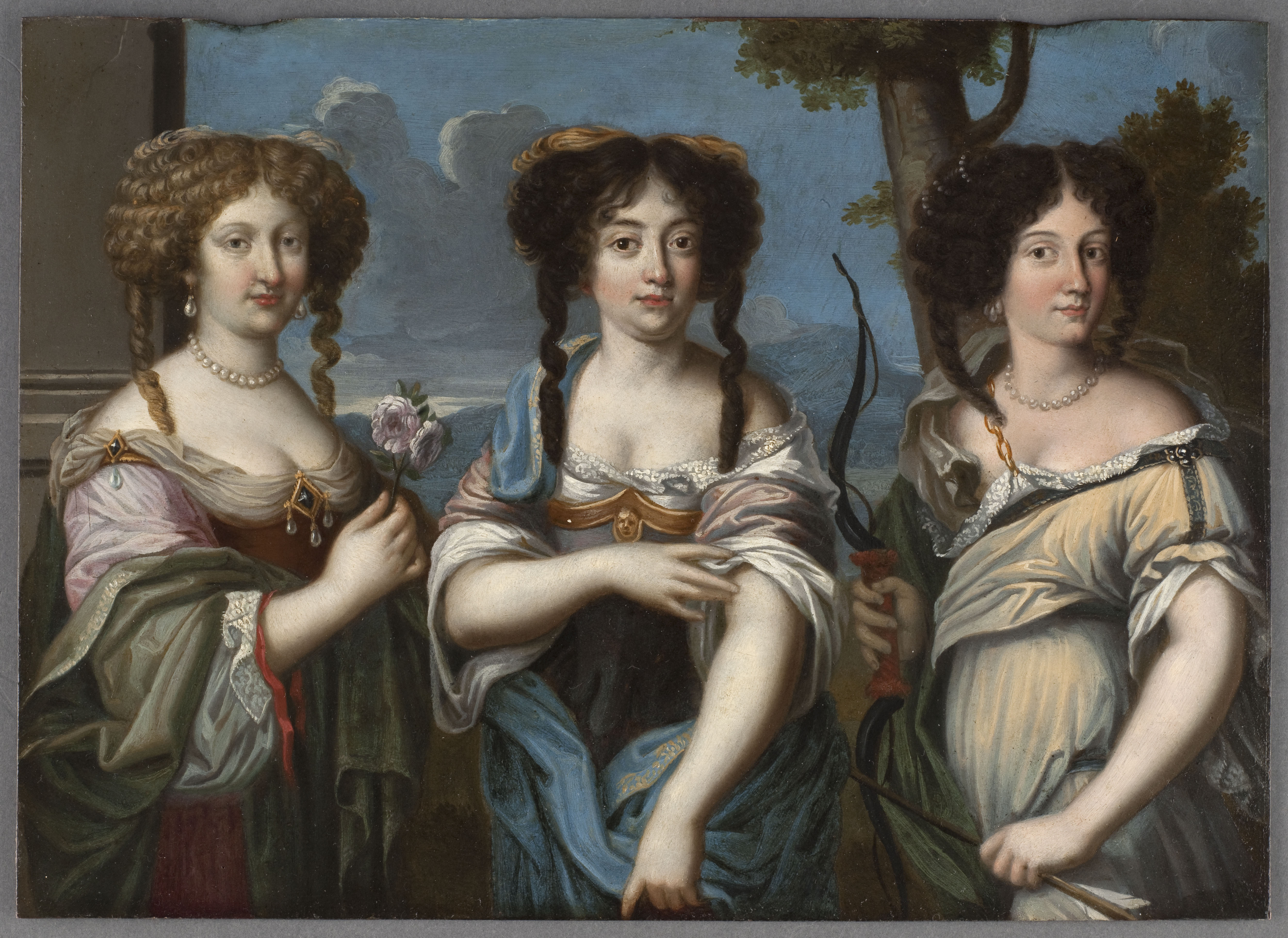
Italian noblewomen
The Mazarinettes were the seven nieces of Cardinal Jules Mazarin, (1639–1661), chief minister to the Kings Louis XIII and Louis XIV of France from 1642 until his death.[[File:Cardinal Mazarin by Pierre Mignard (Musée Condé).jpg|thumb|200px|Cardinal Mazarin]]They were the daughters of the cardinal's two sisters, Laura Margherita (died 1685), the wife of Girolamo Martinozzi, and Girolama, (1614–1656), the wife of Michele Lorenzo Mancini. In 1647, Mazarin brought Laura Margherita and her two daughters, ten-year-old Anne Marie and eight-year-old Laura from Italy to Paris, then, in 1650, when Girolama was widowed, she moved to France, too, with her five daughters and three sons: thirteen-year-old Laura and Paul Jules, eleven-year-old Olympia, ten-year-old Marie, nine-year-old Philippe, six-year-old Alfonso, four-year-old Hortense, and one-year-old Marie Anne.
Mazarin wished to establish a dynasty in France and secure his legacy through advantageous marriages, but could have no children of his own as a member of the Catholic clergy. He also wanted to surround himself with his family, in whom he could confide, as he had many enemies at court.

Anne of Austria, who was ruling as regent after the death of her husband, Louis XIII, and during the minority of his son, Louis XIV, from 1643 to 1651, supervised the education of the Martinozzi and Mancini children herself. She even allowed for the younger children to be educated with the king and his younger brother, Monsieur Philippe, Duke of Anjou.
In Paris, where the beauty ideal was pale skin and a full figure, the darker complexion and thinner build of the Italian girls were widely talked about. The Mazarinettes were discussed in the Mazarinades, the anti-Mazarin pamphlets published in France between 1648 and 1653. One of them described them as follows:
| French original | English translation |
|---|
Other Mazarinades called them "dirt princesses" and "stinking snakes".
When the Mazarinettes were officially presented at court, Marshal Villeroy said to the king's uncle, Gaston, Duke of Orléans:
The Mazarinettes were:
- Laura Victoria Mancini (6 May 1636 – 8 February 1657), who married Louis de Bourbon (1612–1669) in 1651, becoming the Duchess of Mercœur, and had issue
- Anne Marie Martinozzi (1637 – 4 February 1672), who served as Surintendante de la Maison de la Reine for Anne of Austria between 1657 and 1666, and married Armand de Bourbon (1629–1666) in 1654, becoming the Princess of Conti, and had issue, among them François Louis de Bourbon, known as Le Grand Conti ("The Great Conti"), an infamous libertine
- Olympia Mancini (11 July 1638 – 9 October 1708), who became involved in the Affair of the Poisons, for which she was exiled from France. She married Eugene Maurice of Savoy-Carginan (1635–1673) in 1657, becoming the Countess of Soissons, and had issue, among them Prince Eugen of Savoy, one of the most successful military commanders of his time
- Laura Martinozzi (27 May 1639 – 19 July 1687), who married Alfonso IV d'Este (1634–1662) in 1655, becoming the Duchess of Modena, and had issue, among them Mary of Modena, queen consort of England, Scotland and Ireland, from whom the Jacobite pretenders to the English throne descend. Laura ruled as the regent of Modena during the minority of her son, between 1662 and 1674
- Anne Marie Mancini (28 August 1639 – 8 May 1715), who was the first love of Louis XIV, and was banished from court to make the king's political marriage to Maria Theresa of Spain possible. She married Lorenzo Onofrio Colonna (1637–1689) in 1661, becoming the Duchess and Princess of Paliano, and had issue
- Hortense Mancini (6 June 1646 – 2 July 1699), the cardinal's favorite niece, who married Armand-Charles de La Porte (1632–1713), in 1661, becoming Duchess Mazarin, and had issue. She was the official mistress of King Charles II of England, Scotland and Ireland
- Marie Anne Mancini (1649 – 20 June 1714), a patron of the arts, who was tried in court and exiled from Paris for being involved in Affair of the Poisons, but was never convicted. She married Godefroy Maurice de La Tour d'Auvergne (1636-1721) in 1662, becoming the Duchess of Bouillon, and had issue File:Laura Mancini 01.jpg|Laura Mancini, Duchess of Mercœur File:Anna Maria Martonozzi, Princess of Conti by an unknown artist (Palace of Versailles).jpg|Anne Marie Martinozzi, Princess of Conti File:Olympia Mancini by Mignard.png|Olympia Mancini, Countess of Soissons File:Laura Martinozzi duchessa Modena.jpg|Laura Martinozzi, Duchess of Modena File:Marie Mancini (1639-1715).png|Marie Mancini, Duchess and Princess of Paliano File:Follower of Jacob Ferdinand Voet - Hortense Mancini.png|Hortense Mancini, Duchess Mazarin File:Marie-Anne Martinozzi (née Mancini), Duchess of Bouillon by Benedetto Gennari.jpg|Marie Anne Mancini, Duchess of Bouillon
Notes
References
References
- Saint-Evremond. (1728). "The Works of Monsieur de St. Evremond: Made English from the French Original: with the Life of the Author". J. and J. Knapton, J. Darby, A. Battesworth.
- {{harvnb. Guth. 1973
- {{harvnb. Guth. 1973
This article was imported from Wikipedia and is available under the Creative Commons Attribution-ShareAlike 4.0 License. Content has been adapted to SurfDoc format. Original contributors can be found on the article history page.
Ask Mako anything about Mazarinettes — get instant answers, deeper analysis, and related topics.
Research with MakoFree with your Surf account
Create a free account to save articles, ask Mako questions, and organize your research.
Sign up freeThis content may have been generated or modified by AI. CloudSurf Software LLC is not responsible for the accuracy, completeness, or reliability of AI-generated content. Always verify important information from primary sources.
Report