From Surf Wiki (app.surf) — the open knowledge base
Mawlamyine
Capital of Mon State, Myanmar

Capital of Mon State, Myanmar
| Field | Value | |||
|---|---|---|---|---|
| settlement_type | Capital City | |||
| native_name | မော်လမြိုင် | |||
| မတ်မလီု | ||||
| official_name | Mawlamyine | |||
| pushpin_label_position | bottom | |||
| pushpin_map | Burma | |||
| pushpin_map_caption | Location of Mawlamyine, Myanmar (Burma) | |||
| image_skyline | {{multiple image | total_width=280px | perrow=2/3/2/2 | border=infobox |
| image1 | Uzina Pagoda-7.jpg | |||
| image2 | Kyaikthanlan Pagoda-15.jpg | |||
| image3 | Pa-Auk Forest Meditation Center (Main) Entrance.jpg | |||
| image4 | Mahar Myat Muni Pagoda (Mawlamyine)-1.jpg | |||
| image5 | Shri Shivaloganathan Temple.jpg | |||
| image6 | Katedra p.w. św. Rodziny (Mawlamyine) 11.jpg | |||
| image7 | 20200207 083028 Downtown Mawlamyaing Myanmar anagoria.jpg | |||
| image8 | Moulmein University - panoramio - joinai.jpg | |||
| image9 | ShampooIsland.jpg | |||
| image_caption | Top to bottom and left to right: Uzina Pagoda, Kyaikthanlan Pagoda, Pa-Auk Forest Monastery, Mahar Myat Muni Pagoda, Shri Shiva Lokanathan Temple, Cathedral of the Holy Family, Moghul Shiah Mosque, Mawlamyine University, Shampoo Island on the Salween | |||
| subdivision_type | Country | |||
| subdivision_name | ||||
| subdivision_type1 | State | |||
| subdivision_name1 | Mon State | |||
| subdivision_type2 | District | |||
| subdivision_name2 | Mawlamyine District | |||
| subdivision_type3 | Township | |||
| subdivision_name3 | Mawlamyine Township | |||
| unit_pref | Imperial | |||
| area_code | 57 | |||
| population_total | 289,388 | |||
| population_urban | 253,734 | |||
| population_rural | 35,654 | |||
| population_as_of | 2014 Census | |||
| population_footnotes | ||||
| population_blank1 | Mons | |||
| Burmans | ||||
| Chinese | ||||
| Indians | ||||
| Karens | ||||
| population_blank1_title | Ethnicities | |||
| population_blank2 | Theravada Buddhism | |||
| Christianity | ||||
| Islam | ||||
| Hinduism | ||||
| population_blank2_title | Religions | |||
| population_density_km2 | auto | |||
| footnotes | ||||
| population_demonym | Moulmeinian | |||
| coordinates | ||||
| timezone | MST | |||
| utc_offset | +6.30 | |||
| postal_code | 12011 |
မတ်မလီု Burmans Chinese Indians Karens
Rakhines Shan Christianity Islam Hinduism Mawlamyine (also spelled Mawlamyaing; , ; ; , ), formerly Moulmein, is the fourth-largest city in Myanmar (Burma), 300 km southeast of Yangon and 70 km south of Thaton, at the mouth of Thanlwin (Salween) River. Mawlamyine was an ancient city and the first capital of British Burma. It also serves as the capital of Mon State.
Etymology and legend
The Mon name which was previously used for Mawlamyine, Moulmein (မတ်မလီု; ) means "damaged eye" or "one-eyed man." According to legend, a Mon king had a powerful third eye in the centre of his forehead, able to see what was happening in neighbouring kingdoms. The daughter of one of the neighbouring kings was given in marriage to the three-eyed king and managed to destroy the third eye. The Burmese name "Mawlamyine" is believed to be a corruption of the Mon name.
Moulmein was also spelled as Maulmain or Moulmain or Maulmein in some records of the 19th century. The people of Moulmein were referred to as Moulmeinian.
History
Early history
Early Mon reigns
According to Kalyani Inscriptions erected by King Dhammazedi of Hanthawaddy Pegu in 1479, Mawlamyine was mentioned among the '32 myo' or thirty-two Mon cities within the Martaban division. Binnya U, a deputy of Viceroy Saw Binnya, was one of the notable governors of Mawlamyine in the early history of the city.
Toungoo dynasty
In May 1541, King Tabinshwehti and his deputy Bayinnaung captured Mawlamyine. During the reign of Bayinnaung, Toungoo Empire became the largest empire in the history of Southeast Asia. After his passing in 1581, his son Nanda Bayin and successors faced with rebellion by Lan Na, Siam, Lan Xang and renewed Portuguese incursions. In 1594, the governor of Mawlamyine who being in league with Siamese King Naresuan revolted against Toungoo court. Since then, the city became under the control of Siam (present-day Thailand) until 1614.
Konbaung dynasty
In 1760, General Minkhaung Nawrahta of the Royal Burmese Army repaired Mawlamyine on his way back from Burmese–Siamese War in Ayutthaya (former capital of Thailand). Kyaikthanlan Pagoda Inscription hinted that in 1764 (1125 ME), General Maha Nawrahta repaired Kyaikthanlan Pagoda on his way to capture Tavoy, and before finishing the repairment, Mawlamyine faced utter destruction.
Colonial Moulmein (1824–1948)
Mawlamyine was the first capital of British Burma between 1826 and 1852 after the Tanintharyi (Tenassarim) coast, along with Arakan, was ceded to Britain under the Treaty of Yandabo at the end of the First Anglo-Burmese War. After the first Anglo-Burmese war, the British made it their capital between 1826 and 1852, building government offices, churches and a massive prison. In 1829, the Moulmein Bar Association was founded by the Barristers in Mawlamyine. They started business enterprises and the country's first newspaper, The Maulmain Chronicle. Between 1826 and 1862, colonial Mawlamyine was the center of British Burma and the first port city that became a strategically important area and a geographical nodal point for the newly occupied British territory in Southeast Asia. Ever since the first British occupation in 1824, the growth and prosperity of Mawlamyine had steadily increased due to timber trade. Nevertheless, the decline in prosperity of Mawlamyine began when the supply of marketable timber from Salween Valley started to decrease in the 1890s.
During British colonial times, Germany, Siam, Persia, Denmark, Norway and Sweden opened and maintained consulates in Mawlamyine led by either consuls or vice-consuls while Italy and the United States placed consular agencies in Mawlamyine. German explorer Johann Wilhelm Helfer's landing at Moulmein shore on 8 February 1837 made him the first German to arrive in Burma in the history.
Mawlamyine was the setting of George Orwell's famous 1936 essay Shooting an Elephant, which was inspired by Orwell's posting to the city as a police officer in 1926. The story, which is most likely a mixture of fact and fiction, opens with the striking words: :"In Moulmein, in Lower Burma, I was hated by large numbers of people—the only time in my life that I have been important enough for this to happen to me."
During colonial times, Moulmein had a substantial Anglo-Burmese population. An area of the city was known as "Little England" due to the large Anglo-Burmese community, many of them running rubber plantations. This has since dwindled to a handful of families as most have left for the UK or Australia.
It was probably best known to English speakers through the opening lines of Rudyard Kipling's poem Mandalay: :"By the old Moulmein pagoda, lookin' lazy at the sea :There's a Burma girl a-settin', and I know she thinks o' me".
During WWII, the city and the Tanintharyi Region were the first objectives during the Japanese invasion of Burma.
"The old Moulmein pagoda" - Kyaik Than Lan
The "old Moulmein pagoda" Kipling cites is thought to be the Kyaik Than Lan (also spelled Kyaikthanlan) pagoda in Mawlamyine. It stands on a ridge, giving a panoramic view of the city, and is surrounded by 34 smaller temples. Among its sacred treasures is a hair relic of Buddha, received from a hermit in Thaton, as well as a tooth relic conveyed from Sri Lanka by a delegation of monks in ancient times.
Contemporary Mawlamyine
Soon after Burma's independence in 1948, the city fell into the hands of Karen insurgents. The Myanmar military retook the city with the help of UBS Mayu in 1950. Later, many colonial names of streets and parks of the city were changed to more nationalistic Burmese names. Mawlamyine stood as the third-largest city of Myanmar until the recent rise of Naypyidaw.
Geography

Mawlamyine is in the Salween River delta, where the mouth of the Salween is sheltered by Bilugyun Island as it enters the Gulf of Martaban and the Andaman Sea. It is flanked by low hills dotted with ancient pagodas to the east and west.
Climate
Mawlamyine has a tropical monsoon climate (Köppen: Am) similar to the climates of Dawei and Sittwe. There is a lengthy dry season between mid-November and mid-April, and an extremely wet season due to the southwest monsoon between mid-April and mid-November. Between June and August when the surface westerly winds are strongest and supersaturated air is advected onto the nearby mountains, Mawlamyine averages around 1100 mm of rain per month.
| Jan record high C = 37.2 | Feb record high C = 39.1 | Mar record high C = 39.7 | Apr record high C = 40.2 | May record high C = 41.2 | Jun record high C = 36.1 | Jul record high C = 35.2 | Aug record high C = 36.7 | Sep record high C = 35.3 | Oct record high C = 37.2 | Nov record high C = 37.2 | Dec record high C = 36.8 |year record high C = | Jan record low C = 12.2 | Feb record low C = 12.2 | Mar record low C = 16.7 | Apr record low C = 19.4 | May record low C = 16.7 | Jun record low C = 21.1 | Jul record low C = 18.9 | Aug record low C = 18.9 | Sep record low C = 21.1 | Oct record low C = 19.4 | Nov record low C = 15.0 | Dec record low C = 11.1 |year record low C = 11.1 NOAA (extremes)
Transport

Airport
Mawlamyine Airport has regular flights to Yangon (Rangoon).
Bus and taxis
Mawlamyine is the main gateway to south eastern Myanmar. Thanlwin Bridge, the longest road and rail bridge in Myanmar is the most prominent landmark in the area. It stretches 11000 ft over the Thanlwin River connecting the country's south eastern region with Yangon. The city has a central highway bus station. The city is connected to Pa-an in Kayin State in the north-east and Dawei and Myeik in Tanintharyi Division in the south by road. Via Kawkareik, the city is also connected with Thai-Myanmar border town Myawaddy. Newly opened Bogyoke Aung San Bridge (Bilu Kyun) connects Mawlamyine with nearby Bilu island, lies about 500 metres west off the shore of Mawlamyine.
In Mawlamyine, motorcycles and tuk-tuk (Thone Bee in Burmese) motorised tricycles cumulatively registered for use as taxis. Mawlamyine is also served by bus networks which radiate mostly from the north to the south.
Railways
It was the rail head to Ye, linked to Yangon by rail only from Mottama (Martaban) across the river by ferry, but today connected by the Thanlwin Bridge (Mawlamyine) opened in April 2006.
Mawlamyine Railway Station, which was reportedly built to the standards of an "ASEAN railway station", is the terminus of Myanmar Railways' Yangon–Mawlamyine Railway and Tanintharyi Line.
Water transport
In colonial era, Mawlamyine (then Moulmein) port was served by European shipping companies including Scottish-owned British-India Steam Navigation Company and Irrawaddy Flotilla Company.
_01.jpg)
The port was important not only for inland navigation but also for international shipping. Rice and teak from sawmills at Mawlamyine were exported worldwide by those shipping companies. The 1880 handbook of British-India Steam Navigation Company listed:
- Calcutta - Rangoon - Moulmein (started in 1857)
- Moulmein - Penang - Malacca - Singapore (started in 1862)
- Moulmein - Penang - Colombo - Bombay lines in operations. In 1894, the journey between Barr Street Jetty of Rangoon to the Main Wharf of Moulmein took about nine hours at a fare of 10 Rupees for second class.
Nowadays, although much diminished from its past prominence, water-based transport still plays an important role in connecting between Mawlamyine and the immediate upstream towns. The Port of Mawlamyine is currently under the management of Myanma Port Authority and is located on the Thanlwin River about 28 nautical miles inland from the Kyaikkhame point on the Gulf of Martaban, 2 kilometres from Mawlamyine railway station.
Cityscape

Around the city
Heritage buildings
- Kyaikthanlan Pagoda: It was built in 875 AD during the reign of Mon King Mutpi Raja, it was raised from its original height of 56 ft to the present 150 ft by successive kings including Wareru, founder of the Kingdom of Hanthawaddy Pegu. In 1831, to prevent Moulmein's identity from fading away, Sitke Maung Htaw Lay, who later served as Magistrate of Moulmein restored the pagoda with the funds raised by public subscriptions. Being situated on the range of hill, the pagoda overlooks the city, nearby islands, Gulf of Martaban, surrounding rivers and the limestone mountains of Kayin State in the east. Rudyard Kipling is believed to have written his famous "Lookin' lazy at the sea" line at this pagoda in 1890.[[File:Architecture at Kyaikthanlan Paya.jpg|thumb|Architecture at Kyaik Than Lan Pagoda in 2014|alt=]]
- U-zina Pagoda: The pagoda is one of the principal pagodas situated on the range of hill. According to legend, the pagoda contains a hair of Buddha and was built during the reign of King Ashoka, the great protector of Buddhism. The U-zina pagoda was named after the sage, U-zina who restored it in 1838. Prior to this the pagoda had been known as Kyaik Pa-dhan pagoda.
- Princess Ashin Hteik Suhpaya's tomb: Princess Ashin Hteik Suhpaya (also known as Princess Myat Phaya Galay) who was the fourth daughter of King Thibaw, the last king of Konbaung dynasty returned to Burma from exile in 1915 and lived at her mansion on West Cantonment Road, Mawlamyine until her death in 1936. Her tomb is located near Kyaikthanlan Pagoda. The remains of her son, Prince Taw Phaya Nge and her daughter, Princess Hteik Su Phaya Htwe were also buried in the tomb in the later years.[[File:Four Princesses of Burma.jpg|thumb|The four daughters of King Thibaw in 1914 (Princess Myat Phaya Galay on the left)]]
- First Baptist Church: The church is Myanmar's first Baptist church and it was initially built in 1827 by the legendary Adoniram Judson, a 19th-century American missionary who compiled the first Burmese-English dictionary. The church is regarded as a landmark for its significance to the Baptist movement worldwide.
- St Matthew's Church: It was the first English Church (Anglican Church) built in Myanmar. It was initially erected in 1832 and the current handsome structure was rebuilt in 1887. It was designed and restored by the English architects James Piers St Aubyn and Henry J. Wadling of London and the foundation stone was laid by Sir Charles Crosthwaite, then Chief Commissioner of Burma. It is of red brick, the capitals of interior pillars being stone, and is said to be a model of English Church at Dresden. George Orwell attended the church during his days as Imperial Policeman in Moulmein in 1926 and the church compound has grave stones of his relatives. During the Japanese conquest of Burma in WWII, the Japanese Army stored salt in the church. Though the church is still in use, it is in a state of decay and is in urgent need of conservation.
- St Patrick's Church: The St Patrick's Roman Catholic church was built in 1829; the French people constructed the clock tower of the church around 1854. St Patrick's school in the church compound was once a boarding school for the children of the elite in colonial times. The tragic love story of Thailand's Prince Sukkasem, the heir to the Lanna throne, and a Mon commoner girl started during his time at this school in the 1890s and was immortalised in Thai folk song and Thai literature.
- Police Commissioner Headquarters: Built in 1826 on a hill in Than Lwin Park. The impressive colonial building was the place where George Orwell worked as Assistant District Superintendent in 1926.
- Old Moulmein Prison: The Mawlamyine's colonial-era prison was initially built in the 1830s. Sir Richard Hieram Sankey, an Irish military engineer who is credited with designing much of the infrastructure of the Indian city of Bangalore, used to work at this prison as Superintendent of the jail in 1860. George Orwell was believed to have witnessed hanging there and it is the setting of his short story "A Hanging (1931)". During WWII, following the Fall of Singapore in 1942, Allied soldiers transferred from Changi Prison were held in the Moulmein Prison by the Imperial Japanese Army before they were sent to the notorious death railway construction. In 2015, the prison was closed and relocated to a new facility near Yedwingone village in Kyaikmawyaw township.
- Yadanabonmyint Monastery: It is also known as Queen Seindon Monastery. It is known for its craftsmanship.
Islands
- Bilu Island (Belu-kyun): The local meaning of the island's name is Ogre Island. The island is famous for handicraft and Mon traditional culture.
- Gaungsay Kyun Island (Shampoo Island): A tiny island lies between Mottama and the north bank of Mawlamyine is called Gaungsay Kyun island, literally: "Head Washing Island". In ancient times, the clear pristine water obtained from a small rocky outcrop of the island was carried to the palace and used by Burmese kings at royal hair-washing ceremonies during Thingyan. In colonial days, the island was known in its European name "Crow Island" for being the home of all the crows in the city.
Others
- Mon State Cultural Museum (Mon Ethnic Cultural Museum)
- Mottama (formerly Martaban): A small town located opposite to the north bank of Mawlamyine was the first capital of the Hanthawaddy kingdom in the 13th and 14th centuries after the collapse of Pagan (Bagan) Empire in 1287. During Burmese–Siamese wars between the 16th and 18th centuries, Martaban was an important rallying spot for Burmese troops moving from Upper Burma to sack Ayutthaya Kingdom. Between 2nd-century BCE and 15th-century CE, Martaban was a main trading port in the historic Maritime Silk Road that connects Korea, China, Southeast Asia, the Indian subcontinent, Ceylon, Arabian Peninsula, Horn of Africa and all the way to Egypt and eventually Rome or Europe. The Martaban jars were imported and got its namesake from this Martaban port city as early as the fourteenth century.[[File:Silk Road in the I century AD - en.svg|thumb|The Maritime Silk Road in the 1st century]]
- Pa-Auk Forest Monastery: The main monastery complex and meditation centre is located in a forest near Pa-Auk village along the Taung Nyo Mountain range 15 kilometres southeast of Mawlamyine. The monastery is known for the practice of meditation. 500–1000 meditators from over 20 countries reside in the monastery.
- Win Sein reclining Buddha: 29 km south of Mawlamyine is the world's largest reclining Buddha at Mudon. It is approached by a roadway with 500 life size statues of Arahant disciples of Buddha and a hall whose chamber walls display scenes of Buddha's lifetime, and the underworld.
- Thanbyuzayat War Cemetery: 64 kilometres south of Mawlamyine is prisoners-of-war cemetery and the notorious death railway connected with the Bridge over the River Kwai. The cemetery contains the graves of 3,770 British, Australian, Dutch and other soldiers. It was formally opened on 10 December 1946 by General Aung San and then Governor Sir Hubert Rance.
Economy
Mawlamyine is famous for its tropical fruits and for its cuisine as indicated in the popular Burmese expression, "Mandalay for the speaking, Yangon for the bragging, and Mawlamyine for the eating." (မန္တလေးစကား ရန်ကုန်အကြွား မော်လမြိုင်အစား) Among its tropical fruits, Mawlamyine pomelo, durian and rambutan are traded countrywide.
Mawlamyine had several sawmills and rice mills as teak and rice were transported down the Salween. It was once a busy shipbuilding center and remains an important port. At least one major British shipping line had some of their ships built here. The teak "country-built" ships generally had a longer service life than those constructed from European hardwoods. The city had a solar-powered plant for extracting salt from seawater and a diesel electric plant.
Industry
The city has two industrial zones. Of two, the newly opened Kyauktan industrial zone features a variety of different business enterprises, including zinc, barbed wire, ready-mix cement, food and drink production, textiles, gold purification, ice factories, shoe production facilities, furniture enterprise, plastic enterprises, cool seafood storage and car accessory businesses.
As a cross-border investment, the state-of-the-art combined-cycle gas power plant in Mawlamyine was constructed by Singapore's United Overseas Bank (UOB) backed Singapore company Asiatech Energy. The Mawlamyine power plant brings a sustainable supply of power to residents and businesses in Mon State.
In July 2017, to make the country's oil and gas industry more efficient, the Myanmar Investment Commission (MIC) granted an approval to a subsidiary of Singapore-based firm to construct an offshore supply base in the 46 acres of river front land of Mawlamyine. It would provide a wide range of services to the operators of oil and gas fields in the waters off the coast in the Bay of Bengal.
Transport hub
Mawlamyine is the western terminus and an important part of the East-West Economic Corridor. The 1450-kilometre east–west economic corridor links the South China Sea at Da Nang to Mawlamyine through Laos and Thailand. By using the East-West Economic Corridor, the travel time between Bangkok and Yangon is just three days, compared with the two to three weeks needed for conventional marine transportation via the Straits of Malacca. Japan's Nippon Express started land transportation services between Thailand and Myanmar in 2016.
Flora and fauna
File:Mawlamyine pomelo.JPG|Mawlamyine Pomelo File:Mawlamyine durians.jpg|Durian File:Mawlamyine rubber.jpg|Rubber plantation File:Mawlamyine Vegetation.jpg|Durian plantation File:Moulmein rosewood.jpg|Moulmein Rosewood File:Mafai1619.JPG|Baccaurea ramiflora File:Paphiopedilum parishii (Rchb. f.) Stein, drawn by Charles Parish, painted by Eleanor Parish - 1867.png|Paphiopedilum parishii, native to Moulmein discovered by Charles Parish and wife in 1867. File:Tuni (Kashmiri- तूनी) (2560742630).jpg|Moulmein Cedar File:ArhopalaAsopiaHew1869MUpUnAC1.jpg|The plain tailless oakblue butterfly discovered by William Hewitson in Moulmein in 1869.
Culture
Mawlamyine provides a multicultural dimension despite a Buddhist Mon majority. Buddhist cultural dominance is as old as Mawlamyine, but the British annexation and American missionaries in the early 19th century introduced Christianity. Many of the relics of the British Raj remain along with Hindu temples, Chinese temples, mosques and even a slice of Americana, reflecting Mawlamyine's great diversity.[[File:Mawlamyine MMR011001701, Myanmar (Burma) - panoramio (50).jpg|thumb|196-year old First Baptist Church|255x255px|alt=]] The First Baptist Church in Mawlamyine was constructed in 1827 by the legendary Adoniram Judson, the first Caucasian Protestant missionary sent from North America to Myanmar. The building is a masterful blend of Western and local elements, with the materials and building technology speaking directly to Mon cultural traditions and crafts expertise. In 2015, the US Embassy in Myanmar announced that it gave an award of $125,000 to World Monuments Fund (WMF) to restore the historic First Baptist Church in Mawlamyine through the Ambassadors Fund for Cultural Preservation.
The Mon State Cultural Museum exhibits the ancient cultural relics of Mon people and divans used by a Konbaung princess who resided in Mawlamyine.
Education
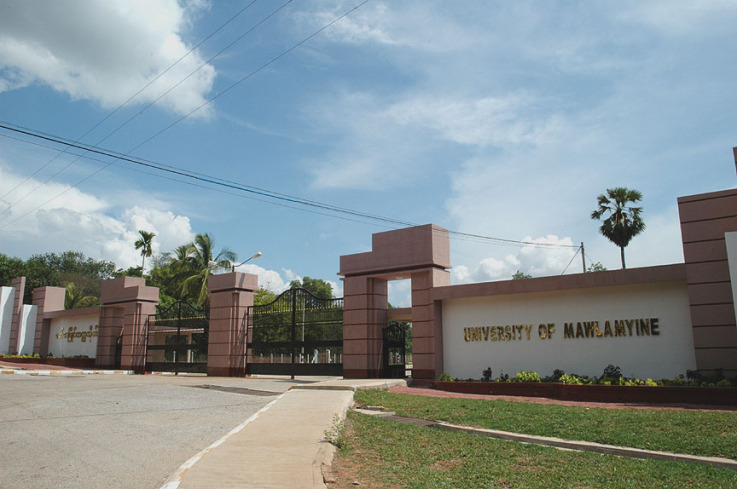
Mawlamyine has 13 public high schools, two institutes, a college and three universities.
The University of Mawlamyine, established in 1953, is the major university for the south eastern region and offers both bachelor's and master's degree programs in liberal arts and sciences. It is the third oldest Arts and Science university in the country after the University of Yangon (est. 1878) and the University of Mandalay (est. 1925). It is one of the few universities in Myanmar that offers a degree in marine science. Its Marine Science Laboratory in Setse, a coastal town about 83 km south of Mawlamyine, was the first of its kind in Myanmar. Technological University (Mawlamyine) offers technological and engineering courses. The Mawlamyine campus of Yezin Agricultural University, administered by Ministry of Agriculture, Livestock and Irrigation (MOALI), offers agriculture courses. Government Technical Institute (Mawlamyine) offers vocational engineering courses located in outskirts of the city. Mawlamyine Education College and Mawlamyine Institute of Education are also located in the city.
The St. Patrick's School (now B.E.H.S. No. 5) founded by the De La Salle Brothers in 1860, Morton Lane-Judson School, (formerly Morton Lane Girls' School, now B.E.H.S No.6) founded in 1867 and Shin Maha Buddhaghosa National School (now B.E.H.S. No.9) founded in 1899 are a few of the oldest public high schools in Myanmar.
The first international student of Bucknell University, Class of 1864, Maung Shaw Loo was the first Burmese physician of Western medicine and the first Burmese to study Western medicine in the United States.
Sports
The 10,000-seat Yamanya Stadium is one of the main venues for local and regional football tournaments. The stadium is also a home for Southern Myanmar F.C., a Myanmar National League (MNL) football club.
Health care
Public Hospitals
- Mawlamyine Women and Children Hospital (former Ellen Mitchell Memorial Hospital)
- Mawlamyine General Hospital
- Mawlamyine Christian Leprosy Hospital
- Mawlamyine University Hospital
- Mawlamyine Traditional Medicine Hospital
Notable people
- Ellen Kate Limouzin
International relations
Sister cities
Mawlamyine established a Friendship City agreement with Fort Wayne, Indiana, United States in 2016. A student exchange program between Mawlamyine University and IPFW of Fort Wayne began in 2017.
Others
A primary road in Novena, Singapore and a road (Solok Moulmein) in George Town, Malaysia were named after the city's old name, Moulmein.
Gallery
File:Kyaik Tan Lan.JPG|Kyaikthanlan Pagoda at night File:Mon King bell.JPG|Old bell donated by Mon King in AD 1533 File:Mawlamyine Railway Station.JPG|Mawlamyine Railway Station File:Mawlamyine 253.JPG|Technological University (Mawlamyine) File:Mawlamyine MMR011001701, Myanmar (Burma) - panoramio (51).jpg|Queen Sein Don Monastery File:Moulmein 2 - panoramio.jpg|A roundabout in Mawlamyine File:Mawlamyine MMR011001701, Myanmar (Burma) - panoramio (42).jpg|St Patrick's School (now BEHS 5) File:Ataran suspension bridge.jpg|Attaran Suspension Bridge File:Mon State Government Office.jpg|Victorian style clock tower (Mon State Government Office in the distance) File:Church in Mawlamyine.jpg|Saint Patrick Church (Mawlamyine) File:U Zee Na Pagoda 2.jpg|U-zina Pagaoda / Kyaik Pa-dhan pagoda File:Sunset over Thanlwin River (8).jpg|Sunset over Salween (Than Lwin) River
References
References
- (May 2015). "The 2014 Myanmar Population and Housing Census The Union Report Census Report Volume 2". Department of Population, Ministry of Immigration and Population.
- "National Telephone Area Codes". Myanmar Yellow Pages.
- "Myanmar: largest cities and towns and statistics of their population: calculation 2010".
- "Population of Cities in Myanmar (2017)".
- "Mawlamyine or Moulmein".
- Banyar, Ko. (7 November 2013). "မွန်တို့ဌာနေ ရာမည တိုင်းက မွန် အခေါ်အဝေါ်များ".
- Tun, Than. (1988). "Observations on the Translation and Annotation of the Royal Orders Of Burma". Crossroads: An Interdisciplinary Journal of Southeast Asian Studies.
- ''Dictionary of Modern Spoken Mon'' by H.L. Shorto (1962, Oxford University Press).
- [http://myanmartravelinformation.com/mon-state/mawlamyaing.html Myanmar Travel Information] {{Webarchive. link. (2016-03-23 . Accessed 16 August 2015)
- (1871). "Memoir of George Edward Lynch Cotton, D.D., Bishop of Calcutta, and Metropolitan : with selections from his journals and correspondence". London : Longmans, Green.
- Shorto, H L. (1963). "The 32 myos in the medieval Mon kingdom". Bulletin of the School of Oriental and African Studies.
- Aung, Htin. (1967). "A History of Burma". Cambridge University Press.
- Rajanubhab, Damrong. (2001). "Our Wars With the Burmese". White Lotus.
- "Moulmein". [[Encyclopædia Britannica]] online.
- (2017-03-09). "Moulmein, Myanmar".
- McPherson, Kenneth. (2002). "Port Cities as Nodal Points of Change". Columbia University Press.
- Bird, George W.. (1897). "Wanderings in Burma". Bournemouth [Eng.] F.J. Bright & son; London, Simpkin, Marshall, Hamilton, Kent & co., ltd..
- {{Cite EB1911
- Archives, The National. "The Discovery Service".
- "1888 Moulmein".
- (1878). "Travels of Doctor and Madame Helfer in Syria, Mesopotamia, Burmah and other lands". London : Richard Bentley & Son.
- Zollner, Hans-Bernd. (2002). "Germans in Burma, 1837-1945". Northern Illinois University.
- Taylor, David John. (2023). "Orwell: the new life". Constable.
- (1984). "Burma: The Longest War 1941-45". Phoenix Press.
- [http://www.mawlamyine.com/places-of-interest-mawlamyine/kyaikthanlan-pagoda Mawlamyine.com Kyaikthanlan pagoda page] Accessed 16 August 2015.
- [http://www.happyfootprints.com/Mawlamyine-attractions/HERITAGES_LANDMARKS Happy Footprints] {{Webarchive. link. (2016-09-18 . Accessed 16 August 2015)
- W. Vivian De Thabreuw, ''Buddhist Monuments and Temples of Myanmar and Thailand'' (Authorhouse, 11 March 2014). E-book. {{ISBN. 9781491896228.
- Tinker, Hugh. "Union of Burma".
- "World Meteorological Organization Climate Normals for 1991–2020". World Meteorological Organization.
- "Global Surface Summary of the Day - GSOD". [[National Oceanic and Atmospheric Administration]].
- "Welcome to Mawlamyine".
- "Myanmar (Burma) Maps - Major country roads". Asterism.
- mizzima. (2017-06-14). "The Bilu Kyun Bridge controversy". Mizzima.
- (2017-05-09). "Bogyoke Aung San Bridge inaugurated {{!}} Global New Light Of Myanmar".
- "Train travel in Myanmar(Burma)".
- "Mon State". Asterism.
- "Irrawaddy Flotilla".
- Brittain, Colin. "British India Steam Navigation Company - Part One".
- Jones, Stephanie. (1986). "Two Centuries Of Overseas Trading". Palgrave Macmillan UK.
- Swiggum, Sue. "British India Steam Navigation Company".
- (1897). "Wanderings in Burma". Bournemouth [Eng.] F.J. Bright & son; London, Simpkin, Marshall, Hamilton, Kent & co..
- "Study underway for new port in Yangon, CM says".
- "2.1.2 Myanmar Port of Mawlamyine, Mon state - Logistics Capacity Assessment - Digital Logistics Capacity Assessments".
- Bird, G W. (1897). "Wanderings in Burma".
- Wai Wai, Myaing. (2005). "A Journey in Time: Family Memoirs (Burma, 1914–1948)". iUniverse.
- "Kyaik Than Lan".
- "Wanderings in Burma".
- "Burma's Last Royals - Los Angeles Review of Books". Los Angeles Review of Books.
- "First Baptist Church of Mawlamyine". World Monuments Fund.
- "Baptist church restoration a mixed blessing for Myanmar".
- "Wanderings in Burma - Southeast Asia Visions".
- Larkin, Emma. (2005). "Finding George Orwell in Burma".
- "Westward, ho!".
- Duangnee, Phoowadon. (27 Jul 2016). "History Carved In Stone". The Nation.
- Meyers, Jeffrey. (2010). "Orwell: Life and Art". University of Illinois Press.
- (2012-02-13). "Why we shouldn't forget Sankey...".
- "Here be monsters: Travelling to Ogre Island".
- Crager, Kelly. (2008). "Hell Under the Rising Sun: Texan Pows and the Building of the Burma-Thailand Death Railway". Texas A&M University Press.
- (2015-04-09). "Mawlamyine Prison to close, future unclear".
- "Bilu Island".
- Scott, James George. (1896). "The Burman, his life and notions". London, Macmillan and co., limited.
- "Maritime Silk Road Archives".
- "GLOSSARY: Martaban wares".
- "Martaban Jar".
- "Pa-Auk Forest Monastery".
- "Pa-Auk Forest Monastery".
- "Pa-Auk Forest Monastery".
- (2014-09-17). "40-Day Meditation Retreat at Pa-Auk Tawya, Burma". UP Development.
- "Myanmar Guide & Reviews".
- Smith, C. Fox (1925). ''Ship Alley''. Methuen. pp. 80-91.
- Lawi Weng. "Fire Destroys Moulmein Market". [[The Irrawaddy]], December 2, 2008.
- (2016-03-16). "New Industrial Zone in Mon State to open this month {{!}} Global New Light Of Myanmar".
- "Powering up Myanmar".
- mizzima. (2017-05-27). "Myanmar Offshore Supply Base Development: Further Chaos or Progress?". Mizzima.
- "Myanmar Offshore Supply Base Ltd (MOSB) - Myanmar opens arms for the first foreign company to build an oil and gas supply base". Electric Energy Online.
- "The race to build a supply base". The Myanmar Times.
- "East-West Economic corridor still in planning stage: ADB official". The Myanmar Times.
- "Roads can convert Myanmar from economic void to hub- Nikkei Asian Review". Nikkei Asian Review.
- Gray, Denis D.. (2017-04-22). "Myanmar's ex-colonial capital captivates with faded glory {{!}} TheRecord.com". TheRecord.com.
- "First Baptist Church of Mawlamyine". World Monuments Fund.
- (2015-09-14). "U.S. Embassy Announces Project to Restore the Historic First Baptist Church in Mawlamyine [Burmese] [Mon] {{!}} U.S. Embassy in Burma". U.S. Embassy in Burma.
- (2009-01-06). "l".
- "Mawlamyine Campus – Yezin Agricultural University".
- "MODiNS [ Myanmar Online Information ]".
- "The New Light of Myanmar (Sunday, November 21, 1999)".
- "Maung Shaw Loo". [[Bucknell University]].
- [http://www.myanmars.net/myanmar-history/myanmar-history-shawloo.htm "Dr. M Shaw Loo"] {{Webarchive. link. (2017-01-03 "The Myanmar Net", Myanmar, Retrieved on 30 March 2014)
- "ဘွဲ့လွန်သင်တန်းများဝင်ခွင့်အရည်အချင်းစစ်စာမေးပွဲဖြေဆိုခွင့်ရရှိသူများ၏ခုံအမှတ်စာရင်း". [[University of Medicine 1, Yangon]].
- (26 January 2016). "Fort Wayne Sister Cities to sign Myanmar friendship agreement". [[The News-Sentinel]].
This article was imported from Wikipedia and is available under the Creative Commons Attribution-ShareAlike 4.0 License. Content has been adapted to SurfDoc format. Original contributors can be found on the article history page.
Ask Mako anything about Mawlamyine — get instant answers, deeper analysis, and related topics.
Research with MakoFree with your Surf account
Create a free account to save articles, ask Mako questions, and organize your research.
Sign up freeThis content may have been generated or modified by AI. CloudSurf Software LLC is not responsible for the accuracy, completeness, or reliability of AI-generated content. Always verify important information from primary sources.
Report