From Surf Wiki (app.surf) — the open knowledge base
Mauritia flexuosa
Species of palm tree
Species of palm tree
- Mauritia minor Burret
- Mauritia sagus Schult. & Schult.f.
- Mauritia setigera Griseb. & H.Wendl.
- Mauritia sphaerocarpa Burret
- Mauritia vinifera Mart.
- Saguerus americanus H.Wendl.
Mauritia flexuosa, known as the moriche palm, ité palm, ita, buriti, muriti, miriti (Brazil), canangucho (Colombia), morete or acho (Ecuador), palma real (Bolivia), or aguaje (Peru), is a palm tree. It grows in and near swamps and other wet areas in tropical South America.
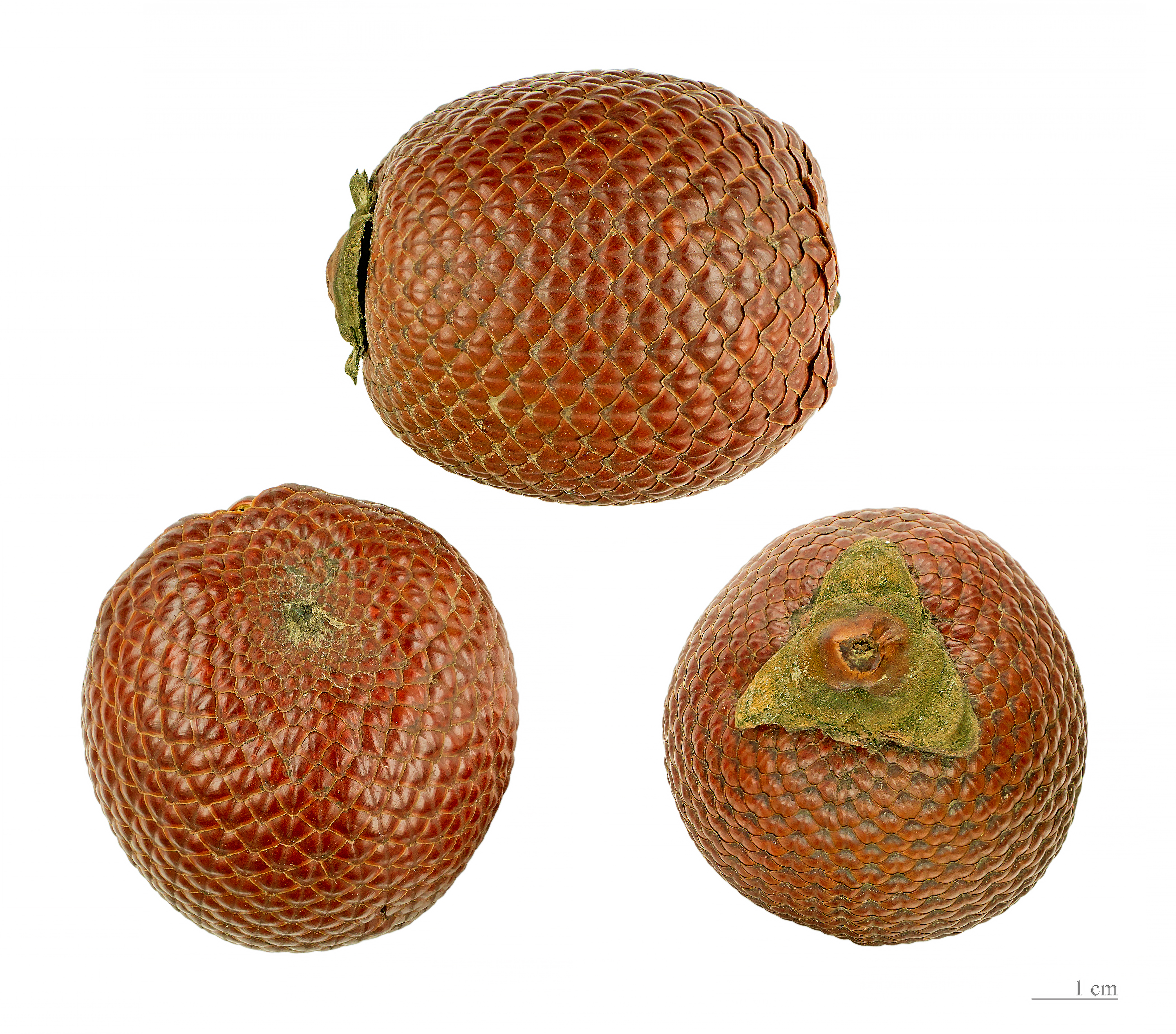
Mauritia flexuosa can reach up to 35 m in height. Henderson and McBride both give a height of 50 m. The trunk can be up to 70 cm diameter at breast height The large leaves form a rounded crown. The tree produces Pneumatophores which can develop as much as 30 m from the trunk. suggesting a very extensive root system. The flowers are yellowish and appear from December to April. The fruit, which grows from December to June, is a chestnut color and is covered with shiny scales. The yellow flesh covers a hard, oval nut. The seeds float, and this is the means by which the palm tree propagates. In natural populations, the tree reaches very high densities.
Distribution
Mauritia flexuosa is found in the wild in South America in Bolivia, Brazil, Colombia, Ecuador, French Guiana, Guyana, Peru, Suriname, Trinidad, and Venezuela.
Fruit
The fruit, which is an orange-brown and covered with neat rows of scales, are consumed by catfish during the annual floods and then deposited sometimes at a considerable distance from the mother plant. When the waters reside, the seeds germinate.
Moriche palm fruit ("morete" in the Oriente of Ecuador) is edible and used to make juice, jam, ice cream, a fermented "wine", desserts and snacks, requiring harvesting of more than 50 tonnes per day in Peru.
The inflorescence buds are eaten as a vegetable and the sap can be drunk fresh or fermented (see palm wine). Threads and cords are locally produced from the tree's fibers.
Humans consume palm weevil larvae (Rhynchophorus palmarum) which burrow in the tree trunk.
Oil
Buriti oil is an orange-reddish oil extracted from the fruit of the moriche palm. The oil contains high concentrations of oleic acid, tocopherols, and carotenoids, especially beta-carotene. The oil has a reddish color used as ink on hides and skins. Batana oil, a similar oil extract, has seen hair and skin care use since indigenous times.
Ecology
This tree is important to many animal species; several bird species, such as the red-bellied macaw, sulphury flycatcher, and moriche oriole, use it for nesting and food. Tapirs, peccaries, fish and monkeys depend on the fruit.

Alexander von Humboldt documented the tree and the ecosystem it supports in 1800 when traveling through the Llanos region of Venezuela. He "observed with astonishment how many things are connected with the existence of a single plant." He called it the "tree of life" and essentially described it as a keystone species although the concept would not be explicitly defined until 1969 by Robert T. Paine.
Miscellaneous
The government of the Federal District – the Brazilian state where the country's capital, Brasília, is located – is called Palácio do Buriti ("Buriti Palace"). Across the street from the building is a square with fountains and a single moriche palm tree, which was taken from the outskirts of the city and replanted there. The species is a common feature of the cerrado vegetation that predominates in central Brazil.
References
_on_Comté_River_..._(25055479137).jpg)
References
- "Mauritia flexuosa L.f. — the Plant List".
- "World Checklist of Selected Plant Families: Royal Botanic Gardens, Kew".
- Henderson, Andrew. (1995). "Palms of the Amazon". Oxford Univ. Press.
- J. Francis McBride, Palmae, FLORA OF PERU volume 13 part 1 issue 2 page 327
- J. Francis McBride, "Palmae", FLORA OF PERU, loc.cit.
- David L. Jones, PALMS THROUGHOUT THE WORLD, Smithsonian Institution Press, (1995) page 72.
- Francis Kahn. "Ecology of Economically Important Palms in Peruvian Amazonia".
- Bright, Michael. (2001). "1000 Wonders of Nature". Reader's Digest Association Ltd.
- (2006). "Absorption and photoluminescence of Buriti oil/polystyrene and Buriti oil/poly(methyl methacrylate) blends". [[European Polymer Journal]].
- PESCE, Celestino. Oleaginosas da Amazonia.-Belém: Museu Paraense Emilio Goeldi, 2009. 334 p.: il. {{ISBN. 978-85-61377-06-9 (MPEG) e 978-85-60548-39-2 (MDA)
- (2023-11-06). "How Is Batana Oil Made?".
- https://dailymed.nlm.nih.gov/dailymed/drugInfo.cfm?setid=252fec30-7583-ab0d-e063-6294a90a0ee9
- "Batana Oil: Benefits, Side Effects, Skin Care, and More".
- (2006). "The amazing palm tree of the Amazon". Instituto de Investigaciones de la Amazonía Peruana.
- (2015). "The Invention of Nature: Alexander von Humboldt's New World: Andrea Wulf: 9780385350662: Amazon.com: Books".
This article was imported from Wikipedia and is available under the Creative Commons Attribution-ShareAlike 4.0 License. Content has been adapted to SurfDoc format. Original contributors can be found on the article history page.
Ask Mako anything about Mauritia flexuosa — get instant answers, deeper analysis, and related topics.
Research with MakoFree with your Surf account
Create a free account to save articles, ask Mako questions, and organize your research.
Sign up freeThis content may have been generated or modified by AI. CloudSurf Software LLC is not responsible for the accuracy, completeness, or reliability of AI-generated content. Always verify important information from primary sources.
Report