From Surf Wiki (app.surf) — the open knowledge base
Mary of Clopas
Woman present at the crucifixion of Jesus

Woman present at the crucifixion of Jesus
| Field | Value | |
|---|---|---|
| honorific prefix | Saint | |
| name | Mary of Clopas | image = The Entombment of Christ-Caravaggio (c.1602-3) (cropped).jpg |
| caption | Detail from The Entombment of Christ by Caravaggio, 1603–1604 | |
| titles | Myrrhbearer | |
| venerated_in | Eastern Orthodox Church | |
| Roman Catholic Church | ||
| feast_day | May 23 (Orthodoxy) | |
| April 24 (Catholicism) |
Roman Catholic Church April 24 (Catholicism)
According to the Gospel of John, Mary of Clopas (, María hē toû Clōpâ) was one of the women present at the crucifixion of Jesus and bringing supplies for his funeral. The expression Mary of Clopas in the Greek text is ambiguous as to whether Mary was the daughter or wife of Clopas, but exegesis has commonly favoured the reading "wife of Clopas". Hegesippus identified Clopas as a brother of Joseph.
Along with Mary Magdalene and "Mary" Salome, Mary of Clopas is known as one of the Three Marys at the tomb of Jesus. Her relics are said to be in France at the Church of the Saintes Maries de la Mer.
Appearances in the gospels
Mary of Clopas is explicitly mentioned only in John 19:25, where she is among the women present at the crucifixion of Jesus: The Gospels of Mark and Matthew each include similar passages that are nearly identical to one another:
This has led scholars to identify Mary of Clopas with "Mary the mother of James and Joseph/Joses". The Gospels of Matthew and Mark mention James and Joseph/Joses (with Mark always using the less common variation "Joses") among the four brothers of Jesus.
According to some interpretations, the same Mary was also among the women that on resurrection morning went to the tomb to anoint the body of Jesus with spices. Matthew calls her "the other Mary" to distinguish her from Mary Magdalene, while Mark uses the name "Mary, the mother of James" (Maria Iacobi in Latin).
Apocryphal writings
In a manner very similar to the Gospel of John, the apocryphal Gospel of Philip (3rd century) also seems to list Mary of Clopas among Jesus' female entourage:
Adding to the confusion, the Gospel of Philip seems to refer to her as Jesus' mother's sister ("her sister") and Jesus' own sister ("his sister").
The Gospel of Pseudo-Matthew (7th century) presents Mary of Cleophas as the daughter of Cleophas and Anna:
Identity of Clopas
The expression Mary of Clopas in the Greek text is ambiguous as to whether Mary was the daughter or wife of Clopas, but exegesis has commonly favoured the reading "wife of Clopas". Clopas appears in early Christian writings as a brother of Joseph, and as the father of Simeon, the second bishop of Jerusalem. Eusebius of Caesarea, referencing the works of Hegesippus, relates in his Church History (Book III, ch. 11), that after the destruction of Jerusalem in 70 AD, the Christians of Jerusalem: This identification would make Joseph a brother-in-law of Mary of Clopas.
Clopas was sometimes further identified with Cleopas and Alphaeus, father of James, one of the Twelve Apostles. In 1982, Stephen S. Smalley, Dean Emeritus of Chester Cathedral, deemed this identification "probable" In medieval tradition, Clopas was identified as the second husband of Anne and as the father of Mary of Clopas, allowing Mary to be identified as the half-sister of Mary, the mother of Jesus.
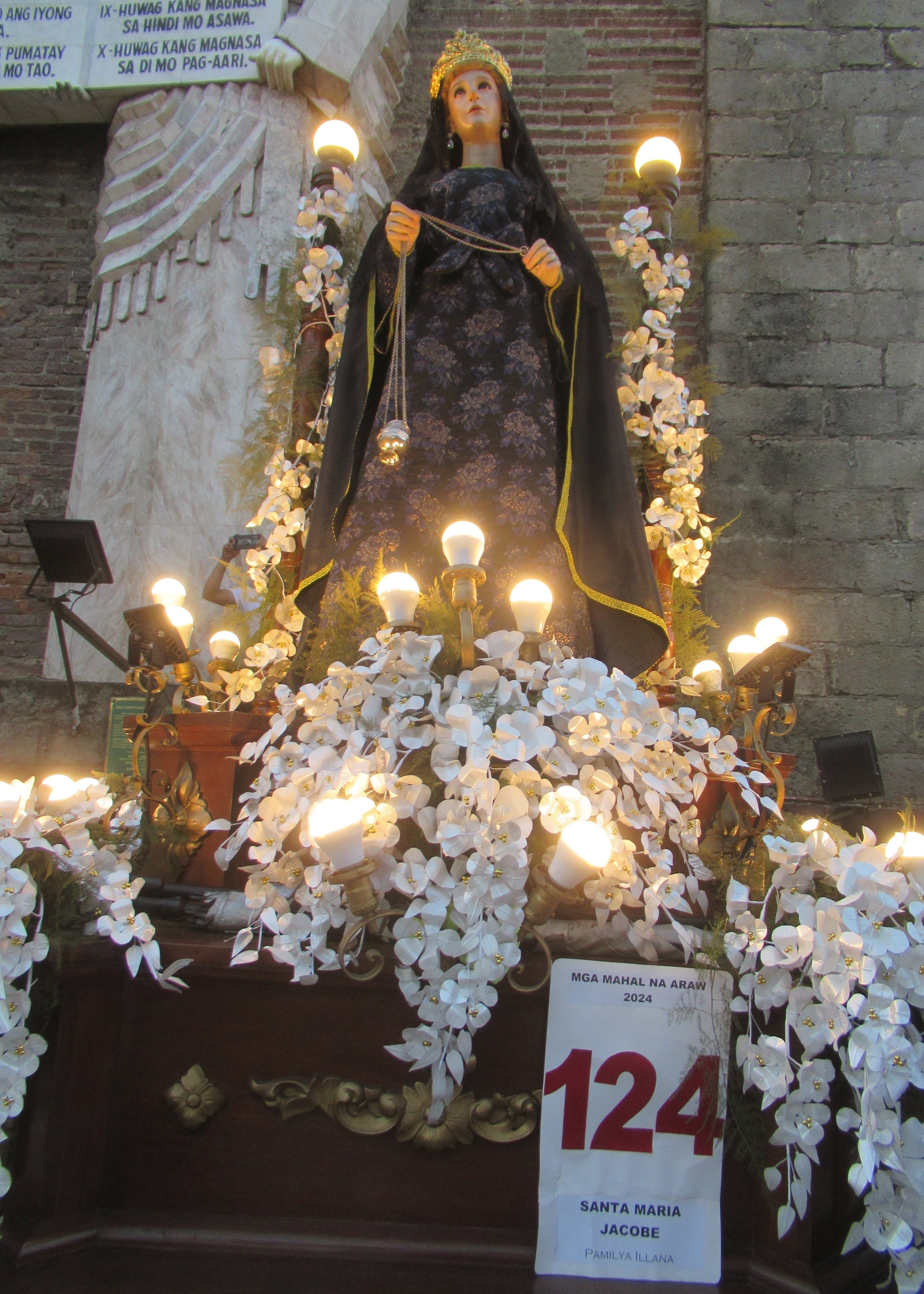
Mary of Clopas and the brothers of Jesus
Jerome (347–420), writing Against Helvidius in defense of perpetual virginity of the mother of Jesus, argued that the brothers of Jesus (James, Simon, Jude (also identified in tradition with Judas Thaddeus), and Joses or Joseph) were children of Mary of Clopas, the sister of the mother of Jesus, making them first cousins of Jesus and not direct siblings. Jerome also identified James, the brother of Jesus, with the Apostle James, son of Alphaeus (James the Less) and thus supposed that Mary of Clopas was married to Alphaeus (Clopas).
This view finds support in a fragment found in a medieval manuscript, which lists four Maries mentioned in the gospels and bears the inscription "Papia" on the margin. According to Papias, "Mary the wife of Cleophas or Alphaeus, was the mother of James, Simon and Thaddeus, and of one Joseph."{{cite web | url = https://biblehub.com/library/papias/fragments_of_papias/fragment_x.htm
James Tabor deduced that "Mary the mother of James and Joses" is none other than Mary, the mother of Jesus herself. This interpretation would necessitate that Mary the mother of Jesus married a man named Clopas, after her marriage to Joseph (perhaps after his death). Tabor proposes that a brother of Joseph would have been obliged to wed his widowed wife in a Levirate marriage, despite this only being permissible if the first marriage had been childless.
References
References
- In the latest official edition of the ''[[Roman Martyrology]]'' of the [[Catholic Church]] she is commemorated with [[Salome (disciple). Salome]] on April 24.''[[Martyrologium Romanum]], ex decreto sacrosancti oecumenici Concilii Vaticani II instauratum auctoritate Ioannis Pauli Pp. II promulgatum, editio [typica] altera, Typis Vaticanis, A.D. MMIV'' (2004), p. 251 {{ISBN. 88-209-7210-7
- {{bibleverse. John. 19:25. ESV
- {{bibleverse. Matthew. 27:56. ESV
- {{bibleverse. Mark. 15:40. ESV
- {{bibleverse. Matthew. 13:55–56. ESV
- {{bibleverse. Mark. 6:3. ESV
- {{bibleverse. Matthew. 28:1. ESV
- {{bibleverse. Mark. 16:1. ESV
- The Old and New Testament and Gnostic contexts and the text are discussed by Robert M. Grant, "The Mystery of Marriage in the Gospel of Philip" Vigiliae Christianae 15.3 (September 1961:129-140).
- "The Gospel of Pseudo-Matthew".
- [http://www.newadvent.org/fathers/250103.htm Eusebius of Caesarea, Church History, Book III], ch. 11. [http://www.ccel.org/ccel/schaff/npnf201.iii.viii.xi.html another link]
- [http://www.newadvent.org/fathers/250103.htm Eusebius of Caesarea, Church History, Book III], ch. 11.
- "St. Cleophas". Catholic Online.
- S. S. Smalley. "Mary," ''New Bible Dictionary'', 1982 p. 793.
- {{Cite Catholic Encyclopedia
- "CHURCH FATHERS: The Perpetual Virginity of Mary (Jerome)".
- Papias of Hierapolis. "Exposition of the Sayings of the Lord. Fragment X". Peter Kirby.
- "Fragments of Papias. Fragment X.".
- (1865). "The Brethren of the Lord".
- "Papias of Hierapolis".
- Tabor, James D.. (2006). "The Jesus Dynasty: A New Historical Investigation of Jesus, His Royal Family, and the Birth of Christianity". Simon & Schuster.
This article was imported from Wikipedia and is available under the Creative Commons Attribution-ShareAlike 4.0 License. Content has been adapted to SurfDoc format. Original contributors can be found on the article history page.
Ask Mako anything about Mary of Clopas — get instant answers, deeper analysis, and related topics.
Research with MakoFree with your Surf account
Create a free account to save articles, ask Mako questions, and organize your research.
Sign up freeThis content may have been generated or modified by AI. CloudSurf Software LLC is not responsible for the accuracy, completeness, or reliability of AI-generated content. Always verify important information from primary sources.
Report