From Surf Wiki (app.surf) — the open knowledge base
Marunouchi
Financial district of Tokyo, Japan

Financial district of Tokyo, Japan
| Field | Value | |||||
|---|---|---|---|---|---|---|
| official_name | Marunouchi | |||||
| native_name | 丸の内 | |||||
| native_name_lang | ja | |||||
| settlement_type | Central business district | |||||
| image_skyline | {{multiple image | border = infobox | perrow = 1/2//2/2 | total_width = 250 | align = center | caption_align = center |
| image1 | Tokyo Marunouchi in autumn.jpg | |||||
| caption1 | Gyoko Street with Tokyo Station at the end | |||||
| image2 | Marunouchi Illumination 2022 (52646998543).jpg | |||||
| caption2 | Naka Street | |||||
| image3 | Tokyo Hibiya-bori - Imperial Palace 2.jpg | |||||
| caption3 | Hibiya-bori moat | |||||
| image4 | Tokyo Station City (234809375).jpeg | |||||
| caption4 | Tokyo Station | |||||
| mapframe | yes | |||||
| mapframe-wikidata | yes | |||||
| founder | Yanosuke Iwasaki (as a business district) | |||||
| area_total_km2 | 0.8082 | |||||
| elevation_m | 3.4 | |||||
| population_total | 9 | |||||
| population_as_of | 2024 | |||||
| population_density_km2 | auto | |||||
| postal_code | 100-0005 |
| mapframe-wikidata = yes Marunouchi (丸の内) is an area in Chiyoda, Tokyo, Japan, located between Tokyo Station and the Imperial Palace. The name, meaning "inside the circle", derives from its location within the palace's outer moat. Marunouchi is the core of Tokyo's central business district as well as one of the main financial centres in Japan. 20 of the Fortune Global 500 companies are headquartered in the area as of 2021, while many other such companies based outside Japan have Asian or Japanese offices there. Together with the neighbouring districts of Yūrakuchō (有楽町) and Ōtemachi (大手町), Marunouchi is part of a larger business district sometimes referred to as Daimaruyū (大丸有).
History
In 1590, before shogun Tokugawa Ieyasu entered Edo Castle, the area now known as Marunouchi was an inlet of Tokyo Bay and had the name Hibiya. With the expansion of the castle, this inlet was filled, beginning in 1592. A new outer moat was constructed, and the earlier moat became the inner moat. The area took the name Okuruwauchi ("within the enclosure"). Daimyōs, particularly shinpan and fudai, constructed their mansions here, and with 24 such estates, the area also became known as daimyō kōji ("daimyō alley"). The offices of the North and South Magistrates, and that of the Finance Magistrate, were also here.

Following the Meiji Restoration, Marunouchi came under control of the national government, which erected barracks and parade grounds for the Imperial Japanese Army. In 1890 Iwasaki Yanosuke, brother of the founder (and later the second leader) of Mitsubishi, purchased the land for 1.5 million yen. As the company developed the land, it came to be known as Mitsubishi-ga-hara (the "Mitsubishi Fields"). Much of the land remains under the control of Mitsubishi Estate Co., and the headquarters of many companies in the Mitsubishi Group are in Marunouchi.
The government of Tokyo constructed its headquarters on the site of the former Kōchi han in 1894. They moved it to the present Tokyo Metropolitan Government Building in Shinjuku in 1991, and the Tokyo International Forum and Toyota Tsusho Corporation now stands on the site. Nearly a quarter of Japan's GDP is generated in this area. Tokyo Station opened in 1914, and the Marunouchi Building in 1923. Marunouchi was targeted in the 1974 Mitsubishi Heavy Industries bombing by the radical far-left terrorist organisation East Asia Anti-Japan Armed Front. Tokyo Station reopened on 1 October 2012 after a 5 year refurbishment.
Landmarks
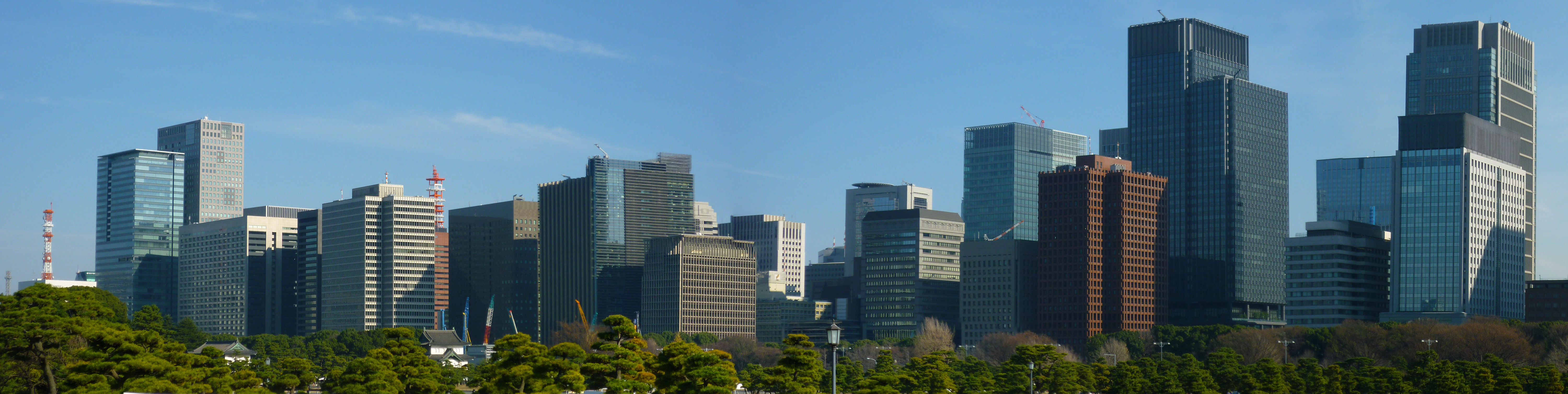
File:Tokyo International Forum - Marunouchi.jpg|Tokyo International Forum, a multi-purpose culture centre File:Marunouchi sunset (46747808872).jpg|Three buildings in Marunouchi redeveloped in the 2000s; the JP Tower (left), the Marunouchi Building (centre), the Shin-Marunouchi building (right) File:桜田濠 桜田門 八重洲ビル群 ❀ 桜田の 門緑陰に 静まれり (小原善郎) - panoramio.jpg|Part of Marunouchi seen from the west
Extant historical buildings
Fully preserved
- Tokyo Station (1914)
- Meiji Insurance Headquarters (1934)
- Mitsubishi Ichigokan Museum (1894, rebuilt partially using original materials in 2009)
Partially preserved
- (1933, preserved as the lower-storey structure of the JP Tower since 2012)
- Japan Industry Club (1920, preserved as the lower-storey structure of the Mitsubishi Trust&Banking Head Office since 2003) File:Tokyo Station Marunouchi Building P5228723.jpg|Tokyo Station (1914) File:Industry club of Japan Bldg 2010.jpg|The Industry Club of Japan (1920) File:Mitsubishi Ichigokan Museum (2023).jpg|Mitsubishi Ichigokan Museum (1894/2009) File:Meiji Yasuda Life Insurance Company Head Office 2009.jpg|Meiji Insurance Headquarters (1934) File:JP-Tower-02.jpg|Tokyo Central Post Office (1933)
Companies based in Marunouchi
Calbee has its headquarters in the Marunouchi Trust Tower Main. Konica Minolta has its headquarters in the Marunouchi Center Building in Marunouchi.
- Mitsubishi Group companies:
- MUFG
- Meiji Yasuda Life Insurance
- Mitsubishi Corporation
- Mitsubishi Heavy Industries
- Mitsubishi Electric
- Nippon Yusen
- Tokio Marine Nichido
- Asahi Glass
- Hitachi
- Furukawa Electric
- Nikko Citigroup
- Ushio, Inc.
- Tanaka Kikinzoku Group
Japan Airlines used to have its headquarters in the Tokyo Building in Marunouchi.
International companies
Marunouchi also houses the Japan offices of Aeroméxico (Pacific Century Place Marunouchi), Bain & Company, Bayerische Landes Bank, Bloomberg, First National Bank of Boston, BT Group, Citigroup, Banca Commerciale Italiana, Deloitte Touche Tohmatsu, Bank of India, JPMorgan Chase, KPMG, Latham & Watkins, Mellon Bank, Morgan, Lewis & Bockius, Morrison & Foerster, NatWest Group, Nikko Cordial, Nikko Citigroup, Rabobank, Bank Negara Indonesia, Overseas Union Bank, Philadelphia National Bank, PwC, Ropes & Gray, Royal Insurance, Standard Chartered and Standard & Poor's.
Rail and subway stations
- Nijūbashimae Station (Chiyoda Line)
- Otemachi Station (Chiyoda Line, Hanzomon Line, Marunouchi Line, Toei Mita Line, Tozai Line)
- Tokyo Station (Chūō Line, Keihin-Tohoku Line, Keiyo Line, Marunouchi Line, Shinkansen, Sōbu Line, Yamanote Line, Yokosuka Line)
Education
operates public elementary and junior high schools. Chiyoda Elementary School (千代田小学校) is the zoned elementary of Marunouchi 1-3 chōme. There is a freedom of choice system for junior high schools in Chiyoda Ward, and so there are no specific junior high school zones.
References
References
- "Notification".
- "Global Business Hub {{!}} Convenient Access {{!}} Corporate Clusters {{!}} Mitsubishi Estate Office Information".
- Sanger, David E. [https://www.nytimes.com/1990/03/07/business/daimler-benz-and-mitsubishi-negotiating-cooperative-plan.html?scp=2&sq=iwasaki%20yanosuke&st=cse&pagewanted=1 "Daimler-Benz and Mitsubishi Negotiating Cooperative Plan,"] ''New York Times,'' March 7, 1990; retrieved 2011-08-30
- (2016). "Drawing Architecture and the Urban". Wiley.
- Nakata, Hiroko, "[http://www.japantimes.co.jp/text/nn20121023i1.html Tokyo Station's Marunouchi side restored to 1914 glory]", ''[[Japan Times]]'', 23 October 2012, p. 3
- "[http://www.calbee.co.jp/english/about.php Corporate Information] {{Webarchive. link. (2009-02-27 ." [[Calbee]]. Retrieved on March 27, 2010.)
- "[http://www.konicaminolta.com/about/corporate/outline.html Company Overview]". [[Konica Minolta]]. Retrieved on May 12, 2009.
- "[http://www.bk.mufg.jp/english/about/index.html About The Bank of Tokyo-Mitsubishi UFJ, Ltd.] {{Webarchive. link. (2010-02-10 " [[The Bank of Tokyo-Mitsubishi UFJ]]. Retrieved on December 7, 2009.)
- "[http://www.mitsubishicorp.com/jp/en/about/profile/ Fact Sheet]." [[Mitsubishi Corporation]]. Retrieved on September 28, 2011.
- "[http://www.tokiomarine-nichido.co.jp/en/us/manage/index.html Corporate Profile]." [[Tokio Marine Nichido]]. Retrieved on July 24, 2011. "Address of Head Office 2-1 Marunouchi 1-chome, Chiyoda-ku, Tokyo"
- "[http://www.agc.com/english/company/profile.html Company Profile] {{Webarchive. link. (2016-12-27 ." [[Asahi Glass]]. Retrieved on April 2, 2014.)
- "[http://www.furukawa.co.jp/english/kaisya/01-01.htm Company Profile]." [[Furukawa Electric]]. Retrieved on March 21, 2014.
- "[http://www.ushio.co.jp/en/company/outline.html Corporate Data]." [[Ushio, Inc.]] Retrieved on May 31, 2018.
- "[https://www.tanaka.co.jp/english/about/group/thd.html Company Outline]." [[Tanaka Kikinzoku. Tanaka Kikinzoku Group]]. Retrieved on March 5, 2019.
- "World Airline Directory". ''Flight International''. March 30, 1985. [http://www.flightglobal.com/pdfarchive/view/1985/1985%20-%200948.html 88]. Retrieved on June 17, 2009.
- "[http://www.aeromexico.jp/images/com03.jpg com03.jpg] {{Webarchive. link. (2010-10-18 ". ''[[Aeroméxico]]''. Retrieved on October 13, 2010.)
- "[http://www.standardandpoors.com/about-sp/office-locations/en/us/?contName=Asia-Pacific&contID=1221191102211 Office Locations Asia]". ''Standard & Poor's''. Retrieved on August 12, 2011. "Japan 28 F Marunouchi Kitaguchi Bldg 1-1 Marunouchi, Chiyoda-ku Tokyo, Japan 100-0005 "
- "区立小学校の通学区域". Chiyoda Board of Education.
- "区立中学校の通学区域と学校選択". Chiyoda Board of Education.

This article was imported from Wikipedia and is available under the Creative Commons Attribution-ShareAlike 4.0 License. Content has been adapted to SurfDoc format. Original contributors can be found on the article history page.
Ask Mako anything about Marunouchi — get instant answers, deeper analysis, and related topics.
Research with MakoFree with your Surf account
Create a free account to save articles, ask Mako questions, and organize your research.
Sign up freeThis content may have been generated or modified by AI. CloudSurf Software LLC is not responsible for the accuracy, completeness, or reliability of AI-generated content. Always verify important information from primary sources.
Report