From Surf Wiki (app.surf) — the open knowledge base
Marriage in Islam
Islamic concept of marriage
.jpg)
Islamic concept of marriage
In Islamic law, marriage involves nikah () the agreement to the marriage contract (ʿaqd al-qirān, nikah nama, etc.), or more specifically, the bride's acceptance (qubul) of the groom's dower (mahr), and the witnessing of her acceptance. In addition, there are several other traditional steps such as khitbah (preliminary meeting(s) to get to know the other party and negotiate terms), walimah (marriage feast), zifaf/rukhsati ("sending off" of bride and groom).
In addition to the requirement that a formal, binding contract – either oral or on paper – of rights and obligations for both parties be drawn up, there are a number of other rules for marriage in Islam: among them that there be witnesses to the marriage, a gift from the groom to the bride known as a mahr, that both the groom and the bride freely consent to the marriage; that the groom can be married to more than one woman (a practice known as polygyny) but no more than four, that the women can be married to no more than one man, developed (according to Islamic sources) from the Quran, (the holy book of Islam) and hadith (the passed down saying and doings of the Islamic prophet Muhammad). Divorce is permitted in Islam and can take a variety of forms, some executed by a husband personally and some executed by a religious court on behalf of a plaintiff wife who is successful in her legal divorce petition for valid cause.
In addition to the usual marriage intended for raising families, the Twelver branch of Shia Islam permits ar or "temporary", fixed-term marriage; and some Sunni Islamic scholars permit nikah misyar marriage, which lacks some conditions such as living together. A nikah 'urfi, "customary" marriage, is one not officially registered with state authorities.
Traditional marriage in Islam has been criticized (by modernist Muslims) and defended (by traditionalist Muslims) for allowing polygamy and easy divorce.
Terminology
In the Hans Wehr Dictionary of Modern Written Arabic, nikah is defined as "marriage; marriage contract; matrimony, wedlock". In the Quran, nikah is used to refer to the contract of marriage. According to at least a couple of sources -- Ibrahim B. Syed and the Ahlan Foundation -- the Quran also uses "a strong agreement" (), in verse Q.4:21, to refer to marriage.
In Arabic-speaking countries, marriage is commonly called zawāj (, from the Quranic term zawj (), referring to a member of a pair), and this term has recently gained currency among Muslim speakers of other languages as well.
The marriage contract is known by different names:
- ʿaqd al-qirān Literary Arabic: عقد القران ar, "matrimony contract";
- ur / ALA-LC;
- akd, ;
- ezdevāj, ezdevāj "marriage" and سند ازدواج or sǎnǎde ezdevāj عقدنامه aqd nāmeh (sǎnǎde ezdevāj, aqd nāmeh) for the certificate.
The marriage celebration may be called
- ʿurs / zawāj (),
- ezdewaj/arusi (Persian),
- shaadi (Urdu),
- biye/biya (Bengali)
- düğün (Turkish).
History
Before Islam
Main article: Marriage in pre-Islamic Arabia
In Arabia before the advent of Islam in the 7th century CE, a variety of different marriage practices existed. The most common and recognized types of marriage at this time were marriage by agreement, marriage by capture, marriage by mahr, marriage by inheritance, and mot'a or temporary marriage. In Mesopotamia, marriages were generally monogamous, except among male royalty, who would have harems consisting of wives and concubines. The Sasanian society followed Zoroastrianism, which viewed women to be possessions in marriage, although consent was required in both marriage and divorce.
According to Islamic sources, most women in the pre-7th century Arabia had little control over their marriages and Islam brought a big improvement. They were bound by contract for marriage or custody of children, and their consent was rarely sought. Women were seldom allowed to divorce their husbands, and their view was not regarded for either a marriage or divorce. However, in the transitional age from non-Islamic to Islamic society, elite women could divorce and remarry without stigma. They were given the power to negotiate the terms of their marriage contract and could even initiate divorce.
Reforms with Islam
During Muhammad's prophethood several chapters and verses from the Quran were revealed which banned common marriage practices that existed prior to that time. The rules of "marriage by agreement (marriage through consent)" were reformed by Muhammad, and strict rules and regulations were set. The practice of "marriage by inheritance" (where a man inherited his father's wives) was forbidden.
Under the Arabian Jahiliyyah (pre-Islamic) law, Islamic sources write that no limitations were set on men's rights to marry or to obtain a divorce. Islamic law limited men to four wives at one time, not including slave concubines. () Additionally, a man was required to provide a suitable marriage gift for each wife and ensure financial support and separate housing for all. As a result, only wealthy men could historically afford to practice polygyny. The institution of marriage was refined into one in which the woman was somewhat of an interested partner. 'For example, the dower, previously regarded as a bride-price paid to the father, became a nuptial gift retained by the wife as part of her personal property'. Under Islamic law, marriage was no longer viewed as a "status" but rather as a "contract". The essential elements of the marriage contract were now an offer by the man, an acceptance by the woman, and the performance of such conditions as the payment of dowry. The woman's consent, given either actively or by silence, was required. Furthermore, the offer and acceptance had to be made in the presence of at least two witnesses.
Encouragement
As in many if not all religions, marriage is encouraged in Islam.
-
Verses from the Quran, indicate positive feelings towards marriage: "marry those among you who are single ..." (Q.24:32), "...Bless us with ˹pious˺ spouses and offspring who will be the joy of our hearts ..." (Q.25:74), " ...He created for you from yourselves mates that you may find tranquility in them..." (Q.30:21), "The love of the desires for women, sons, ... has been made attractive to people." (Q.3:14){{efn|
-
“And marry those among you who are single and those who are fit among your male slaves and your female slaves;" (Q.24:32)
-
˹They are˺ those who pray, “Our Lord! Bless us with ˹pious˺ spouses and offspring who will be the joy of our hearts, and make us models for the righteous.”
-
"And of His signs is that He created for you from yourselves mates that you may find tranquility in them, and He placed between you affection and mercy. (Surah Ar-Rum, 30:21)}}
-
There are hadith calling for Muslims to marry
- as a religious duty: “When a man marries he has fulfilled half of the religion; ...” (Mishkat al-Masabih), “Marriage is part of my sunnah, and whoever does not follow my sunnah has nothing to do with me"(Sunan Ibn Majah)
- as part of the religion of the fitrah, "consistent with the natural instincts and needs of mankind", opposing "the monastic life of Christians”, (Al-Bayhaqi); the "unnatural constraints" such as celibacy
- to increase the number of Muslims: “Marry those who are loving and fertile, for I will be proud of your great numbers before the other nations."
- to fight the temptations of illicit sex (zina, a great sin in Islam), "Whoever among you can marry, should marry, because it helps him lower his gaze and guard his modesty, ....'" (Sahih al-Bukhari), “Whoever has the means, let him get married, and whoever does not, then he should fast for it will diminish his desire" (Sunan Ibn Majah).
-
Other revelation are less concerned about lack of money for a mahr, assuring Muslims God will "... will make them free from want ... " (Q.24:32)
-
Or that they should marry even if they have few resources: "Marry, even with [a Mahr equal to] an iron ring." (Al-Bukhari)
According to scholars, marriage in Islam provides a structure for the relationship between partners creating a family, and safeguards rights of members of the family (Ahlan Foundation, Ahmad Dogarawa). Marrying within the Muslim community and creating a “productive and constructive" family where members help and encourage one and other to "be good and righteous", helps to preserve the religion (Ahmad Dogarawa).
Family life in Islam, finding a partner to share life's joys and sorrows (Ayatollah Ibrahim Amini), is considered a "blessing", a source of stability, the foundation for families. By regulating sexual desire marriage prevents it from destabilizing the community, in the eyes of religious scholars of Islamic law. In a patrilineal society, where a person's social status is defined by their father's lineage, marriage was a crucial institution for controlling reproduction and ensuring that children were properly recognized and claimed (Judith E. Tucker).
According to scholars of fiqh, marriage is either obligatory (fard) or preferred (ar) if a man has the means to marry (can afford mahr), and has no fear of mistreating his wife. If a man fears committing unlawful acts (fornication) if he does not marry, marriage then become obligatory; if he does not fear this it is only preferred (Sheikh Sayyed Sabiq).
Conditions
There are several conditions for an Islamic marriage to take place:
Marriage contract
.jpg)
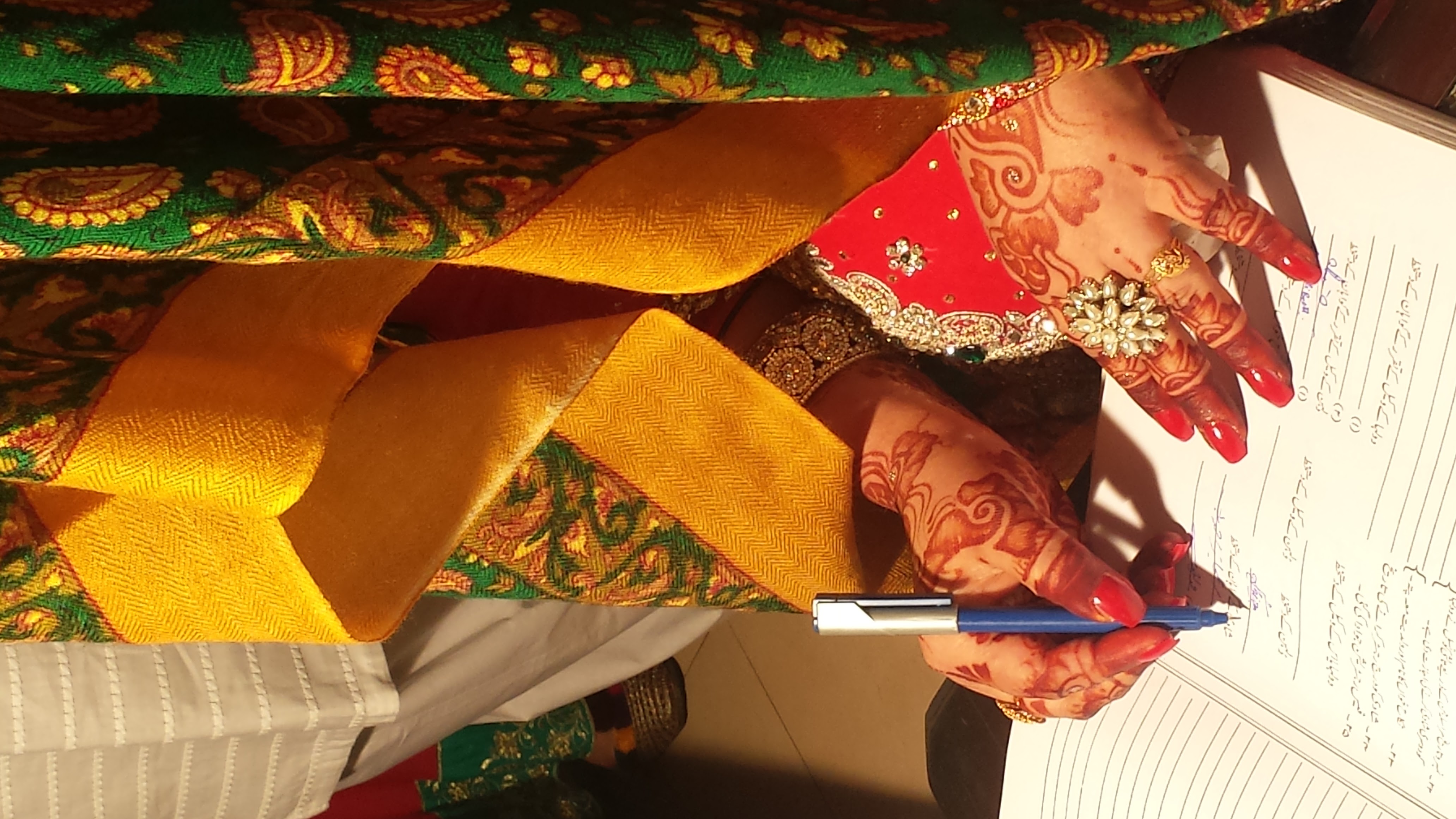
Islamic marriage is based on a contract (ʿaqd al-qirān, nikah nama, etc.) between man and wife.{{efn|examples of marriage contract format:
- and
- a marriage contract "agreed upon by The Council of Shia Muslim Scholars of North America at the 10th annual conference", }}
Mahr
All Islamic marriage contracts include a ar, (donatio propter nuptias), a mandatory sum of wealth provided to the bride by the groom which should be agreed upon before the nikah, and paid to the bride by the groom at the time of nikah unless they have agreed to delay the time of some of its payment. The mahr is for her exclusive use. If the marriage contract fails to contain an exact, specified mahr, the husband must still pay the wife a judicially determined sum. Mahr functions similar to bride wealth. The mahr is important for the wife in case of divorce. (The value of a mahr varies widely. It is often measured in coins with the equivalent weight of 3 grams of silver.) There is no joint marital property in an Islamic marriage. Other conditions may be included in the contract, such as whether the husband taking a second, third, etc. wife, is grounds for divorce.
Consent of bride
Whether the bride must give her consent to marry and how she does, varies according to school of jurisprudence, whether the bride is a virgin, or a minor.
- The Shafi'i school of jurisprudence do allow compulsion in marriage if the daughter is a virgin and is for her benefit. Shafi'i recommends strongly that daughters who are no longer minors be consulted before being married to someone. (If the bride is a virgin and is silent when asked if she consents to the marriage, that may be taken as her agreement to marry.) Spoken consent of the bride is only required if she is not a virgin and her ar (guardian) is neither her father nor her paternal grandfather. According to Al-Masaa’il Al-Maardeeniyyah, by Ibn Taymiyyah. Malak was one of the scholars who ruled that a father may force his virgin daughter who attained puberty to marry.
- the Hanafi, Maliki and Hanbali schools of jurisprudence require the prospective bride's consent if she has reached the age of puberty, but if she is a minor she may be married off without her permission.
- According to Shi'i mujtahid and marja' Khomeini and Ali al-Sistani, the marriage is invalid without the bride's free consent and no obligation can make marriage official and legal.
Wali
Most Sunni schools of jurisprudence (Hanbali, Shafi'i, and Maliki) require a ar (male guardian, who if representing a bride is called a ar){{efn|Wali means means "custodian" or "protector". " the person who has the authority to manage the affairs of both the person and their property." However, in the absence of these, other male relatives such as the bride's brother, uncle, or even a male guardian appointed by a shariah court or the imam of a mosque may act as the walī, depending on the circumstances.
- One Sunni school of jurisprudence (a fourth school) -- Hanafi -- does not require a wali for a bride to become married, even if it is her first marriage. Therefore, the marriage contract is signed between the bride and the groom, not the groom and the wali.{{efn|*A fatwa by one Shaykh Ebrahim Desai interpreting Hanafi Fiqh states that it is "not necessary" for a woman to obtain permission from her Wali to marry or to be represented by a Wali at her Nikah. The Wali may object if the woman is marrying someone "outside of her scope of Kufu (compatibility)", but not forbid the marriage.
- A fatwa by another scholar, Ebrahim Saifuddin, emphasized that a marriage without the wali's approval should be done only as a last resort and that if "the woman marries herself off to someone who is unsuitable" (ghair kufu′), then the marriage is null and void.}}
Other conditions
- Both partners must either be chaste, or if one or more of them have fornicated, they must have made a sincere repentance.
- The bride/wife must be either Muslim or from "the People of the Book" (Jews, Sabians and Christians), but not a polytheist. For women, marriage to anyone but a Muslim man is not permissible.
- The spouse may not be a close relative{{efn|Quranic verse 4:23 gives a list of relatives Muslims are forbidden to marry, a class of people known as Mahram (family members with whom marriage is permanently unlawful or (haram):
- Also forbidden to marry are those of the same sex, anyone who has had the same wetnurse feed them.
- The nikah is required to be witnessed by two adult male Muslims from both sides (or one male and two female Muslims) in Sunni Islam for the contract to be valid. In Shia Islam witnesses to a nikah are mustahabb (recommended) but not wajib (required).
Nikah ceremony
Nikah (wedding) ceremonies vary by culture and religious schools in Islam, but some practices are shared. These include the presence of a male guardian (ar) for the bride (usually her father); two male Muslim witnesses (or one male and two female; witnesses are required in Sunni Islam and recommended in Shia Islam); the offering of mahr (a gift from the groom to the bride); and freedom from any Islamic legal obstacles (such as the bride and groom being close relatives, or the man being a non-Muslim).
If the conditions are met and a ar and contract are agreed upon, an Islamic marriage ceremony, or wedding, can take place. Mutual consent is demonstrated in the form of a verbal exchange of acceptance (qubool, قُبُوْل, ar, meaning 'I accept') and the signing of a marriage contract by the groom and either the bride or her wali. In addition to the qubool, there should be a recitation of the fatihah (the opening surah of the Quran); a sermon (khutbah), which typically starts with three verses from the Quran (, , and ) and a hadith; a recitation of a du’a asking for a blessing of the marriage; and a hadith about blessing marriages.
The nikah is typically followed by a celebratory reception (walima) in line with local customs or those of the couple. The walima may last a couple of hours, or precede the ceremony and conclude several days after.
Contrast with civil marriage law
While Islamic marriage contracts may be binding in Islamic law, they are not legally binding under civil law in non-Muslim countries where practices and concepts like polygamy and mahr are either not legal or not understood. Unless the couple wish to have a nikah 'urfi, "customary" marriage, in a non-Muslim country they must register their marriage with a local government body. Registering a civil marriage is particularly important to Muslim women if anything goes wrong with the marriage. If, for example a Muslim man abandons his wife and their marriage is not registered, she may not have legal recourse to seek divorce or access financial support. (In one case in the 1960s, a Muslim woman who had been married with a mahr of well less than one year's income was divorced by Muslim husband after fourteen years of marriage and three children. An American court found in favor of the husband, that she was owed only her mahr and no portion of her psychiatrist-husband’s estate.)
In the United States, Islamic centers often have authorized officiants who in addition to officiating a nikah ceremony can marry Muslims according to civil law, if the wedding party brings a marriage certificate from the county where the center is located. (Polygamous marriages excepted.){{efn|Some examples: Marriage at Idris Mosque in Seattle In the United Kingdom, weddings combining a legal marriage licence and nikah are less common and marriage problems may be dealt with by Sharia Councils, including the Islamic Sharia Council (ISC) and Muslim Arbitration Tribunal (MAT).(At least one fatwa site advises Muslims in the UK to "complete the civil marriage so that the marriage and rights arising from it are recognised".) In Australia, someone married according to nikah, a Nikah certificate is "an essential document" to legally recognize your marriage.
In at least one Muslim country (Dubai), it is reportedly possible to marry with a nikah ceremony and then marry again in a civil ceremony, or vice versa, or find an imam authorized to do both simultaneously.
In Muslim-majority countries, where the concept of mahr holds strong cultural and religious significance, it is typically recognized and enforceable through Islamic family courts, who are more likely to intervene in cases of non-payment or inadequate payment of mahr.
In today's world, Muslims practice Islamic marital laws in a multitude of ways all over the globe. In the United States, for example, 95% of Muslim American couples included in a 2012 study by the Institute for Social Policy and Understanding (ISPU) had completed both the Nikah and had obtained a civil marriage license, which is required to have a marriage legally recognized in the United States. The study also shares that "In some cases, the Islamic marriage contract is completed once the couple has decided to get married, but cohabitation occurs later after the wedding reception. In other cases, the Islamic marriage contract is completed simultaneously with the civil marriage and is followed immediately by the wedding reception."
There is ongoing debate about whether or not Sharia should be recognized in Western countries like the United States and Australia that would allow for the Nikah to be recognized as a legally valid marriage. There are also other elements to the Islamic marriage rituals that have difficulty being acknowledged in courts, according to the study, including the Mahr, or the dowry. Women who are denied their dowry do not have a clear path to legal contestation in either the US or Canada.
Studies have also shown that even young Muslim Americans who might describe themselves as "not very religious" embrace the rituals of their faith at important moments of transition – birth, death, and marriage. These occasions motivate reaffirmation of emotional and behavioral touchstones, even for those who do not practice their faith by attending mosque, praying or fasting regularly.
When it comes to divorce, the 2014 study conducted by the ISPU states that, "Two divorce rates commonly cited for American Muslims include 32.33% and 21.3%, respectively." Within the United States and Canada, many Muslim couples interviewed in the study mention that they value a religious divorce and its proceedings. Some turn to religious figures to help them navigate the divorce process, while many still go through the courts to terminate the civil marriage. Divorced Muslim women today also face the stigmas associated with being divorced within the North American Muslim community that can make it difficult for them seek remarriage.
Gender roles and ideas about marriage have also shifted since the early onset of Islam when many of the rules around marriage were established. ISPU reports that "the most frequent source of marital conflict in this study was conflict over changing gender roles and expectations," citing a nation-wide increase in women in higher education and professional jobs over the past three decades, and says that they "In many cases are trying to integrate childrearing and family life with professional goals".
Spousal roles, rights and obligations
Main article: Rights and obligations of spouses in Islam
Islam advocates a role-based relationship between husband and wife, where the husband has the main responsibility of earning and the wife of taking care of children. Fatwa and works on Islamic marriage often mention virtues such as "tranquility, love and mercy"; "kindness and patience"; "love, mercy, kindness and mutual respect"; "love, mercy, understanding and aiming to please Allah"; that are to be shown by each partner to the other. As a Sahih al-Bukhari hadith narrated by Abd Allah ibn Umar states:
Gender roles
The Qur'an asserts that there are innate differences between women and men, and therefore Islam gives different rights and duties to husband and wife.
Some rights which the husband owes to his wife are:
- payment of dowry
- financial Support
- kind and proper treatment
- privacy
- equitable treatment if there is more than one wife
- defense of her honor
Some rights which the wife owes to her husband are:
- Accept his being head of the household
- Obedience, unless his order is violates Islam
- To have marital relations with him when he wants
- Not to allow anyone in the house whom he disapproves of
- To protect his property
- To show gratitude to him for his efforts
- To not undertake a fast without his permission.
Obedience to husbands
Obedience to husbands can be a controversial subject. For example Salafi preacher Bilal Philips laments the fact that in Western society, "obedience to one's husband is not even considered a positive characteristic worthy of development in a woman".
- In a fatwa Shazia Ahmad (of the Shafi'i school of fiqh) explains to a frustrated wife that "obedience to the husband regarding [Islamically] permissible actions is obligatory", even if the wife supports herself working full time.
- In another fatwa, Sheikh Muhammed Salih Al-Munajjid (of the Hanbali school) gives as an explanation for why the wife must obey her husband that the husband "is more perfect in rational thinking than her in most cases ... just as women are more able than men to take care of the children and the household affairs. Also, men are obliged to spend on their wives; the wife does not have to work or earn a living".
- The Jordanian and Egyptian Dar-al-Ifta (Hanafi school) give slightly more qualified fatwas, stating the wife must obey, "in whatever preserves the stability of their new family and marital life." (Jordanian) or "according to what is equitable" (Egyptian).
- According to Dr. Salah Sultan, (President of the American Center for Islamic Research in Columbus, Ohio, a member of the European Council for Fatwa and Research, and a "senior member" of the international Muslim Brotherhood), “The man should be obeyed as long as there is no disobedience to Allah".
- Popular woman Muslim author Ruqayyah Waris Maqsood qualifies the necessity of obedience to husbands, saying that the man must "show the protection, the maintenance, and the strength" in order to receive a wife's "obedience and the co-operation".
Physical discipline of wives/''Darb''
Concerning the husband's rights over his wife, Quranic verse 4:34 includes the section The word translated as "discipline them" -- aḍarb wahunna (ﺁضربوهن) -- has been translated as
- "discipline them ˹gently˺" (Dr. Mustafa Khattab, The Clear Quran),
- "scourge them" (Marmaduke Pickthall),
- "strike them" (quranwbw) and in other ways.
The verse has been called "the so-called ‘Wife Beating Verse’", and a number of sources have stated that it does not really call for beating/striking/scourging wives. Shaykh Yusuf Badat in a fatwa writes In analyzing the verse, The Muslim Vibe states that the stirking of the wife is actually "a non-violent, symbolic gesture". Sources that do not deny the verse calls for beating disobedient wives emphasize beatings must not be severe. Zakir Naik states the beating must not leave a mark on the wife, Bilal Philips states that any beating of a wife "must be light" (lashing is forbidden), and quotes a hadith forbidding men from hitting their wife "in her face".
Polygamy
According to the Shariah (Law) and the Quran, Muslim men are allowed to practice polygyny, taking up to four legal wives.
The warning against injustice to the husband is interpreted to mean treating all wives equally -- emotionally as well as financially. A bride-to-be may also include terms in her marriage contract that require monogamy for her husband or require her consent before he marries another wife. Other verses prohibit marriage to a close relative of any of the multiple wives (a wife's sister, daughter, mother, niece, aunt, etc.). Polygamy is legal, (though often with restrictions), in most Muslim majority countries and most African countries, and illegal most everywhere else.
Unconventional marriages
In addition to the traditional marriages there are some Islamic marriages that lack some of the customary rights and obligations:
- Nikah mut'ah, a fixed-term marriage known as ar ("temporary marriage"), is a private and verbal temporary marriage contract in which the duration of the marriage and the mahr must be specified and agreed upon in advance.
- Nikah Misyar, is permanent and permitted by some Sunni scholars, but lacks some conventional conditions such as living together. Most misyar brides don't change their residences but pursue marital relations on a visitation basis. Because the practice relieves the misyar husband of the obligation to support his wife, it is often used in some Islamic countries by men who cannot afford an orthodox marriage, and/or wish to give a legal recognition to behavior that might otherwise be considered adulterous.
- Nikah 'urfi is a "customary" marriage contract, meaning it is not registered with state authorities. It commonly requires a Wali (Islamic legal guardian) and witnesses and usually involves a written document stating that the couple are married, with their signatures and those of two witnesses, although the commitment may be documented by a recording on a cassette tape. Some explanations for not registering a marriage include avoiding pensions lost when a widow remarries, avoiding the high cost of formal marriages that young couples (such as students) cannot afford, avoiding bans on child marriage.
Iddah
Main article: Iddah
In Islam, a woman cannot marry for a certain period after a divorce or the death of her husband. This period of waiting is known as iddah or iddat (), which means "to count", the number of days after death or divorce is what is being counted. One of its main purposes is to remove any doubt as to the paternity of a child born after the divorce or death of the prior husband.
The length of ‘iddah varies according to a number of circumstances. Generally, the ‘iddah of a divorced woman is the length of her three menstrual cycles, but if the marriage was not consummated there is no ‘iddah. For a woman whose husband has died, the ‘iddah is four lunar months and ten days (i.e. about 128 days) after the death of her husband, whether or not the marriage was consummated. If a woman is pregnant when she is widowed or divorced, the ‘iddah lasts until she gives birth.
Islamic scholars consider this directive to be a balance between mourning of husband's death and protecting the widow from criticism that she might be subjected to from remarrying too quickly after her husband’s death. This is also to ascertain whether a woman is pregnant or not, since four and a half months is half the length of a normal pregnancy.
Divorce
Main article: Divorce in Islam
Divorce in Islam can take a variety of forms, some initiated by the husband and some initiated by the wife. The theory and practice of divorce in the Islamic world have varied according to time and place.
The main categories of Islamic customary law of divorce are talaq (repudiation), khulʿ (mutual divorce) and faskh (dissolution of marriage before the Religious Court).
Historically, the rules of divorce were governed by the Sharia, as interpreted by traditional Islamic jurisprudence (fiqh). There were several different schools of jurisprudence (madhhab), and historical practice sometimes diverged from legal theory. In modern times, as personal status (family) laws were codified, they generally remained "within the orbit of Islamic law", but control over the norms of divorce shifted from traditional jurists to the state.
Hanafi/Ottoman rules on divorce and remarriage were fragile and complex. The husband, in repudiating his wife, could declare an irrevocable or revocable divorce. The irrevocable divorce was immediate and the women could not be remarried until after a specific waiting period. One example of a waiting period would be having to wait for three menstrual cycles from the time of the divorce. In the case of the death of the husband, the woman must wait four months and ten days after his death. If the woman is pregnant, she must wait until after the child is born before remarrying. If the divorce was revocable, the divorce is not final until after the waiting period. However, they could remarry if it was a revocable divorce. Many couples did get remarried after a revocable divorce.
The women's ability to divorce was much different and much more limited. If the woman finds out the husband has some disease or is impotent, she has grounds for divorce but must give her husband a year to consummate the marriage before divorce is allowed. Also, the women can divorce by using the "option of puberty" in which the women would have to provide witnesses of the menstrual blood. Finally, a woman could use the "hul", which is a Turkish word, for divorce. This is when the woman asks the husband for a divorce, and he repudiates her for consideration. After that, essentially, it is trading property for the person.
The Qur'an encourages cooperation in marriage, this is done by giving specific rules to follow. One verse says "Consort with them honorably; or if you are averse to them, it is possible that you may be averse to a thing, and God set in it much good". Divorce could lead to women losing their morality or purity if certain values were not followed correctly. The Qur'an exemplifies that divorce is not meant to be the man getting back at the woman. It is to allow the man and the woman to peacefully split up for the good of each other. It also allows for multiple remarriages between the same couple. The couple can divorce and get back together up to two times but after the second remarriage, the divorce is final and there are no more remarriages allowed.
The reason the man typically gets the right to divorce is that his judgment is thought to be more balanced than a woman's. Again, the only reason the woman can ask for a divorce is if there is something significantly wrong with the man. Divorce was supposed to be reserved as a last resort and not something that was used for harm or for trivial disagreements. The Qur'an says, "Divorce must be pronounced twice and then (a woman) must be retained in honor or released in kindness", which exemplifies that it was supposed to be honorable for both man and woman if it needed to be done. It was not taken lightly, and it was a big decision for both parties.
Behavior within marriage
Living with inlaws
The wife has the right to live in separate accommodation with her husband and children, if she does not want to share it with anyone like her in-law or relatives. This is the view of most of the Hanafi, Shaafa'i and Hanbali scholars of fiqh. She also has the right to refuse to live with her husband's father, mother and siblings.
Narrated Abdullah bin Umar: That he heard Allah's Apostle saying,
This indicates that a wife is responsible for the house of her husband. Also that a man should be the guardian of his family, i.e., after his marriage he moves out of his father's house, and runs his own family affairs and is guardian of his family. In a joint family, typically the head is either the father of the husband, or mother of the husband. This also indicates that a husband should look after his parents' house, as "a man is a guardian of his father's property". So the wife should not object to her husband when he is looking after affairs of his parents.
Sexuality
Sexuality in Islam is largely described by the Qur'an, Islamic tradition, and religious leaders both past and present as being confined to marital relationships between men and women, and between slave owners and enslaved females. While most traditions discourage celibacy, all encourage strict chastity and modesty (see haya) with regards to any relationships across gender lines, holding forth that intimacy as perceived within Islam (encompassing a swath of life more broad than strictly sex) is to be reserved for marriage.
Abd Allah ibn Mas'ud narrated:
While adulterous relationships are strictly forbidden, permissible sexual relationships within marriage are described in Islamic sources as great wells of love and closeness for the couple involved. Sexual relationship between married couples are even source of rewards from God as doing the opposite, i.e., satisfying sexual needs through illicit means, has punishment. Specific occasions (most notably daytime fasting (see sawm) and menstruation) are times forbidden for intercourse, though not for other ways of touching and being close to one another. Anal sex with one's wife is also strictly prohibited.
So long as it is within marriage, free of lewdness, fornication and adultery, Islam has sometimes been described as having an open and playful approach to sex.
Notes
References
References
- (2001). "The New Encyclopedia of Islam". AltaMira Press.
- en-asks. (2006-07-13). "Marriage Steps in Islam - Fiqh".
- "Marriage in Islam".
- "Getting Married".
- link. (2016-05-09 Brill 2003 {{ISBN). 9004126023, 9789004126022. Accessed at Google Books 15 March 2014.
- link. (2016-04-23 Asian Educational Services 1 December 1995. Accessed 15 April 2014.)
- link. (2016-06-24 Marshall Cavendish, 2010. {{ISBN). 0761479279, 1780761479277. pp. 47–53.
- link. (2017-06-19 . Print.)
- (12 October 2014). "Misyar now a widespread reality". Arab News.
- Elhadj, Elie. (2006). "The Islamic Shield: Arab Resistance to Democratic and Religious Reforms". Universal Publishers.
- (2001). "Misyar Marriage". Beirut University College, Institute for Women's Studies in the Arab World.
- (1999). "Polygamy in Islam". Tawheed publications.
- Wehr, Hans. (1976). "A Dictionary of Modern Written Arabic". Spoken Language Services.
- (2012). "Nikāḥ". Brill.
- (2009). "Marriage and Divorce". Oxford University Press.
- Vincent J. Cornell (2007), ''Voices of life: family, home, and society''. p. 59–60 (Marriage in Islam by Nargis Virani).
- "Same Sex Marriage and Marriage in Islam. ISLAMIC PERSPECTIVE". irfi.org.
- (3 May 2025). "Islam Marriage Beliefs". Ahlan Foundation.
- (22 March 2020). "How Intimate Can a Couple be Post-Nikkah, but Pre-Marriage?".
- Shah, N.. (2006). "Women, The Koran and International Human Rights Law". [[Martinus Nijhoff Publishers]].
- Ahmed, Leila. (1992). "Women and Gender in Islam". Yale University Press.
- Esposito, John. (2002). "What Everyone Needs To Know About Islam". Oxford Press.
- "Islams Women - Introduction to Marriage in Islam". islamswomen.com.
- Khadduri (1978)
- Esposito (2005) p. 79
- Judith E. Tucker. (1998-12-31). "5. If She Were Ready for Men". University of California Press.
- Esposito (2004), p. 339
- "Marriage in the Quran".
- (23 February 2021). "Marriage In Islam: 8 Quranic Verses About Marriage".
- (22 October 2012). "Islamic Marriage Handbook". Al-Islam.org.
- "13 Marriage Section 3, Mishkat al-Masabih 3096".
- (17 April 2024). "Is Marriage Half of the Religion? 11586 Publication".
- "Sunan Ibn Majah 1846. 9 The Chapters on Marriage (1)Chapter: What was narrated concerning the virtue of marriage".
- (2012). "Marriage and Sexuality in Islam". Islamic Book Trust.
- "Fatwa 84026. Marriage in Islam".
- "Marriage (Nikaah) (3) Chapter: Whoever is not able to marry, is recommended to fast. al-Bukhari 5066. Book 67 Hadith 4".
- Assadullah, Mir Mohammed. [http://www.zawaj.com/weddingways/mir.html Weddings in Islam], zawaj.com
- "67 Wedlock, Marriage (Nikaah) (52)Chapter: To give Mahr in the form of material things..Sahih al-Bukhari 5150. On the authority of Sahl Ibn Sa'd.".
- (9 December 2022). "Marriage in Islam. Why is marriage so important in Islam?". Ahlan Foundation.
- (30 August 2009). "Marriage and Divorce in Islam". Munich Personal RePEc Archive.
- "The Muslim Woman and Her Husband".
- (29 March 2010). "The purpose of marriage in Islam".
- (28 July 2012). "Islam's stance on forced marriage by parents and marriage eligibility for uncircumcised men.".
- "Muslim relationships".
- (19 November 2009). "The Ruling of Marriage".
- (2 October 2003). "Conditions of Marriage according to the Four Fiqh Schools. 86384".
- "Donatio Propter Nuptias". lawin.org.
- Kecia Ali, "Marriage in Classical Islamic Jurisprudence: A Survey of Doctrines", in ''The Islamic Marriage Contract: Case Studies in Islamic Family Law'' 11, 19 (Asifa Quraishi & Frank E. Vogel eds., 2008).
- PEARL & MENSKI, supra note 11, ¶ 7–16, at 180.
- (20 March 2021). "What are the types of Mahr for Nikah and how is it calculated? Answered as per Hanafi Fiqh by TheMufti.com Scholar".
- (2010). "Marriage and Slavery in Early Islam". Harvard University Press.
- (27 May 2004). "Fatwa. Permission of women in marriage. 87853".
- (2010). "Marriage and Slavery in Early Islam". Harvard University Press.
- "Hadith - Book of Tricks - Sahih al-Bukhari. 6968.". sunnah.com.
- Muslim, Al-Jami' al-sahih, 596, (no. 3476){{full citation needed. (May 2014)
- Ilyas, Aleena. (3 Mar 2020). "A Virgin Bride in Islam".
- (13 October 2015). "Forced marriages. 46844".
- Alawi Abdualgader Alsaggaf. "feqhia. Section 2: Conditions of Marriage Contract".
- ''[[Encyclopaedia of Islam]]'' New Edition, Leiden 1995, tome 8, page 27 b, article Nikāḥ: "The ''wali'' can only give the bride in marriage with her consent, but in the case of a virgin, silent consent is sufficient. The father or the grandfather, however, has the right to marry his daughter or granddaughter against her will, as long as she is a virgin (he is therefore called wali mudjbir, wali with power to coercion); the exercise of this power is, however, very strictly regulated in the interests of the bride."
- [[Risalah (fiqh). Risalah]]-ye Towzihul Masaael-e Imam Khomeini. '''(Persian and Arabic)'''. Title translation: ''Imam Khomeini's Islamic Laws Explanation Book'' . Niloofaraaneh Publications. With the cooperation of Mosol, Gorgan and Ebadorrahmaan Publications. 18th print. 2011. {{ISBN. link. (2017-03-02 ."''Pages 375 & 376. ''Marriage Contract Requirements and Conditions. Question No. 2370. '''Translation:''' ''"Marriage contract and marriage agreement have several requirements: First,.... Fifth, Woman and man [must] be content to the marriage and must be willing for it; but, if the woman, in appearance (apparently), gives permission reluctantly and it is obvious and known that she is content to the marriage inly (= in heart), the contract and agreement are valid"'')
- http://www.sistani.org/english/book/48/ . See ''marriage'' links in the table of contents. [https://web.archive.org/web/20161205145309/http://www.sistani.org/english/book/48/ Permanent version]
- ''Resaaleye Daneshjouyi; Porsesh-ha va Pasokh-ha''. ''Motaabeghe Nazar-e 10 Tan az Maraaje'e Ezaam''. رساله دانشجویی؛ پرسش ها و پاسخ ها. مطابق نظر ده تن از مراجع عظام. ''Ma'aaref Publication''. ''Student's [[Risalah (fiqh). Risalah]]''. ''Questions and Answers''. ''Compatible with the Fatwa of Ten People of [[Marja']]s''. {{ISBN. 978-964-531-307-2.
- The term for a wali who represents a woman in Islamic marriage is called a {{transliteration. ar. walī mujbir ({{lang. ar. وَلِي مُجْبِر) to represent a virginal woman in marriage. In most schools of [[Islamic law]], only the father or the paternal grandfather of the bride can be {{transliteration. ar
- (July 31, 2022). "Guardian of a woman in Islam. Why does nikah (marriage in Islam) need a guardian (wali)?".
- (29 July 2012). "If a divorced woman decides to get married, must she be represented by a wali or can she give herself to marriage without a wali?".
- (3 November 2011). "Marriage (Nikah) Without Wali (Guardian)".
- {{qref. 24. 3
- [[Sunan Abu Dawood. Abu Da'ud, Sunan]], vol. 2, 227, (nos. [http://sunnah.com/abudawud/12/6 2051] {{Webarchive. link. (2014-07-09 -[http://sunnah.com/abudawud/12/7 2052] {{Webarchive). link. (2014-07-09 ))
- "Witnesses for Marriage".
- (14 October 2012). "Witnesses for a marriage".
- (21 November 2016). "Marriage according to the five schools of Islamic law". al-Islam.org.
- (29 November 2020). "Marriage in Shia & Sunni Law- an Basic Outline". LL.B Mania.
- The Encyclopaedia of Islam, New Edition, Vol. VIII, p. 27, Leiden 1995.
- "Hadith - The Book of Marriage - Sahih Muslim". sunnah.com.
- "Hadith - Book of Wedlock, Marriage (Nikaah) - Sahih al-Bukhari". sunnah.com.
- (2019-01-14). "Muslim Nikah Ceremony Step by Step In Islam-Complete Nikah Procedure Guide {{!}} Zahid Law Associates".
- "9 The Chapters on Marriage. (23)Chapter: Offering congratulations on the occasion of marriage. Sunan Ibn Majah. Hadith No. 1905".
- sufyan. (2010-08-14). "What Are the Rulings of the Marriage Feast (Walima)?".
- (7 November 2005). "Islamic Marriage and Legal Registration: What You Need to Know in Non-Muslim Countries -".
- (2018). "NOTE ISLAMIC MARRIAGE CONTRACTS IN AMERICAN COURTS: INTERPRETING MAHR AGREEMENTS AS PRENUPTIALS AND THEIR EFFECT ON MUSLIM WOMEN". Southern California Law Review.
- "Marriage".
- "Marriage/Nikah.".
- "Non-legally binding marriages: national and international perspectives in practice".
- (4 March 2017). "Nikah and Civil Marriage. Answered as per Hanafi Fiqh by IslamicPortal.co.uk".
- (12 August 2024). "Nikah Certificate: Everything You Need to Know".
- (19 June 2025). "Civil Marriage for Muslims: Is it Allowed".
- (2023). "Types and Perspectives Across Different Islamic Schools of Thought". The Lex Times.
- Smith, David. (2018-03-03). "'Are you concerned by sharia law?': Trump canvasses supporters for 2020".
- (June 2014). "Recommendations for Promoting Healthy Marriages & Preventing Divorce in the American Muslim Community".
- (28 May 2024). "Wife's Obedience to Her Husband "".
- (24 March 2015). "Should I be obedient to my husband ...6618".
- (2 December 2019). "Fatawaa. Subject : Wife is Obliged to Strike a Balance between Obedience to Husband and Obedience to Parents".
- (18 February 2020). "Do I Have to Obey My Husband in Everything?".
- Sahih al-Bukhari: Volume 7, Book 62, Number 128
- "Surah Ali 'Imran - 36".
- "Islams Women - Fiqh of Marriage - Rights and Duties".
- (28 September 2001). "Obeying the Husband in Islam: Why? Question: 13661".
- (16 March 2015). "Top U.S. Islamic Cleric Dr. Salah Soltan Sentenced to Death in Egypt".
- "The Muslim Marriage Guide': A Review".
- "An-Nisa 4:34".
- (20 January 2019). "Analysing the so-called ‘Wife Beating Verse’: 4:34 of the Holy Quran".
- "Domestic Abuse in Light of Verse 4:34".
- "Dr Zakir Naik: How to beat your wife in Islam - Quran".
- "Inserting stipulation pertaining to polygamy in a marriage contract in Muslim countries".
- "Is a Muslim man allowed to be married to two sisters? » Questions on Islam".
- "Countries Where Polygamy Is Legal 2025".
- (7 December 2020). "Polygamy is rare around the world and mostly confined to a few regions".
- link. (25 November 2015 Oxford University Press, 2003). p.221. Accessed 15 March 2014.
- (13 May 2013). "I do, for now anyway". BBC News.
- Elhadj, Elie. (2006). "The Islamic Shield: Arab Resistance to Democratic and Religious Reforms". Universal Publishers.
- (2001). "Misyar Marriage". Beirut University College, Institute for Women's Studies in the Arab World.
- (7 June 2009). "Marriages of Convenience: Misyar Marriages in the Middle East".
- (11 March 2012). "Temporary Marriage in Islam: Exploitative or Liberating?".
- (1 January 2025). "What Is the Ruling on an 'Urfi Marriage (Secret Marriage) Without Witnesses? [January 1, 2025] [Shaykh Bassem Itani]/in Guidance, Halal and Haram, Marriage and Divorce Answered by Shaykh Bassem Itani".
- Abeer Allam, ''Middle East Times'', 18 February 2000
- "What Is An Orfi Marriage?".
- Mohammad Taqi al-Modarresi. (26 March 2016). "The Laws of Islam". Enlight Press.
- (2003). "[[The Oxford Dictionary of Islam]]". [[Oxford University Press]].
- [[Amin Ahsan Islahi]], [[Tadabbur-i-Quran]], 2nd ed., vol. 1, (Lahore: Faran Foundation, 1986), p. 546
- Shehzad Saleem. ''[http://www.renaissance.com.pk/Marislaw2y4.html The Social Directives of Islam: Distinctive Aspects of Ghamidi’s Interpretation] {{webarchive. link. (2007-04-03 '', [[Al-Mawrid). Renaissance]]. March, 2004.
- Maaike Voorhoeve. (2013). "Divorce. Modern Practice". Oxford University Press.
- "Talaq, Khula, Faskh and Tafweedh: The different methods of Islamic separation - Part 1".
- Kermeli, Eugenia. (2013). "Marriage and Divorce of Christians and New Muslims in Early Modern Ottoman Empire: Crete 1645-1670". Oriente Moderno.
- Husni, Ronak. (2007-11-29). "Muslim Women in Law and Society".
- "49 Manumission of Slaves. (19) Chapter: The slave is a guardian of the property of his master. Sahih al-Bukhari 2558, Book 49, Hadith 40. USC MSA Vol. 3, Book 46, Hadith 733".
- "yl6809永利·主頁(欢迎您)".
- "Wedlock, Marriage (Nikaah)".
- (2 May 2013). "What Muslim women really want in the bedroom".
This article was imported from Wikipedia and is available under the Creative Commons Attribution-ShareAlike 4.0 License. Content has been adapted to SurfDoc format. Original contributors can be found on the article history page.
Ask Mako anything about Marriage in Islam — get instant answers, deeper analysis, and related topics.
Research with MakoFree with your Surf account
Create a free account to save articles, ask Mako questions, and organize your research.
Sign up freeThis content may have been generated or modified by AI. CloudSurf Software LLC is not responsible for the accuracy, completeness, or reliability of AI-generated content. Always verify important information from primary sources.
Report