From Surf Wiki (app.surf) — the open knowledge base
Marmite
Savoury spread

Savoury spread
| Field | Value |
|---|---|
| name | Marmite |
| former_name | Marmite Food Company |
| logo | Marmite brand logo.png |
| logo_size | 200 |
| type | Private (1902–1990) |
| Subsidiary (1990–2000) | |
| industry | Food |
| fate | Acquired by CPC International (then renamed "Best Foods") in 1990, became a brand of Unilever in 2000 |
| predecessor | |
| successor | |
| founded | |
| founder | |
| defunct | (as a manufacturing company) |
| hq_location_city | Burton upon Trent |
| hq_location_country | England |
| products | Food spread |
| owner | Unilever (2000–present) |
| num_employees_year | |
| parent | Best Foods Inc. |
| (1990–2000) | |
| website |
the British spread
Subsidiary (1990–2000) (1990–2000)
Marmite ( ) is a British savoury spread based on yeast extract invented by the Marmite Food Company in 1902. It is made from by-products of beer brewing (lees) and is produced by the British company Unilever. Marmite is a vegan source of B vitamins, including supplementary vitamin B12. It is traditionally eaten spread thinly on buttered toast.
Marmite is a sticky dark-brown paste with a distinctive, salty, powerful flavour and heady aroma. This distinctive taste is represented in the marketing slogan: "Love it or hate it." Such is its prominence in British culture that Marmite is often used as a metaphor for something that is an acquired taste or polarises opinion. Marmite is commonly used as a flavouring, as it is known for its savoury taste due to its high levels of glutamate (1960mg/100g).
The image on the jar shows a marmite (), a French term for a large, covered earthenware or metal cooking pot. Marmite was originally supplied in earthenware pots but since the 1920s has been sold in glass jars. Marmite's distinctive bulbous jars are supplied by the German glass manufacturer Gerresheimer.
Similar products include the Australian Vegemite (whose name is derived from that of Marmite), the Swiss Cenovis, the Brazilian Cenovit, the long-extinct Argentinian Condibé, the French , and the German Vitam-R. Marmite in New Zealand has been manufactured since 1919 under licence, but with a different recipe; it is the only one sold as Marmite in Australasia and the Pacific Islands, whereas elsewhere the British version predominates.
History
The first yeast extract spread was invented during the late 19th century when the German scientist Justus von Liebig discovered that brewer's yeast could be concentrated, bottled and eaten. Initial attempts to manufacture this yeast extract for commercial purposes had little success. This was until 1902, when the Marmite Food Extract Company was formed in Burton upon Trent, Staffordshire, England with Marmite as its main product and Burton as the site of the first factory. The by-product yeast needed for the paste was supplied by Bass Brewery. The initial producers of Marmite found that the yeast produced from British beer did not lend itself to the same treatment as continental yeast, which had different methods of fermentation. New machinery and manufacturing processes were implemented before a satisfactory yeast extract product was ready to market.
By 1907, the product had become successful enough to warrant construction of a second factory at Camberwell Green in London. By 1912, the discovery of vitamins was a boost for Marmite, as the spread is a rich source of the vitamin B complex; with the vitamin B1 deficiency beriberi being common during World War I, the spread became more popular. British troops during World War I were issued Marmite as part of their rations.
During the 1930s, Marmite was used by the English haematologist and physician researcher Lucy Wills to successfully treat a form of anaemia in mill workers in Bombay (present-day Mumbai), British India. She later identified folic acid as the active ingredient. Marmite was used to treat malnutrition by Suriya-Mal workers during the 1934–35 malaria epidemic in British Ceylon (present-day Sri Lanka). Housewives were encouraged to spread Marmite thinly and to "use it sparingly just now" because of limited rations of the product.
In 1990, Marmite Limited, which had become a subsidiary of Bovril Limited, was bought by CPC International Inc, which changed its name to Best Foods Inc in 1998. Best Foods Inc subsequently merged with Unilever in 2000, and Marmite is now a trademark owned by Unilever.
Similar products
There are a number of similar yeast products available in other countries; these products are not directly connected to the original Marmite recipe and brand. The Australian product Vegemite was developed in early 1920s by the chemist and food technologist Cyril Callister for Fred Walker & Co. due to shortages of Marmite exports to Australia as a result of the First World War. It is now distributed in many countries. AussieMite is another marmite-like product sold in Australia. Other products include OzeMite, which is made by Dick Smith Foods; Cenovit, a Brazilian spread; Vitam-R, a German spread; Cenovis, a Swiss spread (sold internationally under the brand Sonaris); and Vegex, an autolyzed yeast product available in the United States since 1913. In the United Kingdom, own-branded yeast extract, very similar to Marmite, is sold by Sainsbury's, Asda, Tesco and Aldi.
Usage
Marmite has traditionally been eaten as a savoury spread on bread, toast, savoury biscuits or crackers, and other similar baked products. Owing to its concentrated taste, it is often spread very thinly in combination with butter or margarine. It can be made into a savoury hot drink by adding one teaspoon to a mug of hot water, much like Oxo or Bovril. It is also commonly used to enrich casseroles and stews.
Marmite is often paired with cheese—for example, in a cheese sandwich or a cheese-flavoured biscuit such as Mini Cheddars. In the UK, Starbucks offers cheese and Marmite panini. There are Marmite-flavoured varieties of Walkers Crisps, and of some brands of rice cakes and biscuits.
Marmite has also been used as an ingredient in cocktails, including the Marmite Cocktail and the Marmite Gold Rush.
Celebrity chefs have created signature Marmite-flavoured recipes: Nigella Lawson has one for Marmite spaghetti, and Heston Blumenthal has one for Marmite consommé.
In 2020, Marmite launched a campaign on Instagram—"The Great Marmite Experiment"—encouraging people to share their Marmite-flavoured recipes. The many entries in response included roast potatoes, beef Wellington and cookies.
In Malaysia, Singapore and Hong Kong, Marmite is enjoyed stirred into congee (savoury rice porridge), and in an intensely savoury Malaysian dish (local Chinese dish) called Marmite chicken, consisting of fried pieces of chicken tossed in a Marmite sauce.
Manufacture
While the process is secret, the general method for making yeast extract on a commercial scale is to add salt to a suspension of yeast, making the solution hypertonic, which results in the cells shrivelling; this triggers autolysis, during which the yeast self-destructs. The dying yeast cells are then heated to complete their breakdown, and since yeast cells have thick cell walls which would detract from the smoothness of the end product, the husks are sieved out. As with other yeast extracts, Marmite contains free glutamic acid, the monosodium salt of which being monosodium glutamate.
Currently, the main ingredients of Marmite are glutamic acid-rich yeast extract, with lesser quantities of salt, vegetable extract, spice extracts and celery extracts, although the precise composition is a trade secret. Vitamins added for food fortification include riboflavin, folic acid, and vitamin B. Vitamin B is not naturally found in yeast extract, but is very important for vegans who are at risk of deficiency.
Nutritional information
| Nutrient | per | ||
|---|---|---|---|
| 100 g | per 8 g | ||
| serving | % RDA | ||
| % RDA = % of Recommended Daily Allowance | |||
| provided by 8 g suggested serving) | |||
| Energy | 1153 kJ | 92 kJ | |
| Calories | 271 kcal | 22 kcal | |
| Protein | 39 g | 3.1 g | |
| Carbohydrates | 29 g | 2.3 g | |
| of which sugars | 0.6 g | * | |
| Fat | |||
| of which saturates | * | * | |
| Fibre | 3.1 g | 0.1 g | |
| Salt | 6.1 g | 0.49 g | |
| Thiamine (B1) | 13.6 mg | 1.09 mg | 99% |
| Riboflavin (B2) | 8.5 mg | 0.68 mg | 49% |
| Niacin (B3) | 86 mg | 6.9 mg | 43% |
| Folic Acid (B9) | 1500 μg | 120 μg | 60% |
| Vitamin B12 | 25 μg | 2 μg | 80% |
Marmite is rich in B vitamins including thiamine (B1), riboflavin (B2), niacin (B3), and folic acid (B9). Vitamin B12 is only available through artificial enrichment; riboflavin and folic acid are added on top of the naturally occurring amount. The sodium content of the spread is high and has caused concern, although it is the amount per serving rather than the percentage in bulk Marmite that is relevant. The main ingredient of Marmite is yeast extract, which contains a high concentration of glutamic acid. Marmite is not gluten-free, as it is made with wheat, and although it is thoroughly washed, it may contain small quantities of gluten. (Sodium amount is noted as table salt-equivalent in UK nutritional labels. 6.1 g of salt corresponds to 2.4 g of sodium.)
Marmite is contraindicated if a person takes a monoamine oxidase inhibitor antidepressant, such as phenelzine (Nardil) or tranylcypromine (Parnate), as yeast extracts interact adversely with these types of medications due to their tyramine content.
Storage
Marmite should be stored in the dark and kept cool, but should not be refrigerated.
Marketing
Marmite's publicity campaigns initially emphasised the spread's healthy nature, extolling it as "The growing up spread you never grow out of". The first major Marmite advertising campaign began during the 1930s, with characters whose faces incorporated the word "good". Soon afterwards, the increasing awareness of vitamins was used in Marmite advertising, with slogans proclaiming that "A small quantity added to the daily diet will ensure you and your family are taking sufficient vitamin B to keep nerves, brain, and digestion in proper working order".
During the 1980s, the spread was advertised with the slogan "My mate, Marmite", chanted in television commercials by an army platoon. The spread had been a standard vitamin supplement for British-based German POWs during the Second World War. For many years television advertisements for Marmite featured the 1975 song "Low Rider" by the American funk band War with the lyrics changed to the phrase "My Mate, Marmite".
Love/hate polarisation
By the 1990s Marmite's distinctive and powerful flavour had earned it as many detractors as it had fans, and it was known for producing a polarised "love/hate" reaction amongst consumers. Marmite began a "Love it or Hate it" campaign in October 1996, and this resulted in the inventing of the phrase "Marmite effect" or "Marmite reaction" for anything which provoked controversy. On 22 April 2010, Unilever threatened legal action against the British National Party (BNP) for using a jar of Marmite and the "love it or hate it" slogan in a party political broadcast.
Availability worldwide

Because of the local product named Marmite, European Marmite is sold by the name "Our Mate" in Australia and New Zealand. New Zealand Marmite uses the name "NZ-Mite" elsewhere.
Denmark
In Denmark, food safety legislation dictates that foodstuffs that contain added vitamins can only be sold by retailers which have been licensed by the Veterinary and Food Administration. In May 2011, the company that imports the product to Denmark revealed that it was not licensed and had therefore stopped selling the product: this resulted in widespread but inaccurate reports by the British media that Marmite had been banned by the Danish authorities. The Danish Veterinary and Food Administration stated in 2015 that Marmite had not been banned in the country, but that fortified foods need to be tested for safety and approved before they can be marketed in the country. The issue was resolved in 2016, after the completion of a 2014 supplier-requested test.
Canada
On 24 January 2014, the Canadian Food Inspection Agency was noted, in a Canadian Broadcasting Corporation story, as preparing to stop the sale of Marmite, as well as Vegemite and Ovaltine, in Canada because they were enriched with vitamins and minerals which were not listed by Canadian food regulations. The agency said the products were not a health hazard. The CFIA later specified that these specific items had been seized because they were not the versions that are formulated for sale in Canada and which satisfy all Canadian food regulations. Canadian versions of Marmite and the other products would still be permitted to be sold in Canada.
In April 2025, after vegemite was once more taken off the shelves of an Australian owned cafe in Toronto by the CFIA, Australian PM Anthony Albanese expressed his support of vegemite over marmite and stated that he found it "rather odd" that Canada permitted vegemite's "rubbish" rival product Marmite.
South Africa
Marmite is manufactured by licence in South Africa by Pioneer Foods in its traditional form.
South Africa also produces a bottled, long-life Marmite-flavoured cheese spread. It is light in texture and contains a hint of Marmite.
Special editions
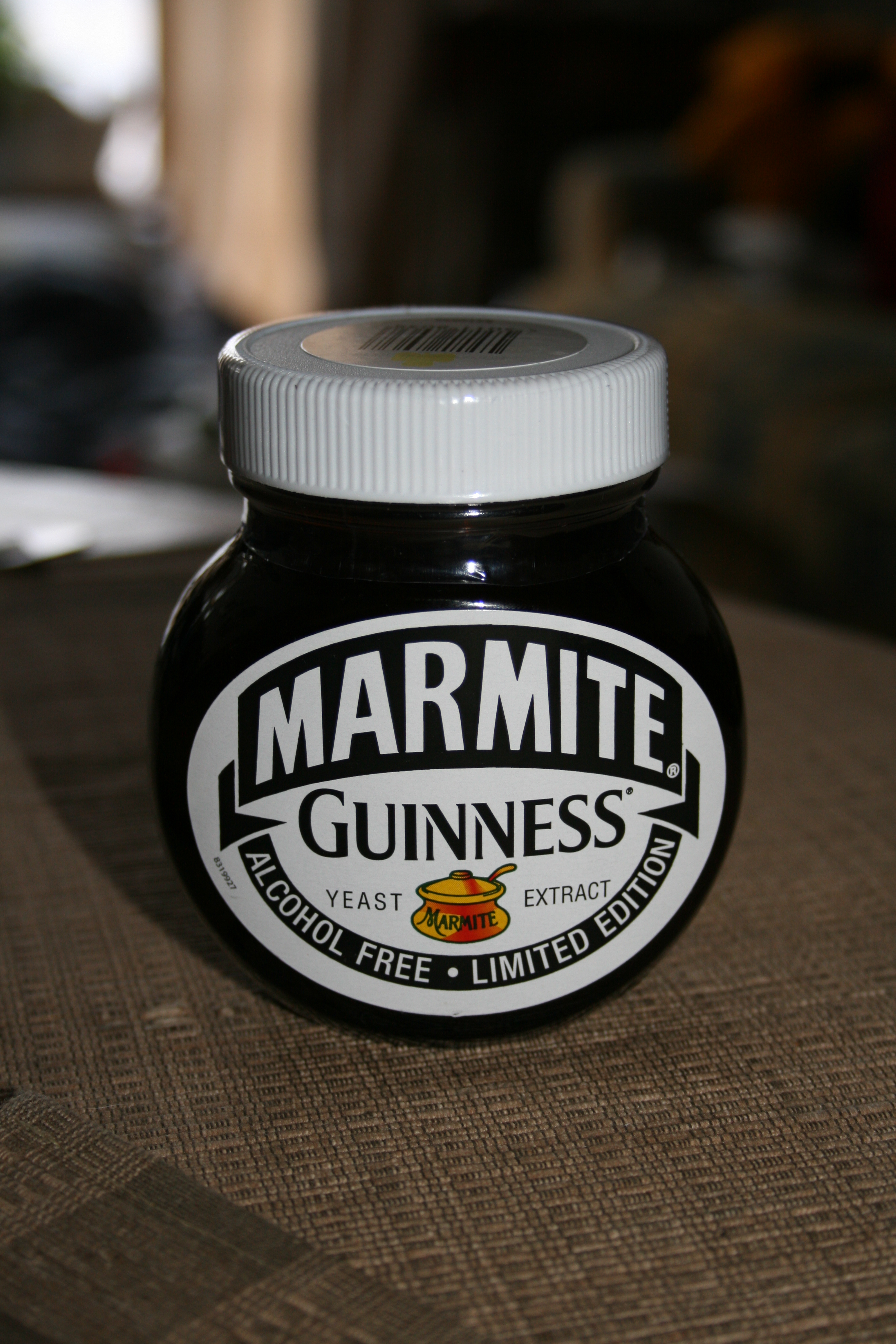
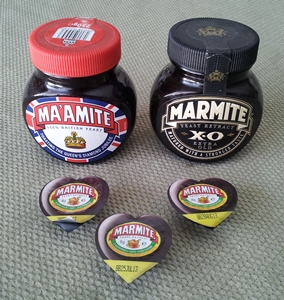
In 2002 a 100th anniversary jar was released.
In February 2007, Marmite produced a limited edition Guinness Marmite of 300,000 jars of 250 g of their yeast extract with 30% Guinness yeast, giving it a noticeable hint of "Guinness" flavour. In January 2008 Champagne Marmite was released for Valentine's Day, with a limited-edition production of 600,000 units initially released exclusively to Selfridges of London. The product had 0.3% champagne added to the recipe, and a modified heart-shaped label with "I love you" in place of the logo.
In 2009 a limited edition Marston's Pedigree Marmite was initiated to celebrate the 2009 Ashes Cricket test series.
In March 2010, a "super-strength" version of Marmite was released, called Marmite XO (XO standing for "extra old"). Marmite XO is matured for 28 days, four times longer than usual. The original Marmite XO's cap was black, and has a black and gold label. In July 2019, Marmite XO returned due to popular demand. The 2019 version has an off-white cap as opposed to the original black.
In April 2012, a special-edition jar in commemoration of the Diamond Jubilee of Queen Elizabeth II was released. With the product renamed "Ma'amite", the redesigned label featured a colour scheme based upon the Union Jack; the marmite and spoon logo replaced by a gold crown, and with a red rather than yellow cap. The front label also declares "Made with 100% British Yeast". Coinciding with the 110th anniversary of the brand, production was limited to 300,000 jars. For Christmas 2012 a gold limited edition was begun, containing edible gold-coloured flecks.
Marmite chocolate is also available.
In 2015 Marmite Summer of Love Special Edition featured a flower power-themed label. This special edition's blend had a lighter taste made using 100% lager yeast.
On 25 March 2019, Marmite peanut butter was introduced.
On 2 May 2022, Marmite Truffle was launched and sold exclusively in Sainsbury's, along with Marmite 'Dynamite', a chilli-flavoured Marmite spread. The Marmite Truffle was marketed with a variation of the 'Love it or Hate it' slogan designed to make it sound more sophisticated: "One either loves it or considers it utterly vulgar".
References
References
- [https://www.gracesguide.co.uk/Marmite_Food_Extract_Co Marmite Food Extract Co] history
- [https://www.unilever.co.uk/brands/foods/marmite/ Marmite brand] on Unilever
- [https://www.marmitemuseum.co.uk/marmite-history/ The history of Marmite] on Marmite Museum
- "A brief history of Marmite".
- "Marmite {{!}} Unilever".
- Hodsdon, Amelia. (22 April 2010). "How Marmite spread its way through journalism". [[The Guardian]].
- Gabbatt, Adam. (13 October 2016). "Marmite: Americans wonder what's all the fuss over divisive British spread?". [[The Guardian]].
- (June 2003). "Sodium Glutamate: A Safety Assessment". [[Food Standards Australia New Zealand]].
- Fogle, Ben. (2018). "English". William Collins.
- (25 May 2011). "Marmite: Ten things you'll love/hate to know".
- "A brief history of Marmite".
- "Marmite Food Extract Co.".
- "A brief history of Marmite".
- "AccomoDATA - Marmite".
- "Food brands: Marmite".
- Bastian, Hilda. (2007). "Lucy Wills (1888–1964): The life and research of an adventurous independent woman". [[Journal of the Royal College of Physicians of Edinburgh]].
- Lerski, George Jan. (1968). "Origins of Trotskyism in Ceylon: A Documentary History of the Lanka Sama Samaja Party, 1935-1942". The [[Hoover Institution]], [[Stanford University]].
- "Trade Mark 2333143".
- "Cyril Callister Biography, Achievements, Australian chemist, Food Technologist".
- By. (2021-07-13). "Worker of the Week: Cyril Callister".
- (21 June 2010). "Vegex".
- (8 March 2021). "'I compared Marmite to supermarket versions and I'm sure one was the same'".
- Barton, Laura. (4 January 2002). "It must be spread thinly. T-h-i-n-l-y...". The Guardian.
- "Cheese and Marmite panini".
- (5 November 2012). "DIY: The Marmite Cocktail".
- (20 September 2014). "Marmite Cocktail Gold Rush".
- Murphy, Patricia. (4 May 2014). "Salty Savoury: The new trend in cocktails?". [[Irish Independent]].
- "Spaghetti With Marmite".
- "Marmite (@marmite) • Instagram photos and videos".
- "Marmite ingredients (company web site)".
- "The vegan diet - Live Well".
- "Nutrition Information".
- "FAQs".
- Hall-Flavin, Daniel K.. (19 January 2016). "Depression (major depressive disorder)".
- Perlman, Elisabeth. (2020-03-12). "Fridge or cupboard: where should it go?".
- House, Arthur. (2021-06-17). "Marketing Marmite: how an advertising agency started a culture war". [[1843 (magazine).
- (29 April 2010). "Desert Island Discs: Cath Kidston".
- (22 April 2010). "BNP facing Marmite legal action".
- (25 May 2011). "Marmite: Ten things you'll love/hate to know".
- Heppenstall, Jason. (24 May 2011). "Spread no more: Denmark bans Marmite". The Guardian.
- Waterfield, Bruno. (25 May 2011). "Marmite made illegal in Denmark". [[The Daily Telegraph]].
- "Marmite not banned in Denmark".
- (22 August 2014). "Vikings defeated! Marmite back on Danish shelves". [[The Copenhagen Post]].
- (24 January 2014). "Ottawa shoppers stocking up on banned British, Scottish items".
- (26 January 2014). "Seizure of British foods an isolated incident, CFIA says".
- (2025-04-22). "'Hats off': Cafe owner in Canada praises Aussie PM for helping in Vegemite row".
- (2025-11-18). "Australian murderer sues for right to Vegemite behind bars".
- "The South African Marmite Cheese Spread (close up) – Marmite Museum".
- (11 January 2008). "Limited Edition Champagne Marmite".
- Wallop, Harry. (1 June 2009). "Marmite limited-edition 'cricket spread' to celebrate Ashes". The Daily Telegraph.
- (2010-03-05). "The extract factor: is Marmite toast?".
- "Marmite XO returns".
- (23 April 2012). "Marmite: Ma'amite – Print (image)".
- (24 April 2012). "Blog : Jubilee Marmite – Ma'amite – already for sale on eBay".
- (12 October 2010). "Marmite Very Peculiar Milk Chocolate".
- "2015 Summer of Love".
- O'Malley, Katie. (23 March 2019). "Marmite peanut butter just launched in the UK". [[The Independent]].
- "Marmite Truffle".
This article was imported from Wikipedia and is available under the Creative Commons Attribution-ShareAlike 4.0 License. Content has been adapted to SurfDoc format. Original contributors can be found on the article history page.
Ask Mako anything about Marmite — get instant answers, deeper analysis, and related topics.
Research with MakoFree with your Surf account
Create a free account to save articles, ask Mako questions, and organize your research.
Sign up freeThis content may have been generated or modified by AI. CloudSurf Software LLC is not responsible for the accuracy, completeness, or reliability of AI-generated content. Always verify important information from primary sources.
Report