From Surf Wiki (app.surf) — the open knowledge base
Mark Tully
British-Indian journalist (1935–2026)
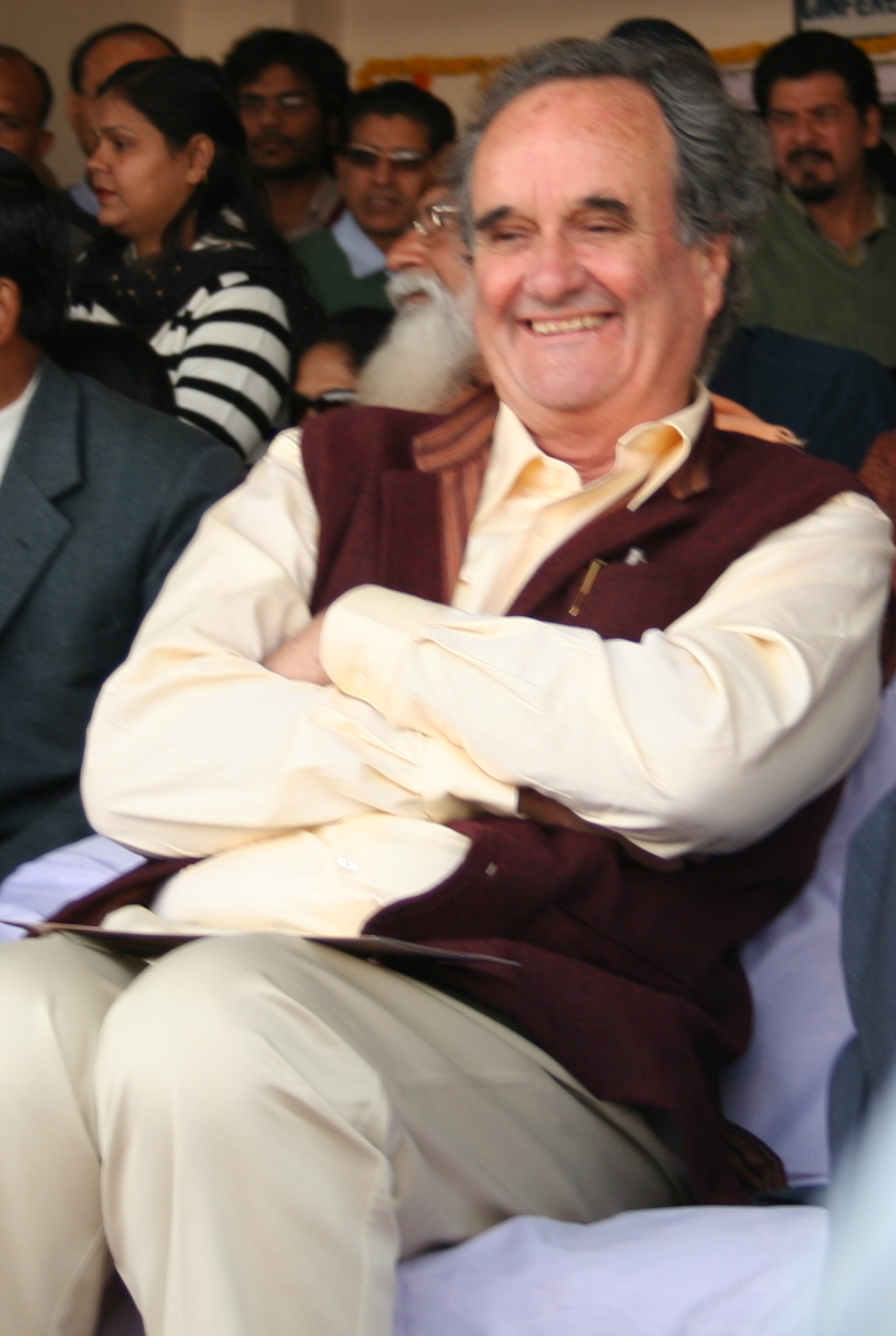
British-Indian journalist (1935–2026)
| Field | Value |
|---|---|
| name | Sir Mark Tully |
| honorific_suffix | |
| image | Mark Tully 1 (cropped).jpg |
| caption | Tully in 2011 |
| birth_name | William Mark Tully |
| birth_date | |
| birth_place | Tollygunge, Calcutta, Bengal Presidency, British India |
| death_date | |
| death_place | New Delhi, India |
| nationality | British |
| occupation | |
| education | Marlborough College |
| Trinity Hall, Cambridge | |
| children | 4 |
| signature | MarkTully Autograph.jpg |
Trinity Hall, Cambridge
Sir William Mark Tully (24 October 1935 – 25 January 2026) was a British journalist and the bureau chief of the BBC in New Delhi, a position he held for 20 years. He worked with the BBC for 30 years before resigning in July 1994. He also wrote and published several books.
Early life and education
Tully was born in Tollygunge, Calcutta, Bengal Presidency, British India, on 24 October 1935. His father was a British businessman who was a partner in one of the leading managing agencies of the British Raj. His mother had been born in Bengal. Tully spent the first decade of his childhood in India, although without being allowed to socialise with Indian people. His British nanny once scolded him for learning to count in Hindi from his driver, saying "that's the servant's language, not yours". before going to England for further schooling from the age of nine. There he was educated at Twyford School (Hampshire), Marlborough College and at Trinity Hall, Cambridge, where he studied Theology.
After Cambridge, Tully intended to become a priest in the Church of England but abandoned this after two terms at Lincoln Theological College, admitting later that he had doubts about "trusting [his] sexuality to behave as a Christian priest".
Journalistic career
Tully joined the BBC in 1964 and moved back to India in 1965 to work as the corporation's India correspondent. He covered all the major incidents in South Asia during his tenure, ranging from Indo-Pakistan conflicts, Bhopal gas tragedy, Operation Blue Star (and the subsequent assassination of Indira Gandhi, anti-Sikh riots), the assassination of Rajiv Gandhi to the demolition of Babri Masjid. He was expelled from India shortly after Indira Gandhi declared a state of emergency and began ruling by decree in 1975; he returned a year and a half later shortly before the restoration of normalcy in the country.
In 1992, when covering the demolition of the Babri Masjid by Hindutva activists, some of the perpetrators confronted him, chanting "Death to Mark Tully", reflecting their distrust of the BBC. Tully was locked in a room until a local official and a Hindu priest helped him leave several hours later; he later said that the demolition was India's "greatest setback" to secularism as an independent nation. He resigned from the BBC in July 1994 after an argument with John Birt, the then director general. He accused Birt of "running the corporation by fear" and "turning the BBC into a secretive monolith with poor ratings and a demoralised staff".
In 1994 he presented an episode of BBC's Great Railway Journeys, "Karachi to The Khyber Pass", travelling by train across Pakistan. A well-known railway enthusiast, he also presented "Steam's Indian Summer", a documentary produced by Nick Lera in his World Steam Classics series. As Tully reports in the journal HIMAL, the two men could not be sure where steam trains were still operating and they travelled around India together locating and filming them.
From 1994, he worked as a freelance journalist and broadcaster based in New Delhi.
He was the regular presenter of the weekly BBC Radio 4 programme Something Understood until the BBC announced its end in 2019.
As a guest of the Bangalore Initiative for Religious Dialogue, on 7 October 2010 he spoke on "How certain should we be? The problem of religious pluralism." He described his experiences and the fact that India had historically been home to all the world's major religions. He said that had taught him that there are many ways to God.
Tully was patron of the British branch of Child in Need India (CINI UK).
Equally well versed in English and Hindi, he contributed his efforts to keep literature alive and was the key speaker among 50 speakers of second Kalinga Literary Festival on 17 May 2015, where he explored the role of literature in nation building.
Books
Tully's first book on India, Amritsar: Mrs Gandhi's Last Battle (1985), was co-authored with his colleague at BBC Delhi, Satish Jacob; the book dealt with the events leading up to Operation Blue Star, Indian military action carried out between 1 and 8 June 1984 to remove militant religious leader Jarnail Singh Bhindranwale and his followers from the buildings of the Harmandir Sahib (Golden Temple) complex in Amritsar, Punjab.
Tully's No Full Stops in India (1988), a collection of journalistic essays, was published in the US as The Defeat of a Congress-man. The Independent wrote that "Tully's profound knowledge and sympathy ... unravels a few of the more bewildering and enchanting mysteries of the subcontinent."
In 2002 came India in Slow Motion, written in collaboration with Gillian Wright and published by Viking. Reviewing the book in The Observer, Michael Holland wrote of Tully that "Few foreigners manage to get under the skin of the world's biggest democracy the way he does, and fewer still can write about it with the clarity and insight he brings to all his work."
The anonymously authored Hindutva Sex and Adventure was a novel featuring a main character with strong similarities to Tully. Tully himself stated that "I am amazed that Roli Books should publish such thinly disguised plagiarism, and allow the author to hide in a cavalier manner behind a nom-de-plume. The book is clearly modelled on my career, even down to the name of the main character. That character's journalism is abysmal, and his views on Hindutva and Hinduism do not in any way reflect mine. I would disagree with them profoundly."
His last book, Upcountry Tales: Once Upon A Time In The Heart Of India (2017), was a collection of short stories set in rural north India.
Personal life and death
In 1960 Tully married Margaret, with whom he had four children during the 1960s. However, after 1981, he lived in Nizamuddin West in Delhi with his girlfriend, Gillian Wright. Tully held an Overseas Citizenship of India card.
Tully died on 25 January 2026 at the age of 90, at a hospital in New Delhi.
Awards and honours
Tully was made an Officer of the Order of the British Empire in 1985 and was awarded the Padma Shri in 1992. He was knighted in the New Year Honours 2002, receiving a KBE, and in 2005 he received the Padma Bhushan.
References
References
- (20 February 2000). "Media reportage: Interview with Mark Tully". [[The Hindu]].
- Victor, Peter. (10 July 1994). "Tully quits BBC". The Independent.
- (20 August 2013). "Why Mark Tully needs a Calcutta birth certificate at 78". BBC News.
- (29 October 2014). "Birthdays". Guardian News & Media.
- (31 December 2001). "Mark Tully: The voice of India". BBC.
- Lakhani, Brenda. (2003). "British and Indian influences in the identities and literature of Mark Tully and Ruskin Bond". University of North Texas.
- (18 June 2007). "Meeting Mark". [[The Hindu]].
- Drogin, Bob. (22 December 1992). "Profile The BBC's Battered Sahib Mark Tully has been expelled by India, chased by mobs and picketed. He loves his job.". Los Angeles Times.
- "After Blue Star". BBC.
- Tully, Mark. (5 December 2002). "Tearing down the Babri Masjid". BBC.
- "Legendary British-Indian journalist and broadcaster Mark Tully passes away". The Wire.
- (25 April 2023). "Steam's Indian Summer - English • Great Railways".
- M Tully, By steam!, HIMAL, 1 October 2011, [https://www.himalmag.com/archives/by-steam] {{Webarchive. link. (12 August 2025)
- "Mark Tully to give annual Toleration lecture at the University of York". The University of York.
- (31 December 2001). "It's Sir Mark Tully in UK honors list". CNN.
- "Mark Tully". BBC Radio 4.
- Marshall, Michelle. (16 April 2019). "Mark Tully: BBC Radio 4 host speaks out on shock programme axe 'I feel sad for myself'". [[Daily Express]].
- (19 October 2010). "Former BBC-India Chief Highlights Multiple Paths To God". Hindu American Foundation.
- "Mark Tully: From Bangladesh war to Bluestar, BBC's voice of India chronicled it all".
- "About Us | Child in Need India | CINI".
- (2 May 2015). "50 Speakers to attend Kalinga Literary Festival 2015".
- (1986). "Amritsar: Mrs Gandhi's last battle". Pan Books.
- (1991). "No full stops in India". Viking.
- (20 September 1992). "The Independent". independent.co.uk.
- (2002). "India in slow motion". Viking.
- Holland, Michael. (7 December 2003). "The Observer". guardian.co.uk.
- Nelson, Dean. (5 April 2010). "Former BBC correspondent Sir Mark Tully attacked in novel". The Daily Telegraph.
- (2017). "Upcountry tales: once upon a time in the heart of India". Speaking Tiger.
- (12 November 2017). "Mark Tully's latest from the frontlines of 'upcountry India'".
- (5 January 2018). "A date with destiny".
- (25 January 2026). "An era ends with Mark Tully: A Delhi life remembered by Mayank Austen Soofi".
- (31 December 2001). "Mark Tully: The Voice of India". BBC.
- (1 November 2016). "Mighty Words Indeed". The Hindu.
- (19 August 2013). "Why Mark Tully needs a Calcutta birth certificate at 78". BBC News.
- (25 January 2026). "Legendary Journalist Mark Tully Passes Away". The Kashmir Monitor.
- "Mark Tully, BBC's "Voice of India", dies aged 90". BBC News.
- (26 January 2026). "Mark Tully (1935-2026): The voice that India trusted when history spoke — or fell silent".
- (1 January 2002). "An honour, says Tully". [[The Hindu]].
- (2005). "Padma Bhushan Awardees". Indian government.
This article was imported from Wikipedia and is available under the Creative Commons Attribution-ShareAlike 4.0 License. Content has been adapted to SurfDoc format. Original contributors can be found on the article history page.
Ask Mako anything about Mark Tully — get instant answers, deeper analysis, and related topics.
Research with MakoFree with your Surf account
Create a free account to save articles, ask Mako questions, and organize your research.
Sign up freeThis content may have been generated or modified by AI. CloudSurf Software LLC is not responsible for the accuracy, completeness, or reliability of AI-generated content. Always verify important information from primary sources.
Report