From Surf Wiki (app.surf) — the open knowledge base
Mark Lane tube station
Disused station on the London Underground
_p044_-_Mark_Lane_(map).jpg)
Disused station on the London Underground
| Field | Value |
|---|---|
| name | Mark Lane |
| image_name | The former Mark Lane Underground Station (District and Circle Lines).jpg |
| owner | Metropolitan Railway & District Railway |
| locale | City of London |
| years1 | |
| events1 | Opened as Mark Lane |
| years2 | 1946 |
| events2 | Renamed Tower Hill |
| years3 | |
| events3 | Closed |
| platforms | 2 |
| replace | Tower Hill |
| coordinates | |
| map_type | Central London |
a closed station originally named Mark Lane but later known as Tower Hill
Mark Lane is a disused station on the London Underground. It was served by the Circle and District lines.
In 1946 it was renamed Tower Hill. It was closed in 1967 and the present Tower Hill station was opened as its replacement, located on the same site as the Tower of London station station that had closed in 1884.
It was named after Mark Lane, the street on which it is located, slightly west of the current Tower Hill station that replaced it in 1967.
History
Mark Lane station was opened on 6 October 1884 to replace the short-lived Tower of London station, which was closed when the Metropolitan Railway and District Railway were connected to form the Circle line and a larger station was required.
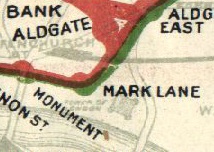
The station was referred to in early plans as Trinity Square, and later named Seething Lane, but it was ultimately given the more recognisable name Mark Lane (the street on which London's Corn Exchanges were located). On 1 September 1946, the station was renamed Tower Hill.
The station was earmarked for closure due to overwhelming passenger numbers and little space available for expansion. It was closed on 4 February 1967 and the present Tower Hill station was opened as its replacement, located on the same site as the Tower of London station that had closed in 1884.
The underground section of Mark Lane station can still be seen between Monument and Tower Hill, though only one platform on the eastbound track now remains due to redevelopment of the track. The surface station, sited in Seething Lane, can be seen in the form of a pedestrian subway under the road converted from the old station overbridge, where large white grilles now cover the original stairways down to the platforms.
The offices above the station were called Mark Lane Station Buildings, and this sign can still be read above an entrance on Byward Street.
In fiction
The disused station features in the 2017 novel Who Sent Clement by Keith A. Pearson as the fictional hiding place for a gold bar from the 1971 Baker Street robbery. The loot is made as a pay-off to a look-out from the robbery, a former ticket office manager of the then recently closed station.

References
Notes
Bibliography
References
- (26 November 2022). "Hidden London Hangouts S6E7 – Mark Lane".
- (2017). "Who Sent Clement". Create Space.
This article was imported from Wikipedia and is available under the Creative Commons Attribution-ShareAlike 4.0 License. Content has been adapted to SurfDoc format. Original contributors can be found on the article history page.
Ask Mako anything about Mark Lane tube station — get instant answers, deeper analysis, and related topics.
Research with MakoFree with your Surf account
Create a free account to save articles, ask Mako questions, and organize your research.
Sign up freeThis content may have been generated or modified by AI. CloudSurf Software LLC is not responsible for the accuracy, completeness, or reliability of AI-generated content. Always verify important information from primary sources.
Report