From Surf Wiki (app.surf) — the open knowledge base
Mark 5
| Field | Value | |
|---|---|---|
| name | Mark 5 | |
| previouslink | Mark 4 | previous=chapter 4 |
| nextlink | Mark 6 | next= chapter 6 |
| book | Gospel of Mark | |
| biblepart | New Testament | |
| booknum | 2 | |
| category | Gospel | |
| image | CodexGigas 515 Mark.jpg | |
| caption | The Latin text of Mark 1:5–5:8 in Codex Gigas (13th century) |
a chapter in the Gospel of Mark
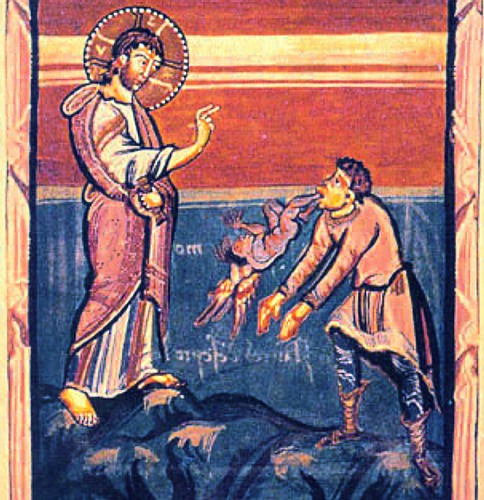
Mark 5 is the fifth chapter of the Gospel of Mark in the New Testament of the Christian Bible. Taken with the calming of the sea in , there are "four striking works [which] follow each other without a break": an exorcism, a healing, and the raising of Jairus' daughter.
Text
The original text was written in Koine Greek. This chapter is divided into 43 verses.
Textual witnesses
Some early manuscripts containing the text of this chapter are:
- Codex Vaticanus (325–350; complete)
- Codex Sinaiticus (330–360; complete)
- Codex Bezae (~400; complete)
- Codex Alexandrinus (400–440; complete)
- Codex Ephraemi Rescriptus (~450; complete)
Healing of the Gerasene demoniac
Main article: Exorcism of the Gerasene demoniac, Legion (demon)
Jesus and his disciples travel across the Sea of Galilee by boat to the non-Jewish country of the Gerasenes (some manuscripts have "Gadarenes", others "Gergesenes"), a region now in modern-day Jordan. Tom Wright notes that "why Jesus went to that bit of territory we'll never know", although Johann Bengel infers that many Jews dwelt there.
A a man with an unclean spirit, or a possessed, man comes to meet them. Mark relates the story "with a wealth of circumstantial detail": the man had lived among the nearby tombs, and had fought off all attempts to chain him up: the Greek text has a complex string of negatives: οὐδὲ ἁλύσει οὐκέτι οὐδεὶς, oude halysei ouketi oudeis, no one, no longer, not even with chains. He now roamed the tombs and hills screaming.
The man falls at Jesus' feet and begs Jesus not to harm him. Jesus asks him what his name is and he replies "My name is Legion, ... for we are many". Legion may be a reference to the Roman army. They see some nearby pigs and the demons ask if they can be put in the pigs, to which Jesus consents. The pigs, about 2000 of them (only Mark's account estimates the numbers), then rush into the lake and are drowned.
The people tending the pigs run off to town telling everyone what has happened, and some townspeople come to see for themselves. When they arrive the man is sitting dressed and sane. They are disturbed and ask Jesus to leave the area, and he complies. Out of "grateful love", but Jesus tells him to go home to his "family" (Amplified Bible) or to his "people" (New International Version) and tell them what God has done for him. The man then travels over the Decapolis telling people the story. Protestant theologian Heinrich Meyer suggests that "he was to abide in his native place as a witness and proclaimer of the marvellous deliverance, that he had experienced from God through Jesus, and in this way to serve the work of Christ".
Anglican biblical scholar Christopher Tuckett argues that "a number of details and inconsistencies within the present narrative suggest that Mark may be combining more than one tradition here into a single story":
- verse 2 has the man "immediately" meet him as Jesus has come out of the boat, whereas verse 6 says that "when he saw Jesus from afar, he ran and worshiped Him"
- verse 8 interrupts a dialogue which otherwise appears to flow from verse 7 to verse 9
- verse 15 seems odd after verse 14, since the latter presupposes a considerable time lapse.
This story also occurs in Matthew , where there are two possessed men, and in Luke . The use of the word "Gadarenes" in some manuscripts may be an attempt to harmonize Mark with .
Jairus' daughter and the woman who touched Jesus' garment
Main article: Jesus healing the bleeding woman, Daughter of Jairus
On the other side of the lake Jesus is met by a man named Jairus, a Synagogue Ruler (a rich patron of the local house of worship), She sneaks up to Jesus and touches his garment, according to and (see also , Mark 6#Healing of the sick of Gennesaret) the "fringe of his cloak" ( – NRSV), by which she is healed. He turns to see who and she fearfully confesses. He says "Daughter, your faith has healed you. Go in peace and be freed from your suffering."
Men arrive and tell Jairus that his daughter is dead. Jesus brushes them off and says "Don't be afraid; just believe." They arrive at the house and everyone is crying loudly. Jesus assures everyone she is not dead, just asleep, goes inside and says to her Talitha kum, telling her to get up, and she does. Unlike his advice about the demon-possessed man, he tells them not to tell people of these events.
This account also appears in the book of Matthew 9:18–26 and Luke 8:40–56. Luke keeps the stories of the possessed man and the two women together, but Matthew inserts the story of the paralyzed man, the calling of Matthew, and the parable of the wineskins found in Mark 2 between these two stories.
Notes
References
Sources
- Brown, Raymond E. et al., The New Jerome Biblical Commentary, Prentice Hall, 1990
- Miller, Robert J.-Editor, The Complete Gospels Polebridge Press 1994.
References
- [[George Chadwick (bishop). Chadwick, G. A.]] (1896), [https://biblehub.com/library/chadwick/the_gospel_of_st_mark/chapter_4_39_5_15_5_31_5_41.htm Four Miracles], in ''The Gospel according to Saint Mark''
- Crossway Bibles, [https://www.biblegateway.com/passage/?search=mark%205&version=ESV#fen-ESV-24362a Footnote a to Mark 5:1] in the [[English Standard Version]], accessed on 22 November 2024
- Wright, N. T. (2001), ''Mark for Everyone'', p. 56
- Bengel, J. A. (1742), [https://biblehub.com/commentaries/bengel/mark/5.htm Bengel's Gnomon of the New Testament] on Mark 5, accessed 21 June 2021
- [[Christopher M. Tuckett. Tuckett, C. M.]], ''Mark'' in Barton, J. and Muddiman, J. (2001), [https://b-ok.org/dl/946961/8f5f43 The Oxford Bible Commentary] {{Webarchive. link. (2017-11-22 , p. 897)
- Meyer, H. A. W. (1880), [https://biblehub.com/commentaries/meyer/mark/5.htm Meyer's NT Commentary] on Mark 5, accessed 7 June 2017
- Miller, Robert J., editor, ''The Complete Gospels'', Polebridge Press 1994, p. 24
- Vincent, M. R., [https://biblehub.com/commentaries/vws/mark/5.htm Vincent's Word Studies] on Mark 5, accessed 21 June 2021
- the man asks Jesus to let him be with him ({{langx. el. ινα μετ αυτου η, ''hina met autou e''), translated as "stay with him" in the [[Jerusalem Bible]],Jerusalem Bible (1966), Mark 5:18
- BibleTexts.com, [https://web.archive.org/web/20210309172253/http://www.bibletexts.com/glossary/gadara.htm To which city did the original account refer?], archived on 9 March 2021, accessed on 22 November 2024
- who begs Jesus to heal his sick, twelve-year-old daughter. Jesus takes only [[Saint Peter. Peter]], [[Saint James the Great. James]], and [[John the Apostle. John]]. This story does not occur in the [[Gospel of John]]. On the way there, a woman who suffers from chronic "bleeding", perhaps [[menorrhagia]] or bleeding from [[Uterine fibroids. fibroids]].Brown et al. 608
- grc. κράσπεδον: 1. edge, border, hem of a garment - But meaning 2 is also possible for these passages, depending on how strictly Jesus followed Mosaic law, and also upon the way in which {{lang. grc. κράσπεδον was understood by the authors and first readers of the gospels. 2. tassel (ציצת), which the Israelite was obligated to wear on the four corners of his outer garment, according to Num 15:38f; Dt 22:12. ... Of the Pharisees ... Mt 23:5."; [http://www.newadvent.org/cathen/06307b.htm Catholic Encyclopedia: Fringes (in Scripture)]: "It was very likely the tassel of the corner thus thrown over Our Lord's shoulder that the woman with the issue of blood touched ("behind him"), in the circumstance recorded in Matt., ix, 20, and Luke, viii, 44." See also [[Christianity and fringed garments]].
This article was imported from Wikipedia and is available under the Creative Commons Attribution-ShareAlike 4.0 License. Content has been adapted to SurfDoc format. Original contributors can be found on the article history page.
Ask Mako anything about Mark 5 — get instant answers, deeper analysis, and related topics.
Research with MakoFree with your Surf account
Create a free account to save articles, ask Mako questions, and organize your research.
Sign up freeThis content may have been generated or modified by AI. CloudSurf Software LLC is not responsible for the accuracy, completeness, or reliability of AI-generated content. Always verify important information from primary sources.
Report