From Surf Wiki (app.surf) — the open knowledge base
Mark 48 torpedo
American heavyweight submarine-launched torpedoes
American heavyweight submarine-launched torpedoes
| Field | Value | ||
|---|---|---|---|
| name | Mark 48 torpedo | ||
| image | [[File:Mk 48 torpedo maintenance 1982.JPEG | border | 300px]] |
| caption | Technicians perform maintenance on a Mark 48 torpedo in 1982. | ||
| origin | United States | ||
| type | Heavyweight dual-purpose ASW and ASuW torpedo | ||
| <!-- Type selection --> | is_ranged | y | |
| is_explosive | y | ||
| is_missile | y | ||
| is_UK | |||
| service | 1972–present (Mod 1) | ||
| used_by | United States Navy | ||
| Brazilian Navy | |||
| Royal Australian Navy | |||
| Royal Canadian Navy | |||
| Royal Netherlands Navy | |||
| Republic of China Navy | |||
| wars | |||
| designer | Gould, Inc. | ||
| Naval Surface Warfare Center | |||
| design_date | 1967 | ||
| manufacturer | Gould/Honeywell (Mod 1) | ||
| Hughes Aircraft (ADCAP) | |||
| unit_cost | $894,000 (1978 USD) | ||
| $3,500,000 (ADCAP) (1988) | |||
| $3,800,000 (CBASS)(2005 USD) | |||
| $5.39m (2022) | |||
| variants | |||
| weight | 3434 lb (original), 3695 lb (ADCAP) | ||
| length | 19 ft | ||
| diameter | 21 in | ||
| crew | |||
| range | 38 km at 55 kn or 50 km at 40 kn (estimated), | ||
| officially "greater than 5 mi" | |||
| sights | |||
| filling | high explosive plus unused fuel | ||
| filling_weight | 647 lb | ||
| detonation | proximity fuze | ||
| yield | |||
| engine | swash-plate piston engine; pump jet | ||
| propellant | Otto fuel II | ||
| depth | 500 fathoms, 800 m (estimated), | ||
| speed | 55 kn (estimated) | ||
| officially "greater than 28 kn" | |||
| guidance | Common Broadband Advanced Sonar System | ||
| launch_platform | Submarine |
1988–present (ADCAP) 2008–present Mod 7 Common Broadband Advanced Sonar System (CBASS) Brazilian Navy Royal Australian Navy Royal Canadian Navy Royal Netherlands Navy Republic of China Navy Naval Surface Warfare Center Hughes Aircraft (ADCAP) Westinghouse Naval Systems Cleveland Ohio $3,500,000 (ADCAP) (1988) $3,800,000 (CBASS)(2005 USD) $5.39m (2022) officially "greater than 5 mi" officially "greater than 28 kn"
The Mark 48 and its improved Advanced Capability (ADCAP) variant are American heavyweight submarine-launched torpedoes. They were designed to sink deep-diving nuclear-powered submarines and high-performance surface ships.
History
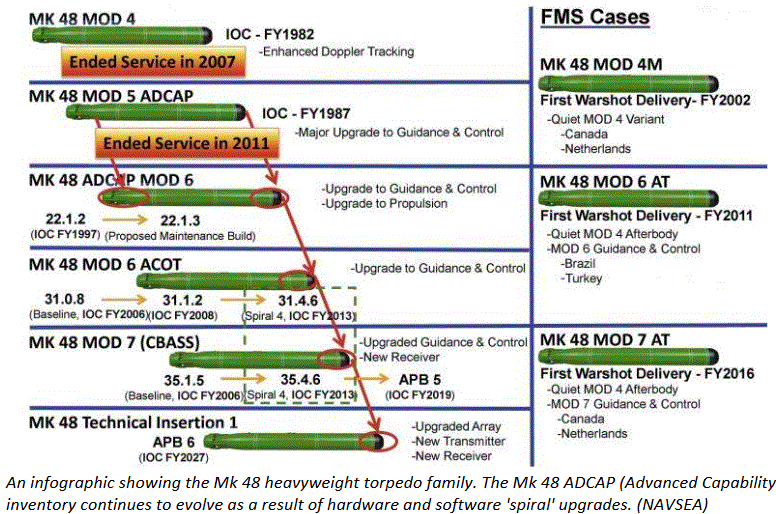
The Mark 48 was initially developed as research torpedo concept II (RETORC II), one of several weapons recommended for implementation by Project Nobska, a 1956 summer study on submarine warfare. The Mk-48 torpedo was designed at the end of the 1960s by Gould Ocean systems Division of Cleveland, Ohio, to keep up with the advances in Soviet submarine technology. Operational since 1972, it replaced the Mk-37, Mk-14 and Mk-16 torpedoes as the principal weapon of US Navy submarines. With the entry into service of the new Soviet in 1977, the decision was made to first upgrade the weapon to MOD 4 status and then accelerate the ADCAP program, which would bring significant modifications to the torpedo. Tests were run to ensure that the weapon could keep up with the developments and the weapon was modified with improved acoustics and electronics. The new version of the weapon, also known as Mk-48 Mod 5 (ADCAP), was extensively tested and production started in 1985, with entry into service in 1988. From then on, various upgrades have been added to the torpedo. the Mk-48 Mod 6 was in service; a Mod 7 version was test fired in 2008 in Exercise RIMPAC. The inventory of the US Navy in 2001 was 1,046 Mk-48 torpedoes. In 2017 Lockheed's production was approximately 50 per year.
Deployment
The Mk-48 torpedo is designed to be launched from submarine torpedo tubes. The weapon is carried by all US Navy submarines, including ballistic missile submarines and -, -, and attack submarines. It is also used on Canadian, Australian, and Dutch submarines.
Mk-48 and Mk-48 ADCAP torpedoes can be guided from a submarine by wires attached to the torpedo. They can also use their own active or passive sensors to execute programmed target search, acquisition, and attack procedures. The torpedo is designed to detonate under the keel of a surface ship, breaking the keel and destroying its structural integrity. In the event of a miss, it can circle back for another attempt.
Propulsion
The swashplate piston engine is fueled by Otto fuel II, a monopropellant which combusts to drive the engine. The thrust is generated by a propulsor assembly, which is an axial-flow pump-jet with approximately 15 rotor blades and 12 stator blades based on US Navy computer graphics from 2011.
Sensors and improvements
The torpedo's seeker has an active electronically steered "pinger" (2D phased array sonar) that helps avoid having to maneuver as it approaches the target. Unconfirmed reports indicate that the torpedo's sensors can monitor surrounding electrical and magnetic fields. This may refer to the electromagnetic coils on the warhead (at least from 1977 to 1981), used to sense the metallic mass of the ship's hull and detonate at the proper stand-off distance.
The torpedo has been the subject of continued improvement over its service lifetime. In the 1990s, a Mod 6 variant of the ADCAP provided much improved noise isolation for the engine, which makes this torpedo more difficult to detect for a potential target.
The Mk48 Mod 7 Common Broadband Advanced Sonar System (CBASS) torpedo is optimized for both the deep and littoral waters and has advanced counter-countermeasure capabilities. The MK48 ADCAP Mod 7 (CBASS) torpedo is the result of a Joint Development Program with the Royal Australian Navy and reached Initial Operational Capability in 2006.
On July 25, 2008 a MK 48 Mod 7 CBASS torpedo fired by an Australian , , successfully sank a test target during the Rim of the Pacific 2008 (RIMPAC) exercises.
In 2015 the USN announced plans to restart production and seek a more modular design. Lockheed Martin is to upgrade existing Mark 48s to include a new guidance-control system known as the Common Broadband Advanced Sonar System (CBASS), in addition to improving propulsion and resistance to electronic countermeasures.{{cite magazine |archive-url=https://web.archive.org/web/20161228193405/http://www.popularmechanics.com/military/weapons/a24511/us-navy-lethal-torpedo/?src=nl&mag=pop&list=nl_pnl_news&date=122816 |archive-date=December 28, 2016 |url-status=dead
Starting in 2003, the US Navy began the Stealth Torpedo Enhancement Program which aims to upgrade the capability of the existing Mk 48 design by implementing alternative fuel sources including electric fuel cells, and a "swim out" capability, a capability that allows a torpedo to leave the tube under its own power without using a torpedo tube's noisier compressed air-launch system. The program is ongoing, with many details yet classified.
Operators

Current operators
References
Bibliography
References
- Jolie, E.W.. (15 September 1978). "A Brief History of US Navy Torpedo Development: Torpedo Mine Mk48".
- Polmar, Norman. "The Ships and Aircraft of the U.S. Fleet: Torpedoes". ''United States Naval Institute Proceedings'', November 1978, p. 159.
- "Mark 48 CBASS".
- (22 September 2022). "New Look at Air Force's Ship-Killing Smart Bomb in Action, Seeker Details Revealed".
- Thomas, Vincent C. ''The Almanac of Seapower 1987''. Navy League of the United States (1987). {{ISBN. 0-9610724-8-2. p. 190.
- link. (2020-07-02 ", ''[[US Navy]]'', 17 January 2009, Retrieved 10 March 2010.)
- Friedman, Norman. (1994). "U.S. Submarines Since 1945: An Illustrated Design History". Naval Institute Press.
- "MK 48". www.fas.org.
- "Mk 48 ADCAP". www.janes.com.
- (24 November 2017). "Navy Engineers New Lethal, Super High-Tech Mk 48 Torpedo". [[Scout.com]].
- "This is what makes the Mark 48 one of the deadliest torpedoes ever built". Mighty Networks.
- (28 January 2025). "Mark 48 Torpedo".
- (1988). "A New Pumpjet Design Theory [ADA201353]".
- (May 31, 2011). "Mk48 Mod 6AT".
- Zimmerman (2000), pp. 129-130.
- The Mod 7 variant increases sonar bandwidth, enabling it to transmit and receive pings over a wider frequency band, taking advantage of broadband signal processing techniques to greatly improve search, acquisition, and attack effectiveness. This version is much more resistant to enemy countermeasures.[http://nationalinterest.org/blog/the-buzz/everything-you-need-know-about-the-us-navys-new-lethal-16413 The U.S. Navy's New Lethal Torpedo Is Almost Ready for War] - Nationalinterest.org, 31 May 2016
- (25 July 2008). "Aussie sub sinks US Warship". [[The Sydney Morning Herald]].
- (July 24, 2008). "BBC Video: Torpedo test sinks US ship". [[BBC]].
- (29 October 2015). "Navy Planning Torpedo Restart, Would Be Modular Design With Multiple Payloads". USNI.
- (9 June 2000). "An Assessment of Undersea Weapons Science and Technology".
- (23 Oct 2023). "Armed with a heavyweight torpedo made to 'break ships in half,' Taiwan's first homemade submarine represents a new threat to China's navy". Business Insider.
This article was imported from Wikipedia and is available under the Creative Commons Attribution-ShareAlike 4.0 License. Content has been adapted to SurfDoc format. Original contributors can be found on the article history page.
Ask Mako anything about Mark 48 torpedo — get instant answers, deeper analysis, and related topics.
Research with MakoFree with your Surf account
Create a free account to save articles, ask Mako questions, and organize your research.
Sign up freeThis content may have been generated or modified by AI. CloudSurf Software LLC is not responsible for the accuracy, completeness, or reliability of AI-generated content. Always verify important information from primary sources.
Report