From Surf Wiki (app.surf) — the open knowledge base
Margaret (moon)
Moon of Uranus

Moon of Uranus
| Field | Value |
|---|---|
| name | Margaret |
| image | File:S2003u3acircle.gif |
| caption | Discovery image of Margaret taken by the Subaru Telescope in August 2003 |
| discovered | August 29, 2003 |
| mpc_name | Uranus XXIII |
| pronounced | |
| adjective | Margaretian |
| mean_orbit_radius | 14,345,000 km |
| eccentricity | 0.6608 (mean) |
| period | 1687.01 d |
| inclination | 57° (to the ecliptic) |
| satellite_of | Uranus |
| mean_radius | 10 km (estimate) |
| surface_area | ~1,300 km2 (estimate) |
| volume | ~4,200 km3 (estimate) |
| mass | ~5.5 kg (estimate) |
| density | ~1.3 g/cm3 (assumed) |
| surface_grav | ~0.0023 m/s2 (estimate) |
| escape_velocity | ~0.0085 km/s (estimate) |
| rotation | ? |
| axial_tilt | ? |
| albedo | 0.04 (assumed) |
| single_temperature | ~65 K (estimate) |
- Scott S. Sheppard
- David C. Jewitt
Margaret is the only known prograde irregular satellite of the moons of Uranus. It was discovered by Scott S. Sheppard, et al. in 2003 and given the provisional designation S/2003 U 3.
Confirmed as Uranus XXIII, it was named after the servant of Hero in William Shakespeare's play Much Ado About Nothing. The name was also chosen to match the name of Sheppard's mother.
Orbit
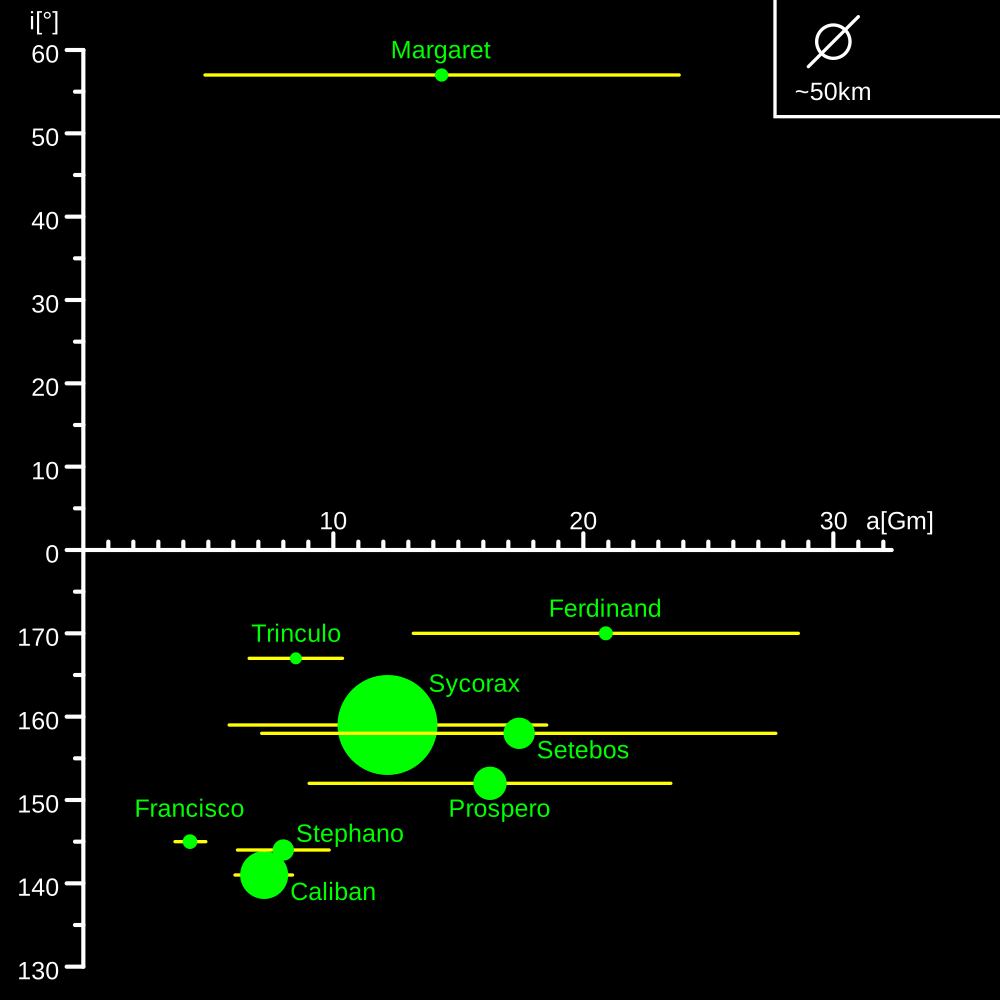
Margaret stands out as the only known prograde irregular satellite of Uranus. The diagram illustrates the orbital parameters of Margaret, unique among the irregular satellites of Uranus, with inclination on the vertical axis and the eccentricity of the orbits represented by the segments extending from the pericentre to the apocentre.
Margaret's inclination of 57° is close to the limit of stability. The intermediate inclinations 60 w) is almost 1.6 million years long. Margaret itself may be ejected from the Uranian system in the far future.
Margaret's orbit is subject to solar and planetary perturbations; thus, its orbital elements are variable over short timescales. Over a timescale of 8,000 years, the average orbital eccentricity of Margaret is 0.68. In 2010, its eccentricity grew to 0.81, temporarily giving Margaret the most eccentric orbit of any known moon in the Solar System, though Nereid's average eccentricity of 0.75 is greater.
References
| archive-url = https://web.archive.org/web/20080505184616/http://www.ifa.hawaii.edu/~sheppard/satellites/uranus2003.html | archive-date = 5 May 2008
.
IAU Circular 8217
References
- Benjamin Smith (1903) ''The Century Dictionary and Cyclopedia''
- Cathcart (1971) ''The Duchess of Kent''
- Paul, Richard. (2014). "The Shakespearean Moons of Uranus". Folger Shakespeare Library.
- (4 March 2009). "The Orbits of the Outer Uranian Satellites". The Astronomical Journal.
This article was imported from Wikipedia and is available under the Creative Commons Attribution-ShareAlike 4.0 License. Content has been adapted to SurfDoc format. Original contributors can be found on the article history page.
Ask Mako anything about Margaret (moon) — get instant answers, deeper analysis, and related topics.
Research with MakoFree with your Surf account
Create a free account to save articles, ask Mako questions, and organize your research.
Sign up freeThis content may have been generated or modified by AI. CloudSurf Software LLC is not responsible for the accuracy, completeness, or reliability of AI-generated content. Always verify important information from primary sources.
Report