From Surf Wiki (app.surf) — the open knowledge base
March of the Volunteers
National anthem of China

National anthem of China
| Field | Value | |||
|---|---|---|---|---|
| title | ||||
| english_title | March of the Volunteers | |||
| image | March of the Volunteers (Pathe Records – 1935).png | |||
| prefix | National | |||
| country | People's Republic of China | |||
| author | Tian Han | |||
| lyrics_date | 1934 | |||
| composer | Nie Er | |||
| music_date | 16 May 1935 | |||
| adopted | * | |||
| * {{unbulleted list | {{nowrap | 27 September 1949 | (provisional)<ref name | "provo" /}}}} |
| * {{unbulleted list | 1 July 1997 | (Hong Kong)<ref name | "hk" /}} | |
| * {{unbulleted list | 20 December 1999 | (Macau)<ref name | "macao" /}} | |
| * {{unbulleted list | 14 March 2004 | (constitutional)<ref name | "constitution" /}} | |
| sound | March of the Volunteers instrumental.ogg | |||
| sound_title | "March of the Volunteers", performed by the United States Navy Band |
The "March of the Volunteers" is the national anthem of the People's Republic of China. Unlike previous Chinese state anthems, it was written entirely in vernacular Chinese, rather than in Classical Chinese.
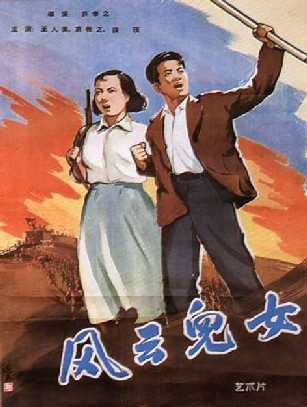
The Japanese invasion of Manchuria saw a boom of nationalistic arts and literature in China. This song had its lyrics written first by the communist playwright Tian Han in 1934, then set to melody by Nie Er and arranged by Aaron Avshalomov for the communist-aligned film Children of Troubled Times (1935). It became a famous military song during the Second Sino-Japanese War beyond the communist faction, most notably the Nationalist general Dai Anlan designated it to be the anthem of the 200th Division, who fought in Burma. It was adopted as the PRC's provisional anthem in 1949 in place of the "Three Principles of the People" of the Republic of China and the Communist "Internationale".
During the Cultural Revolution, Tian Han was criticized and placed in prison, where he died in 1968. The song was briefly and unofficially replaced by "The East Is Red", then reinstated but played without lyrics, restored to official status in 1978 with altered lyrics, before the original version was fully restored in 1982. In 2004, the March of the Volunteers was officially enshrined as the national anthem in the Constitution. In 2017, the Law of the People's Republic of China on the National Anthem was adopted.
History
The lyrics of the "March of the Volunteers", also formally known as the National Anthem of the People's Republic of China, were composed by Tian Han in 1934 as two stanzas in his poem "The Great Wall" ({{linktext|萬里長城}}), ({{linktext|义勇军进行曲}}) intended for a play he was working on at the time. The poem's stanzas were adopted into the song by Nie the composer while Tian was imprisoned. Then the song was chosen as part of the plot's climax in Diantong Company's upcoming film Children of Troubled Times or Sons and Daughters of the Storm. It first appeared in public in the May 1935 screening of the film at Jincheng Grand Theater, Shanghai and two months later in July with Pathé's (a subsidiary of EMI) record release.
The film is a story about a Chinese intellectual who flees during the Shanghai Incident to a life of luxury in Qingdao, only to be driven to fight the Japanese occupation of Manchuria after learning of the death of his friend. Urban legends later circulated that Tian wrote it in jail on rolling paper or the liner paper from cigarette boxes after being arrested in Shanghai by the Nationalists; in fact, he was arrested in Shanghai and held in Nanjing just after completing his draft for the film. During March and April 1935, in Japan, Nie Er set the words (with minor adjustments) to music; in May, Diantong's sound director He Luting had the Russian composer Aaron Avshalomov arrange their orchestral accompaniment. The song plays in the film's concluding scene as the protagonists join the masses in taking up arms to oppose the invading Japanese. The song was performed by actors Gu Menghe and Yuan Muzhi, a future director, along with a small and "hastily-assembled" chorus; He Luting consciously chose to use their first take, which preserved the Cantonese accent of several of the men. On 9 May, Gu and Yuan recorded it in more standard Mandarin for Pathé Orient's Shanghai branch ahead of the movie's release, so that it served as a form of advertising for the film.
Originally translated as "Volunteers Marching On", the English name references the several volunteer armies that opposed Japan's invasion of Manchuria in the 1930s; the Chinese name is a poetic variation—literally, the "Righteous and Brave Armies"—that also appears in other songs of the time, such as the 1937 "Sword March".
In May 1935, the same month as the movie's release, Lü Ji and other leftists in Shanghai had begun an amateur choir and started promoting a National Salvation singing campaign, supporting mass singing associations along the lines established the year before by Liu Liangmo, a Shanghai YMCA leader. Although the movie did not perform well enough to keep Diantong from closing, its theme song became wildly popular: musicologist Feng Zikai reported hearing it being sung by crowds in rural villages from Zhejiang to Hunan within months of its release and, at a performance at a Shanghai sports stadium in June 1936, Liu's chorus of hundreds was joined by its audience of thousands. Although Tian Han was imprisoned for two years, Nie Er fled to the Soviet Union, only to die en route in Japan; and Liu Liangmo eventually fled to the U.S. to escape harassment from the Nationalists. The singing campaign continued to expand, particularly after the December 1936 Xi'an Incident reduced Nationalist pressure against leftist movements. Visiting St Paul's Hospital at the Anglican mission at Guide (now Shangqiu, Henan), W.H. Auden and Christopher Isherwood reported hearing a "Chee Lai!" treated as a hymn at the mission service and the same tune "set to different words" treated as a favorite song of the Eighth Route Army.

The Pathé recording of the march appeared prominently in Joris Ivens's 1939 The 400 Million, an English-language documentary on the war in China. The same year, Lee Pao-chen included it with a parallel English translation in a songbook published in the new Chinese capital Chongqing; this version would later be disseminated throughout the United States for children's musical education during World War II before being curtailed at the onset of the Cold War. The New York Times published the song's sheet music on 24 December, along with an analysis by a Chinese correspondent in Chongqing. In exile in New York City in 1940, Liu Liangmo taught it to Paul Robeson, the college-educated polyglot folk-singing son of a runaway slave. Robeson began performing the song in Chinese at a large concert in New York City's Lewisohn Stadium. and recorded it in both languages as "Chee Lai!" ("Arise!") for Keynote Records in early 1941. Its 3-disc album included a booklet whose preface was written by Soong Ching-ling, widow of Sun Yat-sen, and its initial proceeds were donated to the Chinese resistance. Robeson gave further live performances at benefits for the China Aid Council and United China Relief, although he gave the stage to Liu and the Chinese themselves for the song's performance at their sold-out concert at Washington's Uline Arena on 24 April 1941.{{efn|The Washington Committee for Aid to China had previously booked Constitution Hall but been blocked by the Daughters of the American Revolution owing to Robeson's race. The indignation was great enough that President Roosevelt's wife Eleanor and the Chinese ambassador joined as sponsors, ensuring that the Uline Arena would accept and desegregate for the single concert. When the organizers offered generous terms to the National Negro Congress to help fill the larger venue, however, these sponsors withdrew and attempted to cancel the event, owing to the NNC's Communist ties and Mrs. Roosevelt's personal history with the NNC's founder. appears as the introductory music to Frank Capra's 1944 propaganda film The Battle of China and again during its coverage of the Chinese response to the Rape of Nanking. The song appeared in the Katharine Hepburn-starred film Dragon Seed in 1944, which was about the resistance against Japanese invaders.
The "March of the Volunteers" was used as the Chinese national anthem for the first time at the World Peace Conference in April 1949. Originally intended for Paris, French authorities refused so many visas for its delegates that a parallel conference was held in Prague, Czechoslovakia. At the time, Beijing had recently come under the control of the Chinese Communists in the Chinese Civil War and its delegates attended the Prague conference in China's name. There was controversy over the third line, "The Chinese nation faces its greatest peril", so the writer Guo Moruo changed it for the event to "The Chinese nation has arrived at its moment of emancipation". The song was personally performed by Paul Robeson.
In June, a committee was set up by the Chinese Communist Party to decide on an official national anthem for the soon-to-be declared People's Republic of China. By the end of August, the committee had received 632 entries totaling 694 different sets of scores and lyrics. and supported by Zhou Enlai. The highly fictionalized biopic Nie Er was produced in 1959 for its 10th anniversary; for its 50th in 1999, The National Anthem retold the story of the anthem's composition from Tian Han's point of view.
Although the song had been popular among Nationalists during the war against Japan, its performance was then banned in the territories of the Republic of China until the 1990s.
The 1 February 1966 People's Daily article condemning Tian Han's 1961 allegorical Peking opera Xie Yaohuan as a "big poisonous weed" was one of the opening salvos of the Cultural Revolution, during which he was imprisoned and his words forbidden to be sung. As a result, there was a time when "The East Is Red" served as the PRC's unofficial anthem. Following the 9th National Congress, "The March of the Volunteers" began to be played once again from the 20th National Day Parade in 1969, although performances were solely instrumental. Tian Han died in prison in 1968, but Paul Robeson continued to send the royalties from his American recordings of the song to Tian's family.
The anthem was restored by the 5th National People's Congress on 5 March 1978,

The anthem's status was enshrined as an amendment to the Constitution of the People's Republic of China on 14 March 2004. On 1 September 2017, the Law of the People's Republic of China on the National Anthem, which protects the anthem by law, was passed by the Standing Committee of the National People's Congress and took effect one month later. The anthem is considered to be a national symbol of China. The anthem should be performed or reproduced especially at celebrations of national holidays and anniversaries, as well as sporting events. Civilians and organizations should pay respect to the anthem by standing and singing in a dignified manner. Personnel of the People's Liberation Army, the People's Armed Police and the People's Police of the Ministry of Public Security salute when not in formation when the anthem is played, the same case for members of the Young Pioneers of China and PLA veterans.
Special administrative regions
The anthem was played during the handover of Hong Kong from the United Kingdom in 1997 and during the handover of Macau from Portugal in 1999. It was adopted as part of Annex III of the Basic Law of Hong Kong, taking effect on 1 July 1997, and as part of Annex III of the Basic Law of Macau, taking effect on 20 December 1999.
Macau
The use of the anthem in the Macau Special Administrative Region is particularly governed by Law No.5/1999, which was enacted on 20 December 1999. Article 7 of the law requires that the anthem be accurately performed pursuant to the sheet music in its Appendix 4 and prohibits the lyrics from being altered. Under Article 9, willful alteration of the music or lyrics is criminally punishable by imprisonment of up to two years or up to 360 day-fines and, although both Chinese and Portuguese are official languages of the region, the provided sheet music has its lyrics only in Chinese. Mainland China has also passed a similar law in 2017.
Hong Kong
Nonetheless, the Chinese National Anthem in Mandarin now forms a mandatory part of public secondary education in Hong Kong as well. The local government issued a circular in May 1998 requiring government-funded schools to perform flag-raising ceremonies involving the singing of the "March of the Volunteers" on particular days: the first day of school, the "open day", National Day (1 October), New Year's (1 January), the "sport day", Establishment Day (1 July), the graduation ceremony, and for some other school-organized events; the circular was also sent to the SAR's private schools. The official policy was long ignored, but—following massive and unexpected public demonstrations in 2003 against proposed anti-subversion laws—the ruling was reiterated in 2004 and, by 2008, most schools were holding such ceremonies at least once or twice a year. From National Day in 2004, as well, Hong Kong's local television networks have also been required to preface their evening news with government-prepared promotional videos including the national anthem in Mandarin. Initially a pilot program planned for a few months, it has continued ever since. Viewed by many as propaganda, even after a sharp increase in support in the preceding four years, by 2006, the majority of Hongkongers remained neither proud nor fond of the anthem. On 4 November 2017, the Standing Committee of the National People's Congress decided to insert a Chinese National Anthem Law into the Annex III of the Basic Law of Hong Kong, which would make it illegal to insult or not show sufficient respect to the Chinese national anthem. On 4 June 2020, the National Anthem Bill was passed in Hong Kong after being approved by the Legislative Council.
Tune
\relative g' {
\key g \major \time 2/4
g8. b16 d8 d8 \bar "|" e4 d4 \bar "|" b8. g16 \times 2/3 {d'8 d d} \bar "|" b4 g4 \bar "|" \times 2/3 {d8 d d} \times 2/3 {d8 d d} \bar "|" g4 r8 d8 \bar "|" \break
g4. g8 \bar "|" g8. g16 d8 e16 fis16 \bar "|" g4 g4 \bar "|" r8 b8 g8 a16 b16 \bar "|" d4 d4 \bar "|" \break
b8. b16 g8. b16 \bar "|" d8. b16 a4 \bar "|" a2 \bar "|" e'4^ d4^ \bar "|" a4^ b4^ \bar "|" \break
d8^ b8^ r8 d8 \bar "|" b8 a16 b16 g4 \bar "|" b4 r4 \bar "|" d,8. e16 g8 g8 \bar "|" b8. b16 d8 d8 \bar "|" \break
a8 a16 a16 e4 \bar "|" a4. d,8 \bar "|" ^
g,8. b16 d8 d8 \bar "|" e4 d4 \bar "|" b8. g16 \times 2/3 {d'8 d d} \bar "|" b8 r8 g8 r8 \bar "|" d4^ g4^ \bar "|" \break
b8. g16 \times 2/3 {d'8 d d} \bar "|" b8 r8 g8 r8 \bar "|" d4^ g4^ \bar "|" d4^ g4^ \bar "|" d4^ g4^ \bar "|" g4^ r4 \bar "|."
}
\addlyrics {
起
来! 不 愿 做 奴 隶 的 人 们! 把 我 们 的 血 肉,
筑 成 我 们 新 的 长 城! 中 华 民 族
到 了 最 危 险 的 时 候, 每 个 人 被 迫 着 发 出
最 后 的 吼 声。 起 来! 起 来! 起 来!
我 们 万 众 一 心, 冒 着 敌 人 的 炮 火, 前 进!
冒 着 敌 人 的 炮 火, 前 进! 前 进! 前 进! 进!
}
A 1939 bilingual songbook which included the song called it "a good example of...copy[ing] the good points from Western music without impairing or losing our own national color". Nie's piece is a march, a Western form, opening with a bugle call and a motif (with which it also closes) based on an ascending fourth interval from D to G inspired by "The Internationale". however, create an effect of becoming "progressively more Chinese in character" over the course of the tune. For reasons both musical and political, Nie came to be regarded as a model composer by Chinese musicians in the Maoist era. Howard Taubman, the New York Times music editor, initially panned the tune as telling us China's "fight is more momentous than her art" although, after US entrance into the war, he called its performance "delightful".
Lyrics
Original version for Simplified Chinese, Traditional Chinese, and English
| Simplified Chinese | ||
|---|---|---|
| Pinyin | Traditional Chinese | |
| Bopomofo | English lyrics{{cite web | |
| title = National Anthem | url = https://www.cmab.gov.hk/en/issues/national_anthem.htm | website = CMAB.gov.hk |
| IPA transcription | English translation in Songs of Fighting China | |
|---|---|---|
| wrap=none | [t͡ɕʰi²¹⁴ laɪ̯³⁵ pu⁵¹ ɥɛn⁵¹ t͡swɔ⁵¹ nu³⁵ li⁵¹ ti⁵¹ ʐən³⁵ mən³⁵] |
1978–1982 version
| Simplified Chinese | |
|---|---|
| Pinyin | Traditional Chinese |
| Bopomofo | English lyrics |
Notes
References
References
- The politics of songs: Myths and symbols in the Chinese communist war music, 1937–1949. CT Hung. ''Modern Asian Studies,'' 1996.
- (November 2023)
- 0674047877.
- Palmer, James. (2012-02-22). "Martyrs’ Anthem".
- (2004-03-14). "84 years ago today "March of the Volunteers" was published".
- Rodekohr, Andy. (2016). "Red Legacies in China: Cultural Afterlives of the Communist Revolution". [[Harvard University Asia Center]].
- link. (7 November 2017 .)
- Yang, Jeff & al. [https://books.google.com/books?id=amqzDMOzaCUC&pg=PA136 ''Once Upon a Time in China: A Guide to Hong Kong, Taiwanese, and Mainland Chinese Cinema'', p. 136.] Atria Books (New York), 2003.
- Liu Ching-chih. Translated by Caroline Mason. [https://books.google.com/books?id=AjE3HNO7j3kC&pg=PA172 ''A Critical History of New Music in China'', p. 172]. Chinese University Press (Hong Kong), 2010.
- link. (25 September 2018 University of North Carolina Press (Chapel Hill), 2000.)
- link. (25 September 2018 . Algora Publishing (New York), 2004.)
- ''[[Journey to a War]]'', cited in Chi (2007), p. 225.
- {{lang. zh-Hant. 《電通半月畫報》 [''Diantong Pictorial''], No. 1 (16 May) or No. 2 (1 June). Diantong Film Co. (Shanghai), 1935.
- ''Music Educators Journal''. National Association for Music Education, 1942.
- Roth, Philip. ''Portnoy's Complaint''. 1969.
- link. (30 August 2017 University of California Press (Berkeley), 2006.)
- link. (6 March 2019 . European Foundation Joris Ivens (Nijmegen), October 2010. Accessed 22 January 2015.)
- link. (30 August 2017 Woodrow Wilson Center Press (Washington, DC), 2007.)
- Deane, Hugh. ''Good Deeds & Gunboats: Two Centuries of American-Chinese Encounters'', p. 169. China Books & Periodicals (Chicago), 1990.
- link. (30 August 2017 . University of North Carolina Press (Chapel Hill), 2012. {{ISBN). 9780807835319.
- link. (30 August 2017 . John Wiley & Sons (Hoboken), 2010.)
- Following the [[attack on Pearl Harbor]] and beginning of the [[Pacific War]], the march was played locally in [[British India. India]], [[British Singapore. Singapore]], and other locales in [[South-East Asian theatre of World War II. British]], American, and [[Soviet Union. link. (1 December 2018 Continuum International (New York), 2010.)
- Santi, Rainer. [http://santibox.ch/Peace/Peacemaking.html#5.%20A%20New%20Start "100 Years of Peace Making: A History of the International Peace Bureau and Other International Peace Movement Organisations and Networks" in ''Pax Förlag''] {{Webarchive. link. (21 March 2019 . International Peace Bureau, January 1991.)
- The ''March of the Volunteers'' was suggested by the [[Chinese painting#Modern painting. painter]] [[Xu Beihong]][[Liao Jingwen]]. Translated by Zhang Peiji. ''Xu Beihong: Life of a Master Painter'', pp. 323 f. Foreign Language Press (Beijing), 1987.
- (30 March 1966). "T'ien Han and his Play Hsieh Yao-huan". American Consulate General.
- link. (19 November 2018 University of California Press (Berkeley), 1990. {{ISBN). 9780520059542
- (2003). ""Broadcasting and Politics Spread Across the World" in ''Television: Critical Concepts in Media and Cultural Studies'', Vol. I, p. 361.". Taylor & Francis.
- but with rewritten lyrics including references to the Chinese Communist Party, communism, and [[Mao Zedong. Chairman Mao]]. Following Tian Han's posthumous [[rehabilitation (Soviet). zh. [http://www.gov.cn/guoqing/2005-05/24/content_2615210.htm 《中华人民共和国国歌》] [''Zhōnghuá Rénmín Gònghéguó Guógē'', "National Anthem of the People's Republic of China"]. [[State Council of the People's Republic of China]] (Beijing), 2015. Accessed 21 January 2015. {{in lang. zh
- [http://english.gov.cn/archive/china_abc/2014/08/27/content_281474983873455.htm "National Anthem"] {{Webarchive. link. (4 December 2017 . [[State Council of the People's Republic of China]] (Beijing), 26 August 2014. Accessed 21 January 2015.)
- [[s:Constitution of the People's Republic of China. Constitution of the People's Republic of China]], [[s:Constitution of the People's Republic of China#AMENDMENT FOUR. Amendment IV, §31]]. [[10th National People's Congress]] (Beijing), 14 March 2004. Hosted at [[s:Main Page. Wikisource]].
- link. (1 September 2017). The National People's Congress of the People's Republic of China
- link. (3 January 2019 Koninklijke Brill NV (Leiden), 2011. {{ISBN). 9789004189171.
- [[s:Basic Law of the Hong Kong Special Administrative Region. Basic Law of the Hong Kong Special Administrative Region]], [[s:Basic Law of the Hong Kong Special Administrative Region/Annex III. Annex III]]. [[7th National People's Congress]] (Beijing), 4 April 1990. Hosted at [[s:Main Page. Wikisource]].
- [[s:Basic Law of the Macao Special Administrative Region. Basic Law of the Macao Special Administrative Region]], [[s:Basic Law of the Macao Special Administrative Region/Annex III. Annex III]]. [[8th National People's Congress]] (Beijing), 31 March 1993. Hosted at [[s:Main Page. Wikisource]].
- {{lang. zh. [[s:zh:第5/1999號法律. 第5/1999號法律 國旗、國徽及國歌的使用及保護]] [''Dì 5/1999 Háo Fǎlǜ: Guóqí, Guóhuī jí Guógē de Shǐyòng jí Bǎohù'', "Law №5/1999: The Use and Protection of the [[National Flag of the People's Republic of China. National Flag]], [[National Emblem of the People's Republic of China. National Emblem]], and National Anthem"]. [[Legislative Assembly of Macau. Legislative Assembly]] (Macao), 20 December 1999. Hosted at the [[s:zh:Main Page. Chinese Wikisource]]. {{in lang. zh
- {{lang. pt. [[s:pt:Lei de Macau 5 de 1999. Lei n.º 5/1999: Utilização e protecção da bandeira, emblema e hino nacionais]] ["Law №5/1999: The Use and Protection of the [[National Flag of the People's Republic of China. National Flag]], [[National Emblem of the People's Republic of China. Emblem]], and Anthem"]. [[Legislative Assembly of Macau. Legislative Assembly]] (Macao), 20 December 1999. Hosted at the [[s:pt:Main Page. Portuguese Wikisource]]. {{in lang. pt
- "China's national anthem law takes effect".
- link. (7 November 2017)
- link. (7 November 2017)
- link. (7 November 2017 Comparative Education Research Centre (Hong Kong), 2008.)
- (August 2009). ""Positioning at the Margins" in ''Diasporic Histories: Cultural Archives of Chinese Transnationalism'', pp. 57 f.". Hong Kong University Press.
- link. (7 November 2017 Routledge (Abingdon), 2008. {{ISBN). 0415426545.
- ''Hong Kong 2004: Education'': [http://www.yearbook.gov.hk/2004/en/07_11.htm "Committee on the Promotion of Civic Education"] {{Webarchive. link. (4 July 2019 . Government Yearbook (Hong Kong), 2015. Accessed 25 January 2015.)
- link. (7 November 2017 . Routledge (Abingdon), 2011. {{ISBN). 9780415602525.
- Wong, Martin. [https://www.scmp.com/article/472472/national-anthem-be-broadcast-news "National Anthem To Be Broadcast before News".] {{Webarchive. link. (16 August 2019 ''South China Morning Post'' (Hong Kong), 1 October 2004.)
- Luk, Helen. [http://www.freerepublic.com/focus/f-news/1238125/posts "Chinese National Anthem Video Draws Fire from Hong Kong People"] {{Webarchive. link. (25 January 2016 . Associated Press, 7 October 2004.)
- Jones, Carol. [http://www.lse.ac.uk/asiaResearchCentre/countries/taiwan/TaiwanProgramme/Journal/JournalContents/TCP5Jones.pdf "Lost in China? Mainlandisation and Resistance in Post-1997 Hong Kong" in ''Taiwan in Comparative Perspective'', Vol. 5, pp. 28–ff.] {{Webarchive. link. (4 March 2016 London School of Economics (London), July 2014.)
- link. (7 November 2017)
- (5 May 2020). "Chaos at Hong Kong's legislature as lawmakers battle for control of committee". HKFP.
- (4 June 2020). "Hong Kong passes bill criminalising disrespect of Chinese national anthem". ABC News.
- Lee, Pao-chen. (1939). "China's Patriots Sing". The China Information Publishing Co..
- Howard, Joshua. (2014). ""Music for a National Defense": Making Martial Music During the Anti-Japanese War". Cross-Currents.
- Lee, Pao-Ch'en. Songs of Fighting China [C]. New York: Chinese News Service, Printed in U. S. A. by Alliance-Pacific Press. Inc. 1943.
This article was imported from Wikipedia and is available under the Creative Commons Attribution-ShareAlike 4.0 License. Content has been adapted to SurfDoc format. Original contributors can be found on the article history page.
Ask Mako anything about March of the Volunteers — get instant answers, deeper analysis, and related topics.
Research with MakoFree with your Surf account
Create a free account to save articles, ask Mako questions, and organize your research.
Sign up freeThis content may have been generated or modified by AI. CloudSurf Software LLC is not responsible for the accuracy, completeness, or reliability of AI-generated content. Always verify important information from primary sources.
Report