From Surf Wiki (app.surf) — the open knowledge base
Marceline Desbordes-Valmore
French poet and novelist (1786–1859)

French poet and novelist (1786–1859)
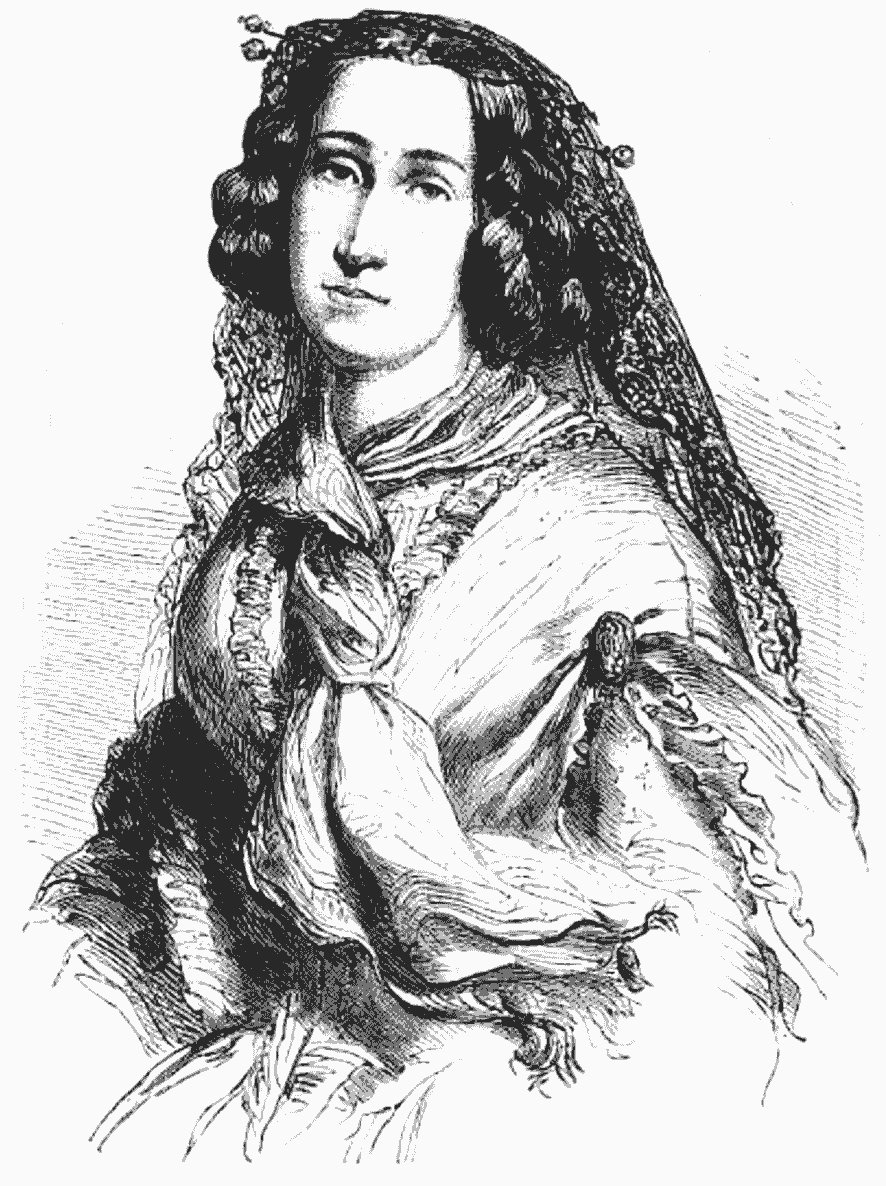
Marceline Desbordes-Valmore (20 June 1786 – 23 July 1859) was a French Romantic poet and novelist.
Early life and education
Desbordes-Valmore was born in Douai. Following the French Revolution, her father's business was ruined, and she traveled with her mother to Guadeloupe in search of financial help from a distant relative. Marceline's mother died of yellow fever there, and the young girl somehow made her way back to France. At age 16, back in Douai, she began a career on stage. In 1817 she married her husband, the "second-rate" actor Prosper Lanchantin-Valmore.
Career
Desbordes-Valmore published Élégies et Romances, her first poetic work, in 1819. In 1821 she published the narrative work Veillées des Antilles. It includes the novella Sarah, a contribution to the genre of slave stories in France.
Desbordes-Valmore appeared as an actress and singer in Douai, Rouen, the Opéra-Comique in Paris, and the Théâtre de la Monnaie in Brussels, where she notably played Rosine in Beaumarchais's Le Barbier de Séville. She retired from the stage in 1823. She later became friends with the novelist Honoré de Balzac, and he once wrote that she was an inspiration for the title character of La Cousine Bette.
Desbordes-Valmore was a friend of the writer Louise Crombach, who introduced Desbordes-Valmore to Marie Pape-Carpantier. Their friendship ended after Crombach was prosecuted for lesbianism in 1845.
The publication of her innovative volume of elegies in 1819 marks her as one of the founders of French Romantic poetry. Her poetry is also known for taking on dark and depressing themes, which reflects her troubled life. She is the only female writer included in the famous Les Poètes maudits anthology published by Paul Verlaine in 1884. A volume of her poetry was among the books in Friedrich Nietzsche's library.
Bibliography
Each year links to its corresponding "[year] in poetry" article:
Notes
References
- Descaves, Lucien. ''La Vie douloureuse de Marceline Desbordes-Valmore.'' Paris.
- "Marceline Desbordes-Valmore".
- L'Harmattan 2006.
- MLA 2008 in French and English translation. See also Doris Y. Kadish, Fathers, Daughters, and Slaves: Women Writers and French Colonial Slavery. Liverpool UP 2012
- Hunt, Herbert J. ''Balzac's Comédie Humaine''. London: [[University of London]] Athlone Press, 1959. {{OCLC. 4566561. p. 380.
- Bouchet. (December 2013). "charlesfourier.fr".
- Aimée Boutin, ''Maternal Echoes: The Poetry of Marceline Desbordes-Valmore and Alphonse de Lamartine.'' University of Delaware Press, 2001.
- 978-0-14-042385-3
This article was imported from Wikipedia and is available under the Creative Commons Attribution-ShareAlike 4.0 License. Content has been adapted to SurfDoc format. Original contributors can be found on the article history page.
Ask Mako anything about Marceline Desbordes-Valmore — get instant answers, deeper analysis, and related topics.
Research with MakoFree with your Surf account
Create a free account to save articles, ask Mako questions, and organize your research.
Sign up freeThis content may have been generated or modified by AI. CloudSurf Software LLC is not responsible for the accuracy, completeness, or reliability of AI-generated content. Always verify important information from primary sources.
Report