From Surf Wiki (app.surf) — the open knowledge base
Marathon
Long-distance running event of 42.195 kilometres

Long-distance running event of 42.195 kilometres
| Field | Value |
|---|---|
| event | Marathon |
| image | BSK CSOB MARATON046 (33791445325).jpg |
| image_size | 250px |
| caption | Competitors during the 2017 Bratislava Marathon |
| WRmen | Kelvin Kiptum 2:00:35 (2023) |
| ORmen | Tamirat Tola 2:06:26 (2024) |
| CRmen | Tamirat Tola 2:05:36 (2022) |
| WRwomen | ****: Ruth Chepng'etich 2:09:56 (2024) |
| ORwomen | Sifan Hassan 2:22:55 (2024) |
| CRwomen | Gotytom Gebreslase 2:18:11 (2022) |
****: Tigst Assefa 2:15:50 (2025)
The marathon is a long-distance foot race with a distance of kilometres ( 26 mi 385 yd), usually run as a road race, but the distance can be covered on trail routes. The marathon can be completed by running or with a run/walk strategy. There are also wheelchair divisions. More than 800 marathons are held worldwide each year, with the vast majority of competitors being recreational athletes, as larger marathons can have tens of thousands of participants.
A creation of the French philologist Michel Bréal inspired by a story from Ancient Greece, the marathon was one of the original modern Olympic events in 1896 in Athens. The distance did not become standardized until 1921. The distance is also included in the World Athletics Championships, which began in 1983. It is the only running road race included in both championship competitions (walking races on roads are also contested in both).
History
Origin
The name Marathon comes from the legend of Pheidippides, the Greek messenger. The legend states that while he was taking part in the Battle of Marathon, which took place in August or September 490 BC, he witnessed a Persian vessel changing its course towards Athens as the battle was near a victorious end for the Greek army. He interpreted this as an attempt by the defeated Persians to rush into the city to claim a false victory or simply raid, hence claiming their authority over Greek land. It was said that he ran the entire distance to Athens without stopping, discarding his weapons and even clothes to lose as much weight as possible, and burst into the assembly, exclaiming "we have won!", before collapsing and dying.
The account of the run from Marathon to Athens first appeared in Plutarch's On the Glory of Athens in the first century AD, which quoted from Heraclides Ponticus's lost work, giving the runner's name as either Thersipus of Erchius or Eucles. Satirist Lucian of Samosata gave one of the earliest accounts similar to the modern version of the story, but its historical veracity is disputed based on its tongue-in-cheek writing and the runner being referred to as Philippides and not Pheidippides.
There is debate about the historical accuracy of this legend. The Greek historian Herodotus, the main source for the Greco-Persian Wars, mentioned Philippides as the messenger who ran from Athens to Sparta asking for help, and then ran back, a distance of over 240 km each way. In some Herodotus manuscripts, the name of the runner between Athens and Sparta is given as Philippides. Herodotus makes no mention of a messenger sent from Marathon to Athens and relates that the main part of the Athenian army, having fought and won the grueling battle and fearing a naval raid by the Persian fleet against an undefended Athens, marched quickly back from the battle to Athens, arriving the same day.
In 1879, Robert Browning wrote the poem Pheidippides. Browning's poem, his composite story, became part of late 19th-century popular culture and was accepted as a historical legend.
Mount Pentelicus stands between Marathon and Athens, which means that Philippides would have had to run around the mountain, either to the north or to the south. The latter and more obvious route is followed by the modern Marathon-Athens highway (EO83–EO54), which follows the lay of the land southwards from Marathon Bay and along the coast, then takes a gentle but protracted climb westwards towards the eastern approach to Athens, between the foothills of Mounts Hymettus and Penteli, and then gently downhill to Athens proper. As it existed when the Olympics were revived in 1896, this route was approximately 40 km long. It was the approximate distance originally used for marathon races. However, there have been suggestions that Philippides might have followed another route: a westward climb along the eastern and northern slopes of Mount Penteli to the pass of Dionysos, and then a straight southward downhill path to Athens. This route is slightly shorter, 35 km, but includes a very steep climb over the first 5 km.

Modern Olympic marathon
Main article: Marathons at the Olympics
When the modern Olympics began in 1896, the initiators and organizers were looking for a great popularizing event, recalling the glory of ancient Greece. The idea of a marathon race came from Michel Bréal, who wanted the event to feature in the first modern Olympic Games in 1896 in Athens. This idea was heavily supported by Pierre de Coubertin, the founder of the modern Olympics, as well as by the Greeks. A selection race for the Olympic marathon was held on 22 March 1896 (Gregorian) that was won by Charilaos Vasilakos in 3 hours and 18 minutes. The winner of the first Olympic marathon, on 10 April 1896 (a male-only race), was Spyridon Louis, a Greek water-carrier, in 2 hours 58 minutes and 50 seconds. The marathon of the 2004 Summer Olympics was run on the traditional route from Marathon to Athens, ending at Panathinaiko Stadium, the venue for the 1896 Summer Olympics. That men's marathon was won by Italian Stefano Baldini in 2 hours 10 minutes and 55 seconds, a record time for this route until the non-Olympics Athens Classic Marathon of 2014 when Felix Kandie lowered the course record to 2 hours 10 minutes and 37 seconds.
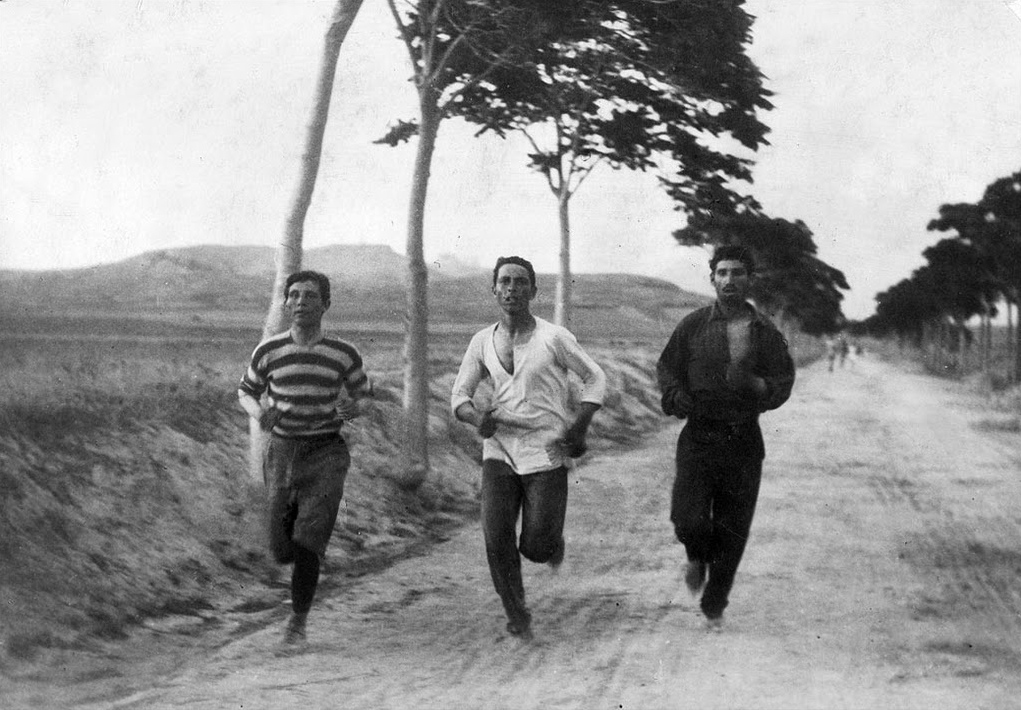
The women's marathon was introduced at the 1984 Summer Olympics (Los Angeles, US) and was won by Joan Benoit of the United States with a time of 2 hours 24 minutes and 52 seconds.
It has become a tradition for the men's Olympic marathon to be the last event of the athletics calendar, on the final day of the Olympics. For many years, the race finished inside the Olympic stadium; however, at the 2012 Summer Olympics (London), the start and finish were on The Mall, and at the 2016 Summer Olympics (Rio de Janeiro), the start and finish were in the Sambódromo, the parade area that serves as a spectator mall for Carnival.
Often, the men's marathon medals are awarded during the closing ceremony (including the 2004 games, 2012 games, 2016 games and 2020 games).
The Olympic men's record is 2:06:26, set at the 2024 Summer Olympics by Tamirat Tola of Ethiopia. The Olympic women's record is 2:22:55, set at the 2024 Summer Olympics by Sifan Hassan of The Netherlands. Per capita, the Kalenjin ethnic group of Rift Valley Province in Kenya has produced a highly disproportionate share of marathon and track-and-field winners.
Marathon mania in the US
The Boston Marathon began on 19 April 1897 and was inspired by the success of the first marathon competition in the 1896 Summer Olympics. It is the world's oldest annual marathon and ranks as one of the world's most prestigious road racing events. Its course runs from Hopkinton in southern Middlesex County to Boylston Street in Boston. Johnny Hayes' victory at the 1908 Summer Olympics also contributed to the early growth of long-distance running and marathoning in the United States. Later that year, races around the holiday season including the Empire City Marathon held on New Year's Day 1909 in Yonkers, New York, marked the early running craze referred to as "marathon mania". Following the 1908 Olympics, the first five amateur marathons in New York City were held on days that held special meanings: Thanksgiving Day, the day after Christmas, New Year's Day, Washington's Birthday, and Lincoln's Birthday.
Frank Shorter's victory in the marathon at the 1972 Summer Olympics would spur national enthusiasm for the sport more intensely than that which followed Hayes' win 64 years earlier. In 2014, an estimated 550,600 runners completed a marathon within the United States. This can be compared to 143,000 in 1980. Today, marathons are held all around the world on a nearly weekly basis.
Inclusion of women
For a long time after the Olympic marathon started, there were no long-distance races, such as the marathon, for women. Although a few women, such as Stamata Revithi in 1896, had run the marathon distance, they were not included in any official results. Marie-Louise Ledru has been credited as the first woman to complete a marathon, in 1918. Violet Piercy has been credited as the first woman to be officially timed in a marathon, in 1926.
Arlene Pieper became the first woman to officially finish a marathon in the United States when she completed the Pikes Peak Marathon in Manitou Springs, Colorado, in 1959. Kathrine Switzer was the first woman to run the Boston Marathon "officially" (with a number), in 1967. However, Switzer's entry, which was accepted through an "oversight" in the screening process, was in "flagrant violation of the rules", and she was treated as an interloper once the error was discovered. Bobbi Gibb had completed the Boston race unofficially the previous year (1966), and was later recognized by the race organizers as the women's winner for that year, as well as 1967 and 1968.
Distance
| Year | Distance | |
|---|---|---|
| (km) | Distance | |
| (miles) | ||
| 1896 | 40 | 24.85 |
| 1900 | 40.26 | 25.02 |
| 1904 | 40 | 24.85 |
| 1906 | 41.86 | 26.01 |
| 1908 | 42.195 | 26.22 |
| 1912 | 40.2 | 24.98 |
| 1920 | 42.75 | 26.56 |
| 1924 onward | 42.195 | 26.22 |
The length of an Olympic marathon was not precisely fixed at first. Despite this, the marathon races in the first few Olympic Games were about 40 km, roughly the distance from Marathon to Athens by the longer, flatter route. The exact length depended on the route established for each venue. The Boston Marathon, established by the inaugural US Olympic team manager, was 24.5 miles from 1897 to 1924.
1908 Olympics
Main article: Athletics at the 1908 Summer Olympics – Men's marathon
The International Olympic Committee agreed in 1907 that the distance for the 1908 London Olympic marathon would be about 25 miles or 40 kilometers. The organizers decided on a course of 26 miles from the start at Windsor Castle to the royal entrance to the White City Stadium, followed by a lap (586 yd) of the track, finishing in front of the Royal Box. The course was later altered to use a different entrance to the stadium, followed by a partial lap of 385 yards to the same finish.
The modern 42.195 km standard distance for the marathon was set by the International Amateur Athletic Federation (IAAF) in May 1921 directly from the length used at the 1908 Summer Olympics in London.
IAAF and world records
Main article: Marathon world record progression#Criteria for record eligibility

An official IAAF marathon course is 42.195 km (42 m tolerance only in excess). Course officials add a short course prevention factor of up to one meter per kilometer to their measurements to reduce the risk of a measuring error producing a length below the minimum distance.
For events governed by IAAF rules, the route must be marked so that all competitors can see the distance covered in kilometers.
Marathon races
Main article: List of marathon races (disambiguation){{!}}List of marathon races

Annually, more than 800 marathons are organized worldwide. Some of these belong to the Association of International Marathons and Distance Races (AIMS) which has grown since its foundation in 1982 to embrace over 300 member events in 83 countries and territories. The marathons of Berlin, Boston, Chicago, London, New York City, Tokyo and Sydney form the World Marathon Majors series, awarding $500,000 annually to the best overall male and female performers in the series.
In 2006, the editors of Runner's World selected a "World's Top 10 Marathons", in which the Amsterdam, Honolulu, Paris, Rotterdam, and Stockholm marathons were featured along with the five original World Marathon Majors events (excluding Tokyo). Other notable large marathons include United States Marine Corps Marathon, Los Angeles, and Rome. The Boston Marathon is the world's oldest annual marathon, inspired by the success of the 1896 Olympic marathon and held every year since 1897 to celebrate Patriots' Day, a holiday marking the beginning of the American Revolution, thereby purposely linking Athenian and American struggle for democracy. The oldest annual marathon in Europe is the Košice Peace Marathon, held since 1924 in Košice, Slovakia. The historic Polytechnic Marathon was discontinued in 1996. The Athens Classic Marathon traces the route of the 1896 Olympic course, starting in Marathon on the eastern coast of Attica, site of the Battle of Marathon of 490 BC, and ending at the Panathenaic Stadium in Athens.

The Midnight Sun Marathon is held in Tromsø, Norway at 70 degrees north. Using unofficial and temporary courses measured by GPS, races of marathon distance are now held at the North Pole, in Antarctica, and over desert terrain. Other unusual marathons include the Great Wall Marathon on The Great Wall of China, the Big Five Marathon among the safari wildlife of South Africa, the Great Tibetan Marathon – a marathon in an atmosphere of Tibetan Buddhism at an altitude of 3500 m, and the Polar Circle Marathon on the permanent ice cap of Greenland.
A few marathons cross international and geographical borders. The Istanbul Marathon is the only marathon where participants run over two continents (Europe and Asia) during a single event. In the Detroit Free Press Marathon, participants cross the US/Canada border twice. The Niagara Falls International Marathon includes one international border crossing, via the Peace Bridge from Buffalo, New York, United States to Fort Erie, Ontario, Canada. In the , participants run through Germany, Switzerland and Austria.
On 20 March 2018, an indoor Marathon occurred in the Armory in New York City. The 200 m track saw a world record in the women's and men's field. Lindsey Scherf (USA) set the indoor women's world record with 2:40:55. Malcolm Richards (USA) won in 2:19:01 with a male indoor world record.
Wheelchair division
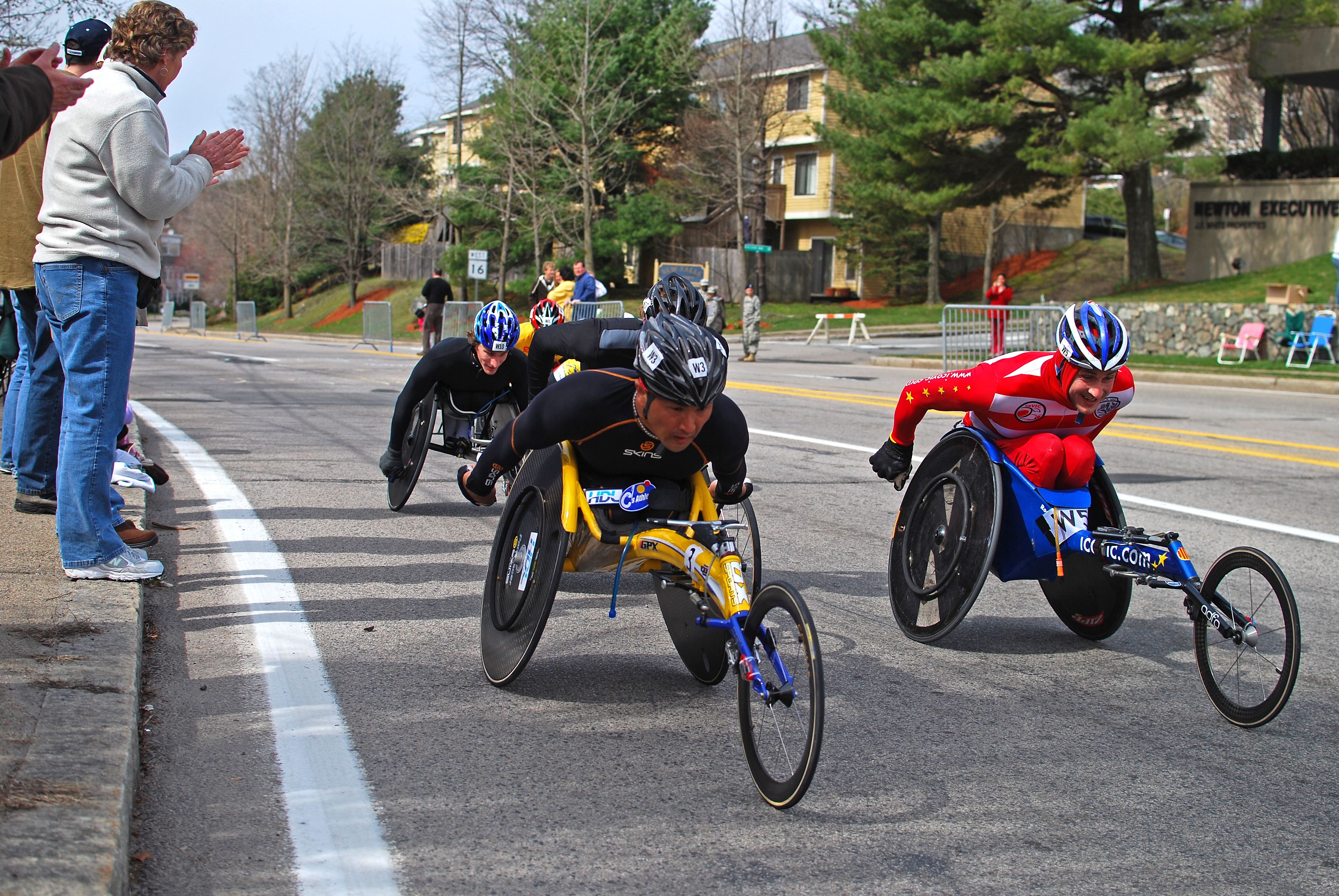
Many marathons feature a wheelchair division. Typically, those in the wheelchair racing division start their races earlier than their running counterparts.
The first wheelchair marathon was in 1974 in Toledo, Ohio, and it was won by Bob Hall at 2:54. Hall competed in the 1975 Boston Marathon and finished in 2:58, inaugurating the introduction of wheelchair divisions into the Boston Marathon. From 1977, the race was declared the US National Wheelchair championship. The Boston Marathon awards $10,000 to the winning push-rim athlete. Jean Driscoll won eight times (seven consecutively) and holds the women's world record at 1:34:22.
The New York City Marathon banned wheelchair entrants in 1977, citing safety concerns, but then voluntarily allowed Bob Hall to compete after the state Division of Human Rights ordered the marathon to show cause. The Division ruled in 1979 that the New York City Marathon and New York Road Runners club had to allow wheelchair athletes to compete, and confirmed this at appeal in 1980, but the New York Supreme Court ruled in 1981 that a ban on wheelchair racers was not discriminatory as the marathon was historically a foot race. However, by 1986, 14 wheelchair athletes were competing, and an official wheelchair division was added to the marathon in 2000.
Some of the quickest people to complete a wheel-chair marathon include Thomas Geierpichler (Austria), who won gold in the men's T52-class marathon (no lower limb function) in 1 hr 49 min 7 sec in Beijing, China, on 17 September 2008; and, Heinz Frei (Switzerland) who won the men's T54 marathon (for racers with spinal cord injuries) in a time of 1 hr 20 min and 14 sec in Oita, Japan, 31 October 1999.
Statistics
World records and world's best
World records were not officially recognized by the IAAF, now known as World Athletics, until 1 January 2004; previously, the best times for the marathon were referred to as the 'world best'. Courses must conform to World Athletics standards for a record to be recognized. However, marathon routes still vary greatly in elevation, course, and surface, making exact comparisons impossible. Typically, the fastest times are set over relatively flat courses near sea level, during good weather conditions and with the assistance of pacesetters.
The current world record time for men over the distance is 2 hours and 35 seconds, set in the Chicago Marathon by Kelvin Kiptum of Kenya on 8 October 2023.
The world record for women was set by Ruth Chepng'etich of Kenya in the Chicago Marathon on 13 October 2024, in 2 hours, 9 minutes, and 56 seconds. This broke Tigst Assefa's previous world record of 2 hours 11 minutes and 53 seconds by almost two minutes, and was the first time in history a woman broke the 2:11 and 2:10 barriers in the marathon.
All-time top 25
| *- denotes top performance (only) for other top 25 athletes who fall outside the top 25 marathon times* |
|---|
The data is correct .{{cite web |access-date = 24 April 2022 |access-date = 24 April 2021
Men
| Ath.# | Perf.# | Time | Athlete | Nation | Date | Place | ||||||||
|---|---|---|---|---|---|---|---|---|---|---|---|---|---|---|
| 1 | 1 | 2:00:35 | Kelvin Kiptum | 8 October 2023 | Chicago | |||||||||
| 2 | 2 | 2:01:09 | Eliud Kipchoge | 25 September 2022 | Berlin | |||||||||
| 3 | 2:01:25 | Kiptum #2 | 23 April 2023 | London | ||||||||||
| 4 | 2:01:39 | Kipchoge #2 | 16 September 2018 | Berlin | ||||||||||
| 3 | 5 | 2:01:41 | Kenenisa Bekele | 29 September 2019 | Berlin | |||||||||
| 4 | 6 | 2:01:48 | Sisay Lemma | 3 December 2023 | Valencia | |||||||||
| 7 | 2:01:53 | Kiptum #3 | 4 December 2022 | Valencia | ||||||||||
| 5 | 8 | 2:02:05 | Sabastian Sawe | 1 December 2024 | Valencia | |||||||||
| 6 | 9 | 2:02:16 | Benson Kipruto | 3 March 2024 | Tokyo | |||||||||
| 10 | 2:02:16 | Sawe #2 | 21 September 2025 | Berlin | ||||||||||
| 7 | 11 | 2:02:23 | Jacob Kiplimo | 12 October 2025 | Chicago | |||||||||
| 8 | 12 | 2:02:24 | John Korir | 7 December 2025 | Valencia | |||||||||
| 13 | 2:02:27 | Sawe #3 | 27 April 2025 | London | ||||||||||
| 14 | 2:02:37 | Kipchoge #3 | 28 April 2019 | London | ||||||||||
| 9 | 15 | 2:02:38 | Deresa Geleta | 1 December 2024 | Valencia | |||||||||
| 16 | 2:02:40 | Kipchoge #4 | 6 March 2022 | Tokyo | ||||||||||
| 17 | 2:02:42 | Kipchoge #5 | 24 September 2023 | Berlin | ||||||||||
| 18 | 2:02:44 | Korir #2 | 13 October 2024 | Chicago | ||||||||||
| 10 | 19 | 2:02:48 | Birhanu Legese | 29 September 2019 | Berlin | |||||||||
| 11 | 20 | 2:02:55 | Mosinet Geremew | 28 April 2019 | London | |||||||||
| Timothy Kiplagat | 3 March 2024 | Tokyo | ||||||||||||
| 13 | 22 | 2:02:57 | Dennis Kipruto Kimetto | 28 September 2014 | Berlin | |||||||||
| 14 | 23 | 2:03:00 | Evans Chebet | 6 December 2020 | Valencia | |||||||||
| Gabriel Geay | 4 December 2022 | Valencia | title=Kiptum and Beriso break course records in Valencia | url=https://www.worldathletics.org/news/report/valencia-marathon-kiptum-beriso | publisher=World Athletics | author=Emeterio Valiente | date=4 December 2022 | access-date=5 December 2022}} | ||||||
| 25 | 2:03:03 | Bekele #2 | 25 September 2016 | Berlin | ||||||||||
| 16 | 2:03:04 | Lawrence Cherono | 6 December 2020 | Valencia | ||||||||||
| 17 | 2:03:11 | Alexander Mutiso | 3 December 2023 | Valencia | ||||||||||
| 18 | 2:03:13 | Emmanuel Kipchirchir Mutai | 28 September 2014 | Berlin | ||||||||||
| Wilson Kipsang Kiprotich | 25 September 2016 | Berlin | title=Bekele gets back to his brilliant best at Berlin Marathon | url=https://www.iaaf.org/news/report/kenenisa-bekele-berlin-marathon-2016 | publisher=IAAF | author=Cathal Dennehy | date=25 September 2016 | access-date=25 September 2016 | archive-url=https://web.archive.org/web/20160926154803/https://www.iaaf.org/news/report/kenenisa-bekele-berlin-marathon-2016 | archive-date=26 September 2016 | url-status=live}} | |||
| Amos Kipruto | 6 March 2022 | Tokyo | title=Kipchoge and Kosgei race to Japanese all-comers' records in Tokyo | url=https://www.worldathletics.org/competitions/world-athletics-label-road-races/news/kipchoge-kosgei-all-comers-records-tokyo-marathon | publisher=World Athletics | author=Jess Whittington | date=6 March 2022 | access-date=8 March 2022}} | ||||||
| Vincent Kipkemoi | 24 September 2023 | Berlin | ||||||||||||
| 22 | 2:03:16 | Mule Wasihun | 28 April 2019 | London | ||||||||||
| 23 | 2:03:17 | Milkesa Mengesha | 29 September 2024 | Berlin | title=Mengesha and Ketema claim Berlin Marathon crowns | url=https://worldathletics.org/competitions/world-athletics-label-road-races/news/50th-berlin-marathon-2024-mengesha-ketema | publisher=World Athletics | date=29 September 2024 | access-date=2 October 2024}} | |||||
| 24 | 2:03:22 | Cyprian Kimurgor Kotut | 29 September 2024 | Berlin | ||||||||||
| 25 | 2:03:23 | Tadese Takele | 2 March 2025 | Tokyo |
Notes
- Eliud Kipchoge (Kenya) ran a time of 1:59:40.2 at the Ineos 1:59 Challenge in Vienna on 12 October 2019. This event was run with no other competitors and with the assistance of fuel and hydration on demand and in-out pacemakers. Therefore, the attempt was not eligible for official ratification. This was faster than his previous assisted run of 2:00:25 at the Nike Breaking2 in Monza on 6 May 2017, which was also ineligible.
- Titus Ekiru (Kenya) ran a time of 2:02:57 at the Milano City Marathon on 16 May 2021, but was later disqualified due to doping violations.
- Geoffrey Mutai (Kenya) ran a time of 2:03:02 at the Boston Marathon on 18 April 2011 that was run on an assisted course (in the case of Boston, a point-to-point, net downhill course in excess of the standards) and is therefore ineligible for record purposes per IAAF rule 260.28
- Moses Mosop (Kenya) ran a time of 2:03:06 at the Boston Marathon on 18 April 2011 that was run on an assisted course and is therefore ineligible for record purposes per IAAF rule 260.28
Women
| Ath.# | Perf.# | Time | Athlete | Nation | Date | Place | |||||||
|---|---|---|---|---|---|---|---|---|---|---|---|---|---|
| 1 | 1 | 2:09:56 | Ruth Chepng'etich | 13 October 2024 | Chicago | ||||||||
| 2 | 2 | 2:11:53 | Tigst Assefa | 24 September 2023 | Berlin | ||||||||
| 3 | 3 | 2:13:44 | Sifan Hassan | 8 October 2023 | Chicago | ||||||||
| 4 | 4 | 2:14:00 | Joyciline Jepkosgei | 7 December 2025 | Valencia | ||||||||
| 5 | 5 | 2:14:04 | Brigid Kosgei | 13 October 2019 | Chicago | ||||||||
| 6 | 2:14:18 | Chepng'etich #2 | 9 October 2022 | Chicago | |||||||||
| 6 | 7 | 2:14:43 | Peres Jepchirchir | 7 December 2025 | Valencia | ||||||||
| 7 | 8 | 2:14:57 | Hawi Feysa | 12 October 2025 | Chicago | ||||||||
| 8 | 9 | 2:14:58 | Amane Beriso Shankule | 4 December 2022 | Valencia | ||||||||
| 9 | 10 | 2:15:25 | Paula Radcliffe | 13 April 2003 | London | ||||||||
| 11 | 2:15:37 | Assefa #2 | 25 September 2022 | Berlin | |||||||||
| Chepng'etich #3 | 8 October 2023 | Chicago | |||||||||||
| 13 | 2:15:50 | Assefa #3 | 27 April 2025 | London | |||||||||
| 10 | 14 | 2:15:51 | Worknesh Degefa | 3 December 2023 | Valencia | ||||||||
| 11 | 15 | 2:15:55 | Sutume Asefa Kebede | 3 March 2024 | Tokyo | ||||||||
| 16 | 2:16:02 | Kosgei #2 | 6 March 2022 | Tokyo | |||||||||
| 12 | 17 | 2:16:07 | Tigist Ketema | 7 January 2024 | Dubai | ||||||||
| 13 | 18 | 2:16:14 | Rosemary Wanjiru | 3 March 2024 | Tokyo | ||||||||
| 19 | 2:16:16 | Jepchirchir #2 | 21 April 2024 | London | |||||||||
| 14 | 20 | 2:16:22 | Almaz Ayana | 3 December 2023 | Valencia | ||||||||
| 21 | 2:16:23 | Assefa #4 | 21 April 2024 | London | |||||||||
| 22 | 2:16:24 | Jepkosgei #2 | 21 April 2024 | London | |||||||||
| 23 | 2:16:28 | Wanjiru #2 | 5 March 2023 | Tokyo | title=Wanjiru and Gelmisa triumph in Tokyo Marathon | url=https://worldathletics.org/competitions/world-athletics-label-road-races/news/tokyo-marathon-2023-wanjiru-gelmisa | publisher=World Athletics | date=5 March 2023 | access-date=12 March 2023}} | ||||
| 24 | 2:16:31 | Kebede #2 | 2 March 2025 | Tokyo | |||||||||
| 15 | 25 | 2:16:34 | Alemu Megertu | 21 April 2024 | London | ||||||||
| 16 | 2:16:49 | Letesenbet Gidey | 4 December 2022 | Valencia | |||||||||
| 17 | 2:16:52 | Yalemzerf Yehualaw | 20 October 2024 | Amsterdam | title=Yehualaw breaks Amsterdam course record, Getachew regains title | url=https://worldathletics.org/competitions/world-athletics-label-road-races/news/amsterdam-marathon-yehualaw-getachew-2024 | publisher=World Athletics | date=20 October 2024 | access-date=2 November 2024}} | ||||
| 18 | 2:16:56 | Winfridah Moseti | 2 March 2025 | Tokyo | title=Tokyo Marathon 2025: All results and times - complete list | url=https://www.olympics.com/en/news/tokyo-marathon-2025-results | website=olympics.com | author=Shintaro Kano | date=2 March 2025 | access-date=23 March 2025}} | |||
| 19 | 2:17:01 | Mary Jepkosgei Keitany | 23 April 2017 | London | url=https://www.worldathletics.org/news/report/london-marathon-2017-keitany-world-record | title=Keitany breaks women's-only world record at London Marathon | publisher=World Athletics | date=23 April 2017 | archive-url=https://web.archive.org/web/20210828171157/https://www.worldathletics.org/news/report/london-marathon-2017-keitany-world-record | archive-date=28 August 2021 | access-date=28 August 2021 | url-status=bot: unknown }} | |
| 20 | 2:17:29 | Sheila Chepkirui | 4 December 2022 | Valencia | |||||||||
| 21 | 2:17:36 | Tadu Teshome Nare | 4 December 2022 | Valencia | |||||||||
| 22 | 2:17:37 | Aynalem Desta | 19 October 2025 | Amsterdam | |||||||||
| 23 | 2:17:45 | Lonah Chemtai Salpeter | 1 March 2020 | Tokyo | title=Legese retains Tokyo Marathon crown while Salpeter smashes course record | url=https://www.worldathletics.org/news/report/tokyo-marathon-2020-legese-salpeter-osako | publisher=IAAF | author=Ken Nakamura | date=1 March 2020 | access-date=25 March 2020}} | |||
| 24 | 2:17:51 | Irene Chepet Cheptai | 13 October 2024 | Chicago | |||||||||
| 25 | 2:17:55 | Workenesh Edesa | 27 April 2025 | Hamburg |
Notes
- Tsehay Gemechu (Ethiopia) ran a time of 2:16:56 at the Tokyo Marathon on 5 March 2023. She received a four-year ban in October 2024, backdated to the provisional suspension issued in November 2023, for an anti-doping rule violation indicated by abnormalities in her Athlete Biological Passport. All her results from March 2020 onwards were disqualified.
World leading times
| Year | Time | Athlete | Place |
|---|---|---|---|
| 2000 | 2:06:36 | António Pinto | London |
| 2001 | 2:06:50 | Josephat Kiprono | Rotterdam |
| 2002 | 2:05:38 | Khalid Khannouchi | London |
| 2003 | 2:04:55 | Paul Tergat | Berlin |
| 2004 | 2:06:14 | Felix Limo | Rotterdam |
| 2005 | 2:06:20 | Haile Gebrselassie | Amsterdam |
| 2006 | 2:05:56 | Haile Gebrselassie | Berlin |
| 2007 | 2:04:26 | Haile Gebrselassie | Berlin |
| 2008 | 2:03:59 | Haile Gebrselassie | Berlin |
| 2009 | 2:04:27 | Duncan Kibet | Rotterdam |
| James Kwambai | |||
| 2010 | 2:04:48 | Patrick Makau Musyoki | Rotterdam |
| 2011 | 2:03:38 | Patrick Makau Musyoki | Berlin |
| 2012 | 2:04:15 | Geoffrey Mutai | Berlin |
| 2013 | 2:03:23 | Wilson Kipsang Kiprotich | Berlin |
| 2014 | 2:02:57 | Dennis Kimetto | Berlin |
| 2015 | 2:04:00 | Eliud Kipchoge | Berlin |
| 2016 | 2:03:03 | Kenenisa Bekele | Berlin |
| 2017 | 2:03:32 | Eliud Kipchoge | Berlin |
| 2018 | 2:01:39 | Eliud Kipchoge | Berlin |
| 2019 | 2:01:41 | Kenenisa Bekele | Berlin |
| 2020 | 2:03:00 | Evans Chebet | Valencia |
| 2021 | 2:03:36 | Bashir Abdi | Rotterdam |
| 2022 | 2:01:09 | Eliud Kipchoge | Berlin |
| 2023 | 2:00:35 | Kelvin Kiptum | Chicago |
| 2024 | 2:02:05 | Sabastian Sawe | Valencia |
| 2025 | 2:02:16 | Sabastian Sawe | Berlin |
| Year | Time | Athlete | Place |
|---|---|---|---|
| 2000 | 2:21:33 | Catherine Ndereba | Chicago |
| 2001 | 2:18:47 | Catherine Ndereba | Chicago |
| 2002 | 2:17:18 | Paula Radcliffe | Chicago |
| 2003 | 2:15:25 | Paula Radcliffe | London |
| 2004 | 2:19:41 | Yoko Shibui | Berlin |
| 2005 | 2:17:42 | Paula Radcliffe | London |
| 2006 | 2:19:36 | Deena Kastor | London |
| 2007 | 2:20:38 | Zhou Chunxiu | London |
| 2008 | 2:19:19 | Irina Mikitenko | Berlin |
| 2009 | 2:22:11 | Irina Mikitenko | London |
| 2010 | 2:22:04 | Atsede Bayisa | Paris |
| 2011 | 2:19:19 | Mary Jepkosgei Keitany | London |
| 2012 | 2:18:37 | Mary Jepkosgei Keitany | London |
| 2013 | 2:19:57 | Rita Jeptoo | Chicago |
| 2014 | 2:20:18 | Tirfi Tsegaye | Berlin |
| 2015 | 2:19:25 | Gladys Cherono Kiprono | Berlin |
| 2016 | 2:19:41 | Tirfi Tsegaye | Berlin |
| 2017 | 2:17:01 | Mary Jepkosgei Keitany | Dubai |
| 2018 | 2:18:11 | Gladys Cherono Kiprono | Berlin |
| 2019 | 2:14:04 | Brigid Kosgei | Chicago |
| 2020 | 2:17:16 | Peres Jepchirchir | Valencia |
| 2021 | 2:17:43 | Joyciline Jepkosgei | London |
| 2022 | 2:14:18 | Ruth Chepng'etich | Chicago |
| 2023 | 2:11:53 | Tigst Assefa | Berlin |
| 2024 | 2:09:56 | Ruth Chepng'etich | Chicago |
| 2025 | 2:14:00 | Joyciline Jepkosgei | Valencia |
Oldest marathoner
Fauja Singh, then 100, finished the Toronto Waterfront Marathon, becoming the first centenarian ever to officially complete that distance. Singh, a British citizen, finished the race on 16 October 2011 with a time of 8:11:05.9, making him the oldest marathoner. Because Singh could not produce a birth certificate from rural 1911 Colonial India, the place of his birth, his age could not be verified and his record was not accepted by the official governing body World Masters Athletics.
Johnny Kelley ran his last full Boston Marathon at the documented age of 84 in 1992. He previously had won the Boston Marathon in both 1935 and 1945 respectively. Between 1934 and 1950, Johnny finished in the top five 15 times, consistently running in the 2:30s and finishing in second place a record seven times at Boston. A fixture at Boston for more than a half century, his 1992 61st start and 58th finish in Boston is a record which still stands today.
Gladys Burrill, a 92-year-old Prospect, Oregon woman and part-time resident of Hawaii, previously held the Guinness World Records title of oldest person to complete a marathon with her 9 hours 53 minutes performance at the 2010 Honolulu Marathon. The records of the Association of Road Racing Statisticians, at that time, however, suggested that Singh was overall the oldest marathoner, completing the 2004 London Marathon at the age of 93 years and 17 days, and that Burrill was the oldest female marathoner, completing the 2010 Honolulu Marathon at the age of 92 years and 19 days. Singh's age was also reported to be 93 by other sources.
In 2015, 92-year-old Harriette Thompson of Charlotte, North Carolina, completed the Rock 'n' Roll San Diego Marathon in 7 hours 24 minutes 36 seconds, thus becoming the oldest woman to complete a marathon. While Gladys Burrill was 92 years and 19 days old when she completed her record-setting marathon, Harriette Thompson was 92 years and 65 days old when she completed hers.
English born Canadian Ed Whitlock is the oldest to complete a marathon in under 3 hours at age 74, and under 4 hours at age 85.
Youngest marathoner
Budhia Singh, a boy from Odisha, India, completed his first marathon at age five. He trained under the coach Biranchi Das, who saw potential in him. In May 2006, Budhia was temporarily banned from running by the ministers of child welfare, as his life could be at risk. His coach was also arrested for exploiting and cruelty to a child and was later murdered in an unrelated incident. Budhia is now at a state-run sports academy.
The youngest under 4 hours is Mary Etta Boitano at age 7 years, 284 days; under 3 hours Julie Mullin at 10 years 180 days; and under 2:50 Carrie Garritson at 11 years 116 days.
Participation
In 2016, Running USA estimated that there were approximately 507,600 marathon finishers in the United States, while other sources reported greater than 550,000 finishers. The chart below from Running USA provides the estimated U.S. Marathon Finisher totals going back to 1976.
Marathon running has become an obsession in China, with 22 marathon races in 2011 increasing to 400 in 2017. In 2015, 75 Chinese runners participated in the Boston Marathon and this increased to 278 in 2017.
Multiple marathons
As marathon running has become more popular, some athletes have undertaken challenges involving running a series of marathons.
The 100 Marathon Club is intended to provide a focal point for all runners, particularly from the United Kingdom or Ireland, who have completed 100 or more races of marathon distance or longer. At least 10 of these events must be United Kingdom or Ireland Road Marathons. Club chairman Roger Biggs has run more than 700 marathons or ultras. Brian Mills completed his 800th marathon on 17 September 2011.
Steve Edwards, a member of the 100 Marathon Club, set the world record for running 500 marathons in the fastest average finish time of 3 hours 15 minutes, at the same time becoming the first man to run 500 marathons with an official time below 3 hours 30 minutes, on 11 November 2012 at Milton Keynes, England. The records took 24 years to achieve. Edwards was 49 at the time.
Over 350 individuals have completed a marathon in each state of the United States plus Washington, D.C., and some have done it as many as eight times. Beverly Paquin, a 22-year-old nurse from Iowa, was the youngest woman to run a marathon in all 50 states in 2010. A few weeks later, still in 2010, Morgan Cummings (also 22) became the youngest woman to complete a marathon in all 50 states and DC. In 2004, Chuck Bryant of Miami, Florida, who lost his right leg below the knee, became the first amputee to finish this circuit. Bryant has completed a total of 59 marathons on his prosthesis. Twenty-seven people have run a marathon on each of the seven continents, and 31 people have run a marathon in each of the Canadian provinces. In 1980, in what was termed the Marathon of Hope, Terry Fox, who had lost a leg to cancer and so ran with one artificial leg, attained 5373 km of his proposed cross-Canada cancer fundraising run, maintaining an average of over 37 km, close to the planned marathon distance, for each of 143 consecutive days.

On 25 September 2011, Patrick Finney of Grapevine, Texas became the first person with multiple sclerosis to finish a marathon in each state of the United States. In 2004, "the disease had left him unable to walk. But unwilling to endure a life of infirmity, Finney managed to regain his ability to balance on two feet, to walk – and eventually to run – through extensive rehabilitation therapy and new medications."
In 2003, British adventurer Sir Ranulph Fiennes completed seven marathons on seven continents in seven days. He completed this feat despite suffering from a heart attack and undergoing a double heart bypass operation just four months before. This feat has since been eclipsed by Irish ultramarathon runner Richard Donovan who in 2009 completed seven marathons on seven continents in under 132 hours (five and a half days). Starting 1 February 2012 he improved on this by completing the 7 on 7 in under 120 hours or in less than five days.
On 30 November 2013, 69-year-old Larry Macon set a Guinness World Record for Most Marathons Run in a Year by Man by running 238 marathons. Larry Macon celebrated his 1,000th career marathon at the Cowtown Marathon in Ft. Worth on 24 February 2013.
Other goals are to attempt to run marathons on a series of consecutive weekends (Richard Worley on 159 weekends), or to run the most marathons during a particular year or the most in a lifetime. A pioneer in running multiple marathons was Sy Mah of Toledo, Ohio, who ran 524 before he died in 1988. As of 30 June 2007, Horst Preisler of Germany had successfully completed 1214 marathons plus 347 ultramarathons, a total of 1561 events at marathon distance or longer. Sigrid Eichner, Christian Hottas and Hans-Joachim Meyer have also all completed over 1000 marathons each. Norm Frank of the United States is credited with 945 marathons.
Christian Hottas is meanwhile the first runner who ever completed 2000 marathons. He ran his 2000th at TUI Marathon Hannover on 5 May 2013 together with a group of more than 80 friends from 11 countries, including 8 officers from the 100 Marathons Clubs U.K., North-America, Germany, Denmark, Austria and Italy. Hottas completed his 2500th marathon on 4 December 2016.
In 2010, Stefaan Engels, a Belgian, set out to run the marathon distance every day of the year. Because of a foot injury he had to resort to a handcycle near the end of January 2010. However, on 5 February he was fully recovered and decided to reset the counter back to zero. By 30 March he broke the existing record of Akinori Kusuda, from Japan, who completed 52 marathons in a row in 2009. On 5 February 2011, Engels had run 365 marathon distances in as many days. Ricardo Abad Martínez, from Spain, later ran 150 marathons in 150 consecutive days in 2009, and subsequently 500 marathons in a row, from October 2010 to February 2012.
In 2024, Belgian Hilde Dosogne ran a marathon every day of the year. On 31 December, the 55-year-old ran her 366th and last marathon, a record for a woman (accounting for 15,445 kilometres, 22 pairs of shoes and 15 falls).
Some runners compete to run the same marathons for the most consecutive years. For example, Johnny Kelley completed 58 Boston Marathons (he entered the race 61 times). Currently, the longest consecutive streak of Boston Marathon finishes—45 in a row—is held by Bennett Beach, of Bethesda, Maryland.
Olympic medalists
Main article: Marathons at the Olympics
Men
Women
World Championship medalists
Main article: Marathons at the World Athletics Championships
Men
Women
General participation

Most participants do not run a marathon to win. More important for most runners is their personal finishing time and their placement within their specific gender and age group, though some runners just want to finish. Strategies for completing a marathon include running the whole distance and a run–walk strategy. In 2005, the average marathon time in the U.S. was 4 hours 32 minutes 8 seconds for men, 5 hours 6 minutes 8 seconds for women. In 2015, the men's and women's median marathon times were 4 hours 20 minutes 13 seconds and 4 hours 45 minutes 30 seconds respectively.
A goal many runners aim for is to break certain time barriers. For example, recreational first-timers often try to run the marathon under four hours; more competitive runners may attempt to finish under three hours. Other benchmarks are the qualifying times for major marathons. The Boston Marathon, the oldest marathon in the United States, requires a qualifying time for all non-professional runners. The New York City Marathon also requires a qualifying time for guaranteed entry, at a significantly faster pace than Boston's.
Typically, there is a maximum allowed time of about six hours after which the marathon route is closed, although some larger marathons keep the course open considerably longer (eight hours or more). Many marathons around the world have such time limits by which all runners must have crossed the finish line. Anyone slower than the limit will be picked up by a sweeper bus. In many cases the marathon organizers are required to reopen the roads to the public so that traffic can return to normal.
With the growth in popularity of marathon-running, many marathons across the United States and the world have been filling to capacity faster than ever before. When the Boston Marathon opened up registration for its 2011 running, the field capacity was filled within eight hours.
Training
The long run is an important element in marathon training. Recreational runners commonly try to reach a maximum of about 32 km in their longest weekly run and a total of about 64 km a week when training for the marathon, but wide variability exists in practice and in recommendations. More experienced marathoners may run a longer distance during the week. Greater weekly training mileages can offer greater results in terms of distance and endurance, but also carry a greater risk of training injury. Most male elite marathon runners will complete weekly distances of over 160 km. It is recommended that those new to running should get a checkup from their doctor, as there are certain warning signs and risk factors that should be evaluated before undertaking any new workout program, especially marathon training.
Many training programs last a minimum of five or six months, with a gradual increase in the distance run and finally, for recovery, a period of tapering in the one to three weeks preceding the race. For beginners wishing to merely finish a marathon, a minimum of four months of running four days a week is recommended. Many trainers recommend a weekly increase in mileage of no more than 10%. It is also often advised to maintain a consistent running program for six weeks or so before beginning a marathon training program, to allow the body to adapt to the new stresses.{{Cite book| author=Burfoot, A. Ed | access-date = 17 April 2009 | author-link = Marius Bakken | archive-url = https://web.archive.org/web/20090209131411/http://www.marathon-training-schedule.com/training-for-a-marathon.html | archive-date = 9 February 2009 | url-status = live }}
Training programs can be found at the websites of Runner's World, Hal Higdon, Jeff Galloway, and in numerous other published sources, including the websites of specific marathons.
The last long training run might be undertaken up to two weeks prior to the event. Many marathon runners also "carbo-load" (increase carbohydrate intake while holding total caloric intake constant) during the week before the marathon to allow their bodies to store more glycogen.
Glycogen and "the wall"
Main article: Hitting the wall
Carbohydrates that a person eats are converted by the liver and muscles into glycogen for storage. Glycogen burns rapidly to provide quick energy. Runners can store about 8 MJ or 2,000 kcal worth of glycogen in their bodies, enough for about 30 km/18–20 miles of running. Many runners report that running becomes noticeably more difficult at that point. When glycogen runs low, the body must then obtain energy by burning stored fat, which does not burn as readily. When this happens, the runner will experience dramatic fatigue and is said to "hit the wall". The aim of training for the marathon, according to many coaches, is to maximize the limited glycogen available so that the fatigue of the "wall" is not as dramatic. This is accomplished in part by utilizing a higher percentage of energy from burned fat even during the early phase of the race, thus conserving glycogen.
Carbohydrate-based "energy gels" are used by runners to avoid or reduce the effect of "hitting the wall", as they provide easy to digest energy during the run. Energy gels usually contain varying amounts of sodium and potassium and some also contain caffeine. They need to be consumed with a certain amount of water. Recommendations for how often to take an energy gel during the race range widely.

Alternatives to gels include various forms of concentrated sugars, and foods high in simple carbohydrates that can be digested easily. Many runners experiment with consuming energy supplements during training runs to determine what works best for them. Consumption of food while running sometimes makes the runner sick. Runners are advised not to ingest a new food or medicine just prior to or during a race.
Temperature
A study of the performance of 1.8 million participants in the Berlin, London, Paris, Boston, Chicago, and New York marathons during the years from 2001 to 2010 found that runners recorded their fastest times when the temperature was around 6 C, with an increase of 10 °C (18 °F) leading to a 1.5% reduction in speed. A July 2020 study found that increasing temperatures affected faster runners' performance more than slower ones.
After a marathon
Marathon participation may result in various medical, musculoskeletal, and dermatological complaints. Delayed onset muscle soreness (DOMS) is a common condition affecting runners during the first week following a marathon. Various types of mild exercise or massage have been recommended to alleviate pain secondary to DOMS. Dermatological issues frequently include "jogger's nipple", "jogger's toe", and blisters.
The immune system is reportedly suppressed for a short time. Changes to the blood chemistry, such as elevated Cardiac Troponin T, may lead physicians to mistakenly diagnose heart malfunction.
After long training runs and the marathon itself, consuming carbohydrates to replace glycogen stores and protein to aid muscle recovery is commonly recommended. In addition, soaking the lower half of the body for approximately 20 minutes in cold or ice water may force blood through the leg muscles to speed recovery.
Health risks
Marathon running has various health risks, though these can be diminished with preparation and care. Training and the races themselves can put runners under stress. While very rare, even death is a possibility during a race.
Common minor health risks include blisters, tendonitis, fatigue, knee or ankle sprain, dehydration (electrolyte imbalance), and other conditions. Many are categorised as overuse injuries.
Cardiac health
In 2016, a systematic medical review found that the risk of sudden cardiac death during or immediately after a marathon was between 0.6 and 1.9 deaths per 100,000 participants, varying across the specific studies and the methods used, and not controlling for age or gender. Since the risk is small, cardiac screening programs for marathons are uncommon. However, this review was not an attempt to assess the overall cardiac health impact of marathon running.
A 2006 study of non-elite Boston Marathon participants tested runners for certain proteins that indicate heart damage or dysfunction (see Troponin) and gave them echocardiogram scans, before and after the marathon. The study revealed that, in that sample of 60 people, runners who had averaged fewer than 56 km of weekly training in the 4 months before the race were most likely to show some heart damage or dysfunction, while runners who had done more than 72 km of weekly training showed few or no heart problems.
According to a Canadian study presented in 2010, running a marathon can temporarily result in decreased function of more than half the muscle segments in the heart's main pumping chamber, but neighboring segments are generally able to compensate. Full recovery is reached within three months. The fitter the runner, the less the effect. The runners with decreased left ventricle function had an average peak weekly training distance of 55.1 km, while those who did not averaged 69.1 km. The marathon was held in 35 C weather. According to one of the researchers: "Regular exercise reduces cardiovascular risk by a factor of two or three in the long run, but while we're doing vigorous exercise such as marathon running, our cardiac risk increases by seven."
Hydration

Overconsumption is the most significant concern associated with water consumption during marathons. Drinking excessive amounts of fluid during a race can lead to dilution of sodium in the blood, a condition called exercise-associated hyponatremia, which may result in vomiting, seizures, coma and even death. Dr. Lewis G. Maharam, medical director for the New York City Marathon, stated in 2005: "There are no reported cases of dehydration causing death in the history of world running, but there are plenty of cases of people dying of hyponatremia."
For example, Dr. Cynthia Lucero died at the age of 28 while participating in the 2002 Boston Marathon. It was Lucero's second marathon. At mile 22, Lucero complained of feeling "dehydrated and rubber-legged." She soon wobbled and collapsed to the ground, and was unconscious by the time the paramedics reached her. Lucero was admitted to Brigham and Women's Hospital and died two days later.
Lucero's cause of death was determined to be hyponatremic encephalopathy, a condition that causes swelling of the brain due to an imbalance of sodium in the blood known as exercise-associated hyponatremia (EAH). While EAH is sometimes referred to as "water intoxication", Lucero drank large amounts of Gatorade during the race, demonstrating that runners who consume sodium-containing sports drinks in excess of thirst can still develop EAH. Because hyponatremia is caused by excessive water retention, and not just loss of sodium, consumption of sports drinks or salty foods may not prevent hyponatremia.
Women are more prone to hyponatremia than men. A study in the New England Journal of Medicine found that 13% of runners completing the 2002 Boston Marathon had hyponatremia.
The International Marathon Medical Directors Association (IMMDA) advised in 2006 that fluid intake should be adjusted individually according to factors such as body weight, sex, climate, pace, fitness (VO2 max), and sweat rate, as fluid requirements can vary between people depending on these variables. The IMMDA also recommended sports drinks that include carbohydrates and electrolytes instead of plain water and said that runners should "drink to thirst", trying to refrain from drinking at every fluid station before feeling thirsty. Heat exposure leads to diminished thirst drive and thirst may not be a sufficient incentive to drink in many situations. The IMMDA and HSL Harpur Hill give recommendations to drink fluid in small volumes frequently at an approximate rate falling between 100 - every 15 minutes. A patient suffering hyponatremia can be given a small volume of a concentrated salt solution intravenously to raise sodium concentrations in the blood. Some runners weigh themselves before running and write the results on their bibs. If anything goes wrong, first aid workers can use the weight information to tell if the patient had consumed too much water.
Body temperature
Exertional heat stroke is an emergency condition in which thermoregulation fails and the body temperature rises dangerously above 40 C. It becomes a greater risk in warm and humid weather, even for young and fit individuals. Treatment requires rapid physical cooling of the body.
Charity involvement
Some charities seek to associate with various races. Some marathon organizers set aside a portion of their limited entry slots for charity organizations to sell to members in exchange for donations. Runners are given the option to sign up to run particular races, especially when marathon entries are no longer available to the general public. In some cases, charities organize their own marathon as a fund-raiser, gaining funds via entry fees or sponsorships.
Culture
; Mars rover marathon

In 2015 the Mars rover Opportunity attained the distance of a marathon from its starting location on Mars, and the valley where it achieved this distance was called Marathon Valley, which was then explored.
Notes
References
Bibliography
- Hans-Joachim Gehrke, "From Athenian identity to European ethnicity: The cultural biography of the myth of Marathon," in Ton Derks, Nico Roymans (ed.), Ethnic Constructs in Antiquity: The Role of Power and Tradition (Amsterdam, Amsterdam University Press, 2009) (Amsterdam Archaeological Studies, 13), 85–100.
- Hans W. Giessen: Mythos Marathon. Von Herodot über Bréal bis zur Gegenwart. (= Landauer Schriften zur Kommunikations- und Kulturwissenschaft. Band 17). Verlag Empirische Pädagogik, Landau 2010
- Tom Derderian, Boston Marathon: History of the World's Premier Running Event, Human Kinetics, 1994, 1996
References
- (2009). "IAAF Competition Rules for Road Races". International Association of Athletics Federations.
- (11 July 2016). "Marathons in history with >30,000 finishers". [[Association of International Marathons and Distance Races]].
- (19 July 2004). "Astronomers Unravel Marathon Mystery".
- "Retreats — Athens". Jeffgalloway.com.
- "Ancient Olympics FAQ 10". Perseus.tufts.edu.
- Moralia 347C
- (4 November 2011). "The Myth of Pheidippides and the Marathon".
- "A slip of the tongue in salutation, Chapter 3; The Works of Lucian of Samosata. Translated by Fowler, H.W. and F.G.; Oxford: The Clarendon Press. 1905".
- "Prologue: The Legend". Marathonguide.com.
- Holland, Tom (2007) ''Persian Fire'', Knopf Doubleday Publishing Group, {{ISBN. 0307386988.
- Kemp, Ian. (27 September 2013). "The Great Marathon Myth". Cool Running New Zealand.
- Herodotus, ''The Histories'' Herodotus makes no mention of a runner following the battle runner, and such a runner is mentioned only in much later sources, Nowadays the story of the "Marathon runner" is generally rejected as a fiction, possibly arising from confusion with the runner sent to Sparta before the battle. (Penguin Books: New York, 1977) p. 425.
- Burfoot, Amby. (26 October 2010). "The Truth about Pheidippides and the Early Years of Marathon History".
- (2002). "Running Encyclopedia". Human Kinetics.
- (Winter 1999). "That Memorable First Marathon". [[International Society of Olympic Historians.
- (1997). "1896 Olympic Games: Results for All Competitors in All Events, with Commentary". McFarland.
- (10 March 2004). "1896, Marathon Runners, Burton Holmes". Getty Images.
- Burton Holmes. (1901). "The Burton Holmes Lectures (Volume 3): The Olympian games in Athens". The Little-Preston Co..
- (2016). "Βιογραφικό Χαρίλαου Βασιλάκου (1875–1964)". pdlakonias.gr.
- "Olympic Champion Joan Benoit Samuelson To Be Guest of Honor at Manchester Marathon — Registration Closed". Cool Running.
- "Marathon Race". Marathon Run Museum.
- (31 July 2012). "Mapping out the London Olympic Marathon course". The AZ Blog.
- "Visualizing the Rio Olympic Marathon Course".
- (12 August 2024). "Tamirat Tola steps in as Ethiopia's reserve – and breaks the Olympic marathon record".
- (11 August 2024). "Paris 2024 - Women's Marathon - Results".
- Warner, Gregory. (1 November 2013). "How One Kenyan Tribe Produces The World's Best Runners". NPR.
- "Finish Area {{!}} Boston Athletic Association".
- (1909). "The World 1910 Almanac and Encyclopedia". Press Publishing Company.
- (1992). "Sport and Exercise Science: Essays in the History of Sports Medicine". University of Illinois Press.
- Robinson, Roger. (January–February 2009). "Footsteps: 'Tis the (Racing) Season; 100 Years of Holiday Running". Running Times Magazine.
- (1999). "The American Marathon". Syracuse University Press.
- (25 May 2016). "2015 Running USA Annual Marathon Report". Running USA.
- "Marathon Guide: International Marathons Report". MarathonGuide.
- (1997). "Olympic Marathon (excerpt)". Greenwood Publishing Group, Inc..
- Karl Lennartz. "Two Women Ran the Marathon in 1896". International Society of Olympic Historians [[International Society of Olympic Historians.
- "World Best Progressions- Road". Association of Road Racing Statisticians.
- Krise, Raymond and Squires, Bill (1982). ''Fast Tracks: The History of Distance Running Since 884 B.C.'', S. Greene Press, p. 43, {{ISBN. 0828904820.
- Gross, Albert C. (1986) ''Endurance'', Dodd Mead, {{ISBN. 0396088880.
- "First woman to run marathon in US".
- (5 November 2017). "Arlene Pieper – 1st Lady Marathoner | Marathon and Beyond".
- (16 April 2012). "Boston, 1967: When marathons were just for men". BBC News.
- Semple, Jock; with John J. Kelley and Tom Murphy (1981). ''Just Call Me Jock: The Story of Jock Semple, Boston's Mr. Marathon'', pages 7, 114–118, Waterford Publishing Co., {{ISBN. 978-0942052015
- [https://web.archive.org/web/20120307073949/http://www.baa.org/races/boston-marathon/boston-marathon-history.aspx Boston Marathon History]. baa.org
- [https://web.archive.org/web/20120307073943/http://www.baa.org/races/boston-marathon/boston-marathon-history/past-champions/past-womens-open-champions.aspx Boston Marathon History: Past Women's Open Champions]. baa.org
- Bryant, J. (2007). "100 Years and Still Running". ''Marathon News''.
- "History".
- Wilcock, Bob. (March 2008). "The 1908 Olympic Marathon". Journal of Olympic History.
- "History of the Athens Marathon".
- [http://www.iaaf.org/disciplines/road-running/marathon "Marathon: How it works"]. {{Webarchive. link. (11 March 2013 . IAAF.)
- (25 April 2008). "The Marathon journey to reach 42.195km".
- (May 2000). "The Olympic Marathon". Human Kinetics.
- "IAAF Competition Rules 2008". [[International Association of Athletics Federations.
- link. (9 February 2013 . Retrieved 18 April 2013.)
- "IAAF Competition Rules 2010–2011". [[International Association of Athletics Federations.
- (4 June 2010). "Cardiac risks associated with marathon running". Sports Health.
- [http://aimsworldrunning.org/about.htm AIMS – About AIMS] {{Webarchive. link. (16 June 2016 . Aimsworldrunning.org (30 March 2007). Retrieved 19 April 2011.)
- [https://web.archive.org/web/20060314045232/http://www.runnersworld.com/article/0%2C5033%2Cs6-51-0-0-2196-1-4-2%2C00.html The World's Top 10 Marathons]. runnersworld.com. Retrieved 18 April 2013.
- "The History of the Boston Marathon: A Perfect Way to Celebrate Patriot's Day".
- guest. (8 November 2012). "In Pheidippides' Footsteps: 30th Annual Athens Classic Marathon | GreekReporter.com". Greece.greekreporter.com.
- "Europe-Asia International Marathon".
- [http://www.freepmarathon.com/ Detroit Free Press Marathon] {{Webarchive. link. (3 February 2011 . Freepmarathon.com. Retrieved 18 April 2013.)
- "Home". Sparkasse 3-Länder Marathon.
- Snyder, Paul. (2018-03-20). "You Won't Believe the Pace (and Patience) Needed to Set the Indoor Marathon World Record".
- (1991). "Sports medicine, training, and rehabilitation".
- (1987). "The Existential Self in Society". University of Chicago Press.
- Davis, Alison. (1996). "The History of Wheelchair Racing at the Boston Marathon". University of Illinois Board of Trustees.
- Davis, Alison. (1996). "Interview with Bob Hall". University of Illinois Board of Trustees.
- Couch, Aaron. (18 April 2011). "Boston Marathon: five historic moments". The Christian Science Monitor.
- Vega, Michael. (19 April 2010). "Ernst Van Dyk wins record 9th wheelchair title". The Boston Globe.
- (1996). "Exercise in rehabilitation medicine". Human Kinetics.
- (17 October 1977). "Wheelchair entrants axed from marathon". Calgary Herald.
- Association Press. (22 October 1977). "Marathon entry on wheels". Lakeland Ledger.
- (26 October 1980). "Wheelchair athletes win marathon appeal". Tri City Herald.
- United Press International. (11 April 1981). "Marathon Wins Wheelchair Ban". The New York Times.
- (11 November 1986). "Fast Forward in Reverse". The New York Times.
- Dicker, Ron. (5 November 2000). "New York City Marathon; New Equipment Stirs Division Within Wheelchair Ranks". The New York Times.
- Glenday, Craig. (2013). "Guinness World Records Limited". Jane Boatfield.
- "Runner's World {{!}} What Will It Take to Run A 2-Hour Marathon".
- "Marathon - women - senior - all".
- (12 October 2021). "All-time men's best marathon".
- (12 October 2021). "All-time women's best marathon".
- "Kiptum smashes world marathon record with 2:00:35, Hassan runs 2:13:44 in Chicago {{!}} REPORT {{!}} World Athletics".
- (25 September 2022). "Kenya's Kipchoge shatters marathon world record in Berlin". Reuters.
- Bob Ramsak. (29 September 2019). "Bekele clocks 2:01:41 in Berlin, second fastest marathon ever". IAAF.
- Emeterio Valiente. (3 December 2023). "Lemma breaks course record, Degefa dominates in Valencia". [[World Athletics]].
- "Valencia Marathon 2024 Results".
- (3 March 2024). "Kipruto and Kebede run Japanese all-comers' records in Tokyo". [[World Athletics]].
- (21 September 2025). "51. BMW Berlin-Marathon 2025 Results - Sabastian Sawe".
- Nick Zaccardi. (12 October 2025). "2025 Chicago Marathon Results".
- "Valencia Marathon 2025 Result".
- Dan Beck. (27 April 2025). "Results from the 2025 London Marathon". [[Runner's World]].
- "Bank of America Chicago Marathon: Results". Mika timing.
- Simon Hart. (28 April 2019). "Kipchoge cracks course record in London with second-fastest time in history". IAAF.
- (28 September 2014). "Kimetto breaks marathon world record in Berlin with 2:02:57". World Athletics.
- (6 December 2020). "Maratón Valencia Trinidad Alfonso EDP". World Athletics.
- Emeterio Valiente. (4 December 2022). "Kiptum and Beriso break course records in Valencia". [[World Athletics]].
- Cathal Dennehy. (25 September 2016). "Bekele gets back to his brilliant best at Berlin Marathon". IAAF.
- Jess Whittington. (6 March 2022). "Kipchoge and Kosgei race to Japanese all-comers' records in Tokyo". World Athletics.
- (29 September 2024). "Mengesha and Ketema claim Berlin Marathon crowns". World Athletics.
- Bob Ramsak. (12 October 2019). "Kipchoge Breaks 2-Hour Barrier in Vienna". IAAF.
- Jon Mulkeen. (6 May 2017). "Kipchoge a 'happy man' in Monza". IAAF.
- Diego Sampaolo. (16 May 2021). "Ekiru and Gebrekidan break Italian all-comers' records in Milan". World Athletics.
- (24 September 2023). "Assefa smashes world marathon record in Berlin with 2:11:53, Kipchoge achieves record fifth win". World Athletics.
- Jon Mulkeen. (13 October 2019). "Kosgei smashes marathon world record in Chicago". IAAF.
- (9 October 2022). "Chepngetich dominates in Chicago with second-fastest marathon in history". World Athletics.
- (13 April 2003). "Radcliffe runs 2:15:25 in London!". World Athletics.
- (25 September 2022). "Tigist Assefa 2022 Berlin Marathon Results". mikatiming.com.
- (25 September 2022). "Kipchoge breaks world record in Berlin with 2:01:09". World Athletics.
- (7 January 2024). "Ketema stuns with 2:16:07 marathon debut in Dubai".
- (3 March 2024). "Kipruto and Kebede run Japanese all-comers' records in Tokyo". World Athletics.
- (21 April 2024). "Jepchirchir breaks women-only world marathon record in London". [[World Athletics]].
- (5 March 2023). "Wanjiru and Gelmisa triumph in Tokyo Marathon". [[World Athletics]].
- Shintaro Kano. (2 March 2025). "Tokyo Marathon 2025: All results and times - complete list".
- (23 April 2017). "Keitany breaks women's-only world record at London Marathon". World Athletics.
- Ken Nakamura. (1 March 2020). "Legese retains Tokyo Marathon crown while Salpeter smashes course record". IAAF.
- "Bank of America Chicago Marathon: Results". Mika timing.
- "Women's Marathon Results".
- (30 November 2023). "Ethiopian marathoner Gemechu suspended for doping". Athletics Weekly.
- (16 October 2011). "100-year-old sets record with marathon finish". CBC News.
- [https://www.telegraph.co.uk/news/newstopics/howaboutthat/8431206/Gladyator-aged-92-breaks-marathon-record.html 'Gladyator' aged 92 breaks marathon record] {{Webarchive. link. (15 September 2018 . Telegraph (6 April 2011). Retrieved 19 April 2011.)
- [http://www.dailyindia.com/show/433449.php Brit woman, 92, breaks world record after finishing Honolulu Marathon] {{Webarchive. link. (9 April 2011 . Dailyindia.com. Retrieved 19 April 2011.)
- (20 January 2011). "World Single Age Records- Marathon". Association of Road Racing Statisticians.
- Fenton, Ben. (19 April 2004) [https://www.telegraph.co.uk/news/uknews/1459650/Everything-you-wanted-to-know-about-the-marathon-but-were-too-exhausted-to-ask.html Everything you wanted to know about the marathon but were too exhausted to ask] {{Webarchive. link. (15 September 2018 . Telegraph. Retrieved 19 April 2011.)
- [https://www.independent.co.uk/sport/general/london-marathon-25-reasons-to-celebrate-the-london-marathon-489404.html London Marathon: 25 reasons to celebrate the London Marathon – More Sports, Sport] {{Webarchive. link. (11 February 2017 . The Independent (16 April 2005). Retrieved 19 April 2011.)
- "Harriette Thompson, 92, becomes oldest woman to complete a marathon | Sport". The Guardian.
- "Single Age Records Marathon".
- "Archived copy".
- [http://news.blogs.cnn.com/2011/11/03/boy-who-ran-marathons-at-3-still-worries-filmmaker 3 year-old marathon runner] {{Webarchive. link. (7 October 2013 Retrieved 4 July 2013)
- "2016 Running USA Annual Marathon Report {{!}} Running USA".
- "Marathon Statistics — FindMyMarathon.com".
- Meyers, Jessica. (2017-09-11). "As running booms in China, marathoners look to Boston". [[The Boston Globe]].
- "100 Marathon Club". 100 Marathon Club.
- Trevallion, Lucy. (13 November 2012). "New multi marathon world record". Runner's World UK.
- [http://www.50anddcmarathongroupusa.com/finish1.cfm 50&DC Marathon Group U.S.A.] {{webarchive. link. (27 December 2007 . Retrieved 11 April 2010.)
- [http://blogs.desmoinesregister.com/dmr/index.php/2010/10/20/mile-posts-and-now-the-rest-of-the-story-with-beverly-paquin/ Mile posts: And now the rest of the story with Beverly Paquin. Des Moines Register Staff Blogs] {{Webarchive. link. (12 July 2012 . Blogs.desmoinesregister.com (20 October 2010). Retrieved 19 April 2011.)
- [https://web.archive.org/web/20101120064652/http://alum.mit.edu/pages/sliceofmit/2010/11/16/alumna-runs-50-marathons-in-50-states-and-d-c-sets-record/ Alumna Runs Marathons in 50 States and D.C., Sets Record! « Slice of MIT by the Alumni Association]. Alum.mit.edu (16 November 2010). Retrieved 19 April 2011.
- "Accolades". 50anddcmarathongroupusa.com.
- "CBC Archives: television and radio spots on Terry Fox". Canadian Broadcasting Corporation.
- Richter, Marice. (26 September 2011). "Multiple sclerosis patient finishes 50th marathon". Reuters.
- (3 November 2003). "Fiennes relishes marathon feat". BBC News.
- [https://www.theguardian.com/theguardian/2007/oct/05/features11.g21 I am not a madman] {{Webarchive. link. (11 February 2017 . Interview with Guardian, 5 October 2007)
- [http://www.independent.ie/national-news/irishman-runs-rings-around-marathon-records-1630137.html Irish Independent retrieved 120812] {{Webarchive. link. (18 October 2012 . Independent.ie (6 February 2009). Retrieved 18 April 2013.)
- [http://edition.cnn.com/video/?/video/sports/2012/02/28/ws-intv-ultramarathon-runner.cnn Interviewed on CNN] {{Webarchive. link. (23 September 2012 . Edition.cnn.com (28 February 2012). Retrieved 18 April 2013.)
- [http://www.worldmarathonchallenge.com/ Welcome to the World Marathon Challenge 2012] {{Webarchive. link. (18 September 2012 . Worldmarathonchallenge.com. Retrieved 18 April 2013.)
- Davis, Leanne. (24 February 2013). "Cowtown notes: San Antonio runner logs his 1,000th marathon". Fort Worth Star-Telegram.
- Orton, Kathy. (27 October 2004). "Texan's Weekend Job Provides Great Benefits". The Washington Post.
- Blaikie, David. (14 September 1998). "The Sy Mah Trophy honours a running legend". Ultramarathon World.
- [http://100mc.de/statistik_30062008.html Gesamtstatistik zum 30.06.2008] {{Webarchive. link. (21 February 2009 . 100mc.de (30 June 2008). Retrieved 18 April 2013.)
- [http://100mc.de/100mc.html 100 Marathon Club site (in German)] {{webarchive. link. (1 July 2009 . 100mc.de. Retrieved 18 April 2013.)
- [http://www.50anddcmarathongroupusa.com/megadivision.cfm 50 States & D.C. Marathon Group site] {{webarchive. link. (27 December 2007 . Retrieved 28 November 2007.)
- "2000. Marathon von Christian Hottas – Mitglied der A-Eskorte | 100 Marathon Club Austria".
- (5 December 2016). "Christian Hottas lief seinen 2.500sten Marathon". [[Runner's World.
- Dou, Eva. (10 February 2011). "Belgian sets world record for marathon running". Reuters.
- (5 February 2011). "Belgian Stefaan Engels completes record 365th marathon". BBC.
- "Seres sobrehumanos". Corredor de fondo.
- (13 February 2012). "Challenge accomplished: 500 marathons in 500 days".
- (31 December 2024). "42 kilometer lopen, eten, slapen, werken, herhalen… een jaar lang: Hilde (55) loopt laatste marathon uit en zet waanzinnig record neer".
- [[Johnny Kelley]]
- Litsky, Frank (8 October 2004) [https://www.nytimes.com/2004/10/08/sports/othersports/08kelley.html John A. Kelley, Marathoner, Dies at 97] {{Webarchive. link. (28 May 2015 . ''[[The New York Times]]''. Retrieved 6 December 2009.)
- Kita, Meghan. (30 March 2012). "Runner With Longest Boston Streak Retires".
- "Running a sub 3-hour marathon". allaboutrunning.net.
- "Boston Athletic Association". Bostonmarathon.org.
- (7 September 2016). "Run in 2017".
- link. (22 October 2010 . Boston.com (19 October 2010). Retrieved 18 April 2013.)
- McMillan, Greg [https://web.archive.org/web/20070219054928/http://www.mcmillanrunning.com/rununiv/marathonlongrun.htm The Marathon Long Run]. mcmillanrunning.com
- Daniels, J.. (September 2010). "Daniels' Running Formula, 2nd Ed.". Human Kinetics Publishing.
- "Marathon Training Tips". Rush University Medical Center.
- Whitsett ''et al.'' (1998) The Non-Runner's Marathon Trainer. Master's Press.
- {{usurped
- (15 February 2008). "Marathon Training at Runner's World". Runnersworld.com.
- "Training programs". Hal Higdon.
- "Boston Athletic Association". Bostonmarathon.org.
- "Hitting the wall for marathon runners". Half-marathon-running.com.
- Klein, Michael. (3 October 2008). "Lesser-known Dangers Associated with Running a Marathon". E-articles.info.
- Brater, D. Craig. (17 January 2000). "Effects of nonsteroidal anti-inflammatory drugs on renal function: focus on cyclooxygenase −2–selective inhibition". The American Journal of Medicine.
- (2012-05-23). "Impact of Environmental Parameters on Marathon Running Performance". [[PLOS One]].
- S, J. (2017-10-04). "Can the marathon's two-hour barrier be broken?". [[The Economist]].
- (July 2020). "Diverse Effects of Thermal Conditions on Performance of Marathon Runners". Frontiers in Psychology.
- Jaworski CA. (June 2005). "Medical concerns of marathons". Current Sports Medicine Reports.
- [http://www.pfitzinger.com/labreports/marathonrecovery1.shtml Pete Pfitzinger – Lab Reports – Recovering From a Marathon, Part One] {{Webarchive. link. (10 May 2013 . Pfitzinger.com. Retrieved 19 April 2011.)
- (August 2004). "The wear and tear of 26.2: dermatological injuries reported on marathon day". British Journal of Sports Medicine.
- Mackinnon, Laurel T.. (July 2000). "Chronic exercise training effects on immune function". Medicine & Science in Sports & Exercise.
- (2021-12-14). "Exercise-Induced Cardiac Troponin Elevations: From Underlying Mechanisms to Clinical Relevance". Circulation.
- (October 1999). "Effects of a proposed challenge on effort sense and cardiorespiratory responses during exercise". Medicine & Science in Sports & Exercise.
- Stouffer Drenth, Tere. (2003). "Marathon Training for Dummies". Wiley Publishing Inc..
- (7 March 2003). ""Marathon Training For Dummies - Tere Stouffer Drenth - Google Books"". Wiley.
- Keener, Candace. (27 February 2008) [http://entertainment.howstuffworks.com/marathon6.htm HowStuffWorks "The Health Risks of the Marathon"] {{Webarchive. link. (18 April 2010 . Entertainment.howstuffworks.com. Retrieved 19 April 2011.)
- (January 2016). "Sudden cardiac death in marathons: a systematic review". The Physician and Sportsmedicine.
- (28 November 2006). "Myocardial injury and ventricular dysfunction related to training levels among non-elite participants in the Boston Marathon". Circulation.
- Pappas, Stephanie. (25 October 2010). "Temporary Heart Damage May Explain Marathon Deaths". Live Science.
- (October 2013). "Transient Myocardial Tissue and Function Changes During a Marathon in Less Fit Marathon Runners". Canadian Journal of Cardiology.
- [http://www.merckmanuals.com/professional/sec12/ch156/ch156d.html Merck Manual: Hyponatremia] {{Webarchive. link. (11 January 2011 . Merckmanuals.com. Retrieved 18 April 2013.)
- Kolata, Gina. (20 October 2005). "Marathoners Warned About Too Much Water". The New York Times.
- (13 August 2002). "Fluid Cited in Marathoner's Death". Associated Press News.
- Noakes, MD, DSc, Tim. (1 May 2012). "Waterlogged". Human Kinetics.
- (19 April 2002). "ROAD RACING; Boston Marathon Runner Dies". The New York Times.
- "Doctors: Marathoner Died From Too Much Water". WCVB News.
- Nearman, Steve. (23 October 2003). "Too much of a good thing". The Washington Times.
- (April 2005). "Hyponatremia among runners in the Boston Marathon". N. Engl. J. Med..
- Engler, Natalie. (2003). "Marathon Dilemma: How Much Water is Too Much?". American Running Association.
- (April 2005). "Hyponatremia among runners in the Boston Marathon". The New England Journal of Medicine.
- Writing committee: Lewis G. Maharam, MD.FACSM (chair), Tamara Hew DPM, Arthur Siegel MD, Marv Adner, MD, Bruce Adams, MD and Pedro Pujol, MD, FACSM. (6 May 2006). "IMMDA's REVISED FLUID RECOMMENDATIONS FOR RUNNERS & WALKERS". Association of International Marathons and Distance Races.
- (July 2005). "Dehydration Review, Report Number HSL/2005/29". Health & Safety Laboratory Harpur Hill, Buxton, Derbyshire.
- (March 2007). "American College of Sports Medicine position stand: Exertional heat illness during training and competition". Medicine & Science in Sports & Exercise.
- "NASA's Opportunity Mars Rover Finishes Marathon, Clocks in at Just Over 11 Years - NASA".
- Fleur, Nicholas St. (2015-03-25). "NASA's Opportunity Rover Completes a Martian Marathon".
This article was imported from Wikipedia and is available under the Creative Commons Attribution-ShareAlike 4.0 License. Content has been adapted to SurfDoc format. Original contributors can be found on the article history page.
Ask Mako anything about Marathon — get instant answers, deeper analysis, and related topics.
Research with MakoFree with your Surf account
Create a free account to save articles, ask Mako questions, and organize your research.
Sign up freeThis content may have been generated or modified by AI. CloudSurf Software LLC is not responsible for the accuracy, completeness, or reliability of AI-generated content. Always verify important information from primary sources.
Report