From Surf Wiki (app.surf) — the open knowledge base
Manzhouli
Sub-prefectural city in Inner Mongolia, China
.jpg)
Sub-prefectural city in Inner Mongolia, China
| Field | Value |
|---|---|
| name | Manzhouli |
| official_name | |
| native_name | |
| settlement_type | County-level and sub-prefectural city |
| total_type | |
| image_skyline | {{multiple image |
| border | infobox |
| total_width | 280 |
| image_style | border:1; |
| perrow | 1/2/2/ |
| image1 | 城市风光 - panoramio.jpg |
| image2 | Century_square_Manzhouli.jpg |
| image3 | 中东铁路技术学校 现为满洲里博物馆 - panoramio.jpg |
| image4 | 满洲里市北方市场夜景 - panoramio.jpg |
| image5 | 满洲里 体育馆 - panoramio.jpg |
| image_caption | Clockwise from top: |
| City center, Manzhouli Museum, Manzhouli Stadium, Beifang Market, Shiji Square | |
| image_map | ChinaHulunbuirManzhouli.png |
| map_caption | Manzhouli in Hulunbuir |
| pushpin_map | Inner Mongolia#China |
| pushpin_map_caption | Location in Inner Mongolia |
| pushpin_mapsize | 240 |
| subdivision_type | Country |
| subdivision_name | China |
| subdivision_type1 | Autonomous region |
| subdivision_name1 | Inner Mongolia |
| subdivision_type2 | Prefecture-level city |
| subdivision_name2 | Hulunbuir |
| seat_type | Municipal seat |
| seat | Dongshan Subdistrict |
| parts_style | |
| parts | |
| p2 | |
| leader_title1 | |
| established_title | |
| established_title1 | |
| established_title2 | |
| area_total_km2 | 732.4 |
| area_footnotes | |
| elevation_footnotes | tags-- |
| population_footnotes | |
| population_density_km2 | auto |
| population_total | 150,508 |
| population_as_of | 2020 |
| timezone | China Standard |
| utc_offset | +8 |
| coordinates | |
| postal_code_type | Postal code |
| postal_code | 021400 |
| area_code | 0470 |
| website |
City center, Manzhouli Museum, Manzhouli Stadium, Beifang Market, Shiji Square Default is list if up to 5 items, coll if more than 5--
Manzhouli (; ; ) is a sub-prefectural city in the Hulunbuir prefecture-level city jurisdiction, Inner Mongolia Autonomous Region, China. Located on the border with Russia and also not far from the country of Mongolia, Manzhouli is a major land port of entry. It has an area of 696.3 km2 and a population of almost 250,000 (in 2010).
History
In ancient times, the area was inhabited by the Donghu, Xiongnu, Xianbei, Khitan, Jurchen, Mongols and Manchu. During the decline of China's last dynasty, the Russian Empire forced the Qing (1644–1912) to cede Outer Manchuria in the 1858 Treaty of Aigun. That treaty made the Argun River, which originates in the area, the border between China and Russia.
In 1901, the China Far East Railway was completed in accordance with the Sino-Russian Secret Treaty of 1896, linking Siberia, Manchuria/northeast China, and the Russian Far East. A settlement then formed around Manchzhuriya Station, the first stop within Manchuria for Russians. It was the beginning of the modern city of Manzhouli and the name of Manzhouli came from Russian Манжули (Manzhuli).
In 1905, Manzhouli was designated a trading center, greatly boosting Manzhouli's growth. In 1908, the Manzhouli customs post was set up. Under the Republic of China, Manzhouli (under the name Lubin []) came under the jurisdiction of the province of Hsingan. In 1927, Manzhouli was designated as a city. In 1931, Manzhouli came under Japanese control and, with Hsingan and surrounding areas, became part of the Empire of Manchuria, a Japanese puppet state from 1932 to 1945. With the defeat of Japan at the end of World War II, the Chinese government made Manzhouli part of Inner Mongolia in 1946.
In 1992, Manzhouli became one of the first land border cities opened up by the People's Republic of China. It has since experienced a boom as a conduit for the increasing trade between China and Russia. It became even more important with the surge in cross-border trade to help ease the effect of Western sanctions on Russia following its invasion of Ukraine.
In 2017, the Manzhouli Stadium opened. The football stadium has a capacity of 20,153.
Geography and climate
Manzhouli is located in the western part of the Hulunbuir prefecture-level city. To the east, south and west it borders New Barag Left Banner and New Barag Right Banner, also in Hulunbuir, and Russia to the north, with which it shares a border 54 km long. The Russian townlet of Zabaykalsk is situated immediately north of Abagaitu Islet and Manzhouli.
Manzhouli is located on the Hulunbuir grasslands. Lake Hulun to its immediate south is the PRC's fifth largest freshwater lake with an area of 2,600 km2 and an average depth of just 5 m.
Manzhouli has a semi-arid climate (Köppen (BSk), with temperatures in winter capable of plummeting below −40 C. However, in each month there is more than 55% of possible sunshine, and over three-fourths of annual precipitation occurs from June to August.
| Jan record high C = -0.6 | Feb record high C = 8.1 | Mar record high C = 18.4 | Apr record high C = 30.0 | May record high C = 34.3 | Jun record high C = 40.2 | Jul record high C = 40.5 | Aug record high C = 36.6 | Sep record high C = 34.0 | Oct record high C = 25.6 | Nov record high C = 11.5 | Dec record high C = 1.2 | Jan record low C = -43.8 | Feb record low C = -42.5 | Mar record low C = -34.0 | Apr record low C = -21.6 | May record low C = -11.6 | Jun record low C = -2.4 | Jul record low C = 2.5 | Aug record low C = 0.8 | Sep record low C = -9.5 | Oct record low C = -23.8 | Nov record low C = -35.1 | Dec record low C = -39.4 all-time extreme temperature{{cite web |access-date= 2024-09-22
Administration
Manzhouli is divided into five subdistricts and one town.
| Name | Simplified Chinese | Hanyu Pinyin | Mongolian (Hudum Script) | Mongolian (Cyrillic) | Administrative division code |
|---|---|---|---|---|---|
| Subdistricts | |||||
| Dongshan Subdistrict | 东山街道 | zh | Лин чиован балгас | 150621001 | |
| Nanqu Subdistrict | 南区街道 | zh | Өмнө дугаргийн зээл гудамж | 150621002 | |
| Beiqu Subdistrict | 北区街道 | zh | Умард дугараг | 150621003 | |
| Xinghua Subdistrict | 兴华街道 | zh | Шин ухаа зээл гудамж | 150621004 | |
| Orjin Subdistrict | 敖尔金街道 | zh | Оржин зээл гудамж | 150781012 | |
| Town | |||||
| Xinkaihe Town | 新开河镇 | zh | Шин кай ге балгас | 150781100 |
- Others:
- Manzhouli Mutual Trade Zone (满洲里市互市贸易区)
- Manzhouli Economic Cooperation Zone (满洲里市经济合作区)
- Manzhouli Comprehensive Bonded Zone (满洲里综合保税区)
Tourism

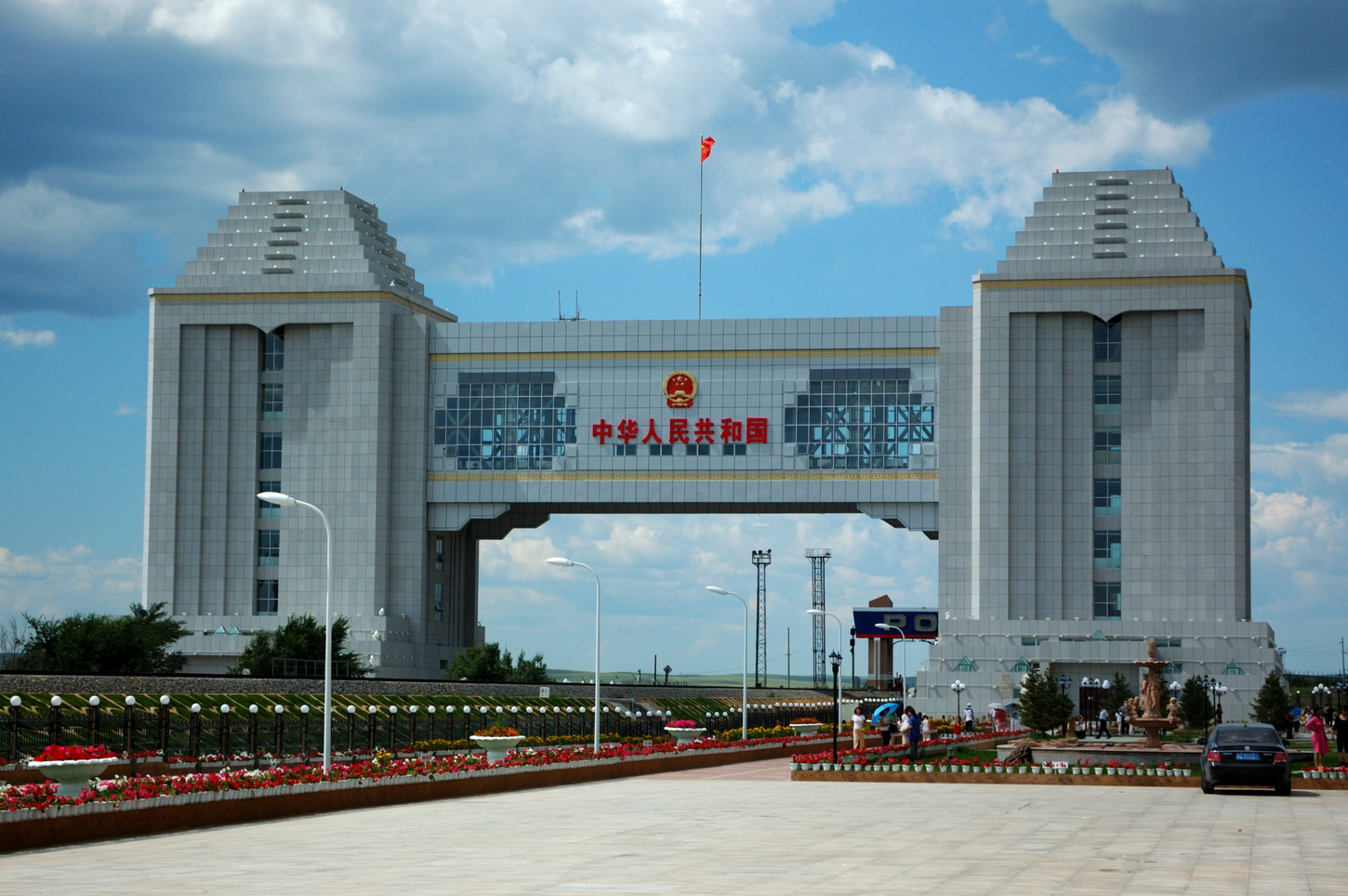
The border crossing with Russia is a tourist attraction. The Manzhouli China-Russia Border Tourist Area is a destination that brings together the border gate, a giant Matryoshka doll shaped hotel, and park filled with Matryoshka dolls. Other attractions within the scenic area are the No 41 Border Monument and the Locomotive Square. It has been rated as a AAAAA (5A) tourist attraction.
Manzhouli Ice & Snow Festival takes place every winter from some time in February to early March. This is a smaller version of the Harbin International Ice and Snow Sculpture Festival.
There is a replica of the Soviet World War II monument, The Motherland Calls.
Economy
Manzhouli is China's busiest land port of entry, and is responsible for 60% of all imports from and exports to Eastern Europe.
Sino-Russian Border Trade Zone
Manzhouli hosts a "Sino-Russian Mutual Market Trade Zone," a designated area where Chinese and Russian citizens can engage in tax-free trade of goods up to a certain value. This zone is a key component of cross-border economic cooperation, facilitating the exchange of commodities and fostering people-to-people ties.
Demographics
|1990|137000 |2004|160000 |2007|163441 |2010|249473 |}} Ninety-five percent of Manzhouli's population is Han Chinese. The remainder are Buryat, Russian, Mongol, Manchu, or of other ethnicities.
Media
Much of the plot of the 2018 film An Elephant Sitting Still revolves around a number of characters traveling to a circus in Manzhouli.
Transportation
Railway
The Chinese rail system, with a track gage of , meets the Russian rail system, with track gauge of , at Manzholi. That break of gauge means that trains cannot run through. To help cope with the problem in the face of increasing cross-border rail traffic, a break of gauge multi-modal transshipment facility was completed in 2008 on the Russian side of the border in Zabaikalsk.
Trains from Beijing to Moscow on the Trans-Manchurian branch of the Trans-Siberian Railway pass through Manzhouli Railway Station. There are also tourist lines to Chita, Krasnokamensk, Irkutsk, and Ulan Ude.
Air
Manzhouli Xijiao Airport is located in the western part of the city. Passengers can fly to Beijing and Inner Mongolia's capital city Hohhot from the airport as well as the Russian city of Chita and the Mongolian capital city Ulaanbaatar via Choibalsan.
Highway
- By China National Highway 301 linked to Inner Mongolia and Heilongjiang.
Education
Secondary schools include:
- Manzhouli No. 7 (满洲里市第七中学)
- Manzhouli No. 8 School (满洲里市第八学校)
- Manzhouli No. 11 (满洲里市第十一中学)
Sister cities
Manzhouli is twinned with the following sister cities.
- RUS Chita, Zabaykalsky Krai, Russia
- RUS Krasnokamensk, Zabaykalsky Krai, Russia
- RUS Ulan-Ude, Buryatia, Russia
References
References
- (2019). "China Urban Construction Statistical Yearbook 2017". China Statistics Press.
- [http://www.citypopulation.de/en/china/neimenggu/admin/ Inner Mongolia: Prefectures, Cities, Districts and Counties]
- [https://news.bbc.co.uk/2/hi/programmes/crossing_continents/7338623.stm Siberia's black market logging] (BBC News, 2008-04-09)
- (2025-05-30). "Giant dolls, an empty theme park and semi-trailers: The tourist trap that's now a lifeline for Russia". The Age.
- link. [[China Meteorological Administration]]
- "满洲里 – 气象数据 -中国天气网".
- "Code of administrative divisions(County level divisions and the higher) of People's Republic of China in 2013".
- (December 12, 2017). "Manzhouli China-Russia Border Tourist Area". China Daily.
- "满洲里市人民政府互市贸易区政策".
- "Hunnu Air launches Manchuria flight, stops Shanghai flight".
- "Sister cities".
This article was imported from Wikipedia and is available under the Creative Commons Attribution-ShareAlike 4.0 License. Content has been adapted to SurfDoc format. Original contributors can be found on the article history page.
Ask Mako anything about Manzhouli — get instant answers, deeper analysis, and related topics.
Research with MakoFree with your Surf account
Create a free account to save articles, ask Mako questions, and organize your research.
Sign up freeThis content may have been generated or modified by AI. CloudSurf Software LLC is not responsible for the accuracy, completeness, or reliability of AI-generated content. Always verify important information from primary sources.
Report