From Surf Wiki (app.surf) — the open knowledge base
Mantis
Order of insects including praying mantises

Order of insects including praying mantises
- Mantearia
- Mantoptera
Mantises are an order (Mantodea) of insects that contains over 2,400 species in about 460 genera in 33 families. The largest family is the Mantidae ("mantids"). Mantises are distributed worldwide in temperate and tropical habitats. They have triangular heads with bulging eyes supported on flexible necks. Their elongated bodies may or may not have wings, but all mantodeans have forelegs that are greatly enlarged and adapted for catching and gripping prey; their upright posture, while remaining stationary with forearms folded, resembling a praying posture, has led to the common name praying mantis.
The closest relatives of mantises are termites and cockroaches (Blattodea), which are all within the superorder Dictyoptera. Mantises are sometimes confused with stick insects (Phasmatodea), other elongated insects such as grasshoppers (Orthoptera), or other more distantly related insects with raptorial forelegs such as mantisflies (Mantispidae). Mantises are mostly ambush predators, but a few ground-dwelling species are found actively pursuing their prey. They normally live for about a year. In cooler climates, the adults lay eggs in autumn, then die. The eggs are protected by their hard capsules and hatch in the spring. Females sometimes practice sexual cannibalism, eating their mates after copulation.
Mantises were considered to have supernatural powers by early civilizations, including ancient Greece, ancient Egypt, and Assyria. A cultural trope popular in cartoons imagines the female mantis as a femme fatale. Mantises are among the insects most commonly kept as pets.
Etymology
The name mantodea is formed from the Ancient Greek words (mántis) meaning "prophet", and (eîdos) meaning "form" or "type". It was coined in 1838 by the German entomologist Hermann Burmeister. The name "mantid" properly refers only to members of the family Mantidae, which was, historically, the only family in the order. The other common name, praying mantis, applied to any species in the order (though in Europe mainly to Mantis religiosa), comes from the typical prayer-like posture these mantises adopt when their forelegs are folded. The vernacular plural "mantises" (used in this article) was originally confined largely to the US, with "mantids" predominantly used as the plural in the UK and elsewhere, until the family Mantidae was further split in 2002; at present, only some 75 out of 430 known genera are mantids, the rest are in 28 other families, and therefore no longer "mantids".
Taxonomy and evolution
Over 2,400 species of mantises in about 430 genera are recognized. They are predominantly found in tropical regions, but some live in temperate areas. The systematics of mantises have long been disputed. Mantises, along with stick insects (Phasmatodea), were once placed in the order Orthoptera with the cockroaches (now Blattodea) and ice crawlers (now Grylloblattodea). Kristensen (1991) combined the Mantodea with the cockroaches and termites into the order Dictyoptera, suborder Mantodea.
Phylogeny
External
Evolutionary relationships based on Evangelista et al. 2019 are shown in the cladogram:
Internal
One of the earliest classifications splitting an all-inclusive Mantidae into multiple families was that proposed by Beier in 1968, recognizing eight families, though it was not until Ehrmann's reclassification into 15 families in 2002 that a multiple-family classification became universally adopted. Klass, in 1997, studied the external male genitalia and postulated that the families Chaeteessidae and Metallyticidae diverged from the other families at an early date. However, as previously configured, the Mantidae and Thespidae especially were considered polyphyletic, so the Mantodea have been revised substantially as of 2019 and now includes 29 families.
|{{clade|style=font-size:80%; |}}
Fossil mantises

Mantises are thought to have evolved from cockroach-like ancestors. Some of the earliest confidently identified mantis fossils date to the Early Cretaceous, although the Jurassic taxon Lovec was identified in 2024 from the Karabastau Formation. Fossil mantises, including one from Japan with spines on the front legs as in modern mantises, have been found in Cretaceous amber. Most fossils in amber are nymphs; compression fossils (in rock) include adults. Fossil mantises from the Crato Formation in Brazil include the 10 mm long Santanmantis axelrodi, described in 2003; as in modern mantises, the front legs were adapted for catching prey. Well-preserved specimens yield details as small as 5 μm through X-ray computed tomography. Extinct families and genera include:
- †Juramantidae
- †Lovecidae
- †Baissomantidae
- †Gryllomantidae
- †Cretomantidae
- †Santanmantidae
- †Amelidae
- Incertae sedis:
- †Jersimantis
- †Chaeteessites
- †Cretophotina
- †Ambermantis
Similar insects in the [[Neuroptera]]
Because of the superficially similar raptorial forelegs, mantidflies may be confused with mantises, though they are unrelated. Their similarity is an example of convergent evolution; mantidflies do not have tegmina (leathery forewings) like mantises, their antennae are shorter and less thread-like, and the raptorial tibia is more muscular than that of a similar-sized mantis and bends back farther in preparation for shooting out to grasp prey.
Biology
Anatomy
Mantises have large, triangular heads with a beak-like snout and mandibles. They have two bulbous compound eyes, three small simple eyes, and a pair of antennae. The articulation of the neck is also remarkably flexible; some species of mantis can rotate their heads nearly 180°. The mantis thorax consists of a prothorax, a mesothorax, and a metathorax. In all species apart from the genus Mantoida, the prothorax, which bears the head and forelegs, is much longer than the other two thoracic segments. The prothorax is also flexibly articulated, allowing for a wide range of movements of the head and fore limbs while the remainder of the body remains more or less immobile. Mantises also are unique to the Dictyoptera in that they have tympanate hearing, with two tympana in an auditory chamber in their metathorax. Most mantises can only hear ultrasound.
Mantises have two spiked, grasping forelegs ("raptorial legs") in which prey items are caught and held securely. In most insect legs, including the posterior four legs of a mantis, the coxa and trochanter combine as an inconspicuous base of the leg; in the raptorial legs, however, the coxa and trochanter combine to form a segment about as long as the femur, which is a spiky part of the grasping apparatus (see illustration). Located at the base of the femur is a set of discoidal spines, usually four in number, but ranging from none to as many as five depending on the species. These spines are preceded by a number of tooth-like tubercles, which, along with a similar series of tubercles along the tibia and the apical claw near its tip, give the foreleg of the mantis its grasp on its prey. The foreleg ends in a delicate tarsus used as a walking appendage, made of four or five segments and ending in a two-toed claw with no arolium.
Mantises can be loosely categorized as being macropterous (long-winged), brachypterous (short-winged), micropterous (vestigial-winged), or apterous (wingless). If not wingless, a mantis has two sets of wings: the outer wings, or tegmina, are usually narrow and leathery. They function as camouflage and as a shield for the hindwings, which are clearer and more delicate. The abdomen of all mantises consists of 10 tergites, with a corresponding set of nine sternites visible in males and seven visible in females. The abdomen tends to be slimmer in males than females, but ends in a pair of cerci in both sexes.
Vision
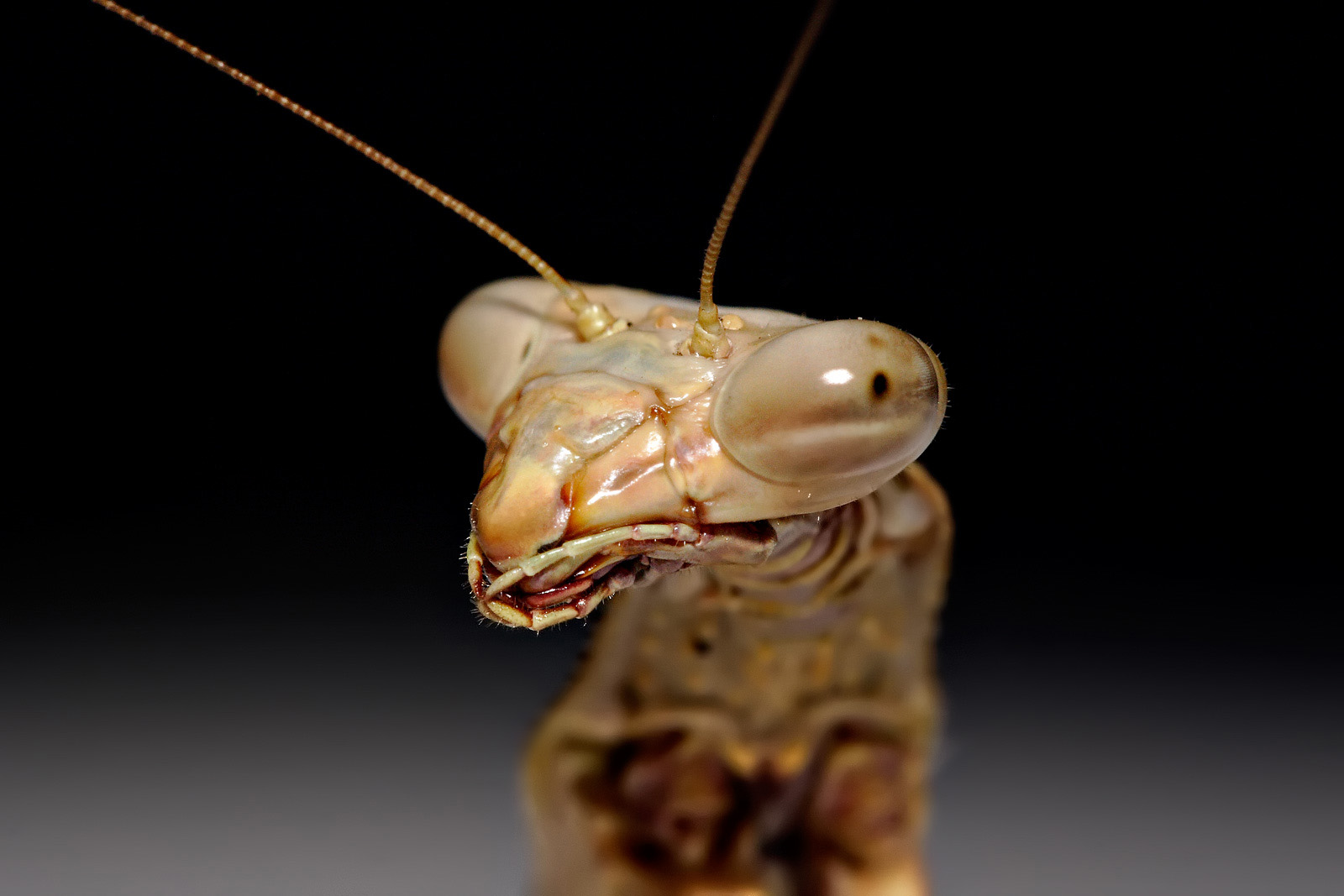
Mantises have stereo vision. They locate their prey by sight; their compound eyes contain up to 10,000 ommatidia. A small area at the front called the fovea has greater visual acuity than the rest of the eye, and can produce the high resolution necessary to examine potential prey. The peripheral ommatidia are concerned with perceiving motion; when a moving object is noticed, the head is rapidly rotated to bring the object into the visual field of the fovea. Further motions of the prey are then tracked by movements of the mantis's head so as to keep the image centered on the fovea. The use of stereoscopic vision differs from humans or primates because they specifically utilize this vision for capturing and spotting prey. The eyes are widely spaced and laterally situated, affording a wide binocular field of vision and precise stereoscopic vision at close range. The dark spot on each eye that moves as it rotates its head is a pseudopupil. This occurs because the ommatidia that are viewed "head-on" absorb the incident light, while those to the side reflect it.
As their hunting relies heavily on vision, mantises are primarily diurnal. Many species, however, fly at night and may then be attracted to artificial lights. They have good night vision. Male mantises in the family Liturgusidae are more frequently collected at night, suggesting greater nocturnal activity or attraction to light sources. This pattern likely extends to other mantis families, where males are also more commonly observed during nighttime surveys. Nocturnal flight is especially important to males in locating less-mobile females by detecting their pheromones. Flying at night exposes mantises to fewer bird predators than diurnal flight would. Many mantises also have an auditory thoracic organ that helps them avoid bats by detecting their echolocation calls and responding evasively.
Diet and hunting
Mantises are generalist predators of arthropods. The majority of mantises are ambush predators that only feed upon live prey within their reach. They either camouflage themselves and remain stationary, waiting for prey to approach, or stalk their prey with slow, stealthy movements. Larger mantises sometimes eat smaller individuals of their own species, as well as small vertebrates such as lizards, frogs, fish, and particularly small birds.
Most mantises stalk tempting prey if it strays close enough, and will go further when they are especially hungry. Once within reach, mantises strike rapidly to grasp the prey with their spiked raptorial forelegs. Some ground and bark species pursue their prey in a more active way. For example, members of a few genera such as the ground mantises Entella, Ligaria, and Ligariella run over dry ground seeking prey, much as tiger beetles do. Some mantis species such as Euantissa pulchra can discriminate between different types of prey, and approach spiders mimicking non-aggressive ant species much more than spiders that mimick aggressive ant species.
The foregut of some species extends the whole length of the insect and can be used to store prey for digestion later. This may be advantageous in an insect that feeds intermittently. Chinese mantises live longer, grow faster, and produce more young when they are able to eat pollen.
File:Tenodera sinensis 2 Luc Viatour.jpg|Tenodera sinensis feeding on a cricket File:Pm eating pm.webm|thumbtime=46|Tenodera sinensis consuming a smaller immature mantis File:Mantis catches grasshopper.webm|thumbtime=3|A chinese mantis catches a differential grasshopper
Antipredator adaptations
Mantises are preyed on by vertebrates such as frogs, lizards, and birds, and by invertebrates such as spiders, large species of hornets, and ants. Some hunting wasps, such as some species of Tachytes, also paralyze some species of mantis to feed their young. Generally, mantises protect themselves by camouflage, most species being cryptically colored to resemble leaves or other backgrounds, both to avoid predators and to better snare their prey. Those that live on uniformly colored surfaces such as bare earth or tree bark are dorsoventrally flattened so as to eliminate shadows that might reveal their presence. The species from different families called flower mantises are aggressive mimics: they resemble flowers convincingly enough to attract prey that come to collect pollen and nectar. Some species in Africa and Australia are able to turn black after a molt towards the end of the dry season; at this time of year, bush fires occur and this coloration enables them to blend in with the fire-ravaged landscape (fire melanism).
When directly threatened, many mantis species stand tall and spread their forelegs, with their wings fanning out wide. The fanning of the wings makes the mantis seem larger and more threatening, with some species enhancing this effect with bright colors and patterns on their hindwings and inner surfaces of their front legs. If harassment persists, a mantis may strike with its forelegs and attempt to pinch or bite. As part of the bluffing (deimatic) threat display, some species may also produce a hissing sound by expelling air from the abdominal spiracles. Mantises lack chemical protection, so their displays are largely bluff. When flying at night, at least some mantises are able to detect the echolocation sounds produced by bats; when the frequency begins to increase rapidly, indicating an approaching bat, they stop flying horizontally and begin a descending spiral toward the safety of the ground, often preceded by an aerial loop or spin. If caught, they may slash captors with their raptorial legs.
Mantises, like stick insects, show rocking behavior in which the insect makes rhythmic, repetitive side-to-side movements. Functions proposed for this behavior include the enhancement of crypsis by means of the resemblance to vegetation moving in the wind. However, the repetitive swaying movements may be most important in allowing the insects to discriminate objects from the background by their relative movement, a visual mechanism typical of animals with simpler sight systems. Rocking movements by these generally sedentary insects may replace flying or running as a source of relative motion of objects in the visual field. As ants may be predators of mantises, genera such as Loxomantis, Orthodera, and Statilia, like many other arthropods, avoid attacking them. A variety of arthropods, including some early-instar mantises, exploit this behavior and mimic ants to evade their predators.
File:Choeradodis stalii MHNT dos.jpg|Leaf mimicry: Choeradodis has leaf-like forewings and a widened green thorax. File:Gottesanbeterin Abwehr.JPG|Adult female Iris oratoria performs a bluffing threat display, rearing back with the forelegs and wings spread and mouth opened. File:Gemmatus.jpg|The jeweled flower mantis, Creobroter gemmatus: the brightly colored wings are opened suddenly in a deimatic display to startle predators. File:Ant-Mantis.jpg|Some mantis nymphs mimic ants to avoid predators. File:Schizocephala bicornis, Grass Mantis, Udaipur.jpg|The grass mantis Schizocephala bicornis mimics dry grass both to avoid predators and to approach unwitting prey. File:Mantis Hymenopus coronatus 2 Luc Viatour.jpg|Aggressive mimicry: Malaysian orchid mantises are camouflaged pink or yellow, matching the coloration of local orchids.
Reproduction and life history
The mating season in temperate climates typically takes place in autumn, while in tropical areas, mating can occur at any time of the year. To mate following courtship, the male usually leaps onto the female's back, clasping her thorax and wing bases with his forelegs. He then arches his abdomen to deposit and store sperm in a special chamber near the tip of the female's abdomen. The female lays between 10 and 400 eggs, depending on the species. Eggs are typically deposited in a froth mass-produced by glands in the abdomen. This froth hardens, creating a protective capsule, which together with the egg mass is called an ootheca. Depending on the species, the ootheca can be attached to a flat surface, wrapped around a plant, or even deposited in the ground. Despite the versatility and durability of the eggs, they are often preyed on, especially by several species of parasitoid wasps. In a few species, mostly ground and bark mantises in the family Tarachodidae, the mother guards the eggs. The cryptic Tarachodes maurus positions herself on bark with her abdomen covering her egg capsule, ambushing passing prey and moving very little until the eggs hatch. An unusual reproductive strategy is adopted by Brunner's stick mantis from the southern United States: no males have ever been found in this species, and the females breed parthenogenetically. The ability to reproduce by parthenogenesis has been recorded in at least two other species, Sphodromantis viridis and Miomantis sp., although these species usually reproduce sexually. In temperate climates, adults do not survive the winter and the eggs undergo a diapause, hatching in the spring.
As in closely related insect groups in the superorder Dictyoptera, mantises go through three life stages: egg, nymph, and adult (mantises are among the hemimetabolous insects). For smaller species, the eggs may hatch in 3–4 weeks as opposed to 4–6 weeks for larger species. The nymphs may be colored differently from the adult, and the early stages are often mimics of ants. A mantis nymph grows bigger as it molts its exoskeleton. Molting can happen five to 10 times before the adult stage is reached, depending on the species. After the final molt, most species have wings, though some species remain wingless or brachypterous ("short-winged"), particularly in the female sex. The lifespan of a mantis depends on the species; smaller ones may live 4–8 weeks, while larger species may live 4–6 months.
File:Mantis religiosa couple.JPG|Mantis religiosa mating (brown male, green female) File:Mantis laying ootheca.jpg|Stagmomantis carolina laying ootheca File:Mantis religiosa (egg case).jpg|Recently laid M. religiosa ootheca File:PrayingMantisesJustBorn (cropped).jpg|Hatching from the ootheca File:Sphodromantis Lineola molting.jpg|Sphodromantis lineola molting
Sexual cannibalism

Sexual cannibalism is common among most predatory species of mantises in captivity. It has sometimes been observed in natural populations, where about a quarter of male–female encounters result in the male being eaten by the female. Around 90% of the predatory species of mantises exhibit sexual cannibalism. Adult males typically outnumber females at first, but their numbers may be fairly equivalent later in the adult stage, In Tenodera sinensis, 83% of males escape cannibalism after an encounter with a female, but since multiple matings occur, the probability of a male's being eaten increases cumulatively.
The female may begin feeding by biting off the male's head (as they do with regular prey), and if mating has begun, the male's movements may become even more vigorous in its delivery of sperm. Early researchers thought that because copulatory movement is controlled by a ganglion in the abdomen, not the head, removal of the male's head was a reproductive strategy by females to enhance fertilization while obtaining sustenance. Later, this behavior appeared to be an artifact of intrusive laboratory observation. Whether the behavior is natural in the field or also the result of distractions caused by the human observer remains controversial. Mantises are highly visual organisms and notice any disturbance in the laboratory or field, such as bright lights or moving scientists. Chinese mantises that had been fed ad libitum (so that they were not hungry) actually displayed elaborate courtship behavior when left undisturbed. The male engages the female in a courtship dance, to change her interest from feeding to mating. Under such circumstances, the female has been known to respond with a defensive deimatic display by flashing the colored eyespots on the inside of her front legs.
The reason for sexual cannibalism has been debated; experiments show that females on poor diets are likelier to engage in sexual cannibalism than those on good diets. Some hypothesize that submissive males gain a selective advantage by producing offspring; this is supported by a quantifiable increase in the duration of copulation among males which are cannibalized, in some cases doubling both the duration and the chance of fertilization. This is contrasted by a study where males were seen to approach hungry females with more caution, and were shown to remain mounted on hungry females for a longer time, indicating that males that actively avoid cannibalism may mate with multiple females. The same study also found that hungry females generally attracted fewer males than those that were well fed. The act of dismounting after copulation is dangerous for males, for it is the time that females most frequently cannibalize their mates. An increase in mounting duration appears to indicate that males wait for an opportune time to dismount a hungry female, who would be likely to cannibalize her mate.
Relationship with humans
In culture, literature and art

One of the earliest mantis references is in the ancient Chinese dictionary Erya, which gives its attributes in poetry, where it represents courage and fearlessness, and a brief description. A later text, the () from 1108, gives accurate details of the construction of the egg packages, the development cycle, anatomy, and the function of the antennae. Although mantises are rarely mentioned in Ancient Greek sources, a female mantis in threat posture is accurately illustrated on a series of fifth-century BC silver coins, including didrachms, from Metapontum in Lucania. The 10th-century Byzantine encyclopedia Suda described the insect called "mantis" (μάντις) as a pale green, clumsy, and slow-moving locust, adding that some people observed its movements for the purpose of augury. In addition, the Suda mentions the phrase "arouraia mantis" (Ἀρουραία μάντις), explaining that it was a proverbial expression used to mock people who were sluggish and ineffectual but still treated as if they had wisdom or insight. He translates Zenobius 2.94 with the words seriphos (maybe a mantis) and graus, an old woman, implying a thin, dried-up stick of a body.
Mantises are a common motif in Luna Polychrome ceramics of pre-Columbian Nicaragua, and are believed to represent a deity or spirit called "Madre Culebra".
Western descriptions of the biology and morphology of the mantises became more accurate in the 18th century. Roesel von Rosenhof illustrated and described mantises and their cannibalistic behavior in the Insekten-Belustigungen (Insect Entertainments).
_Photograph_By_Shantanu_Kuveskar.jpg)
In the early 1900s, people in the United States Ozarks region referred to them as Devil's horses.
Aldous Huxley made philosophical observations about the nature of death while two mantises mated in the sight of two characters in his 1962 novel Island (the species was Gongylus gongylodes). The naturalist Gerald Durrell's humorously autobiographical 1956 book My Family and Other Animals includes a four-page account of an almost evenly matched battle between a mantis and a gecko. Shortly before the fatal dénouement, Durrell narrates:
M. C. Escher's woodcut Dream depicts a human-sized mantis standing on a sleeping bishop.
A cultural trope imagines the female mantis as a femme fatale. The idea is propagated in cartoons by Cable, Guy and Rodd, LeLievre, T. McCracken, and Mark Parisi, among others. It ends Isabella Rossellini's short film about the life of a praying mantis in her 2008 Green Porno season for the Sundance Channel.
The Deadly Mantis is a 1957 American science fiction monster film, with a giant mantis threatening mankind.
Martial arts

Two martial arts separately developed in China have movements and fighting strategies based on those of the mantis. and 'Southern Praying Mantis'. Both are very popular in China, and have also been exported to the West in recent decades.
In mythology and religion
According to local beliefs in Africa, this insect brings good luck. The mantis was revered by the southern African Khoi and San in whose cultures man and nature were intertwined; for its praying posture, the mantis was even named Hottentotsgot ("god of the Hottentots") in the Afrikaans language that had developed among the first European settlers. However, at least for the San, the mantis was only one of the manifestations of a trickster-deity, ǀKaggen, who could assume many other forms, such as a snake, hare or vulture. Several ancient civilizations did consider the insect to have supernatural powers; for the Greeks, it had the ability to show lost travelers the way home; in the Ancient Egyptian Book of the Dead, the "bird-fly" is a minor god that leads the souls of the dead to the underworld; in a list of 9th-century BC Nineveh grasshoppers (buru), the mantis is named necromancer (buru-enmeli) and soothsayer (buru-enmeli-ashaga). Some pre-Columbian cultures in western Nicaragua have preserved oral traditions of the mantis as "Madre Culebra", a powerful predator and symbol of female symbolic authority.
As pets

Mantises are among the insects most widely kept as pets. Because the lifespan of a mantis is only about a year, people who want to keep mantises often breed them. In 2013 at least 31 species were kept and bred in the United Kingdom, the Netherlands, and the United States. In 1996 at least 50 species were known to be kept in captivity by members of the Mantis Study Group.
For pest control
Naturally occurring mantis populations provide plant pest control. Gardeners who prefer to avoid pesticides may encourage mantises in the hope of controlling insect pests. However, mantises do not have key attributes of biological pest control agents; they do not specialize in a single pest insect, and do not multiply rapidly in response to an increase in such a prey species, but are general predators. They therefore have "negligible value" in biological control.
Two species, the Chinese mantis and the European mantis, were deliberately introduced to North America in the hope that they would serve as pest controls for agriculture; they have spread widely in both the United States and Canada.
Robotics
In 2016, the Association for the Advancement of Artificial Intelligence had produced a prototype robot inspired by the forelegs of the praying mantis, with front legs that allow the robot to walk, climb steps, and grasp objects. The multi-jointed leg provides dexterity via a rotatable joint. Future models may include a more spiked foreleg to improve the grip and ability to support more weight.
References
References
- Vršanský, Peter. (2024). "Late Mesozoic cockroaches s.l. from the Karabastau Formation in Kazakhstan". AMBA Projekty.
- (May 2009). "Evidence for Carboniferous origin of the order Mantodea (Insecta: Dictyoptera) gained from forewing morphology". [[Zoological Journal of the Linnean Society]].
- Essig, Edward Oliver. (1947). "College entomology". Macmillan Company.
- {{OEtymD. mantis
- Bullock, William. (1812). "A companion to the London Museum and Pantherion".
- Partington, Charles Frederick. (1837). "The British Cyclopædia of Natural History". W. S. Orr.
- (10 September 2010). "Praying Mantis". [[National Geographic Society]].
- Bragg, P. E. (1996). "Mantis, Mantid, Mantids, Mantises". ''Mantis Study Group Newsletter'', 1:4.
- Ehrmann, R. 2002. Mantodea: Gottesanbeterinnen der Welt. Natur und Tier, Münster.
- "Mantodea Species File Online".
- Hurd, I. E.. (1999). "The Praying Mantids". [[Johns Hopkins University Press]].
- Costa, James. (2006). "The Other Insect Societies". [[Harvard University Press]].
- Capinera, John L.. (2008). "Encyclopedia of Entomology". Springer.
- (23 January 2019). "An integrative phylogenomic approach illuminates the evolutionary history of cockroaches and termites (Blattodea)". [[Proc. R. Soc. B]].
- Beier, M.. (1968). "Ordnung Mantodea (Fangheuschrecken)". Handbuch der Zoologie.
- Klass, Klaus-Dieter. (1997). "The external male genitalia and phylogeny of Blattaria and Mantodea". Zoologisches Forschungsinstitut.
- (2007). "The Crato Fossil Beds of Brazil: Window into an Ancient World". [[Cambridge University Press]].
- [https://www.tandfonline.com/doi/full/10.1080/00379271.2018.1556567 Schwarz CJ, Roy R (2019) The systematics of Mantodea revisited: an updated classification incorporating multiple data sources (Insecta: Dictyoptera) ''Annales de la Société entomologique de France (N.S.) International Journal of Entomology'' '''55 [2]''': 101–196.]
- (28 July 2003). "A Revision of Cretaceous Mantises and Their Relationships, Including New Taxa (Insecta: Dictyoptera: Mantodea)". [[American Museum Novitates]].
- Li, Xinran. (2019-08-30). "Disambiguating the scientific names of cockroaches". Palaeoentomology.
- (2022-10-31). "A new species of mantis (Insecta: Mantodea: Amelidae) from the Miocene Amber-Lagerstätte in Mexico". [[Historical Biology]].
- (25 April 2008). "Ancient Praying Mantis Found in Amber". [[National Geographic Society]].
- (1983). "Mimicry, predation and potential pollination by the mantispid, ''Climaciella brunnea'' var. ''instabilis'' (Say) (Mantispidae: Neuroptera)". Journal of the New York Entomological Society.
- Siwanowicz, Igor. (2009). "Animals Up Close". Dorling Kindersley.
- (1 July 2008). "Patterns of praying mantis auditory system evolution based on morphological, molecular, neurophysiological, and behavioural data.". [[Biological Journal of the Linnean Society]].
- Roy, Roger. (1999). "The Praying Mantids". [[Johns Hopkins University Press]].
- Kemper, William T.. "Insect Order ID: Mantodea (Praying Mantises, Mantids)". [[Missouri Botanical Garden]].
- (2016). "Insect stereopsis demonstrated using a 3D insect cinema". Scientific Reports.
- (1983). "Binocular stereopsis in an insect". Nature.
- (1996). "Binocular vision in insects: How mantids solve the correspondence problem". [[Proceedings of the National Academy of Sciences of the United States of America]].
- (1990). "Prey capture in the praying mantis ''Tenodera aridifolia sinensis'': coordination of the capture sequence and strike movements". Journal of Experimental Biology.
- (1999). "Nerve Cells and Animal Behaviour". [[Cambridge University Press]].
- (2016). "Insect stereopsis demonstrated using a 3D insect cinema". Scientific Reports.
- (1995). "Binocular Vision and Stereopsis". Oxford University Press.
- (1996). "Variations in the optical properties of the compound eyes of ''Uca lactea annulipes''". [[The Journal of Experimental Biology]].
- Robert. (2023-07-05). "Can Praying Mantis See in the Dark?".
- (2010). "A review of the Liturgusidae of Borneo (Insecta: Mantodea)". Sepilok Bulletin.
- Yager, David. (1999). "The Praying Mantids". Johns Hopkins University Press.
- (2005). "Evolution of the Insects". [[Cambridge University Press]].
- Ross, Edward S.. (February 1984). "Mantids – The Praying Predators". [[National Geographic]].
- Capinera, John L.. (2008). "Encyclopedia of Entomology". Springer.
- (2005). "Evolution of the Insects". Cambridge University Press.
- (2017). "Bird predation by praying mantises: a global perspective". The Wilson Journal of Ornithology.
- (2018). "The fishing mantid: predation on fish as a new adaptive strategy for praying mantids (Insecta: Mantodea)". Journal of Orthoptera Research.
- (July 1968). "Feeding behaviour of the praying mantis: a learned modification". Nature.
- (1996). "The predatory strike of free ranging praying mantises, ''Sphodromantis lineola'' (Burmeister). I: Strikes in the mid-sagittal plane". Brain, Behavior and Evolution.
- (2016). "Similar yet different: differential response of a praying mantis to ant-mimicking spiders". [[Biological Journal of the Linnean Society]].
- Capinera, John L.. (2008). "Encyclopedia of Entomology". Springer.
- (2003). "Pollen feeding and fitness in praying mantids: the vegetarian side of a tritrophic predator". [[Environmental Entomology]].
- (13 August 2011). "Down to earth". Frontline Magazine.
- Fabre, Jean-Henri. (1921). "More Hunting Wasps". Dodd, Mead.
- (2010). "The Insects: An Outline of Entomology". Wiley.
- (1999). "The Praying Mantids". [[Johns Hopkins University Press]].
- Cott, Hugh. (1940). "Adaptive Coloration in Animals". Methuen.
- Annandale, Nelson. (1900). "Observations on the habits and natural surroundings of insects made during the 'Skeat Expedition' to the Malay Peninsula, 1899–1900". [[Proceedings of the Zoological Society of London]].
- (2014). "Pollinator deception in the orchid mantis". [[The American Naturalist]].
- (1993). "Coming in on a wing and an ear". Natural History.
- (19 November 2002). "Praying Mantis Uses Ultrasonic Hearing to Dodge Bats". National Geographic Society.
- O'Dea, J. D.. (1991). "Eine zusatzliche oder alternative Funktion der 'kryptischen' Schaukelbewegung bei Gottesanbeterinnen und Stabschrecken (Mantodea, Phasmatodea)". Entomologische Zeitschrift.
- (2006). "Innate aversion to ants (Hymenoptera: Formicidae) and ant mimics: experimental findings from mantises (Mantodea)". [[Biological Journal of the Linnean Society]].
- Michael, Maxwell. R.. (1999). "The Praying Mantids". Johns Hopkins University Press.
- Ene, J. C.. (1964). "The distribution and post-embryonic development of ''Tarachodes afzelli'' (Stal) (Mantodea: Eremiaphilidae)". Journal of Natural History.
- Bragg, P.E. (1987) A case of parthenogenesis in a mantis. ''Bulletin of the Amateur Entomologists' Society'', 46 (356): 160.
- (December 1989). "Parthenogenetic mantid named". Mantis Study Group.
- Dickie, S. (1996) Parthenogenesis in mantids. ''Mantis Study Group Newsletter'', 1: 5.
- Hurd, I. E.. (1999). "The Praying Mantids". Johns Hopkins University Press.
- (1992). "Sexual cannibalism in the praying mantid, ''Mantis religiosa'': a field study". Animal Behaviour.
- (1994). "Cannibalism reverses male-biased sex ratio in adult mantids: female strategy against food limitation?". Oikos.
- (1998). "Lifetime mating opportunities and male mating behaviour in sexually cannibalistic praying mantids". Animal Behaviour.
- (2009). "The importance of ecological and phylogenetic conditions for the occurrence and frequency of sexual cannibalism". Annual Review of Ecology, Evolution, and Systematics.
- (22 December 2013). "Do Female Praying Mantises Always Eat the Males?". Entomology Today.
- (1984). "Sexual behaviour of the Chinese praying mantis". Animal Behaviour.
- (2006). "Complicity or conflict over sexual cannibalism? Male risk taking in the praying mantis ''Tenodera aridifolia sinensis''". The American Naturalist.
- (1987). "Courtship and mating behaviour of the Chinese praying mantis, Tenodera aridifolia sinenesis". Animal Behaviour.
- (2010). "Effects of female feeding regime in a sexually cannibalistic mantid: fecundity, cannibalism, and male response in ''Stagmomantis limbata'' (Mantodea)". Ecological Entomology.
- (2005). "Males Respond to the Risk of Sperm Competition in the Sexually Cannibalistic Praying Mantis, ''Mantis religiosa''". Ethology.
- Bodson, Liliane. (2014). "The Oxford Handbook of Animals in Classical Thought and Life". Oxford University Press.
- [https://www.cs.uky.edu/~raphael/sol/sol-entries/mu/169 Suda, mu, 169]
- [https://www.cs.uky.edu/~raphael/sol/sol-entries/mu/169 Suda, mu, 169]
- (1992). "Adages: Iivii1 to Iiiiii100". University of Toronto Press.
- (1 April 2020). "Praying to the Predator: Symbols of Insect Animism on Luna/El Menco Polychrome from Pre-Columbian Pacific Nicaragua". Latin American and Latinx Visual Culture.
- Randolph, Vance. (2012-07-31). "Ozark Magic and Folklore". Courier Corporation.
- (2006). "My Family and Other Animals". Penguin Books.
- (2007). "M.C. Escher's Legacy: A Centennial Celebration". Springer.
- (29 November 2010). "Shoddy Research and Cultural Tropes: The Praying Mantis". The Society Pages.
- "Praying Mantises Cartoons and Comics". CartoonStock.
- "Praying Mantis Cartoons". Off the Mark.
- "Praying Mantis Should Be Gay". McHumor Cartoons.
- (2008). "Green Porno". Sundance Channel.
- Rossellini, Isabella. (2009). "Green Porno: a series of short films by Isabella Rossellini". Sundance Channel.
- [https://www.imdb.com/title/tt0050294/ Imdb]
- "History of Praying Mantis Kung Fu". Praying Mantis Kung Fu Academy.
- "Praying Mantis Kung Fu". Praying Mantis Kung Fu.
- (2012). "18 Buddha Hands: Southern Praying Mantis Kung Fu". Southern Mantis Press.
- "Chow Gar". Southern Mantis Kung Fu.
- [https://www.reference.com/pets-animals/praying-mantis-good-luck-7d4194e515defa22 Is a Praying Mantis Good Luck?], Reference.com, 11 April 2020
- "Insek-kaleidoskoop: Die 'skynheilige' hottentotsgot".
- "Siyabona Africa: Kruger National Park: San".
- (1999). "The Praying Mantids". Johns Hopkins University Press.
- "Mantid".
- "Pet bugs: Kentucky arthropods". University of Kentucky.
- (16 March 2011). "European Mantis". Keeping Insects.
- (October 2013). "Breeding Reports: 1st July 2013–1st October 2013". UK Mantis Forums.
- Bragg, P.E. [editor] (1996) Species in culture. ''Mantis Study Group Newsletter'', '''1''': 2–3.
- (2007). "Ecosystem services and dis-services to agriculture". [[International Society for Ecological Economics]] ([[Elsevier]]).
- "The Praying Mantis (Leaflet 21019)". University of California Division of Agricultural Sciences.
- "Praying and Chinese Mantises". New York State Department of Environmental Conservation.
- "Leg Design for a Praying Mantis Robot". Florida Artificial Intelligence Research Society.
This article was imported from Wikipedia and is available under the Creative Commons Attribution-ShareAlike 4.0 License. Content has been adapted to SurfDoc format. Original contributors can be found on the article history page.
Ask Mako anything about Mantis — get instant answers, deeper analysis, and related topics.
Research with MakoFree with your Surf account
Create a free account to save articles, ask Mako questions, and organize your research.
Sign up freeThis content may have been generated or modified by AI. CloudSurf Software LLC is not responsible for the accuracy, completeness, or reliability of AI-generated content. Always verify important information from primary sources.
Report