From Surf Wiki (app.surf) — the open knowledge base
Mantilla
Traditional Spanish lace or silk veil worn over the head and shoulders
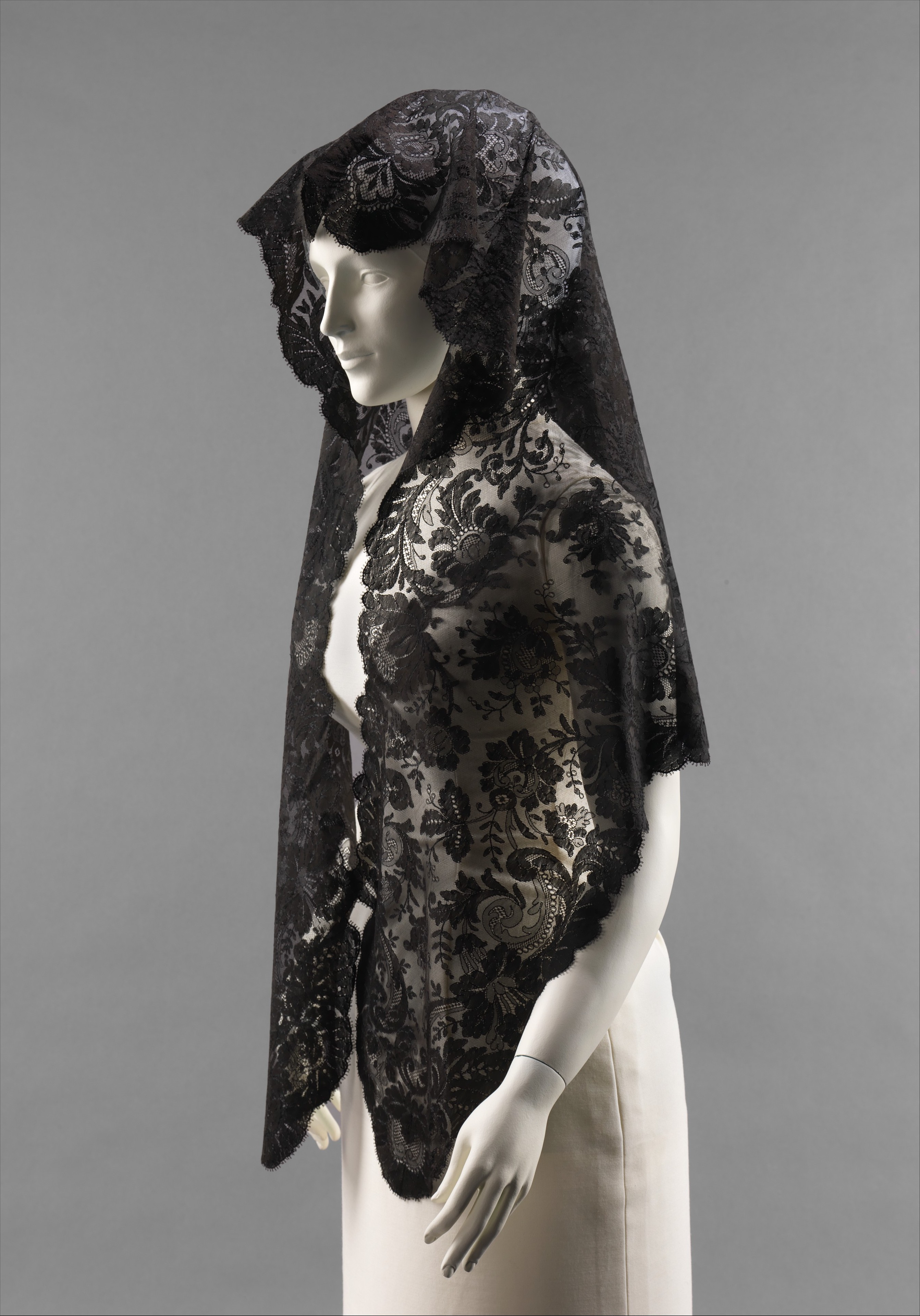
Traditional Spanish lace or silk veil worn over the head and shoulders
| Field | Value |
|---|---|
| image_file | Objectes de la Sala Secà i Muntanya (26914857930).jpg |
| caption | Blond mantillina. Valencian Museum of Ethnology. |
| type | Headgear |
| material | Silk lace or tulle |
| location | Spain |
| introduced | 16th century |
A mantilla is a traditional female liturgical lace or silk veil or shawl worn over the head and shoulders, often over a high hair ornament called a peineta, particularly popular with women in Spain and Latin America. Within Christendom, it is worn by Catholic and Plymouth Brethren women around the world, Mennonite women in Argentina, and without the peineta by Eastern Orthodox women in Russia. When worn by Eastern Orthodox women the mantilla is often white, and is worn with the ends crossed over the neck and draped over the opposite shoulder. The mantilla is worn as a Christian headcovering by women during church services, as well as during special occasions. A smaller version of the mantilla is called a toquilla.
History
The lightweight ornamental mantilla came into use in the warmer regions of Spain towards the end of the 16th century, and ones made of lace became popular with women in the 17th and 18th centuries, being depicted in portraits by Diego Velázquez and Goya. With Spain being largely a Christian country, the mantilla is a Spanish adaption of the Christian practice of women wearing headcoverings during prayer and worship (cf. ).
As Christian missionaries from Spain entered the Americas, the wearing of the mantilla as a Christian headcovering was brought to the New World. Fray Nicolás García Jerez, who in the 19th century served as the Bishop of Nicaragua and Costa Rica, as well as the Governor of Nicaragua, mandated that mantillas be opaque and not made of transparent lace; women who continued to wear thin mantillas were excommunicated from the Catholic Church.{{efn-ua|The early Christian Church's Apostolic Tradition specified that Christian headcovering is to be observed with an "opaque cloth, not with a veil of thin linen".
In the 19th century, Queen Isabella II actively encouraged the use of the mantilla. The practice diminished after her abdication in 1870, and by 1900 the use of the mantilla became largely limited to church services, as well as formal occasions such as bullfights, Holy Week and weddings.

_-_Fondo_Marín-Kutxa_Fototeka.jpg)
In Spain, women still wear mantillas during Holy Week (the week leading to Easter), bullfights and weddings. Also a black mantilla is traditionally worn when a woman has an audience with the Pope and a white mantilla is appropriate for a church wedding, but can be worn at other ceremony occasions as well. In accordance with what is known as the privilège du blanc, only the queen of Spain and selected other Catholic wives of Catholic sovereigns can wear a white mantilla during an audience with the Pope.
In Argentina, many women who are Mennonite Christians wear the mantilla as a Christian headcovering. Traditional Catholic women and Plymouth Brethren women in various parts of the globe use it for the same purpose.
Peineta
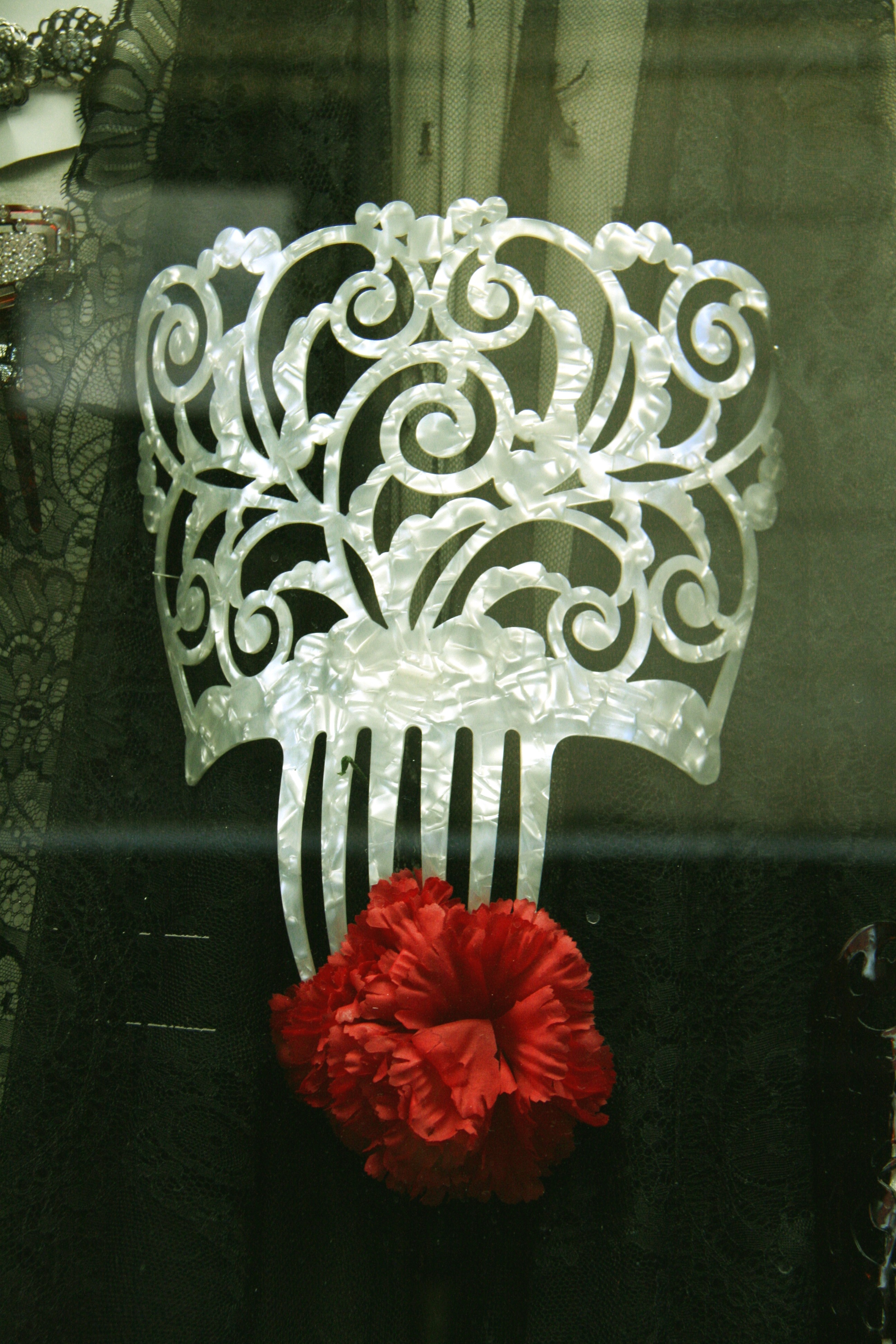
A peineta, similar in appearance to a large comb, is used to hold up a mantilla. This ornamental comb, usually in tortoiseshell color, originated in the 19th century. It consists of a convex body and a set of prongs and is often used in conjunction with the mantilla. It adds the illusion of extra height to the wearer and also holds the hair in place when worn during weddings, processions and dances. It is a consistent element of some regional costumes of Valencia and Andalusia and it is also often found in costumes used in the Moorish and Romani people influenced music and dance called Flamenco.
File:Nebel Voyage 16 La Mantilla.jpg|Mexican women wearing the mantilla, painting by Carl Nebel, 1836 File:Raquel Meller by Julio Romero de Torres.jpg|Raquel Meller, Spanish singer and actress, 1910 File:Julio Romero de Torres - Venus of Poetry - Google Art Project.jpg|Raquel Meller with her husband, Enrique Gómez Carrillo, in the painting Venus of Poetry, 1913 File:Melilla en Semana Santa.jpg|Mantilla made of white lace, during a Holy Week procession in Spain, 2006.
References
Notes
Citations
References
- ''The American Heritage Dictionary of the English Language''; 4th edition. 2000
- (2 February 1999). "Gospel Versus Gospel: Mission and the Mennonite Church, 1863-1944". Wipf and Stock Publishers.
- (1905). "The Delineator, Volume 66". The Butterick Publishing Co..
- (2018). "Our Lady of Everyday Life: La Virgen de Guadalupe and the Catholic Imagination of Mexican Women in America". [[Oxford University Press]].
- (11 January 2012). "On Head Coverings". Classical Christianity.
- (12 May 2020). "Why I Keep My Headcovering". [[N. T. Wright]].
This article was imported from Wikipedia and is available under the Creative Commons Attribution-ShareAlike 4.0 License. Content has been adapted to SurfDoc format. Original contributors can be found on the article history page.
Ask Mako anything about Mantilla — get instant answers, deeper analysis, and related topics.
Research with MakoFree with your Surf account
Create a free account to save articles, ask Mako questions, and organize your research.
Sign up freeThis content may have been generated or modified by AI. CloudSurf Software LLC is not responsible for the accuracy, completeness, or reliability of AI-generated content. Always verify important information from primary sources.
Report