From Surf Wiki (app.surf) — the open knowledge base
Manticore
Mythical lion beast in Persian folklore
.jpg)
Mythical lion beast in Persian folklore
The manticore or mantichore (Latin: mantichorās; reconstructed Old Persian: peo; Modern fa) is a legendary creature from ancient Persian mythology, similar to the Egyptian sphinx that proliferated in Western European medieval art as well. It has the face of a human, the body of a lion, and the tail of a scorpion or a tail covered in venomous spines similar to porcupine quills. There are some accounts that the spines can be launched like arrows. It eats its victims whole, using its three rows of teeth, and leaves no bones behind.
Etymology
The English-language term manticore comes via Latin mantichorās from Ancient Greek μαρτιχόρας (martikhórās). This in turn is a transliteration of an Old Persian compound word consisting of martīya 'man' and xuar- stem, 'to eat' (Mod. ; mard + {{linktext|خوردن}}; ḫordan); i.e., man-eater.
An early account of the manticore and of its naming occurs in Indica by Ctesias, |orig-date = 2020 |publication-place = London |access-date = 26 May 2025 a Greek physician of the 5th century BC who worked at the Persian court during the Achaemenid dynasty. Ctesias based his report on the testimonies of his Persian-speaking informants who had travelled to India. He recorded the Persian-language name of the beast as martichora (μαρτιχόρα), which translated into Greek as androphagon or anthropophagon (ἀνθρωποφάγον), i.e., "man-eater". But the name was mistranscribed as 'mantichoras' in a faulty copy of Aristotle, through whose works the legend of the manticore was perpetuated across Europe.
Ctesias was later cited by Pausanias regarding the martichoras or grc of India.
Classical literature
An account of the manticore was given in Ctesias's lost book Indica ("India"), and circulated among Greek writers on natural history, but has survived only in fragments and epitomes preserved by later writers.
Photius's Myriobiblon (or Bibliotheca, 9th century) serves as base text, but Aelian (De Natura Animalium, 3rd century) preserves the same information and more:
Aelian, citing Ctesias, adds that the Mantichora prefers to hunt humans, lying in wait and even taking down even two or three men at a time. The Indians, he continues, take the young captive and disable the tail by crushing it with a stone before the sting begins growing.
Pliny's Aethiopian beasts
Pliny described the "mantichora" in his Naturalis Historia (c. 77 AD) having relied on a faulty copy of Aristotle's natural history that contained the misspelling ("martikhoras").
Pliny also introduced the confused notion that the manticore might occur in Africa, because he had discussed this and other creatures (such as the yale) within a passage on Aethiopia. But he also described the crocotta and the mantichora of Aethiopia together, and while the crocotta imitated the voices of men the mantichora of Aethiopia also mimicked human speech, on authority of Juba II, with a voice like the pipe (panpipe, fistula) mixed with trumpet.
Legacy
Ctesias purportedly saw a martichora presented to the Persian king by the Indians. The Romanised Greek Pausanias was skeptical and considered it an unreliable exaggerated account of a tiger. Apollonius of Tyana also dismissed the mantichore as a tall tale, according to the biography by Philostratus (c. 170–247).
Pliny did not share Pausanias' skepticism. And for 1500 years afterwards, it was Pliny's account, also copied by Solinus (2nd century), which was held to be authoritative on matters of natural history whether real or mythological. In the advent of Christianity, writings in the Holy Scripture combined with Plinian-Aristotelian learning gave rise to the Physiologus (also c. 2nd century), which later evolved into the medieval bestiaries some of which contained entries on the manticore.
Medieval sources
Bestiaries
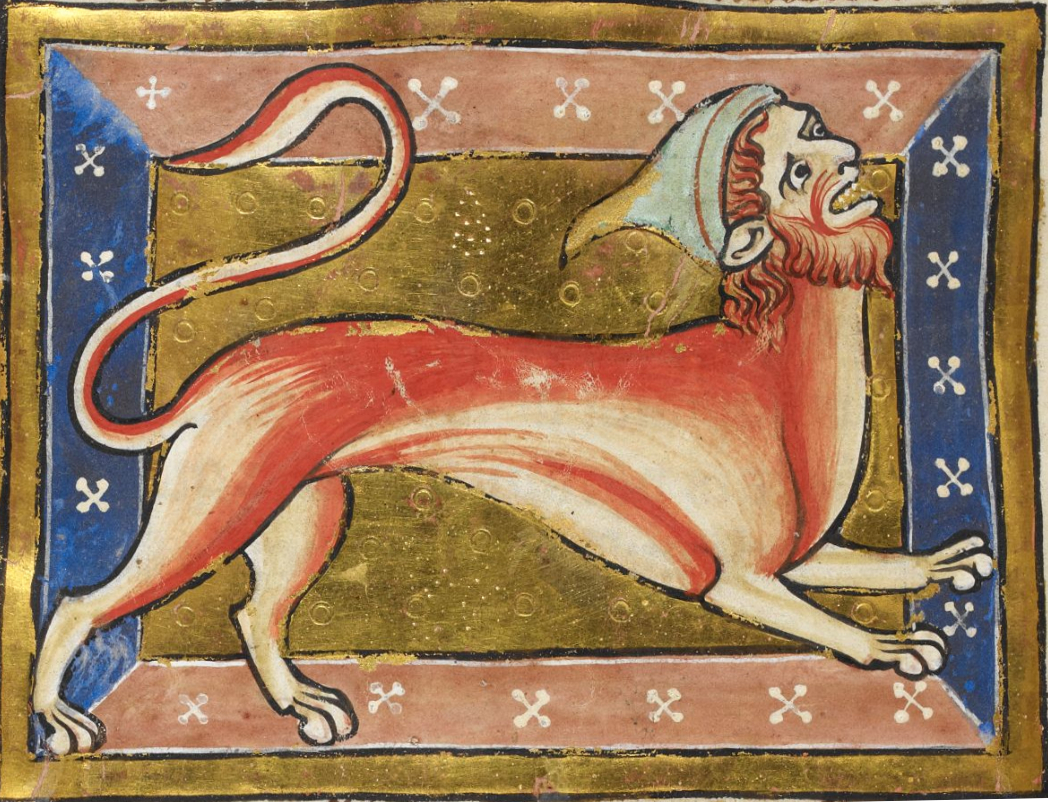
The manticore has been included in some medieval bestiaries, with accompanying illustrations, though not all.
The thick-maned (and long-bearded) manticore wearing a Phrygian cap is a commonplace design (fig., top left).
In most instances, the manticora is "coloured red or brown and has clawed feet". Artists took the liberty of coloring the manticore blue at times. One example is depicted "as a long-haired blond" (fig., top right). Another has the face of a woman and the body of a blue manticore (fig., bottom right) .
Most manuscripts do not bother detailing the scorpion tail and simply draw a long cat's tail, but in Harley MS 3244 the manticore has an "oddly pointed tail" or an "extraordinary spike on the end" of it, and a tail covered in spikes from end to end is shown on the manticore in several other second family manuscripts.
The three-rows of teeth are not faithfully represented except in some third family examples.
Manuscripts and text
;Second Family The manticore () occurs in about half of the Second Family Latin bestiaries. The specific source used in this case was probably Solinus (2nd century),
The text here describing the beast differs little from Pliny's Latin version in language, or the Greek version in content (paraphrased above). This is naturally the case, since much of Solinus was recopied out of Pliny. The manticora is here described as "bloody-colored" rather than "red like cinnabar".
The text concludes by stating that the manticore "seeks human flesh, is active, and leaps so that neither large spaces nor broad obstacles can delay it (neither the broadest space nor the widest barrier can hinder it)".
;H text Actually there are two candidate sources given for the passage, "Solinus 52.37" and "H iii.8"; this "H" being the pseudo-Hugh of Saint Victor De bestiis et aliis rebus, edited by Migne, but this source has been regarded circumspectly as the "problematic De bestiis et aliis rebus" by Clark.
;Transitional The manticore also occurs in the earliest "Transitional" First Family bestiary (c. 1185), and some Third Family codices as well, whose illustrations attempted to reproduce some of the finer details given in its text.
Confounding with other hybrid beasts
As aforementioned, the manticore is one of three hybrids from Aithiopia described together by Solinus, appearing in (nearly) successive chapters of the bestiary. This created the groundwork for the beasts in adjacent chapters being confounded or amalgamated through scribal errors, as described below in the cases of bestiaries produced in France.
French mistransmission
The manticore is basically absent from the French bestiary of Pierre de Beauvais, which exist in the short versions of 38 or 39 chapters, and the long version of 71 chapters. Instead, there is a Chapter 44 on the "centicore" (or santicora, var. ceucrocata), which suggests manticore in name, but which is nothing like the standard manticore. The name is thought to have arisen from misspellings of leucrocotta, compounded by the suffix replaced by -cora by scribal error. Due to further mistransmission, "centicore" became the French misnomer for the yale (eale), a mythic antelope which should be a separate entry in the bestiaries.
Neither manticore nor leucrotta () appears in Philippe de Thaun's bestiary in Anglo-Norman verse.
Post-medieval natural history
.jpg)

Edward Topsell, in 1607, described the manticore as:
Topsell thought the manticore was described by other names elsewhere. He thought that it was the "same Beast which Avicen calleth Marion, and Maricomorion" and also, the same as the "Leucrocuta, about the bigness of a wilde Ass, being in legs and Hoofs like a Hart, having his mouth reaching on both sides to his ears, and the head and face of a female like unto a Badgers".
And Topsell wrote that in India they would "bruise the buttockes and taile" of the whelp or cub they captured, causing it to be incapable of using its quills, thus removing the danger. This differs somewhat from the original sources which stated that they would crush the tail with stone to make them useless.
Heraldry
-0211-Mayster_Ratleffe-mantyger-detail.png)
-0212-Lord_Fitzwater-babyon-detail.png)
--
The likeness of manticore or similar creatures by another name have been used in heraldry, spanning from the late High Middle Ages into the modern period. A number of broadly related terms are utilized in heraldry, including manticore, mantygre, satyral, lampago, and variant spellings. Whether these are treated as variant terminology for the same charge or as distinct entities varies between different heraldic authorities.
The mantyger is glossed as merely a variant reading of manticore in the OED,, while the heraldic scholar Arthur Charles Fox-Davies classed the "manticore", "mantegre", and "man-tiger" together as a variant of the "man-lion" or "lympago", a modification of the heraldic lion with a human face, with horns on its forehead. However, the 17th century heraldry collector Randle Holme made a fine distinction between manticore and mantyger. Holme's description of the manticore seems to derive directly from naturalist Edward Topsell (cf. above), while he describes the mantyger as having etc., and also noting that they may be horned or unhorned.
The manticore first appeared in English heraldry in c. 1470, as a badge of William Hastings, 1st Baron Hastings; and in the 16th century.
The mantyger device was later used as a badge by Robert Radcliffe, 1st Earl of Sussex, and by Sir Anthony Babyngton. The Radford[e]'s device was described as "3 mantygers argent" by one source, c. 1600. Thus in heraldic discourse the term "manticore" became usurped by "mantyger" during the 17–18th centuries, and "mantiger" in the 19th.
It is noted that the manticore/mantiger of heraldic devices has a beast of prey body as standard, but sometimes chosen to be given dragon feet. The Radcliffe family manticore appears to have human feet, and (not so surprisingly), a chronicler described as a "Babyon" (baboon) the device by John Radcliffe (Lord Fitzwater) accompanying Henry VIII into war in France. It has also been speculated the Babyngton device is intended to represent the "Babyon, or baboon, as a play upon his name", and it too also has characteristically "monkey-like feet".
The typical heraldic manticore is supposed to have not only the face of an old man, but spiraling horns as well, although this is not really ascertainable in the Radcliffe family badge, where the purple manticore is wearing a yellow cap (cap of dignity ).
Parallels
Gerald Brenan linked the manticore to the mantequero, a monster feeding on human fat in Andalusian folklore.
The Hindu god Narasimha is often referred to as a Manticore. Narasimha, the man lion, is the fourth avatar of Vishnu and is described as having a man’s torso and the head and claws of a lion.
In fiction
Dante Alighieri, in his Inferno, depicted the mythical Geryon as resembling a manticore, following Pliny's description where it has the face of an honest man, the body of a wyvern, the paws of a lion, and the stinger of a scorpion at the end of its tail.
Fine art

The heraldic manticore influenced some Mannerist representations of the sin of Fraud, conceived as a monstrous chimera with a beautiful woman's face – for example, in Bronzino's allegory Venus, Cupid, Folly and Time (National Gallery, London), and more commonly in the decorative schemes called grotteschi (grotesque). From here it passed by way of Cesare Ripa's Iconologia into the seventeenth- and eighteenth-century French conception of a sphinx.
Popular culture
In some modern depictions, such as in the tabletop role-playing game Dungeons & Dragons (D&D) and the card game Magic: The Gathering, manticores are depicted as having wings. They are more specifically given "wings of a dragon" in the implementation of D&D′s 5th edition, according to the Monster Manual (2014), though an earlier version of the manual described them as "batlike wings".
In the animated sitcom television series Krapopolis, the character of Shlub is depicted as a "mantitaur" which is a half-centaur, half-manticore creature where he was the result of a union between a female centaur and a male manticore. In this show besides the fact that the manticores are depicted with dragon-like wings like other depictions of them, the manticores are shown to have dragon-like horns on their head.
In the animated film Onward Octavia Spencer plays "Corey" The Manticore, a manticore who is the proprietor of the Manticore's Tavern.
Explanatory notes
References
Citations
Bibliography
- American edition, Clarkson N. Potter, Inc. 1976
- , Aelian, pp. 61–62; Pausanias, pp. 62–63
- ; [ Reprint], C. N. Potter, 1976
- Translated from the Latin (Cambridge Univ. Library MS. Ii.4.26).
References
- [[Karl Ernst Georges]]: ''Ausführliches lateinisch-deutsches Handwörterbuch.'' 8th ed., Hannover, 1918, vol. 2, col. 802, s.v. ''mantichorās''. ([http://www.zeno.org/Georges-1913/A/mantichoras])
- [[Félix Gaffiot]]: ''Dictionnaire latin-français.'' 1934, p. 974. ([http://micmap.org/dicfro/introduction/gaffiot] → [http://micmap.org/dicfro/search/gaffiot/mantichoras])
- Cf. [[Henry Liddell. Henry George Liddell]] & [[Robert Scott (philologist). Robert Scott]], ''A Greek-English Lexicon'', {{LSJ. martixo/ras. μαρτιχόρας
- <Old Persian ''martijaqâra'' according to the ''[[New English Dictionary. NED]]'', apud {{harvp. McCulloch. 1962, p. 142 n103
- {{harvp. Nichols tr.. 2013. Bibliotheca]]'' 72.
- {{L&S. mantichora. mantĭchō^ra. ref lists Plin. 8, 21, 30, § 75; 8, 30, 45, § 107. So the same passage may be designated variously as 8.21 (30), or 8.30 or 8.75 depending on the editor.
- Bostock, John ed. "[http://data.perseus.org/citations/urn:cts:latinLit:phi0978.phi001.perseus-eng1:8.45 Chap. 45. The Crocotta. The Mantichora]
- {{harvp. Clark. 2006
- By comparison of Latin texts
- By comparison of English translations
- {{harvp. McCulloch. 1962 "Manticore", pp. 142–143
- {{harvp. Clark. 2006
- {{harvp. White [1954]. 1984
- Vinycomb, John. (1906). "Fictitious and Symbolic Creatures in Art, With Special Reference to Their Use in British Heraldry". Chapman and Hall, Limited.
- (1909). "A Complete Guide to Heraldry". T.C. and E.C. Jack.
- Holme, Randle. (1688). "The Academy of Armorie and Blazon".
- {{harvp. Holme. Dennys. 1975
- ''Al Sur de Granada'', pages 190-193, [[Gerald Brenan]], 1997, Fábula - Tusquets Editores. Originally ''[[South from Granada (book). South from Granada]]'', 1957
- (1933). "La Divina commedia di Dante Alighieri". D.C. Heath and Co..
- Moffitt, John F.. (1996). "An Exemplary Humanist Hybrid: Vasari's "Fraude" with Reference to Bronzino's "Sphinx"". Renaissance Quarterly.
- Wood, Juliette. (2018). "Fantastic Creatures in Mythology and Folklore: From Medieval Times to the Present Day". [[Bloomsbury Publishing]].
- (2 August 2022). "manticore".
- Bennett, Tara. (September 23, 2023). "Krapopolis Review: Beware of Greeks bearing too many poop jokes.".
- (March 7, 2020). "'Onward': Meet the Voices Behind the Animated Characters".
- (December 12, 2018). "Pixar's 'Onward' To Star Chris Pratt, Tom Holland, Julia Louis-Dreyfus and Octavia Spencer".
- (2017-04-12). "Oxford, Bodleian Library MS. Ashmole 1511, fol. 22v (manticora)".
- . (26 August 2022). ["Manuscripts: Manticore"](https://bestiary.ca/beasts/beastmanu177.htm).
- (1898). "An Armory of the Western Counties". J.G. Commin.
- "British Library Add MS 11283".
- "Bodleian Library MS. Bodl. 764".
- Thomas Evelyn Scott-Ellis Baron Howard de Walden. (1904). "Banners, Standards, and Badges: From a Tudor Manuscript in the College of Arms". De Walden Library.
- Diekstra, Frans N.M.. (1998). "Book for a Simple and Devout Woman: A Late Middle English Adaptation of Peraldus's Summa de Vitiis Et Virtutibus and Friar Laurent's Summa Le Roi : Edited from British Library Mss Harley 6571 and Additional 30944". Egbert Forsten.
- Dines, Ilya. (2005). "A hitherto unknown bestiary (Paris, BnF, MS Lat. 6838 B)". Rivista di studi testuali.
- (2018-01-08). "Oxford, Bodleian Library MS. Douce 151, fol. 18v (manticora)".
- 1-57607-283-5
- George, Wilma. (1968). "The Yale". Journal of the Warburg and Courtauld Institutes.
- Académie des inscriptions & belles-lettres (France). (1914). "Histoire littéraire de la France". Imprimerie nationale.
- Pseudo-Hugo de St. Vicotor. (1854). "Sæculum XI Hugonis de S. Victore.. Opera omnia". Apud Garnieri Fratres.
- (July 2003). "Monster Manual: Dungeons & Dragons Core Rulebook". Wizards of the Coast.
- Gygax, Gary. (1993). "Monstrous Manual". TSR.
- (27 February 2018). "Workshop Bestiary MS M.81 fols. 38v–39r".
- {{OED
- {{OED
- {{OED
- Flavius Philostratus, ''The Life of Apollonius of Tyana'', translated by F. C. Conybeare, volume I, book III. Chapter XLV, pp. 327–329.{{blockquote. And inasmuch as the following conversation also has been recorded by Damis as having been held upon this occasion with regard to the mythological animals and fountains and men met with in India, I must not leave it out, for there is much to be gained by neither believing nor yet disbelieving everything. Accordingly Apollonius asked the question, whether there was there an animal called the man-eater (''martichoras''); and Iarchas replied: "And what have you heard about the make of this animal? For it is probable that there is some account given of its shape." "There are," replied Apollonius, "tall stories current which I cannot believe; for they say that the creature has four feet, and that his head resembles that of a man, but that in size it is comparable to a lion; while the tail of this animal puts out hairs a cubit long and sharp as thorns, which it shoots like arrows at those who hunt it."
- Ctesias. (1825). "Ctesiae Cnidii operum reliquiae". In Officina Broenneriana.
- Robinson, Margaret. (Winter 1965). "Some Fabulous Beasts". Folklore.
- Rothery, Guy Cadogan. (1915). "A. B. C. of Heraldry". Stanley Paul & Co..
- Rowland, Beryl. (2016). "Beasts and Birds of the Middle Ages: The Bestiary and Its Legacy". University of Pennsylvania Press.
- Stoneman, Richard. (2021). "The Greek Experience of India: From Alexander to the Indo-Greeks". Princeton University Press.
- Philip de Thaun. (1841). "Popular Treatises on Science Written During the Middle Ages: In Anglo-Saxon, Anglo-Norman and English". Historical Society of Science.
- Topsell, Edward. (1658). "The History of Four-footed Beasts and Serpents..". E. Cotes, for G. Sawbridge [etc.].
- Tulin, Melissa S.. (1998). "Aardvarks to Zebras: A Menagerie of Facts, Fiction, and Fantasy about the Wonderful World of Animals". MJF Books.
- Uhl, Patrice. (1999). "La constellation poétique du non-sens au moyen âge: onze études sur la poésie fatrasique et ses environs". l'Harmattan.
- (14 October 2016). "MS 120: Bestiary". University College Oxford.
- Wiedl, Birgit. (2010). "Anti-Jewish Propaganda and Humor from the Middle Ages to the Early Modern Period". Walter de Gruyter.
This article was imported from Wikipedia and is available under the Creative Commons Attribution-ShareAlike 4.0 License. Content has been adapted to SurfDoc format. Original contributors can be found on the article history page.
Ask Mako anything about Manticore — get instant answers, deeper analysis, and related topics.
Research with MakoFree with your Surf account
Create a free account to save articles, ask Mako questions, and organize your research.
Sign up freeThis content may have been generated or modified by AI. CloudSurf Software LLC is not responsible for the accuracy, completeness, or reliability of AI-generated content. Always verify important information from primary sources.
Report