From Surf Wiki (app.surf) — the open knowledge base
Mantel clock
Small clocks designed to be on shelves

Small clocks designed to be on shelves
.jpg)
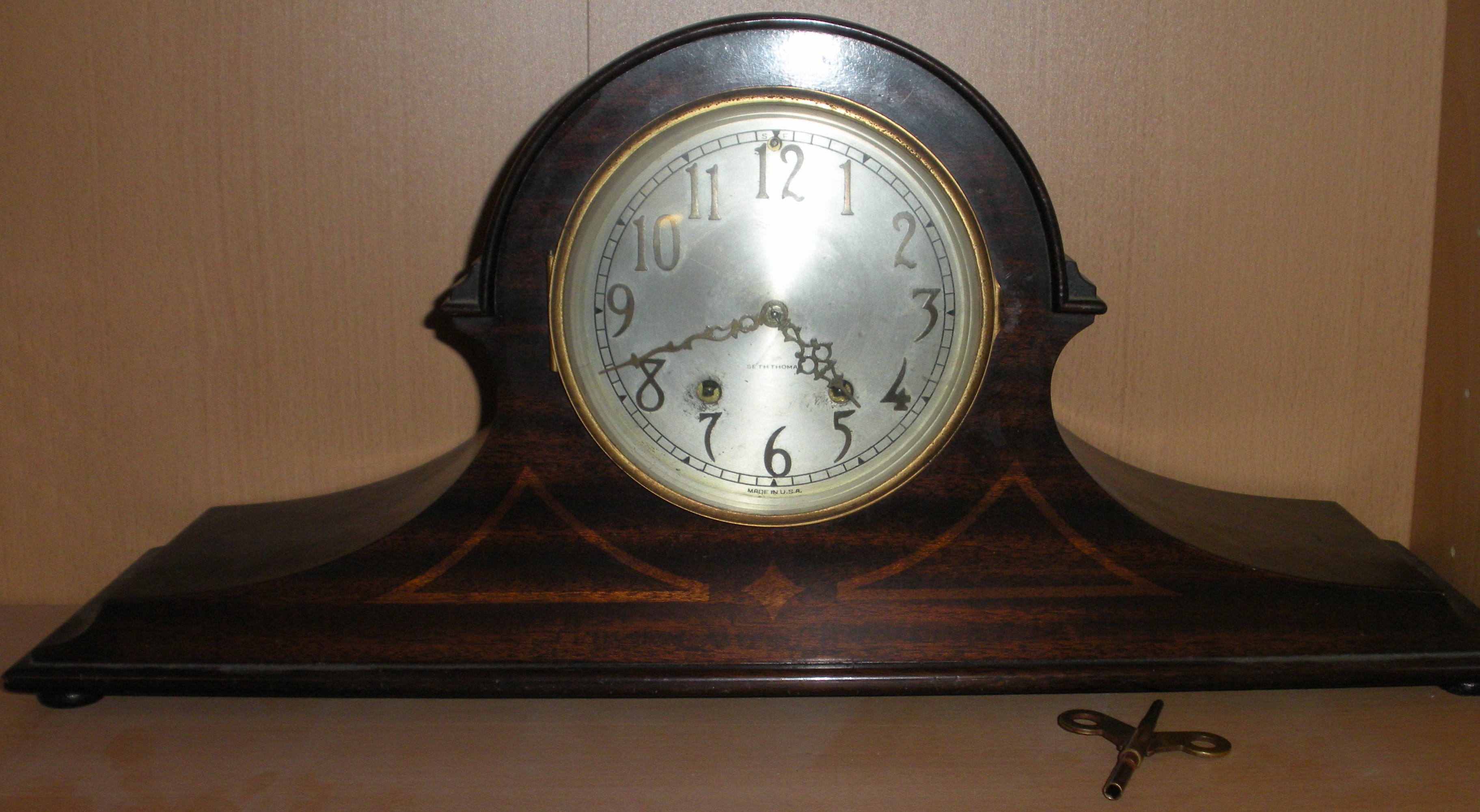

Mantel clocks—or shelf clocks—are relatively small house clocks traditionally placed on the shelf, or mantel, above the fireplace. The form, first developed in France in the 1750s, can be distinguished from earlier chamber clocks of similar size due to a lack of carrying handles.
These clocks are often highly ornate, decorative works. They are most frequently constructed from any combination of ormolu, porcelain, and wood. One of the most common and valued types of mantel clocks are the French Empire-style timepieces.
Simon Willard's shelf clock (half clock, Massachusetts shelf clock) was a relatively economical clock which was produced by the celebrated Simon Willard's Roxbury Street workshop, in Boston, Massachusetts, around the first decades of the 19th century. Right after inventing the banjo clock, Simon Willard brought the design further, designing the similar Massachusetts shelf clock which was related to the traditional bracket clocks. Simon's new creation ran for eight days.
Specifications
In contrast to wall clocks, whose movements were attached to the back board, the shelf clock had its movement supported by a seat board. In the 1790s in Boston, Simon Willard began selling other standardized shelf clocks. Indeed, it looked like a standard tall clock whose hood and base were directly conjoined and whose body was missing. These models included both a second hand and a calendar dial.
[[Georgian era]]
Simon Willard's shelf clocks were weight-driven and some models had an extended base for the weight so they achieved a one-week running period. Also, they had a pinwheel escapement. Their strike mechanism was the rack and snail. The pendulum length could be adjusted through a hole in the clock face at the 12 o'clock position, so it was not necessary to open the case.
[[Victorian decorative arts]]
Some later shelf clocks featured two artistically finished glass tablets which were beside the circular dial. The whole clock was mounted on lion paws. Willard's shelf clocks were produced until the 1830s. The Willard Brothers revolutionized the clock manufacturing by both labor division and using multiple previously molded parts. However, it is commonly accepted that historically their clocks were not definitively popular. Instead, Eli Terry popularized the clock ownership among common American people. Nowadays, Simon Willard's clocks are recognized as American masterpieces. As such, they are avidly sought by both antiquarians and museums. A Simon Willard clock in perfect condition can be purchased for anywhere from $50,000 up to $250,000.
Edwardian
Carriage clock
In popular culture
An animated figure of a mantel clock, "Cogsworth", is a character in Disney's films, Beauty and the Beast (1991; animated), voiced by David Ogden Stiers, and Beauty and the Beast (2017; live action/CGI), portrayed by Ian McKellen.
References
References
- King, Darryn. (2 March 2017). "Beauty and the Beast’s Lumiére and Cogsworth Have a Fascinating Real-Life Backstory".
This article was imported from Wikipedia and is available under the Creative Commons Attribution-ShareAlike 4.0 License. Content has been adapted to SurfDoc format. Original contributors can be found on the article history page.
Ask Mako anything about Mantel clock — get instant answers, deeper analysis, and related topics.
Research with MakoFree with your Surf account
Create a free account to save articles, ask Mako questions, and organize your research.
Sign up freeThis content may have been generated or modified by AI. CloudSurf Software LLC is not responsible for the accuracy, completeness, or reliability of AI-generated content. Always verify important information from primary sources.
Report