From Surf Wiki (app.surf) — the open knowledge base
Mannose
manno-Hexose
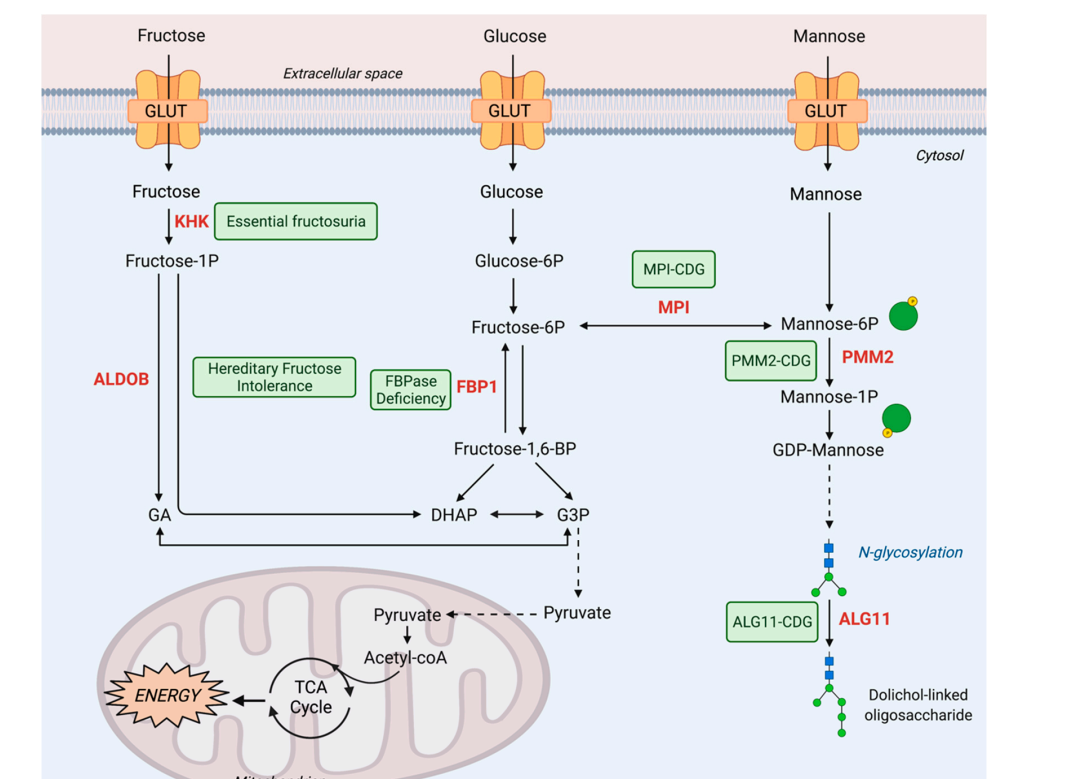
Mannose is a sugar with the formula , which sometimes is abbreviated Man. It is one of the monomers of the aldohexose series of carbohydrates. It is a C-2 epimer of glucose. Mannose is important in human metabolism, especially in the glycosylation of certain proteins. Several congenital disorders of glycosylation are associated with mutations in enzymes involved in mannose metabolism.{{Cite journal
Mannose is not an essential nutrient; it can be produced in the human body from glucose, or converted into glucose. Mannose provides 2–5 kcal/g. It is partially excreted in the urine.
Etymology
The root of both "mannose" and "mannitol" is manna, which the Bible describes as the food supplied to the Israelites during their journey in the region of Sinai. Several trees and shrubs can produce a substance called manna, such as the "manna tree" (Fraxinus ornus) from whose secretions mannitol was originally isolated.
Structure
Mannose commonly exists as two different-sized rings, the pyranose (six-membered) form and the furanose (five-membered) form. Each ring closure can have either an alpha or beta configuration at the anomeric position. The chemical rapidly undergoes isomerization among these four forms.
| [[File:Alpha-D-Mannopyranose.svg | 100px]] | |
|---|---|---|
| α-D-Mannopyranose | ||
| 63.7% | [[File:Beta-D-Mannopyranose.svg | 100px]] |
| β-D-Mannopyranose | ||
| 35.5% |
Metabolism
While much of the mannose used in glycosylation is believed to be derived from glucose, in cultured hepatoma cells (cancerous cells from the liver), most of the mannose for glycoprotein biosynthesis comes from extracellular mannose, not glucose.{{Cite journal | doi-access = free
Mannose is present in numerous glycoconjugates including N-linked glycosylation of proteins. C-Mannosylation is also abundant and can be found in collagen-like regions.
The digestion of many polysaccharides and glycoproteins yields mannose, which is phosphorylated by hexokinase to generate mannose-6-phosphate. Mannose-6-phosphate is converted to fructose-6-phosphate, by the enzyme phosphomannose isomerase, and then enters the glycolytic pathway or is converted to glucose-6-phosphate by the gluconeogenic pathway of hepatocytes.
Mannose is a dominant monosaccharide in N-linked glycosylation, which is a post-translational modification of proteins. It is initiated by the en bloc transfer on Glc3Man9GlcNAc2 to nascent glycoproteins in the endoplasmic reticulum (ER) in a co-translational manner as the protein entered through the transport system. Glucose is hydrolyzed on fully folded protein and the mannose moieties are hydrolyzed by ER and Golgi-resident mannosidases. Typically, mature human glycoproteins only contain three mannose residues buried under sequential modification by GlcNAc, galactose, and sialic acid. This is important, as the innate immune system in mammals is geared to recognise exposed mannose residues. This activity is due to the prevalence of mannose residues, in the form of mannans, on the surfaces of yeasts. The human immunodeficiency virus displays considerable amount of mannose residues due to the tight clustering of glycans in its viral spike. These mannose residues are the target for broadly neutralizing antibodies.
Biotechnology
Recombinant proteins produced in yeast may be subject to mannose addition in patterns different from those used by mammalian cells.{{Cite journal
Formation
Mannose can be formed by the oxidation of mannitol.
It can also be formed from glucose in the Lobry de Bruyn–van Ekenstein transformation.
Uses
Mannose (-mannose) is used as a dietary supplement to prevent recurrent urinary tract infections (UTIs). , one review found that taking mannose was as effective as antibiotics to prevent UTIs,
Configuration
Mannose differs from glucose by inversion of the C-2 chiral center. Mannose displays a ^4C_1 pucker in the solution ring form. This simple change leads to the drastically different biochemistry of the two hexoses. This change has the same effect on the other aldohexoses, as well.
Mannose PTS permease

The PEP-dependent sugar transporting phosphotransferase system transports and simultaneously phosphorylates its sugar substrates. Mannose XYZ permease is a member of the family, with this distinct method being used by bacteria for sugar uptake particularly exogenous hexoses in the case of mannose XYZ to release the phosphate esters into the cell cytoplasm in preparation for metabolism primarily through the route of glycolysis.{{Cite journal | doi-access = free MANXYZ possesses four domains in three polypeptide chains; ManX, ManY, and ManZ. The ManX subunit forms a homodimer that is localized to the cytoplasmic side of the membrane. ManX contains two domains IIA and IIB linked by a hinge peptide with each domain containing a phosphorylation site and phosphoryl transfer occurs between both subunits.{{Cite journal | doi-access = free | doi-access =
References
References
- "Appendix".
- (30 March 2025). "Traverso V. The return of Sicily's ancient 'white gold'". BBC News.
- (2023-10-06). "Obtaining Pure 1 H NMR Spectra of Individual Pyranose and Furanose Anomers of Reducing Deoxyfluorinated Sugars". The Journal of Organic Chemistry.
- (2001). "Glycoscience. Chemistry and Chemical Biology I–III". Springer.
- (2015-06-24). "Glycan clustering stabilizes the mannose patch of HIV-1 and preserves vulnerability to broadly neutralizing antibodies". Nature Communications.
- (2015-06-16). "Structural Constraints Determine the Glycosylation of HIV-1 Envelope Trimers". Cell Reports.
- (2015-04-01). "Targeting host-derived glycans on enveloped viruses for antibody-based vaccine design". Current Opinion in Virology.
- (1 August 2020). "D-mannose vs other agents for recurrent urinary tract infection prevention in adult women: a systematic review and meta-analysis". American Journal of Obstetrics and Gynecology.
- (30 August 2022). "D-mannose for preventing and treating urinary tract infections". Cochrane Database of Systematic Reviews.
- Gail Hayward. (April 8, 2024). "d-Mannose for Prevention of Recurrent Urinary Tract Infection Among Women {{!}} A Randomized Clinical Trial". JAMA Intern. Med..
- (6 February 2025). "D-mannose does not prevent urinary tract infections". NIHR Evidence.
- (2019-06-17). "Structure of the mannose transporter of the bacterial phosphotransferase system". Cell Research.
- (2021-04-06). "Structure of the mannose phosphotransferase system (man-PTS) complexed with microcin E492, a pore-forming bacteriocin". Cell Discovery.
This article was imported from Wikipedia and is available under the Creative Commons Attribution-ShareAlike 4.0 License. Content has been adapted to SurfDoc format. Original contributors can be found on the article history page.
Ask Mako anything about Mannose — get instant answers, deeper analysis, and related topics.
Research with MakoFree with your Surf account
Create a free account to save articles, ask Mako questions, and organize your research.
Sign up freeThis content may have been generated or modified by AI. CloudSurf Software LLC is not responsible for the accuracy, completeness, or reliability of AI-generated content. Always verify important information from primary sources.
Report