From Surf Wiki (app.surf) — the open knowledge base
Mann Act
1910 law of the United States Congress
1910 law of the United States Congress
| Field | Value |
|---|---|
| shorttitle | Mann Act |
| othershorttitles | White-Slave Traffic Act of 1910 |
| longtitle | An Act to further regulate interstate and foreign commerce by prohibiting the transportation therein for immoral purposes of women and girls, and for other purposes. |
| nickname | White-Slave Traffic Act |
| enacted by | 61st |
| effective date | June 25, 1910 |
| cite public law | |
| cite statutes at large | |
| title amended | |
| sections created | |
| introducedin | House |
| introducedbill | |
| introducedby | James Robert Mann (R–IL) |
| introduceddate | December 21, 1909 |
| signedpresident | William Howard Taft |
| signeddate | June 25, 1910 |
| cite statutes at large =
The Mann Act, previously called the White-Slave Traffic Act of 1910, is a United States federal law, passed June 25, 1910 (ch. 395, ; codified as amended at ). It is named after Congressman James Robert Mann of Illinois.
In its original form, the act made it a felony to engage in interstate or foreign commerce transport of "any woman or girl for the purpose of prostitution or debauchery, or for any other immoral purpose". Its primary stated intent was to address prostitution, immorality, and human trafficking, particularly where trafficking was for the purposes of prostitution. It was one of several acts of protective legislation aimed at moral reform during the Progressive Era. In practice, its ambiguous language about "immorality" resulted in it being used to criminalize even consensual sexual behavior between adults. It was amended by Congress in 1978 and again in 1986 to limit its application to transport for the purpose of prostitution or other illegal sexual acts.
Background and motivation
In the 19th century, many cities in the United States had designated legally protected areas of prostitution. Increased urbanization, as well as greater numbers of young women entering the workforce, led to greater flexibility in courtship without supervision. In this changing social sphere in the mid-1800s, concern over "white slavery" began. This term referred to women kidnapped for the purposes of prostitution and derives from Charles Sumner's 1847 description of the Barbary slave trade.
Numerous communities appointed vice commissions to investigate the extent of local prostitution, whether prostitutes participated in it willingly or were forced into it, and the degree to which it was organized by any cartel-type organizations. The second significant action at the local level was to close the brothels and the red-light districts. From 1910 to 1913, city after city changed previously tolerant approaches and forced the closing of their brothels. Opposition to openly practiced prostitution had been growing steadily throughout the last decades of the 19th century. The federal government's response was the Mann Act. The purpose of the act was to make it a crime to "transport or cause to be transported, or aid to assist in obtaining transportation for" or to "persuade, induce, entice, or coerce" a woman to travel. Many of the changes that occurred after 1900 were a result of tensions between social ideals and practical realities. Family form and functions changed in response to a complex set of circumstances that were the effects of economic class and ethnicity.
Rescuing sex trafficked young women
Exploitation of young women to work as prostitutes was not merely a figment of social panic or racist hysteria. Suffrage activists, especially Harriet Burton Laidlaw and Rose Livingston, took up the concerns. They worked in New York City's Chinatown and in other cities to rescue young white and Chinese girls from forced prostitution, and helped pass the Mann Act to make interstate sex trafficking a federal crime. Other groups, such as the Woman's Christian Temperance Union and Hull House, focused on children of prostitutes and poverty in community life while trying to pass protective legislation. The American Purity Alliance also supported the Mann Act.
Conspiracy narrative
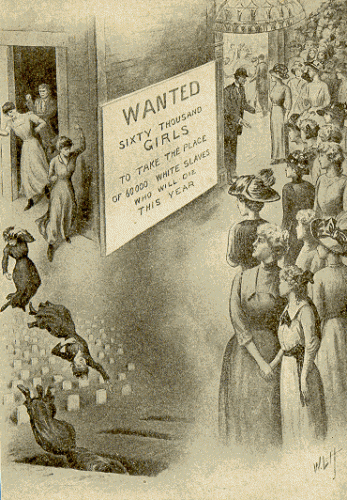
According to historian Mark Thomas Connelly, "a group of books and pamphlets appeared announcing a startling claim: a pervasive and depraved conspiracy was at large in the land, brutally trapping and seducing American girls into lives of enforced prostitution, or 'white slavery'. These white-slave tracts began to circulate around 1909." Such narratives often misleadingly portrayed innocent girls "victimized by a huge, secret and powerful conspiracy controlled by foreigners" as they were drugged or imprisoned and forced into prostitution.
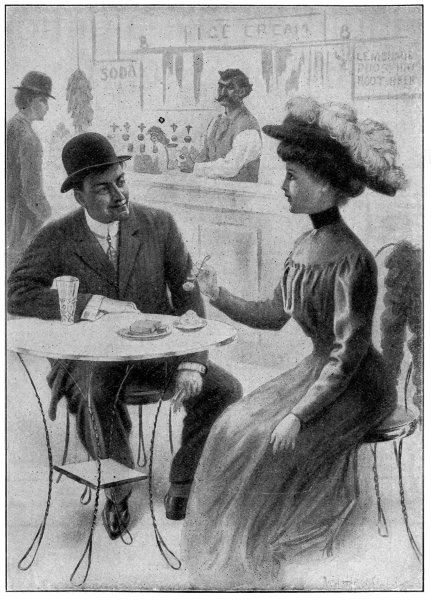
This excerpt from The War on the White Slave Trade was written by the United States District Attorney in Chicago:
While prostitution was widespread, studies by local vice commissions at the time indicate that it was "overwhelmingly locally organized without any large business structure, and willingly engaged in by the prostitutes."
Some contemporaries did question the idea of abduction and foreign control of prostitution through cartels. For example, noted radical and feminist Emma Goldman observed, "Whether our reformers admit it or not, the economic and social inferiority of woman is responsible for prostitution."
Legal application
Although the law was created to stop forced sexual slavery of women, the most common initial use of the Mann Act was to prosecute men for having sex with underage females. The phrase "immoral purpose" in the statute allowed a broad application of the law following its affirmation in
In addition to its stated purpose of preventing human trafficking, the law was used to prosecute unlawful premarital, extramarital, and interracial relationships. The penalties would be applied to men whether or not the woman involved consented, and if she had consented, the woman could be considered an accessory to the offense. Some attribute enactment of the law to the case of world-champion heavyweight boxer Jack Johnson. Johnson was known to be intimate with white women, some of whom he met at the fighting venue after his fights. In 1912, he was prosecuted, and later convicted, for "transporting women across state lines for immoral purposes" as a result of his relationship with a white prostitute named Belle Schreiber; the month prior to the prosecution, Johnson had been charged with violating the Mann Act due to traveling with his white girlfriend, Lucille Cameron, who refused to cooperate with the prosecution and whom he married soon thereafter.
The 1948 prosecution of Frank LaSalle for abducting Florence Sally Horner is believed to have been an inspiration for Vladimir Nabokov in writing his novel Lolita. Humbert Humbert, the narrator, at one point explicitly refers to LaSalle.
The Mann Act has also been used by the U.S. federal government to prosecute polygamists such as Mormon fundamentalists. Bigamy is illegal in the U.S. and all states have antipolygamy laws. Colorado City, Arizona; Hildale, Utah; Bountiful, British Columbia, northern Mexico are historic locations of several Mormon sects that practiced polygamy, although The Church of Jesus Christ of Latter-day Saints has expressly forbidden polygamy since the start of the 20th century. Sect leaders and individuals have been charged under the Mann Act when "wives" are transported across the Utah–Arizona state line or the U.S.–Canadian and U.S.–Mexican borders.
Notable prosecutions under the Mann Act
| Person | Year | Decision | Notes | ||
|---|---|---|---|---|---|
| Bella Moore | 1910 | Convicted | In People v. Moore, an all-white jury convicted Bella Moore, a mixed race woman from New York, for the "compulsory prostitution" of two white women, Alice Milton and Belle Woods, using the Mann Act. | ||
| Jack Johnson | 1913 | Convicted (pardoned in 2018) | In October and November 1912, boxer Jack Johnson was arrested twice under the Mann Act. It was generally acknowledged that the arrests were racially motivated. A posthumous presidential pardon was granted in 2018 by President Donald Trump. | ||
| Farley Drew Caminetti | 1913 | Convicted | Caminetti and Maury Diggs took their mistresses from Sacramento, California to Reno, Nevada. Their wives informed the police, and both men were arrested in Reno. Caminetti v. United States expanded Mann Act prosecutions from prostitution to non-commercial extramarital sex. | ||
| William I. Thomas | 1918 | Acquitted | Pioneering sociologist William I. Thomas's academic career at the University of Chicago was irreversibly damaged after he was arrested under the Mann Act when caught in the company of Mrs. Granger, whose husband was an army officer with the American forces in France. Thomas was acquitted at trial. | ||
| Fred Toney | 1918 | Convicted | Toney, a professional baseball player, pleaded guilty to traveling with a woman, whom he falsely claimed was his wife, from Louisville, Kentucky to Cincinnati, Ohio where they lived together while he played for the Cincinnati Reds. He was sentenced to four months in jail. | ||
| Frank Lloyd Wright | 1926 | Charges dropped | In October 1926, Wright and his future wife, Olga Lazovich Hinzenburg were accused of violating the Mann Act and he was arrested in Minnetonka, Minnesota. | ||
| Finis Dake | 1937 | Convicted | In 1937, he was convicted of violating the Mann Act by willfully transporting Emma Barelli, age 16, across the Wisconsin state line "for the purpose of debauchery and other immoral practices". The May 27, 1936, issue of the Chicago Daily Tribune reported that Dake registered at hotels in Waukegan, Bloomington, and East St. Louis with the girl under the name "Christian Anderson and wife". In order to avoid a jury trial and the possibility of being sentenced to a maximum of 10 years in prison and a fine of $10,000, Dake pleaded guilty. Subsequently, he served six months in the House of Corrections in Milwaukee, Wisconsin. | ||
| George Barker | 1940 | Charges dropped | The British poet was arrested crossing a state border with his lover Canadian author Elizabeth Smart in 1940. She described the arrest in her book By Grand Central Station I Sat Down and Wept. | ||
| Charlie Chaplin | 1944 | Acquitted | Chaplin met Joan Barry, age 24, in 1941. He signed her to a $75-a-week contract for a film he was putting together, and she became his mistress. By mid-1942, Chaplin let her contract expire. To send her home, Chaplin paid her train fare to New York which led to his arrest. Chaplin was acquitted of the charges. | ||
| Rex Ingram | 1949 | Convicted | Pleading guilty to the charge of transporting a teenage girl to New York for immoral purposes, the actor was sentenced to eighteen months in jail. He served just ten months of his sentence, but the incident had a serious impact on his career for the next six years. | ||
| Frank La Salle | 1950 | Convicted | La Salle was tried, convicted, and sentenced to 30 to 35 years in prison under the Mann Act for abducting and raping Florence Sally Horner during a 21-month period while traveling from New Jersey to California. | ||
| Kid Cann | 1959 | Convicted/ | |||
| Acquitted on appeal | Cann, who was an organized crime figure from Minneapolis, Minnesota, was prosecuted and convicted for transporting a prostitute from Chicago to Minnesota. His conviction was later overturned on appeal. Cann was later prosecuted and convicted of offering a $25,000 bribe to a juror at his Mann Act trial. | ||||
| Charles Manson | 1960 | Charges dropped | Manson took two prostitutes from California to New Mexico to work. | ||
| Chuck Berry | 1962 | Convicted | In January 1962, Berry was sentenced to three years in prison for offenses under the Mann Act when he had transported a girl, age 14, across state lines. | ||
| Tony Alamo | 2008 | Convicted | The former American religious leader was arrested under the Mann Act in September 2008. He was subsequently convicted on 10 counts of interstate transportation of minors for illegal sexual purposes, rape, sexual assault, and contributing to the delinquency of minors. | ||
| Brian David Mitchell | 2010 | Convicted | Former street preacher and pedophile; convicted in 2010 of interstate kidnapping and unlawful transportation of a minor across state lines in connection with the 2002 abduction of Elizabeth Smart; currently serving a life sentence in federal prison. | ||
| Jack Schaap | 2012 | Convicted | Pastor at mega-church First Baptist Church and Chancellor of Hyles–Anderson College, pleaded guilty to transportation of a minor, age 16, across state lines to have sex with her. He was sentenced to 12 years in prison. | ||
| R. Kelly | 2021 | Convicted | Singer/actor who has faced multiple sexual abuse trials. At his first federal trial, he was charged with:{{multiref | ||
| Ghislaine Maxwell | 2021 | Convicted | Socialite/publishing heiress charged with sex trafficking of minors for Jeffrey Epstein. In December 2021, a jury found her guilty on five of six counts involving sex trafficking of minors, and in June 2022, she was sentenced to 20 years. Her conviction and sentence were upheld on appeal. | ||
| Sean Combs ("Diddy") | 2025 | Convicted | In 2025, a jury in federal court in New York found Combs guilty of two counts of violating the Mann Act; he was acquitted of sex trafficking and racketeering. |
Individuals considered for prosecution under the Act
- Anwar al-Awlaki, an American citizen, Islamist cleric, and al-Qaeda organizer, was investigated for violations of the Mann Act, authorities primarily wanting to arrest him for his ties to the 9/11 hijackers, but left the United States for Yemen before he could be detained.
- Dušan Popov, a World War II Allied double agent with a "James Bond" lifestyle, was threatened with arrest under the Mann Act.{{cite book
- Individuals associated with the Emperors Club VIP prostitution ring, one of whose more prominent clients was Eliot Spitzer while he was governor of New York.
- Individuals associated with the Fundamentalist Church of Jesus Christ of Latter-Day Saints (FLDS), such as Warren Jeffs and Merril Jessop have refused to answer questions during depositions and court hearings, citing the 5th Amendment, over concerns of self-incrimination related to "potential state investigation still ongoing, as well as criminal investigations under the Mann Act out of the U.S. Attorney's Office."
Mann Act case decisions by the United States Supreme Court
- Hoke v. United States, . The Court held that Congress could not regulate prostitution per se, as that was strictly the province of the states. Congress could, however, regulate interstate travel for purposes of prostitution or "immoral purposes".
- Athanasaw v. United States, . The Court decided that the law was not limited strictly to prostitution, but to "debauchery" as well.
- In a 1915 ruling, the Court determined that it is not impossible for a victim of the Act to be charged with conspiracy under specific circumstances. The requirements for conspiracy by a victim of the Act were limited in a 1932 ruling.
- Caminetti v. United States, . In 1917, the Court decided that the Mann Act did not apply strictly to purposes of prostitution, but to other noncommercial consensual sexual liaisons; thus consensual extramarital sex fell within the category of "immoral sex".
- In 1932, the Court ruled that consent by the victim to their own transportation does not constitute conspiracy or culpability under the Act.
- Cleveland v. United States, . The Court decided that a man can be prosecuted under the Mann Act even when married to the woman if the marriage is polygamous; therefore, in 1946, polygamous marriage was determined to be an "immoral purpose".
- Bell v. United States, . The Court decided that simultaneous transportation of two women across state lines constituted only one violation of the Mann Act, not two violations.
- The Court affirmed that a victim can be compelled to testify against a spouse who violated the Act, in exception to the common law spousal privilege rule.
Congressional amendments to the law
In 1978, Congress updated the act's definition of "transportation" and added protections against commercial sexual exploitation for minors.
Congress amended the law in 1986 to make it gender-neutral and to fix its ambiguous language. In particular, as part of a larger 1986 bill, the Child Sexual Abuse and Pornography Act of 1986, focused on criminalizing various aspects of child pornography, the Mann Act was revised by replacing the ambiguous "debauchery" and "any other immoral purpose" with the more specific "any sexual activity for which any person can be charged with a criminal offense".
The law was amended in 2006 to enhance the penalties for transporting minors.
| Date of Enactment | Public Law Number | U.S. Statute Citation | U.S. Legislative Bill | U.S. Presidential Administration |
|---|---|---|---|---|
| June 25, 1948 | P.L. 80-772 | Harry S. Truman | ||
| February 6, 1978 | P.L. 95–225 | Jimmy Carter | ||
| November 7, 1986 | P.L. 99–628 | Ronald Reagan | ||
| September 13, 1994 | P.L. 103–322 | Bill Clinton | ||
| February 8, 1996 | P.L. 104–104 | Bill Clinton | ||
| October 30, 1998 | P.L. 105–314 | Bill Clinton | ||
| April 30, 2003 | P.L. 108–21 | George W. Bush | ||
| July 27, 2006 | P.L. 109–248 | George W. Bush |
Effects and alterations of the Mann Act
The Mann Act was one of the more salient legislation passed during the early 20th century Progressive Era. While the Mann Act was meant to combat forced prostitution, it had repercussions that extended into consensual sexual activity, including criminalizing many people who were not participating in prostitution. It was also abused for political persecution and as a tool for blackmail.
The scope of the Mann Act was expanded in September 1913, as a result of charges brought against Drew Caminetti and Maury Diggs, both of Sacramento, California. The two men were married, and took their mistresses (Lola Norris and Marsha Warrington, respectively) to Reno, Nevada. The men's wives contacted the police, and the men were arrested in Reno and found guilty under the Mann Act.
Such an interpretation of the law in effect criminalized all premarital or extramarital sexual relationships that involved interstate travel. With behavior that was so commonplace now illegal, federal prosecutors had a weapon that could very easily be abused in order to prosecute "undesirables" who were otherwise law-abiding citizens.
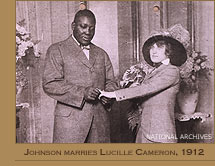
"Undesirables" included black men who had consensual premarital affairs or married women who were not black, as well as men with perceived left-of-center political views. For example, the heavyweight champion of the world, Jack Johnson, as well as Charlie Chaplin, and later, Chuck Berry were all prosecuted and convicted under the Mann Act. The instigating circumstances resulting in prosecution were that Johnson married a white woman, Chaplin had a premarital relationship with a 24-year-old actress then later paid her train fare home (crossing over state lines), and Berry paid for transportation of an underage Apache girl to her home, across state lines.
Following multiple blackmail accounts, The New York Times became an advocate against the Mann Act. In 1915, the paper published an editorial pointing out how the Act led to extortion. In 1916, it labeled the Mann Act "The Blackmail Act", arguing that its dangers had been clear from the start as the Act could make a harmless spree or simple elopement a crime. The paper also called the "blackmail that resulted from the Mann Act [...] worse than the prostitution it sought to suppress".
One author wrote about an incident of blackmail in 1914. A woman met a U.S. Army colonel in Los Angeles and was his mistress for two years. He promised to divorce his wife and marry her. When the colonel decided to leave her and return to his wife in Providence, Rhode Island, his former mistress and her mother pursued him there. The two women consulted lawyers and then the former mistress unsuccessfully tried to bring charges against him under the Mann Act, attempting to bribe an official to assist in her favor.
While the Mann Act has never been repealed, it has been amended and altered. The 1978 amendments expanded coverage to issues around child pornography and exploitation. Most recently, in 1986, the Mann Act was significantly altered to make it gender neutral and to redress the ambiguous phrasing that had enabled decades of unjust applications of the Act. With the 1986 amendments, the Mann Act outlaws interstate or foreign transport of "any person" for purposes of "any sexual activity for which any person can be charged with a criminal offense." Prior to the Supreme Court ruling in Lawrence v. Texas (2003), old laws in many states made sodomy illegal, which left open the possibility of prosecution under the Mann Act of consenting adult couples, especially gay couples, though there is no record of such enforcement actions.
By 2024 the term "White Slave Traffic Act" has fallen out of use although the associated law continues to be enforced.
References
References
- Weiner, Eric. (11 March 2008). "The Long, Colorful History of the Mann Act".
- (1847). "White Slavery in The Barbary States. A Lecture Before The Boston Mercantile Library Association, Feb. 17, 1847". William D. Ticknor and Company.
- Landsberg, Brian K. (2004). "Macmillan Reference USA". Macmillan.
- Faue, Elizabeth. (2003). "Encyclopedia of American History". Infobase.
- Laidlaw, Harriet Burton. "Papers, 1851–1958". Harvard.
- [https://archive.org/stream/fightingtraffici00bell#page/44/mode/2up Bell], pp. 44–45.
- Bell, Ernest Albert. (1910). "The War on the White Slave Trade". GS Ball.
- Langum, David J.. (1994). "Crossing Over the Line: Legislating Morality and the Mann Act". University of Chicago Press.
- (June 4, 1913). "Year in Cell for Johnson; $1,000 Fine, Too, for Pugilist's White Slavery Offense". [[New York Times]].
- Dolinin, Alexander. "What Happened to Sally Horner?: A Real-Life Source of Nabokov's Lolita". Art & Humanities Library of [[Pennsylvania State University]].
- (1994). "Crossing Over the Line: Legislating Morality and the Mann Act". University of Chicago Press.
- Goldman, Emma. (1972). "''Red Emma Speaks: Selected Writings and Speeches''". [[Random House]].
- Lui Yi, Mary Ting. (September 1, 2009). "Saving young girls from Chinatown: white slavery and woman suffrage, 1910–1920". Journal of the History of Sexuality.
- "People v. Moore". Caselaw Access Project.
- (2011). "Narratives of Sexual Consent and Coercion: Forced Prostitution Trials in Progressive-Era New York City". Law & Social Inquiry.
- Donovan, Brian. (2006). "White slave crusades : race, gender, and anti-vice activism, 1887–1917". University of Illinois Press.
- (May 24, 2018). "Trump Pardons Jack Johnson, Heavyweight Boxing Champion". The New York Times.
- (September 6, 1913). "Caminetti Guilty On Only One Count. Two Jurors Hold Out for Acquittal for Three Hours, but Finally Compromise". [[The New York Times]].
- (April 20, 1918). "Thomas and Woman Freed. Evidence Sought for Prosecution under the Mann Act". The New York Times.
- (1 January 1919). "Fred Toney Pleads Guilty To White Slave Charge; Sentenced". [[The Tennessean]].
- Chambers, Pastor Joseph. (September 19, 1999). "An Open Letter to Pastor Joseph Chambers, Author of an Article Entitled 'Confused Charismatic Theology & the Dake's Bible'". Paw Creek Ministries.
- (April 3, 1944). "Mann & Woman".
- Eder, Bruce. (August 2025). "Rex Ingram Biography". [[AMC (TV channel).
- [[Vincent Bugliosi. Bugliosi, Vincent]] with [[Curt Gentry. Gentry, Curt]] (1994). ''Helter Skelter – The True Story of the Manson Murders 25th Anniversary Edition''. W. W. Norton & Company. {{ISBN. 0-393-08700-X. pp. 137–146.
- "Chuck Berry". [[Rock and Roll Hall of Fame.
- Weiner, Eric. (March 11, 2008). "The Long, Colorful History of the Mann Act". [[NPR]].
- "295 F.2d 192". ftp.resource.org.
- [http://edition.cnn.com/2008/CRIME/09/25/childporn.alamo/ Evangelist arrested, charged with child pornography crimes]. [[CNN]]. September 26, 2008. Retrieved July 30, 2011.
- [https://archive.today/20120710224509/http://articles.cnn.com/2009-07-24/justice/arkansas.evangelist.trial_1_tony-alamo-christian-ministries-bernie-hoffman-arkansas Trial of Arkansas evangelist]. July 24, 2009. [[CNN]]. Retrieved July 30, 2011.
- (September 25, 2008). "Evangelist Arrested In Child Sex Probe". CBS News.
- Enos, Robin (May 25, 2011), "[https://blogs.findlaw.com/blotter/2011/05/brian-david-mitchell--elizabeth-smart-abductor-gets-life-sentence.html Kidnapper Brian David Mitchell Sentenced to Life]. findlaw.com
- (August 2, 2012). "Jack Schaap Confesses To Sexual Relationship With Teen After Firing From Megachurch". [[The Huffington Post]].
- (August 27, 2012). "Jack Schaap Pleads Guilty in Teen Sex Case, Denies Knowing Act Was Crime". [[Christian Post]].
- (January 5, 2013). "Judge Rejects Reduced Sentence In Former Pastor's Sex Case". [[CBS Chicago]].
- {{Cite court. link
- (December 29, 2021). "Ghislaine Maxwell convicted in Epstein sex abuse case".
- Aoife Walsh. (September 17, 2024). "Ghislaine Maxwell loses sex trafficking appeal". BBC News.
- (July 2, 2025). "Live Updates: Sean Combs Acquitted of Sex Trafficking but Found Guilty on Lesser Charges". New York Times.
- Rhee, Joseph. (November 30, 2009). "How Anwar Awlaki Got Away: Fort Hood Investigation". ABC News.
- (March 10, 2008). "Spitzer Is Linked to Prostitution Ring". The New York Times.
- Anthony, Paul. (January 28, 2009). "FLDS leader invokes 5th in deposition: He pleads it more than 250 times, court transcript says". [[San Angelo Standard-Times]].
- [[:wikisource:Louis Athanasaw v. United States]]
- "Athanasaw v. United States".
- (7 November 1986). "H.R.5560 - Child Sexual Abuse and Pornography Act of 1986". 99th Congress (1985–1986).
- (8 November 1986). "President Reagan signed a bill Friday strengthening provisions of...". [[United Press International]].
- Adam Walsh Child Protection and Safety Act of 2006. {{usstat. 120. 587.
- "The Mann Act". Public Broadcasting Service.
- "Johnson's Arrest". [[PBS]].
- "The Rise and Fall of Jack Johnson". PBS.
- McLaren, Angus. "Entrapping the Jazz-Age American Male". ''Sexual Blackmail: A Modern History''. Cambridge, Mass.: Harvard University Press, 2002. p. 87. Print.
- Langum, David J. "Mann Act (1910)". Major Acts of Congress. 2004. Encyclopedia.com. November 14, 2013 http://www.encyclopedia.com
- Cevallos, Danny. (2024-09-22). "The checkered origins of the law at the center of Sean 'Diddy' Combs' prosecution". [[MSNBC]].
This article was imported from Wikipedia and is available under the Creative Commons Attribution-ShareAlike 4.0 License. Content has been adapted to SurfDoc format. Original contributors can be found on the article history page.
Ask Mako anything about Mann Act — get instant answers, deeper analysis, and related topics.
Research with MakoFree with your Surf account
Create a free account to save articles, ask Mako questions, and organize your research.
Sign up freeThis content may have been generated or modified by AI. CloudSurf Software LLC is not responsible for the accuracy, completeness, or reliability of AI-generated content. Always verify important information from primary sources.
Report