From Surf Wiki (app.surf) — the open knowledge base
Manjung District
District in Perak, Malaysia
.jpg)
District in Perak, Malaysia
| Field | Value |
|---|---|
| name | Manjung District |
| official_name | Daerah Manjung |
| native_name | 曼绒县 |
| settlement_type | District of Perak |
| pushpin_map | Malaysia District |
| mapframe | yes |
| coordinates | |
| pushpin_label_position | Center |
| pushpin_map_caption | Location of Manjung District in Malaysia |
| image_seal | The Seal of Manjung Municipal Council.png |
| subdivision_type | Country |
| subdivision_name | Malaysia |
| subdivision_type1 | State |
| subdivision_name1 | Perak |
| seat | Seri Manjung |
| seat1_type | Largest town |
| seat1 | Sitiawan |
| parts_type | Local area government(s) |
| parts | Manjung Municipal Council |
| leader_title | District officer |
| leader_name | Fariz Hanip |
| area_total_km2 | |
| area_footnotes | |
| population_total | |
| population_as_of | 2010 |
| population_density_km2 | auto |
| population_footnotes | |
| population_est | |
| pop_est_as_of | 2015 |
| pop_est_footnotes | |
| timezone | MST |
| utc_offset | +08:00 |
| timezone_DST | Not observed |
| utc_offset_DST | +08:00 |
| postal_code_type | Postcode |
| postal_code | 320xx-325xx, 327xx, 349xx |
| area_code | +6-05 |
| area_code_type | Calling code |
| registration_plate_type | Vehicle registration plates |
| registration_plate | A |
The Manjung District, formerly known as Dindings (its official name until 1973), is a district in the south-western part of the state of Perak, Malaysia. It is the 26th-most populated district in Malaysia. It is administered by the Manjung Municipal Council (), which was formerly known as the Manjung District Council () from 1 January 1980 until 31 July 2001. Seri Manjung is the district's principal urban centre while other towns include Lumut town, Sitiawan town, Ayer Tawar, Pantai Remis, Changkat Keruning and Beruas.
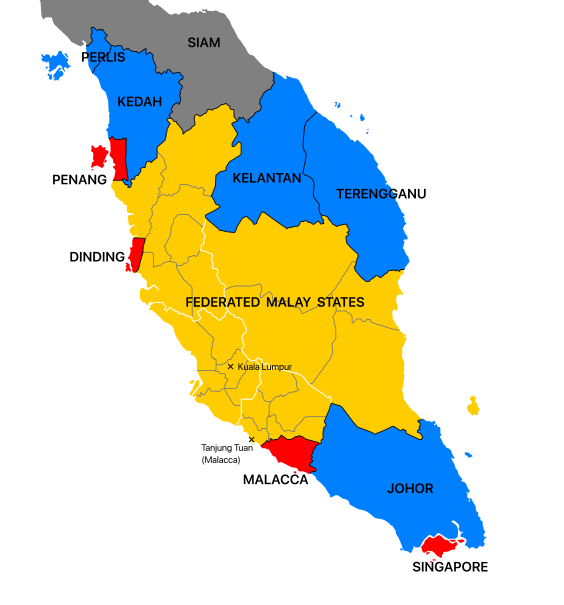
The district is well known for Pangkor Island, a major attraction in Perak, and also serves as the headquarters of the Royal Malaysian Navy (TLDM) at the Lumut Naval Base and dockyard. Historically, Dindings was briefly part of the British Straits Settlements colony but was returned to Perak in 1935.
History
Prior to 1873, the district was called Dindings and was part of the Straits Settlements, then under the administration of Penang. Dindings district became part of the Pangkor Treaty signed by Britain, and the British appointed Sultan of Perak Sultan Abdullah, in January 1874. This agreement was signed to stop the bloodshed resulting from two major events: the power struggle among Perak royalty upon the death of Sultan Ali; and Chinese clan wars between Ghee Hin and Hai San to grab tin mining areas in late colonial Taiping.
The agreement required the Sultan of Perak to surrender Dindings to the British, to accept a British Resident, James W. W. Birch, and the appointment of an assistant resident in Taiping, Captain Tristram Speedy. Sultan Ismail was also to abdicate the throne of Perak.
During the British colonial era, colonial Dindings comprised three main areas: Sitiawan, Lumut and Pangkor Island.
Dindings Agreement (Approval) Act 1934 | use_new_UK-LEG = | UK-LEG_title = The British had hoped that Dindings would prove to be a valuable natural harbour. However, this did not become the case. In 1935, Sultan Iskandar Alang successfully appealed to the British for the return of Dindings to Perak. The Perak government united the former colony with Bruas and coastal areas to the south, forming the Dindings District. In 1973, it was given the current name, Manjung.
On 24 April 2009, Lumut was declared by the Sultan of Perak as the Royal Malaysian Navy's Town, abbreviated as “TLDM Town” or “Navy Town”. Manjung also was declared as “Bandar Pelancongan dan Maritim” (“Tourism and Maritime Town”) by state government of Perak.
In August 2016, Sembilan Island was separated from Manjung District and incorporated into Bagan Datuk District.
Administrative divisions
Manjung District is divided into five mukims:
- Beruas
- Lekir
- Lumut
- Pengkalan Baharu
- Sitiawan
Federal Parliament and State Assembly Seats
مجليس ڤربندرن منجوڠ Onward, Progressive, Prosperous
Manjung district is divided to two parliamentary constituencies with the northern part of district is under Beruas constituency while southern part is part of Lumut constituency. As of 2022, there were 201,345 voters in both the parliament seats combined.
Voter demographics
List of Manjung district representatives in the Federal Parliament (Dewan Rakyat)
| Parliament | Seat Name | Member of Parliament | Party | P68 | P74 |
|---|---|---|---|---|---|
| Beruas | Ngeh Koo Ham | Pakatan Harapan (DAP) | |||
| Lumut | Nordin Ahmad Ismail |
List of Manjung district representatives in the State Legislative Assembly of Perak
| Parliament | State | Seat Name | State Assemblyman | Party | P68 | P68 | P68 | P74 | P74 |
|---|---|---|---|---|---|---|---|---|---|
| N36 | Pengkalan Baharu | Azman Noh | Barisan Nasional (UMNO) | ||||||
| N37 | Pantai Remis | Wong May Ing | Pakatan Harapan (DAP) | ||||||
| N38 | Astaka | Jason Ng Thien Yeong | Pakatan Harapan (DAP) | ||||||
| N51 | Pasir Panjang | Rosli Abd Rahman | |||||||
| N52 | Pangkor | Norhaslinda Zakaria |
Demographics
The following is based on Department of Statistics Malaysia 2020 census.
| Ethnic groups in Manjung, 2020 census | Ethnicity | Population | Percentage | Total | 246,977 | 100% | ||
|---|---|---|---|---|---|---|---|---|
| Bumiputera | 133,449 | 54.05% | ||||||
| Chinese | 65,921 | 26.69% | ||||||
| Indian | 29,400 | 11.90% | ||||||
| Others | 919 | 0.37% | ||||||
| Non-Malaysians | 17,288 | 6.99% |
Education
Manjung has numerous schools, with 24 Chinese primary schools and five Chinese secondary schools in the district. Of these, five schools were founded by Ong Seok Kim. They are SJK (C) Chung Cheng, Sitiawan in 1920; SMJK Nan Hwa (which split into Sekolah Tinggi Nan Hwa, Ayer Tawar Road in 1984) in 1935; SJK (C) Ping Min, Lumut in 1951; and SMJK Dindings, Lumut in 1953. Ong Seok Kim died in 1964. The following year, the Manjung community established the Ong Seok Kim Memorial Education Fund in his honour. The fund offers scholarships and loans to students in the Manjung District, irrespective of ethnicity. All school are under the administration of district education office.
Secondary education
- City Harbour International School
- SMK Seri Manjung
- SMK Kampung Dato’ Seri Kamaruddin
- SMK Ahmad Boestamam
- SMK Convent, Sitiawan
- SMK Methodist (ACS), Sitiawan
- SMK Tok Perdana
- SMK Ambrose
- SMK Methodist, Ayer Tawar
- SMK Raja Shahriman
- SMK Pantai Remis
- SMK Changkat Beruas
- SMK Dato' Idris, Pengkalan Bharu
- SMK Seri Samudera
- SMK Batu Sepuluh, Lekir
- SMK Pangkalan TLDM
- SMK Pangkor
- Kolej Vokasional Seri Manjung
Tertiary education
- Universiti Kuala Lumpur Malaysian Institute of Marine Engineering Technology (UniKL MIMET)
- Institut Kemahiran Mara (IKM) (Lumut)
- Kolej Komuniti (located partly in Sekolah Teknik Seri Manjung)
- Kolej Kejururawatan Ipoh (Lumut branch – located near in Lumut Town)
Training centres
- Outward Bound Malaysia, Lumut
- Pusat Latihan Khidmat Negara, (Teluk Rubiah & Segari)
Transport
The public transportation servicing the Manjung area are public buses in the Seri Manjung and Lumut bus stations.
Manjung district is accessible via Route 5, Route 60, Ipoh-Lumut Highway and West Coast Expressway.
There are two small airfields located in Sitiawan and Pangkor but both of them are unused.
Healthcare
The main public healthcare centre serving Manjung is Hospital Seri Manjung, Hospital Angkatan Tentera in Lumut. Besides this, there are numerous clinics in the surrounding region such as in Sitiawan, Ayer Tawar, Pulau Pangkor, Pantai Remis, Beruas, Lekir. A new hospital opened in 2014, Pantai Hospital Seri Manjung. There is also KPJ Manjung.
Columbia Asia Hospital in Sitiawan will replace the earlier proposed Goodhope Specialist Hospital, Sitiawan which was abandoned in January 2014. This project was then abandoned.
Economy
The major economic sectors in Manjung are agriculture, manufacturing and the services industries. Agriculture is the main economic sector, making up the majority of the population's employment. Manjung is well known for its livestock production, especially poultry. Sea fishing and fish/prawn farming are the most important economic activities for some community members. At least 5,000 residents are fishermen. Farming of fresh-water fish and prawns are being carried out thoroughly in the district. There are more than 300 ponds of prawns in operation. The most popular prawn farming area is along Dinding River.
Manjung District has become the fastest growing district in the state of Perak. In terms of growth of commercial sector, Manjung is the second fastest growing district in the state, with 5,947 developed units or 13.32%. Many of these businesses and industries are located along the roads connecting Sitiawan, Seri Manjung, Lumut and Ayer Tawar. Industrial and commercial activities are also present in other smaller, neighboring towns such as Beruas, Pantai Remis, Pekan Gurney, Lekir and Changkat Kuring.
Businesses in Manjung include wholesale, groceries and services. There are also informal activities such as settled hawkers (1,029 which cover 11.00%) and itinerant hawkers (1,092 which cover 11.00%) in Manjung district.
Of all the business activities here, services contribute about 72.30% of all the commercial activities. The groceries sector is the second largest commercial activity, covering 24.40% (1,449 unit), while wholesale activities cover the remaining portion, with about 3.40%.
Vale, a Brazilian company, is a major employer in the Manjung district, and operates the Teluk Rubiah Maritime Terminal, of which 60% of its workforce come from the district. The terminal contributes to the economy of Perak, as it is the largest single foreign direct investment in the state.
Tourism
Pangkor

Pangkor Island, a holiday resort, is one of the most well known islands in Malaysia. It is located approximately 90 km southwest of Ipoh. The main tourist drawer to Pangkor Island are beaches on the western coastline, such as Pantai Puteri Dewi, Pasir Bogak Beach, Teluk Belanga, Teluk Segadas, Teluk Nipah, and Teluk Cempedak.
The main island of Pangkor is populated mainly by fisherfolk who occupy the eastern coastline. The island is known for its anchovies and squid.
There are also ruins of a 330-year-old Dutch Fort located in Teluk Gadong which was one of the Dutch strongholds against pirates and local Malays. Another historical interest on Pangkor Island is the Pangkor Stone Tablet (Batu Bersurat Pangkor in Malay) which is near the Dutch fort.
Pangkor Laut Island, a small privately owned island to the southwest of the main island, is the second largest of the nine islands that make up the Pangkor archipelago. Pangkor Laut is known for its white beaches and clear waters. It has three main beaches, Emerald Bay, Coral Beach and Royal Bay.
Marina Island
Marina Island is one of the man-made island in Malaysia, built on the coast of Teluk Muruh, opposite Pangkor Island and Pangkor Laut Resort, in the state of Perak, Malaysia. The island covers an area of 316.9 acre located 400 m from the mainland's shoreline. Marina Island took five years of planning and feasibility studies to ensure that the making of the island would not disrupt the environment.
Marina Island is also a gateway to Pangkor Island with the establishment of a domestic jetty terminal in the island. The journey to Pangkor Island takes 10 minutes from the Marina Island Jetty.
Beaches

Aside from beaches on Pangkor Island, there are other beaches in Manjung that are popular among locals and tourists. Teluk Batik is often a choice for campers, picnickers and swimmers. Other nearby beaches include Pasir Panjang, Tanjung Kepah and Teluk Senangin.
Other places of interest
The Terrapin Breeding Centre is a breeding and information centre for terrapins (or Batagur baska).
There are two museums in the district, namely Beruas Museum and Sitiawan Settlement Museum.
Sport attractions
- Manjung stadium
- Padang Astaka Sitiawan
- MP3 Badminton Court Centre
- Manjung Indoor Sport Arena (MISA)
- Manjung Badminton Arena Lekir
- Golf courses in Manjung include Damai Laut Golf and Country Club.
References
References
- "Portal Rasmi Pejabat Daerah Dan Tanah - Pegawai Daerah".
- "Rancangan Struktur Negeri Perak 2040".
- "Rancangan Struktur Negeri Perak 2040".
- (February 2022). "Population and Housing Census of Malaysia 2020". [[Department of Statistics Malaysia]].
- See pages 86–88, Chapter 8 Malaysian Confrontations, Send A Gunboat: The Victorian Navy and Supremacy at Sea, 1854–1904, by Antony Preston & John Major, Conway, an imprint of Anova Books Ltd, London, UK, 2007 Revised Edition, {{ISBN. 978-0-85177-923-2
- [https://britishmalaya.home.blog/2022/08/02/dindings-the-forgotten-territory/ Dindings, the forgotten member of the Straits Settlements]
- {{EB1911. Clifford. Hugh Charles
- SAID, MOHAMAD HAFIZI MOHD. "Pulau Sembilan kini bawah Bagan Datoh".
- "Portal Rasmi Pejabat Daerah Dan Tanah - Profil Daerah".
- (2017). "Toponymic Guidelines for Map and Other Editors for International Use". Malaysian National Committee on Geographical Names.
- "14th General Election Malaysia (GE14 / PRU14) - Results Overview".
- Wang Jianshi, Ong Eng-Joo: No Other Way Out – A Biography of [[Ong Seok Kim]]. Petaling Jaya, Malaysia: Strategic Information and Research Development Centre, 2013, see [http://www.ongseokkim.com Official Site of Ong Seok Kim]
- "Chung Cheng Primary School, Sitiawan - Ong Seok Kim".
- "Nan Hwa High School, Sitiawan - Ong Seok Kim".
- "Ping Min Free School, Pundut, Lumut - Ong Seok Kim".
- "50LKC_4020_edited-1 - Ong Seok Kim".
- "Ong Seok Kim Memorial Education Fund – Ong Seok Kim".
- [http://www.outwardbound.my/ Outward Bound Malaysia]
- "Pusat Latihan Khidmat Negara".
- "Malaysian Digest". malaysiandigest.com.
- (28 December 2021). "Vale committed to sustainable and viable presence in Malaysia". The Malaysian Reserve.
- "Marina Island Pangkor - An Integrated Man-made World".
This article was imported from Wikipedia and is available under the Creative Commons Attribution-ShareAlike 4.0 License. Content has been adapted to SurfDoc format. Original contributors can be found on the article history page.
Ask Mako anything about Manjung District — get instant answers, deeper analysis, and related topics.
Research with MakoFree with your Surf account
Create a free account to save articles, ask Mako questions, and organize your research.
Sign up freeThis content may have been generated or modified by AI. CloudSurf Software LLC is not responsible for the accuracy, completeness, or reliability of AI-generated content. Always verify important information from primary sources.
Report