From Surf Wiki (app.surf) — the open knowledge base
Manhole
Opening to a confined space
Opening to a confined space


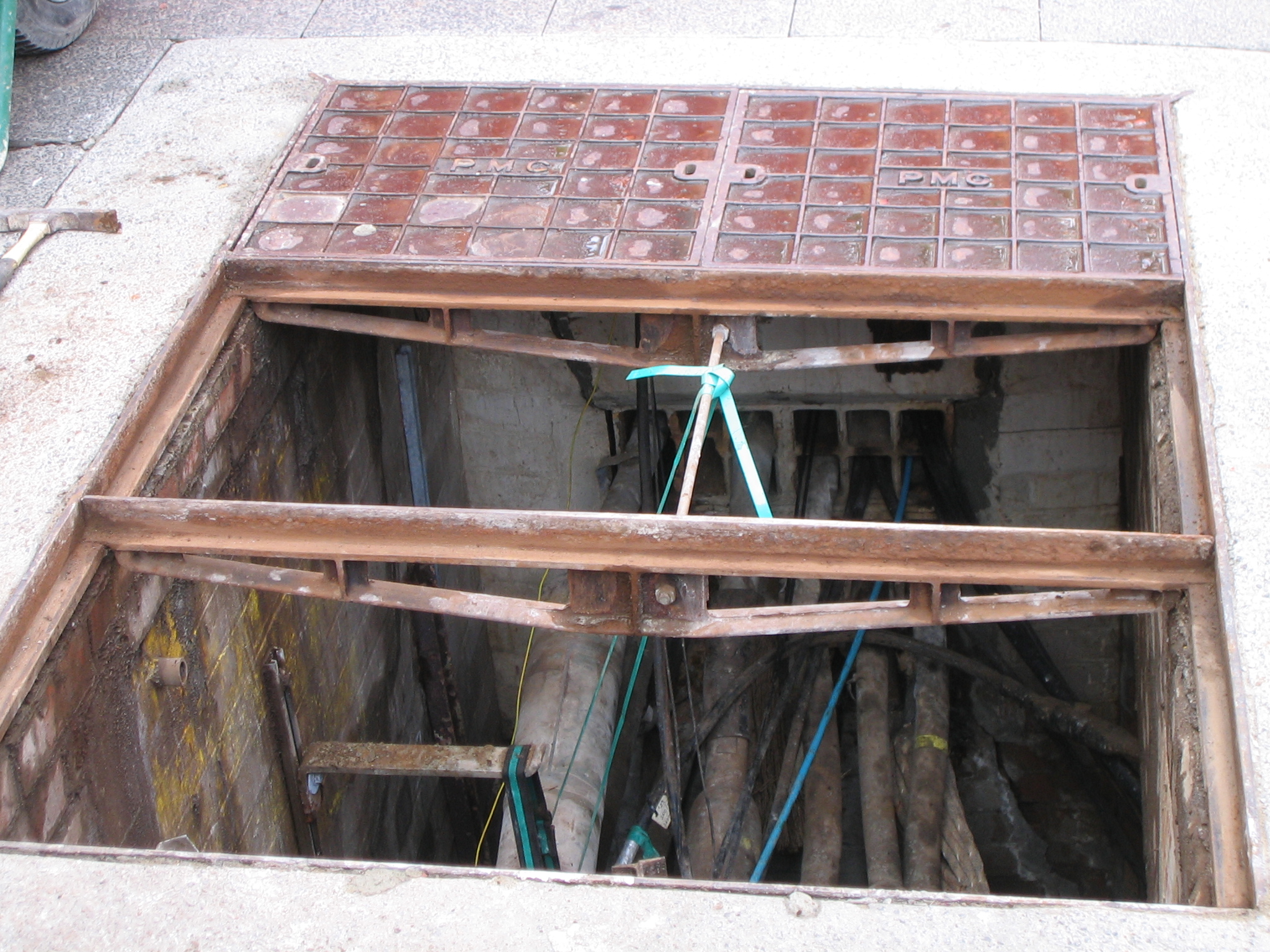
A manhole (utility hole, maintenance hole, or sewer hole) is an opening to a confined space such as a shaft, utility vault, or large vessel. Manholes, typically protected by a manhole cover, are often used as an access point for an underground public utility, allowing inspection, maintenance, and system upgrades. The majority of underground services have manholes, including water, sewers, telephone, electricity, storm drains, district heating, and gas.
Manholes are generally found in urban areas, in streets and occasionally under sidewalks. In rural and undeveloped areas, services such as telephone and electricity are usually carried on utility poles or even pylons rather than underground.
In Australia, manhole also commonly refers to an access hatch used to get access from a room or hallway into the ceiling cavity of a building. These manholes are typically around 450 x square.
Construction
.jpg)
Manhole closings are protected by a grating or manhole cover, a flat plug designed to prevent accidental or unauthorized access to the manhole. These covers are traditionally made of metal, but may be constructed from precast concrete, glass reinforced plastic or other composite materials (especially where cover theft is of concern). Because of legislation restricting acceptable manual handling weights, Europe has seen a move toward lighter-weight composite manhole cover materials, which also have the benefits of greater slip resistance and electrical insulating properties.
Manholes are usually outfitted with metal, polypropylene, or fiberglass steps installed in the inner side of the wall to allow easy descent into the utility space.
Manholes are usually round, primarily because roundness is the best shape to resist the compression of the earth; covers are round because they are easier to move by rolling, and they can't fall into the opening. But in the United Kingdom they are nearly always square, or rectangular, in shape, at least at street level. Manholes can also be found in a triangular shape (e.g. in Cambridge, and surrounding villages).
Composite manholes
Composite (fiberglass) manholes are commonly used in applications where infiltration, exfiltration, or corrosion by hydrogen sulfide (from sewer gas) are a concern, or where structures need to be factory integrated into a manhole before placement. In these manholes, the entire underground enclosure is constructed of some composite material, in addition to the cover.
Structures that can be integrated into composite manholes include:
- Flow inverts
- Flumes
- Drop structures from higher elevation flows to lower elevation discharge pipes
- Weirs
- Storm water screening structures
- Sewage grinders
- Energy absorbing structures to dissipate undesirable flow stream turbulence or velocity
Hazards caused by manholes
In urban areas, damaged or uncovered manholes and stray voltage issues have become a significant concern.
On January 16, 2004, Jodie S. Lane was electrocuted after stepping on a metal manhole cover, while walking her two dogs in New York City.{{cite news| title=East Village Woman Was Electrocuted on Street With Metal Plate, Medical Examiner Says|url=https://www.nytimes.com/2004/01/19/nyregion/east-village-woman-was-electrocuted-street-with-metal-plate-medical-examiner.html|work=New York Times|first=Anthony |last=Ramirez|date=January 19, 2004|access-date=2009-12-03}}
On December 3, 2020, Justin Carey, a 49-year-old special education teacher, was injured after stepping on a broken manhole cover on Route 111 in Smithtown. As he exited his parked car near the Route 347 intersection, the split cover gave way, causing his left leg to fall into the hole. He suffered a strained Achilles tendon and a bruised knee.
Sewer manhole location

The location of a sewer manhole must be carefully considered to ensure that the drainage system is effective and easy to maintain. According to design standards, the distance between two manholes is typically between 7 and 20 meters, depending on the specific characteristics of the project. In cities, the distance is 20 meters per manhole, while in industrial or commercial settings it is 10-15 meters per manhole. The distance between manholes in homes or restaurants is typically 7-10 meters.
Gallery
File:Open Manhole and Cover Mid-City New Orleans.jpg|A round manhole in New Orleans, and its cover File:Bueirocemig.JPG|Manhole cover in Belo Horizonte, Brazil File:Cambridgeshire Manhole.jpg|Manhole cover in Sawston, Cambridgeshire File:Manhole.jpg|Installation of a sewer manhole. Upon completion, typically only the top ring and cover (not pictured) would be visible. File:- Manhole cover in Germany -.jpg|Manhole cover of precast concrete in Germany File:Manhole without manhole cover in Villebon-sur-Yvette 4.jpg|Storm drain manhole without cover in France File:ManHoleDoorFoundersHallGirard1840.jpg|"Man Hole Door" at Girard College, Philadelphia, constructed in the 1840s File:Openchannelflow-domed-metering-manhole.JPG|An open packaged metering manhole made of fiberglass before installation File:Sasa manhole cover.jpg|Manhole cover in Kibbutz Sasa, Israel File:HAIFA DOWN TAWN.jpg|Manhole cover in downtown of Haifa, Israel File:Golden manhole cover Tel Aviv.jpg|Painted gold Manhole cover in Tel Aviv, Israel File:Gas manhole in Dnipro.jpg|Small gas manhole in Ukraine.
References
- Isles, Paul (2010). "Dover Engineering Works". Dover Life Magazine
References
- (2009). "Environmental Engineering: Environmental Health and Safety for Municipal Infrastructure, Land Use and Planning, and Industry". John Wiley & Sons.
- Singh, Kanwarjot. (2023-06-30). "What is a Manhole- Function, Construction, Materials, and Types of Manhole - Civil Engineering Portal".
- Attribus Innovation. (17 January 2019). "Assessment Requirements for CPCCPB3027 Install ceiling insulation products". Commonwealth of Australia.
- "How to install a manhole".
- "Management of Underground Infrastructure".
- Scheckel, Larry. (2013-12-17). "Ask a Science Teacher: 250 Answers to Questions You've Always Had About How Everyday Stuff Really Works". The Experiment.
- "The ultimate manhole covers site {{!}} Info cover {{!}} Cover's details: Cambridge - Surface water - Cover in a shape close to the triangle (2)".
- "Manhole inverts". Containment Solutions.
- "Packaged Fiberglass (FRP) Flume Manholes". Openchannelflow.
- "Packaged Fiberglass (FRP) Weir Manholes for Flow Monitoring". Openchannelflow.
- "Fiberglass (FRP) Storm Water Manholes for Initial Oil, Grease, Sediment, and Debris Collection". Openchannelflow.
- "Fiberglass (FRP) Grinder Manholes integrating grinders from JWC, Franklin Miller, MonoFlo, and more". Openchannelflow.
- "Fiberglass Energy Absorbing Manholes for Controlling Excess Line Velocities". Openchannelflow.
- (2021-05-27). "Long Island Man Injured Falling Into Manhole".
- (2023-06-13). "Tái diễn tình trạng hố ga mất nắp giữa lòng đô thị thông minh Thái Nguyên".
- (2023-05-30). "Cận cảnh vị trí các "lô cốt" sắp lắp đặt trên đường Nguyễn Trãi".
- danviet.vn. (23 October 2023). "Ám ảnh với hố ga mất nắp, "nuốt trọn" xe máy của người đi đường".
- "Đường mới mở và "điệp khúc" mất nắp hố ga".
- (2003). "Báo cáo chuyên đề: Mức độ bao phủ của các chương trình y tế công cộng". Nhà xuất bản Y học.
- Lê, Thành Châu. (2002). "Tìm hiểu quy định về quy hoạch, xây dựng, & cấp giá̂y chứng nhận quyền sở hữu nhà ở: áp dụng tại thành phố Hồ Chí Minh và các tỉnh, thành phố trực thuộc Trung ương". Thống kê.
- (2005). "Tuyển tập các tác phẩm báo chí Việt Nam thời kỳ đổi mới, 1985-2004". Hội nhà báo Việt Nam.
- (2013-10-31). "Cách sử dụng hố ga ngăn mùi hiệu quả".
- Minh, Huy. "Nắp hố ga".
- (2006). "Một só̂ vá̂n đè̂ kinh té̂ - xã hội trong tié̂n trình công nghiệp hóa, hiện đại hóa vùng đò̂ng bà̆ng sông Hò̂ng". Nhà xuá̂t bản Lý luận chính trị.
This article was imported from Wikipedia and is available under the Creative Commons Attribution-ShareAlike 4.0 License. Content has been adapted to SurfDoc format. Original contributors can be found on the article history page.
Ask Mako anything about Manhole — get instant answers, deeper analysis, and related topics.
Research with MakoFree with your Surf account
Create a free account to save articles, ask Mako questions, and organize your research.
Sign up freeThis content may have been generated or modified by AI. CloudSurf Software LLC is not responsible for the accuracy, completeness, or reliability of AI-generated content. Always verify important information from primary sources.
Report