From Surf Wiki (app.surf) — the open knowledge base
Mandaic language
Language of the Mandaean religion and community
Language of the Mandaean religion and community
| Field | Value | ||
|---|---|---|---|
| name | Mandaic | ||
| nativename | {{script | Mand | ࡋࡉࡔࡀࡍࡀ ࡖ ࡌࡀࡍࡃࡀࡉࡉࡀ}} |
| myz | |||
| states | Iraq and Iran | ||
| region | Iraq: Baghdad, Basra; Iran: Khuzistan | ||
| ethnicity | Mandaeans | ||
| speakers | 5,500 | ||
| date | 2001–2006 | ||
| ref | e18 | ||
| familycolor | Afro-Asiatic | ||
| fam2 | Semitic | ||
| fam3 | Central Semitic | ||
| fam4 | Northwest Semitic | ||
| fam5 | Aramaic | ||
| fam6 | Eastern | ||
| fam7 | Southeastern | ||
| ancestor | Proto-Afroasiatic | ||
| ancestor2 | Proto-Semitic | ||
| ancestor3 | Old Aramaic | ||
| ancestor4 | Middle Aramaic | ||
| ancestor5 | Eastern Middle Aramaic | ||
| script | Mandaic alphabet | ||
| lc1 | mid | ||
| ld1 | Mandaic | ||
| lc2 | myz | ||
| ld2 | Classical Mandaic | ||
| linglist | mid | ||
| lingname | Neo-Mandaic | ||
| linglist2 | myz | ||
| lingname2 | Classical Mandaic | ||
| glotto | mand1468 | ||
| glottorefname | Macro-Mandaic | ||
| glotto2 | nucl1706 | ||
| glottorefname2 | Mandaic | ||
| glotto3 | clas1253 | ||
| glottorefname3 | Classical Mandaic |
myz
Mandaic, or more specifically Classical Mandaic, is the liturgical language of Mandaeism and a South Eastern Aramaic variety in use by the Mandaean community, traditionally based in southern parts of Iraq and southwest Iran, for their religious books. Mandaic, or Classical Mandaic, is still used by Mandaean priests in liturgical rites. The modern descendant of Mandaic or Classical Mandaic, known as Neo-Mandaic or Modern Mandaic, is spoken by a small group of Mandaeans around Ahvaz and Khorramshahr in the southern Iranian Khuzestan province.
Liturgical use of Mandaic or Classical Mandaic is found in Iran (particularly the southern portions of the country), in Baghdad, Iraq and in the diaspora (particularly in the United States, Sweden, Australia and Germany). It is an Eastern Aramaic language notable for its abundant use of vowel letters (mater lectionis with aleph, he only in final position, ‘ayin, waw, yud) in writing, so-called plene spelling (Mandaic alphabet) and the amount of Iranian and Akkadian language influence on its lexicon, especially in the area of religious and mystical terminology. Mandaic is influenced by Jewish Aramaic, Samaritan Aramaic, Hebrew, Greek, Latin, in addition to Akkadian and Parthian.
Classification
Classical Mandaic belongs to the Southeastern group of Aramaic and is closely related to the Jewish Babylonian Aramaic dialect in the major portions of the Babylonian Talmud, but less to the various dialects of Aramaic appearing in the incantation texts on unglazed ceramic bowls (incantation bowls) found mostly in central and south Iraq as well as the Khuzestan province of Iran. It is considered a sister language to the northeastern Aramaic dialect of Suret.
Usage
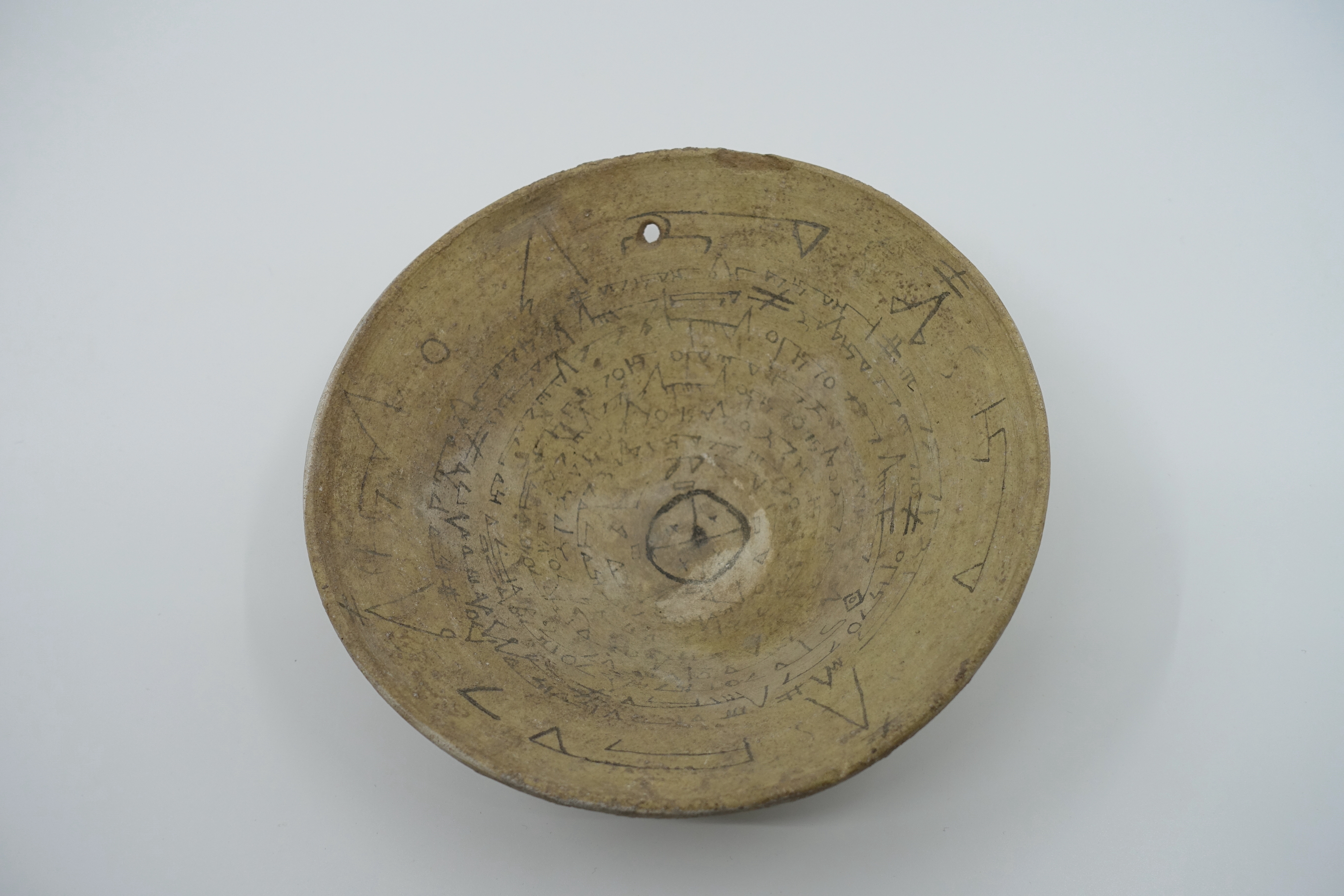
This southeastern Aramaic dialect is transmitted through religious, liturgical, and esoteric texts, most of them stored today in the Drower Collection, Bodleian Library (Oxford), the Bibliothèque Nationale (Paris), the British Library (London), and in the households of various Mandaeans as religious texts. More specific written objects and of linguistic importance on account of their early transmission (5th–7th centuries CE) are the earthenware incantation bowls and Mandaic lead rolls (amulets) (3rd–7th centuries CE), including silver and gold specimens that were often unearthed in archaeological excavations in the regions of their historical living sites between Wasiṭ and Baṣra, and frequently in central Iraq, for example (Bismaya, Kish, Khouabir, Kutha, Uruk, Nippur), north and south of the confluences of the Euphrates and Tigris (Abu Shudhr, al-Qurnah), and the adjacent province of Khuzistan (Hamadan).
Phonology
Consonants
| Labial | Dental | Alveolar | Palato- | ||||||||||||||||
|---|---|---|---|---|---|---|---|---|---|---|---|---|---|---|---|---|---|---|---|
| alveolar | Palatal | Velar | Uvular | Pharyngeal | Glottal | plain | emphatic | Nasal | Stop/ | ||||||||||
| Affricate | voiceless | voiced | Fricative | voiceless | voiced | Approximant | Trill | ||||||||||||
| () | () | ||||||||||||||||||
| () | () | ||||||||||||||||||
| () | |||||||||||||||||||
| () | () | () |
- The glottal stop is said to have disappeared from Mandaic.
- and are said to be palatal stops, and are generally pronounced as and , but are transcribed as /, /, however; they may also be pronounced as velar stops [, ].
- and are noted as velar, but are generally pronounced as uvular and , however; they may also be pronounced as velar fricatives [, ].
- Sounds [, , ] only occur in Arabic and Persian loanwords.
- Both emphatic voiced sounds [, ] and pharyngeal sounds [, ] only occur in Arabic loanwords.
Vowels
| Front | Central | Back | Close | Mid | Open |
|---|---|---|---|---|---|
| () |
- A short is often replaced by the short sound.
Alphabet
Main article: Mandaic alphabet
Mandaic is written in the Mandaic alphabet. It consists of 23 graphemes, with the last being a ligature. Its origin and development is still under debate. Graphemes appearing on incantation bowls and metal amulet rolls differ slightly from the late manuscript signs.
Lexicography
Lexicographers of the Mandaic language include Theodor Nöldeke, Mark Lidzbarski, Ethel S. Drower, Rudolf Macúch, and Matthew Morgenstern.
Neo-Mandaic
Main article: Neo-Mandaic
Neo-Mandaic represents the latest stage of the phonological and morphological development of Mandaic. Having developed in isolation from one another, most Neo-Aramaic dialects are mutually unintelligible and should therefore be considered separate languages. Determining the relationship between Neo-Aramaic dialects is difficult because of poor knowledge of the dialects themselves and their history.
Although no direct descendants of Jewish Babylonian Aramaic survive today, most of the Neo-Aramaic dialects spoken today belong to the Eastern sub-family of Jewish Babylonian Aramaic and Mandaic, among them Neo-Mandaic that can be described with any certainty as the direct descendant of one of the Aramaic dialects attested in Late Antiquity, probably Mandaic. Neo-Mandaic preserves a Semitic "suffix" conjugation (or perfect) that is lost in other dialects. The phonology of Neo-Mandaic is divergent from other Eastern Neo-Aramaic dialects.
Three dialects of Neo-Mandaic were native to Shushtar, Shah Vali, and Dezful in northern Khuzestan Province, Iran before the 1880s. During that time, Mandeans moved to Ahvaz and Khorramshahr to escape persecution. Khorramshahr had the most Neo-Mandaic speakers until the Iran–Iraq War caused many people to leave Iran. Ahvaz is the only community with a sizeable portion of Neo-Mandaic speakers in Iran as of 1993.
The following table compares a few words in Old Mandaic with three Neo-Mandaic dialects. The Iraq dialect, documented by E. S. Drower, is now extinct.
| Meaning | Script | Old Mandaic | Iraq dialect | Ahvaz dialect | Khorramshahr dialect |
|---|---|---|---|---|---|
| house | baita | bejθæ | b(ij)eθa/ɔ | bieθɔ | |
| in, ins | ࡁ | b- | gaw; b- | gu | gɔw |
| work | ebada | wad | wɔd | əwɔdɔ | |
| planet | šibiaha | ʃewjæ | ʃewjɔha | ʃewjɔhɔ | |
| come! (imp.pl) | ࡀࡕࡅࡍ | atun | doθi | d(ij)ɵθi | doθi |
Sample text
The following is a sample text in Mandaic of Article 1 of the Universal Declaration of Human Rights.
Mandaic: ""
Transliteration: "Kul anaša mitlir šauia b-ʿqara u-agria. Bintautirta ʿthiblun u-luat hraria ṭabuta abrin akuat ḏ-nihun ahia."
English original: "All human beings are born free and equal in dignity and rights. They are endowed with reason and conscience and should act towards one another in a spirit of brotherhood."
Citations
General and cited references
- Ethel S. Drower and Rudolf Macuch (1963). A Mandaic Dictionary. Oxford: Clarendon Press.
- Charles G. Häberl (2009). The Neo-Mandaic Dialect of Khorramshahr. Wiesbaden: Harrassowitz.
- Rudolf Macuch (1965). Handbook of Classical and Modern Mandaic. Berlin: De Gruyter.
- Rudolf Macuch (1989). Neumandäische Chrestomathie. Wiesbaden: Harrasowitz.
- Joseph L. Malone (1997). "Modern and Classical Mandaic Phonology", in Phonologies of Asia and Africa, edited by Alan S. Kaye. Winona Lake, Ind.: Eisenbrauns.
- Theodor Nöldeke (1862). "Ueber die Mundart der Mandäer", Abhandlungen der Historisch-Philologischen Classe der königlichen Gesellschaft der Wissenschaften zu Göttingen 10: 81–160.
- Theodor Nöldeke (1964). Mandäische Grammatik, Halle: Waisenhaus; reprint Darmstadt: Wissenschaftliche Buchgesellschaft with Appendix of annotated handnotes from the hand edition of Theodor Nöldeke by Anton Schall.
- Svend Aage Pallis (1933). Essay on Mandaean Bibliography. London: Humphrey Milford.
- Franz Rosenthal (1939). "Das Mandäische", in Die aramaistische Forschung seit Th. Nöldeke’s Veröffentlichungen. Leiden, Netherlands: Brill, pp. 224–254.
- Rainer M. Voigt (2007). "Mandaic", in Morphologies of Asia and Africa, in Alan S. Kaye, ed., Phonologies of Asia and Africa. Winona Lake, Ind.: Eisenbrauns.
References
- [[Ethel Stefana Drower]], ''The Mandaeans of Iraq and Iran'' (Leiden: Brill, 1937; reprint 1962); Kurt Rudolph, ''Die Mandäer II. Der Kult'' (Vandenhoeck & Ruprecht; Göttingen, 1961; Kurt Rudolph, ''Mandaeans'' (Leiden: Brill, 1967); Christa Müller-Kessler, Sacred Meals and Rituals of the Mandaeans”, in David Hellholm, Dieter Sänger (eds.), ''Sacred Meal, Communal Meal, Table Fellowship, and the Eucharist: Late Antiquity, Early Judaism, and Early Christianity'', Vol. 3 (Tübingen: Mohr, 2017), pp. 1715–1726, pls.
- Theodor Nöldeke, ''Mandäische Grammatik'' (Halle: Waisenhaus, 1875), pp. 3–8.
- No comprehensive and individual study exists yet except for some word discussions in [[Geo Widengren]], ''Iranisch-semitische Kulturbegegnung in parthischer Zeit'' (Köln: Westdeutscher Verlag, 1960) and the etymological sections in [[E. S. Drower. Ethel Stefana Drower]] and [[Rudolf Macúch. Rudolf Macuch]], ''A Mandaic Dictionary'' (Oxford: Clarendon Press, 1963).
- Stephen A. Kaufman, ''The Akkadian Influences on Aramaic'' (Assyriological Studies 19; Chicago: The University of Chicago: 1974).
- Häberl, Charles. (3 March 2021). "Hebraisms in Mandaic".
- (2021). "Mandaic and the Palestinian Question". Journal of the American Oriental Society.
- Häberl, Charles G.. (February 2006). "Iranian Scripts for Aramaic Languages: The Origin of the Mandaic Script". Bulletin of the American Schools of Oriental Research.
- Theodor Nöldeke, ''Mandäische Grammatik'' (Halle: Waisenhaus, 1875), pp. XXVI–XXVII
- [[Franz Rosenthal]], Das Mandäische, in ''Die aramaistische Forschung seit Th. Nöldeke’s Veröffentlichungen'' (Leiden: Brill 1939), pp. 228–229.
- Tapani Harvaianen, An Aramaic Incantation Bowl from Borsippa. Another Specimen of Eastern Aramaic “Koiné”, ''Studia Orientalia'' 53.14, 1981, pp. 3–25.
- Christa Müller-Kessler, "Zauberschalen und ihre Umwelt. Ein Überblick über das Schreibmedium Zauberschale," in Jens Kamran, Rolf Schäfer, Markus Witte (eds.), ''Zauber und Magie im antiken Palästina und in seiner Umwelt'' (Abhandlungen des Deutschen Palästina-Vereins 46; Wiesbaden: Harrassowitz, 2017), pp. 59–94, figs. 1–2, 5, pls. 2, 4, 7–8, map.
- [[Ethel Stefana Drower]], ''The Mandaeans of Iraq and Iran'' (Leiden: Brill, 1937; reprint 1962).
- [[Ethel Stefana Drower]], ''The Book of the Zodiac (sfar Malwašia) D.C. 31'' (Oriental Translation Fund XXXVI; London: The Royal Asiatic Society, 1949).
- [[Ethel Stefana Drower]], "A Mandaean Bibliography", in ''Journal of the Royal Asiatic Society'' 1953, pp. 34–39.
- Buckley, Jorunn Jacobsen. (2002). "The Mandaeans: ancient texts and modern people". [[Oxford University Press]].
- Christa Müller-Kessler, "A Mandaic Gold Amulet in the British Museum," in ''Bulletin of the American Schools of Oriental Research'' 311, 1998, pp. 83–88.
- M. Thevenot, ''Relations de divers voyages curieux, première partie'' (Paris, 1663–1672), map with Mandaean villages.
- J. Heinrich Petermann, ''Reisen im Orient'', Vol. II (Leipzig: Veit, 1861), pp. 66, 83–123, 447–465.
- [[Henri Pognon]], "Une incantation contre les génies malfaisantes, en Mandaite," in ''Mémoires de la Soceté de Linguitiques de Paris'' 8, 1892, p. 193
- Peter R. S. Moorey, ''Kish Excavation 1923 – 1933'' (Oxford: Oxford Press, 1978), pp. 123–124.
- [[Henri Pognon]], ''Inscriptions mandaïtes des coupes de Khouabir'' (Paris: H. Wetter, 1898; reprint Amsterdam: Philo Press, 1979), pp. 1–5.
- Christopher Walker ''apud ''Jehudah B. Segal, ''Catalogue of the Aramaic and Mandaic Incantation Bowls in the British Museum'' (London: British Museum Press, 2000), pp. 35–39.
- [[Rudolf Macúch. Rudolf Macuch]], "Gefäßinschriften," in Eva Strommenger (ed.), ''Gefässe aus Uruk von der Neubabylonischen Zeit bis zu den Sasaniden'' (Ausgrabungen der deutschen Forschungsgemeinschaft in Uruk-Warka 7; Berlin 1967), pp. 55–57, pl. 57.1–3.
- J. P. Peters, ''Nippur or Explorations and Adventures on the Euphrates'', Vol. II (New York, 1897); Hermann V. Hilprecht, ''Explorations in Bible Lands During the Nineteenth Century'' (Philadelphia: A. J. Molman and Company, 1903), p. 326; James A. Montgomery, ''Aramaic Incantation Texts from Nippur'' (Publications of the Babylonian Section 3; Philadelphia, 1913), pp. 37–39, 242–257; Christa Müller-Kessler (ed.), ''Die Zauberschalentexte der Hilprecht-Sammlung, Jena und weitere Nippur-Texte anderer Sammlungen'' (Texte und Materialen der Frau Professor Hilprecht-Collection 7; Wiesbaden 2005), pp. 110–135, 143–147.
- François Lenormant, ''Essai sur la propagation de l’alphabet phénicien dans l’ancien monde'', vol. II (Paris, 1872), pp. 76–82, pls. X–XI; Edmund Sollberger, "Mr. Taylor in Chaldaea," in ''Anatolian Studies'' 22, 1972, pp. 130–133.
- Christa Müller-Kessler, "Interrelations between Mandaic Lead Rolls and Incantation Bowls," in Tzvi Abusch, Karel van der Toorn (eds.), ''Mesopotamian Magic. Textual, Historical, and Interpretative Perspectives'' (Ancient Magic and Divination 1; Groningen: STYX, 1999), pp. 197–198, pl. 209.
- Cyrus H. Gordon, "Two Magic Bowls in Teheran," in ''Orientalia'' 20, 1951, pp. 306–311.
- Christa Müller-Kessler, "Zauberschalen und ihre Umwelt. Ein Überblick über das Schreibmedium Zauberschale," n Jens Kamran, Rolf Schäfer, Markus Witte (eds.), ''Zauber und Magie im antiken Palästina und in seiner Umwelt'' (Abhandlungen des Deutschen Palästina-Vereins 46; Wiesbaden, 2017), pp. 59–94, pls. 1–8, map, {{ISBN. 978-3-447-10781-5.
- Macuch, Rudolf. (1965). "Handbook of Classical and Modern Mandaic". Berlin: Walter de Gruyter.
- Malone, Joseph. (1967). "A Morphologic Grammar of the Classical Mandaic Verb". University of California at Berkeley.
- [[Rudolf Macúch. Rudolf Macuch]], ''Handbook of Classical and Modern Mandaic'' (Berlin: De Gruyter, 1965), p. 9.
- Peter W. Coxon, “Script Analysis and Mandaean Origins,” in ''Journal of Semitic Studies'' 15, 1970, pp. 16–30; Alexander C. Klugkist, “The Origin of the Mandaic Script,” in Han L. J. Vanstiphout et al. (eds.), ''Scripta Signa Vocis. Studies about scripts, scriptures, scribes and languages in the Near East presented to J. H. Hospers'' (Groningen: E. Forsten, 1986), pp. 111–120; Charles G. Häberl, “Iranian Scripts for Aramaic Languages: The Origin of the Mandaic Script,” in ''Bulletin for the Schools of American Oriental Research'' 341, 2006, pp. 53–62.
- Tables and script samples in Christa Müller-Kessler, “Mandäisch: Eine Zauberschale,” in Hans Ulrich Steymans, Thomas Staubli (eds.), ''Von den Schriften zur (Heiligen) Schrift'' (Freiburg, CH: Bibel+Orient Museum, Stuttgart Katholisches Bibelwerk e.V., 2012), pp. 132–135, {{ISBN. 978-3-940743-76-3.
- [[Theodor Nöldeke]]. 1964. ''Mandäische Grammatik'', Halle: Waisenhaus; reprint Darmstadt: Wissenschaftliche Buchgesellschaft with Appendix of annotated handnotes from the hand edition of Theodor Nöldeke by Anton Schall.
- In his masterful translations of several Mandaic Classical works: 1915. ''Das Johannesbuch''. Giessen: Töpelmann; 1920. ''Mandäische Liturgien'' (Abhandlungen der königlichen Gesellschaft der Wissenschaften zu Göttingen. Phil.-hist. Kl. NF XVII,1) Berlin: Weidmannsche Buchhandlung; 1925: ''Ginza: Der Schatz oder das grosse Buch der Mandäer''. Göttingen: Vandenhoeck & Ruprecht.
- [[E. S. Drower. Ethel S. Drower]] and [[Rudolf Macúch. Rudolf Macuch]]. 1963. ''A Mandaic Dictionary''. Oxford: Clarendon Press. This work is based on Lidzbarski’s lexicrographical files, today in the University of Halle an der Saale, and Drower’s lexical collection.
- Charles Häberl, ''The Neo-Mandaic Dialect of Khorramshahr'', (Wiesbaden: Harrassowitz, 2009).
- [[Rudolf Macúch. Rudolf Macuch]], ''Neumandäische Chrestomathie'' (Wiesbaden: Harrasowitz, 1989).
- [[Rudolf Macúch. Rudolf Macuch]], ''Neumandäische Texte im Dialekt von Ahwaz'' (Wiesbaden: Harrasowitz, 1993).
- Häberl, Charles G.. (2019). "The Semitic languages". Routledge.
- Ager, Simon. "Mandaic alphabet". Omniglot.
This article was imported from Wikipedia and is available under the Creative Commons Attribution-ShareAlike 4.0 License. Content has been adapted to SurfDoc format. Original contributors can be found on the article history page.
Ask Mako anything about Mandaic language — get instant answers, deeper analysis, and related topics.
Research with MakoFree with your Surf account
Create a free account to save articles, ask Mako questions, and organize your research.
Sign up freeThis content may have been generated or modified by AI. CloudSurf Software LLC is not responsible for the accuracy, completeness, or reliability of AI-generated content. Always verify important information from primary sources.
Report