From Surf Wiki (app.surf) — the open knowledge base
Manchester State Park (Washington)
State park in Washington (state), United States

State park in Washington (state), United States
| Field | Value |
|---|---|
| name | Manchester State Park |
| photo | Manchester State Park Torpedo Building.JPG |
| photo_caption | Former torpedo building, now a picnic shelter |
| photo_alt | Building |
| photo_width | 280 |
| map | USA Washington#USA |
| map_caption | Location in the state of Washington |
| map_width | 280 |
| relief | 1 |
| label | Manchester State Park |
| location | Kitsap County, Washington, United States |
| coordinates | |
| coords_ref | |
| area | 111 acre |
| elevation | 20 ft |
| established | 1970 |
| administrator | Washington State Parks and Recreation Commission |
| visitation_num | 261,014 |
| visitation_year | 2024 |
| visitation_ref | |
| website |
Manchester State Park is a 111 acre state park in Kitsap County, Washington, United States. It is situated on the east side of the Kitsap Peninsula with 3400 ft of shoreline facing Puget Sound. It was at one time a harbor defense installation for the nearby Bremerton, then a fuel supply depot and U.S. Navy fire-fighting station. The park contains a former torpedo warehouse, a mining casement, and a gun battery. Park activities include picnicking, camping, boating, fishing, hiking on 1.9 mi of trails, birdwatching, volleyball, wildlife viewing, and horseshoes.
History
Manchester State Park, originally called Middle Point Military Reservation, was used as a fortification with Fort Ward on Bainbridge Island to protect the Puget Sound Naval Shipyard in Bremerton during the early 1900s. The Coast Artillery Corps established Middle Point while the defense of the Puget Sound Naval Shipyard became a priority for the United States Army and United States Navy.
Since Fort Ward could protect part of Puget Sound with its four coastal artillery batteries, the primary defensive tactic at Middle Point was the operation of a minefield in Rich Passage. The mines were electrically controlled from a mining casemate, being able to detonate at the will of the operator instead of from direct contact. In 1901, a torpedo warehouse was built at Middle Point as a place to store the naval mines that would be used in the minefield. Later, the warehouse was "used as an officers' club, barracks, and mess hall".
Middle Point's gun battery, Battery Mitchell, was designed to have two 3-inch rapid-fire guns as an added defense for the Rich Passage minefield. However, the guns were never fitted due to Fort Ward having the necessary gun emplacements to protect it from Bainbridge Island. Battery Mitchell's layout includes rooms where ammunition would have been stored for the guns, and rooms where soldiers would have sought protection under enemy fire. The gun battery is named after Lieutenant Robert B. Mitchell.
Although Middle Point never encountered any threats, the Navy controlled it through World War I and World War II as a fuel supply depot and fire-fighting station until it was decommissioned in 1958. After the state of Washington claimed it in 1970, the land became Manchester State Park, named after the town of Manchester, Washington. It remained undeveloped until the state government was able to fund cleanup and construction of campsites. The park opened to the public on May 22, 1981.
Activities and amenities
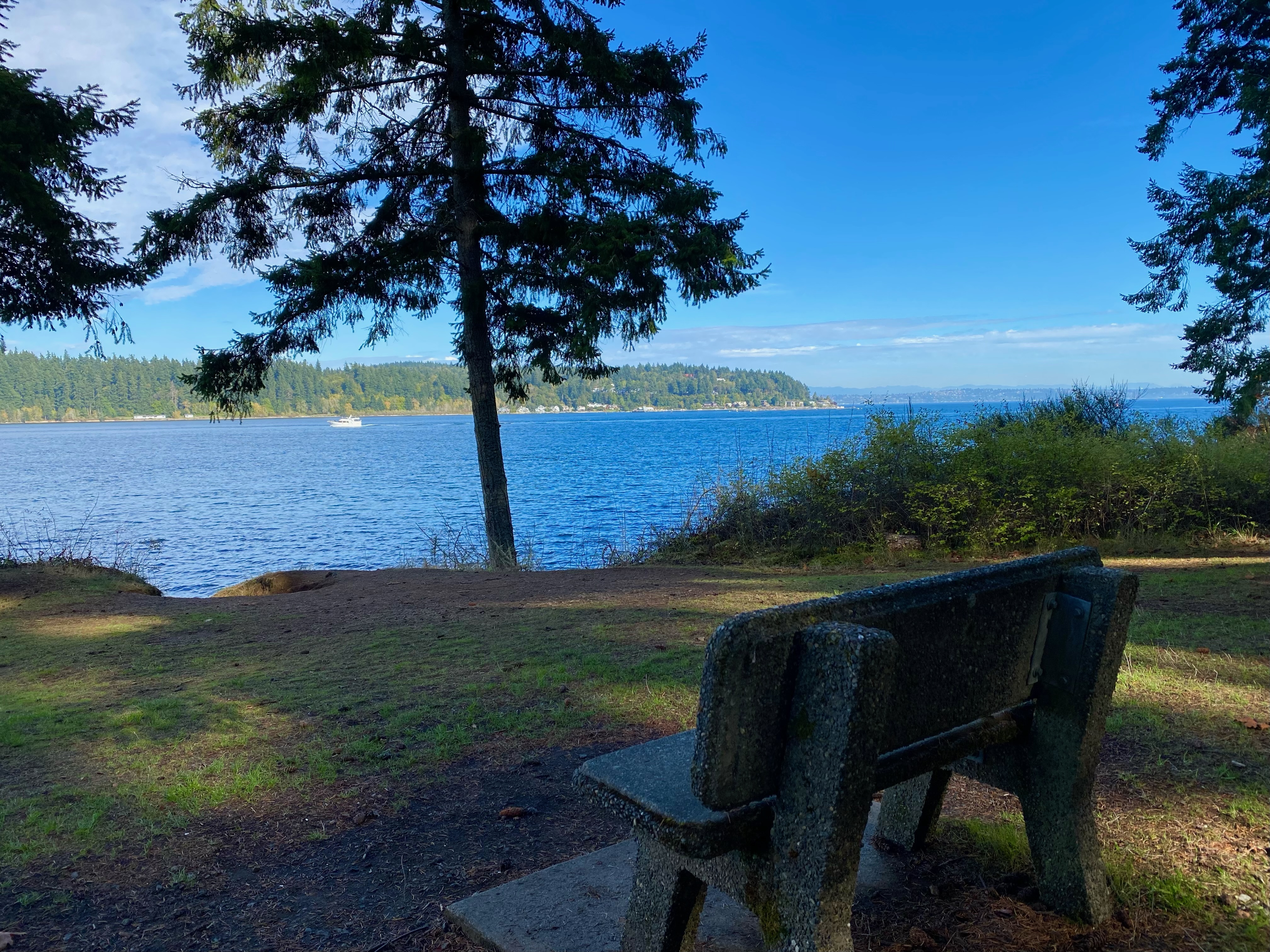
Manchester State Park offers standard and RV campsites that are open year round, two picnic shelters, 1.9 miles (3.1 km) of hiking trails, public restrooms, and beach access.
Water activities include boating, diving, kayaking, and saltwater fishing. Other activities include hiking, picnicking, birdwatching, volleyball, badminton, wildlife viewing, horseshoes, and mountain biking.
The former torpedo warehouse is open to the public and can be reserved for special occasions, such as weddings and reunions.
In 2015, three exhibit signs were installed at the park as a part of a park improvement plan. The signs explain the area's coastal defense history to visitors.
References
References
- "Triangle of Fire - The Harbor Defenses of Puget Sound (1897-1953)". [[HistoryLink]].
- (October 28, 2015). "Coastal defense history at Manchester State Park".
- "Manchester - Torpedo Warehouse". Washington State Parks and Recreation Commission.
- Smith, Bob. (November 5, 2019). "Manchester State Park shows its true fall colors".
- Walker, T.. "Manchester State Park".
- Hauptli, Jack. (May 8, 1980). "Work continuing on 3 campgrounds". [[The Seattle Times]].
- Hauptli, Jack. (June 25, 1981). "Camping: Obsolete big-gun forts fine state parks". The Seattle Times.
- "Manchester State Park". Washington State Parks and Recreation Commission.
- "Manchester State Park History". Washington State Parks and Recreation Commission.
- "Visitation Reports". Washington State Parks and Recreation Commission.
This article was imported from Wikipedia and is available under the Creative Commons Attribution-ShareAlike 4.0 License. Content has been adapted to SurfDoc format. Original contributors can be found on the article history page.
Ask Mako anything about Manchester State Park (Washington) — get instant answers, deeper analysis, and related topics.
Research with MakoFree with your Surf account
Create a free account to save articles, ask Mako questions, and organize your research.
Sign up freeThis content may have been generated or modified by AI. CloudSurf Software LLC is not responsible for the accuracy, completeness, or reliability of AI-generated content. Always verify important information from primary sources.
Report