From Surf Wiki (app.surf) — the open knowledge base
Manchester Square
Garden square in London, United Kingdom
Garden square in London, United Kingdom
| Field | Value |
|---|---|
| short_title | Manchester Square Improvement Act 1789 |
| type | Act |
| parliament | Parliament of Great Britain |
| long_title | An Act for the Improvement of Manchester Square, within the Parish of Saint Mary-le-bone, in the County of Middlesex. |
| year | 1789 |
| citation | 29 Geo. 3. c. 5 |
| territorial_extent | Great Britain |
| royal_assent | 24 March 1789 |
| commencement | 20 November 1788 |
| status | Current |
| original_text | https://books.google.co.uk/books?id=XrIuAAAAIAAJ&pg=PA570 |
| collapsed | yes |

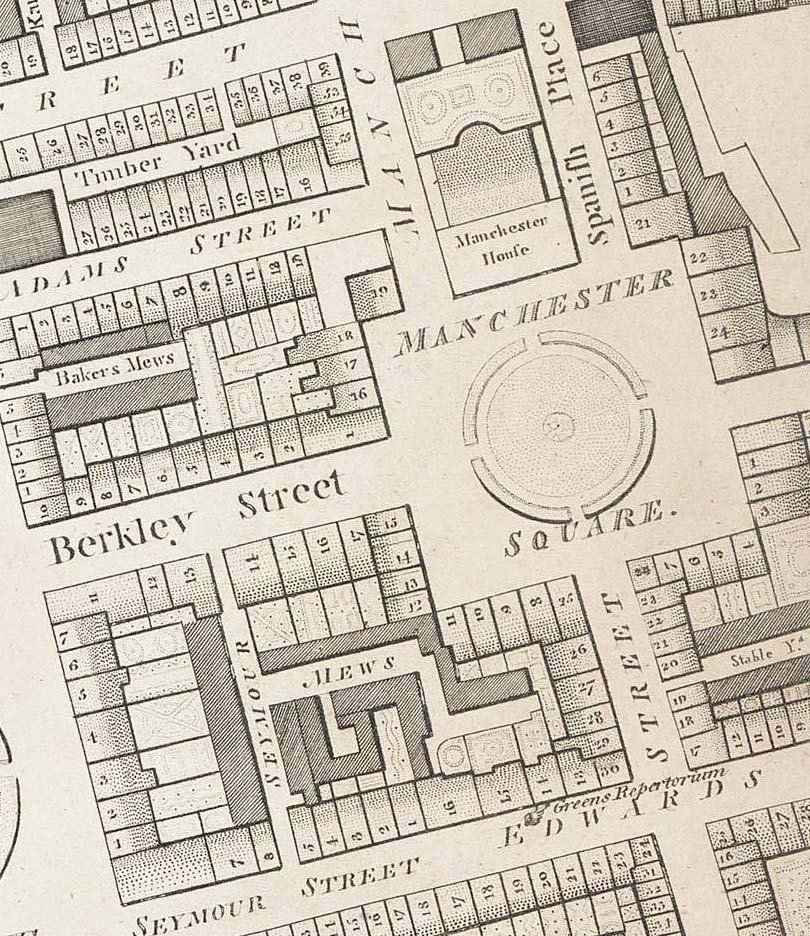
Manchester Square is an 18th-century garden square in Marylebone, central London. Centred 950 ft north of Oxford Street it measures 300 ft internally north-to-south, and 280 ft across. It is a small Georgian square, predominantly 1770s-designed. Construction began around 1776. The north side has a central mansion, Hertford House, which is flanked by approach ways. Its first name was Manchester House and since 1897 it has housed the Wallace Collection of fine and decorative arts. The square forms part of west Marylebone, most of which sees minor but overarching property interests held by one owner (through lease reversions managed as the Portman Estate). Many buildings have been recognised by statutory protection as listed buildings.
Notable residents
Among residents figured:
- Admiral Sir Thomas Foley (1757–1833), and his noble wife (later widow) at № 1
- Julius Benedict (1804–1885), German-born composer, at № 2
- John Hughlings Jackson (1835–1911), English neurologist, at № 3
- Alfred, Lord Milner (1854–1925), British statesman and colonial administrator, at № 14
- Timothy Yeats Brown (1789–1858), British banker
- Edward Henry Sieveking (1816–1904), English physician
- Major-General Sir Richard Henry Havelock Charles, 1st Baronet, GCVO, KCSI (1858–1934), British medical doctor, and Serjeant Surgeon to King George V
Listed buildings
- №s 1–3
- №s 4–7
- 1A Duke Street (has equal face to any lower numbers on this square)
- 2A Duke Street (as mentioned)
- №s 8–11
- №s 12–14
- Hertford House
- №s 22–25
- № 26
Spanish Place
This six-house long approach fronts the east side of Hertford House (or its small public front lawn with steps, benches and paths). The first five buildings of Spanish Place are those listed, in the mainstream, initial category of Grade II. They were built c.1780–90, associated with the Duke of Manchester's development of the square, on Portman land. Their materials are brown brick, recessed slate roofs above five varying-prominence storeys with 3-window wide fronts. They have semicircular arched doorways to right; panelled doors with sidelights and fanlights; one a stuccoed Doric porch. Their windows are recessed sashes, in stuccoed reveals, under flat gauged arches. Reaching out below the first floor is a stucco plat band, painted stone or stucco cornice over the next, then a stucco cornice and blocking course marking the attic storey. Original, cast iron, geometric patterned balconies adorn the first floor. Cast iron area railings with urn finials enclose the front. №3 has a blue plaque as the home of Captain Marryat and George Grossmith.
In film, fiction and the media
In 1814 and 1815, the square was the chosen setting for cheaper newspapers and, above all, their inner page articles to perpetuate a fresh round of the urban myth of a pig-faced woman.
The cover photograph for Please Please Me, the first LP by The Beatles, was taken by Angus McBean in 1963. It showed the group looking down over the stairwell inside EMI House (now demolished) in the square, EMI's then London headquarters. A repeat photo was taken in 1969 for the cover of their then-intended Get Back album; it was not used when the project saw release as Let It Be, but was eventually used on the retrospective albums 1962–1966 and 1967–1970.
In the early 20th century, the chemical company ICI moved into a new headquarters in the north-west corner of the square, which was designed in a modern style with classical elements. Around the rest of the square stand tall brick Georgian terraced houses, many of which are inside converted to offices.
Manchester Square Fire Station, just over a full block north-west, in retail/leisure street Chiltern Street, was decommissioned in June 2005 by the London Fire and Emergency Planning Authority (LFEPA) and, expanding further south, forms a luxury hotel and restaurant.
Notes
References
- Georgian London (1945) by Sir John Summerson. .
References
- {{NHLE
- {{NHLE
- {{NHLE
- {{NHLE
- {{NHLE
- {{NHLE
- {{NHLE
- {{NHLE
- {{NHLE
- {{NHLE
- Bondeson, Jan. (2006). "The Pig-Faced Lady of Manchester Square & Other Medical Marvels". Tempus Publishing.
- "Photograph of EMI House, 20 Manchester Square, 1960". [[Royal Institute of British Architects]].
- Stummer, Robin. (1995-08-12). "Stairwell to pop history heaven".
- Welham, Jamie. (7 November 2008). "It's a rare thing: A luxury hotel plan with community support". West End Extra.
This article was imported from Wikipedia and is available under the Creative Commons Attribution-ShareAlike 4.0 License. Content has been adapted to SurfDoc format. Original contributors can be found on the article history page.
Ask Mako anything about Manchester Square — get instant answers, deeper analysis, and related topics.
Research with MakoFree with your Surf account
Create a free account to save articles, ask Mako questions, and organize your research.
Sign up freeThis content may have been generated or modified by AI. CloudSurf Software LLC is not responsible for the accuracy, completeness, or reliability of AI-generated content. Always verify important information from primary sources.
Report