From Surf Wiki (app.surf) — the open knowledge base
Malus
Flowering genus, rose family Rosaceae

Flowering genus, rose family Rosaceae
- Chloromeles (Decne.) Decne. (1882)
- Docynia Decne. (1874)
- Eriolobus (Ser.) M.Roem.(1847)
- Prameles Rushforth (2018)
- Sinomalus Koidz. (1932)
- × Tormimalus Holub (1998)
Malus ( or ) is a genus of about 32–57 species of small deciduous trees or shrubs in the family Rosaceae, including the domesticated orchard apple, crab apples (sometimes known in North America as crabapples) and wild apples.
The genus is native to the temperate zone of the Northern Hemisphere.
Description
Apple trees are typically 4 – tall at maturity, with a dense, twiggy crown. The leaves are 3 – long, alternate, simple, with a serrated margin. The flowers are borne in corymbs, and have five petals, which may be white, pink, or red, and are perfect, with usually red stamens that produce copious pollen, and a half-inferior ovary; flowering occurs in the spring after 50–80 growing degree-days, varying greatly according to subspecies and cultivar.
Many apples require cross-pollination between individuals by insects (typically bees, which freely visit the flowers for both nectar and pollen); these are called self-sterile, so self-pollination is impossible, making pollinating insects essential.
A number of cultivars are self-pollinating, such as "Granny Smith" and "Golden Delicious", but there are fewer self-pollinating varieties than cross-pollinating ones. Several Malus species, including domestic apples, hybridize freely.
The fruit is a globose pome, varying in size from 1 – in diameter in most of the wild species, to 6 cm in M. sylvestris sieversii, 8 cm in M. domestica, and even larger in certain cultivated orchard apples. The centre of the fruit contains five carpels arranged star-like, each containing one or two seeds.
|20071103Tradkrafta1.JPG|Trunk |Flowering crabapple in Washington DC.jpg|Crabapple blossoms |Apple blossom. Eastern Siberia.jpg|Eastern Siberia
Subdivision
36 species and 4 hybrids are accepted.
Species
36 species and four natural hybrids are accepted:
- Malus angustifolia (Aiton) Michx. – southern crabapple
- Malus asiatica Nakai – Chinese pearleaf crabapple
- Malus baccata (L.) Borkh. – Siberian crabapple
- Malus brevipes – shrub apple
- Malus coronaria (L.) Mill. – sweet crabapple
- Malus crescimannoi Raimondo
- Malus daochengensis C.L.Li
- Malus delavayi (Franch.) B.B.Liu
- Malus domestica (Suckow) Borkh. – domestic or orchard apple
- Malus doumeri (Bois) A.Chev. – Taiwan crabapple
- Malus florentina (Zuccagni) C.K.Schneid. – Florentine crabapple, hawthorn-leaf crabapple
- Malus fusca (Raf.) C.K.Schneid. – Oregon or Pacific crabapple
- Malus halliana Koehne – Hall crabapple
- Malus honanensis Rehder
- Malus hupehensis (Pamp.) Rehder – tea crabapple
- Malus indica (Wall.) B.B.Liu
- Malus ioensis (Alph.Wood) Britton – prairie crabapple
- Malus jinxianensis J.Q.Deng & J.Y.Hong
- Malus kansuensis (Batalin) C.K.Schneid. – Calva crabapple
- Malus komarovii (Sarg.) Rehder
- Malus leiocalyca S.Z.Huang
- Malus longiunguis (Q.Luo & J.L.Liu) B.B.Liu
- Malus mandshurica (Maxim.) Kom. ex Skvortsov
- Malus muliensis T.C.Ku
- Malus niedzwetzkyana – Niedzwetzky's Apple
- Malus ombrophila Hand.-Mazz.
- Malus orientalis Uglitzk.
- Malus prattii (Hemsl.) C.K.Schneid. – Pratt's crabapple
- Malus prunifolia (Willd.) Borkh. – plum-leaf crabapple, Chinese crabapple
- Malus rockii Rehder – native to China and Bhutan
- Malus sikkimensis (Wenz.) Koehne – Sikkim crabapple
- Malus spectabilis (Aiton) Borkh. – Asiatic apple, Chinese crabapple
- Malus spontanea (Makino) Makino - nokaidō
- Malus sylvestris (L.) Mill. – European crabapple
- Malus toringo (Siebold) de Vriese (syns. Malus sargentii, Malus sieboldii) – Sargent crabapple, Toringo crabapple, or Siebold's crabapple
- Malus toringoides (Rehder) Hughes – cut-leaf crabapple
- Malus transitoria (Batalin) C.K.Schneid. – cut-leaf crabapple
- Malus trilobata (Labill. ex Poir.) C.K.Schneid. – Lebanese wild apple, erect crabapple, or three-lobed apple tree
- Malus turkmenorum Juz. & Popov (syn. Malus sieversii) – wild ancestor of cultivated species Malus domestica
- Malus yunnanensis (Franch.) C.K.Schneid. – Yunnan crabapple
- Malus zhaojiaoensis N.G.Jiang ;Hybrids
- Malus × floribunda Siebold ex Van Houtte – Japanese flowering crabapple
- Malus × kaido (Wenz.) Pardé (syn. Malus × micromalus) – midget crabapple
- Malus × soulardii (L.H.Bailey) Britton
- Malus × zumi (Matsum.) Rehder
Formerly placed here
- Macromeles tschonoskii (Maxim.) Koidz. (as Malus tschonoskii (Maxim.) C.K.Schneid.) – Chonosuki crabapple and pillar apple
Selected artificial hybrids
- Malus × sublobata – yellow autumn crabapple (M. asiatica × M. toringo)
Fossil species
After
- Malus collardii Axelrod, North America (Idaho), Eocene
- Malus kingiensis Budants, Kamchatka Peninsula, Russia, Eocene
- Malus florissantensis (Cockerell) MacGinitie Green River Formation, North America (Colorado) Eocene
- Malus pseudocredneria (Cockerell) MacGinitie Green River Formation, North America (Colorado) Eocene
- Malus idahoensis R.W.Br. North America (Idaho), Miocene
- Malus parahupehensis J.Hsu and R.W.Chaney Shanwang, Shandong, China, Miocene
- Malus antiqua Doweld Romania, Pliocene
- Malus pseudoangustifolia E.W.Berry North America (South Carolina), Pleistocene
Cultivation

Crabapples are popular as compact ornamental trees, providing blossom in spring and colourful fruit in autumn. The fruits often persist throughout winter. Numerous hybrid cultivars have been selected.
Some crabapples are used as rootstocks for domestic apples to add beneficial characteristics. For example, the rootstocks of Malus baccata varieties are used to give additional cold hardiness to the combined plants for orchards in cold northern areas.
They are also used as pollinizers in apples orchards. Varieties of crabapple are selected to bloom contemporaneously with the apple variety in an orchard planting, and the crabs are planted every sixth or seventh tree, or limbs of a crab tree are grafted onto some of the apple trees. In emergencies, a bucket or drum bouquet of crabapple flowering branches is placed near the beehives as orchard pollenizers.
Because of the plentiful blossoms and small fruit, crabapples are popular for use in bonsai culture.
Cultivars
These cultivars have won the Royal Horticultural Society's Award of Garden Merit:
- 'Adirondack'{{cite web | url = https://www.rhs.org.uk/Plants/138380/i-Malus-i-Adirondack/Details
- 'Butterball'{{cite web | url = https://www.rhs.org.uk/Plants/85932/i-Malus-i-Butterball/Details
- 'Comtesse de Paris'
- 'Evereste'{{cite web | url = https://www.rhs.org.uk/Plants/116626/i-Malus-i-Evereste/Details
- 'Jelly King'='Mattfru'
- 'Laura'{{cite web | url = https://www.rhs.org.uk/Plants/124642/i-Malus-i-Laura/Details
- Malus × robusta 'Red Sentinel'{{cite web | url = https://www.rhs.org.uk/Plants/45895/i-Malus-i-×-i-robusta-i-Red-Sentinel/Details
- 'Sun Rival'{{cite web | url = https://www.rhs.org.uk/Plants/104053/i-Malus-i-Sun-Rival/Details
Other varieties are dealt with under their species names.
Toxicity
The seeds contain cyanide compounds.
Uses
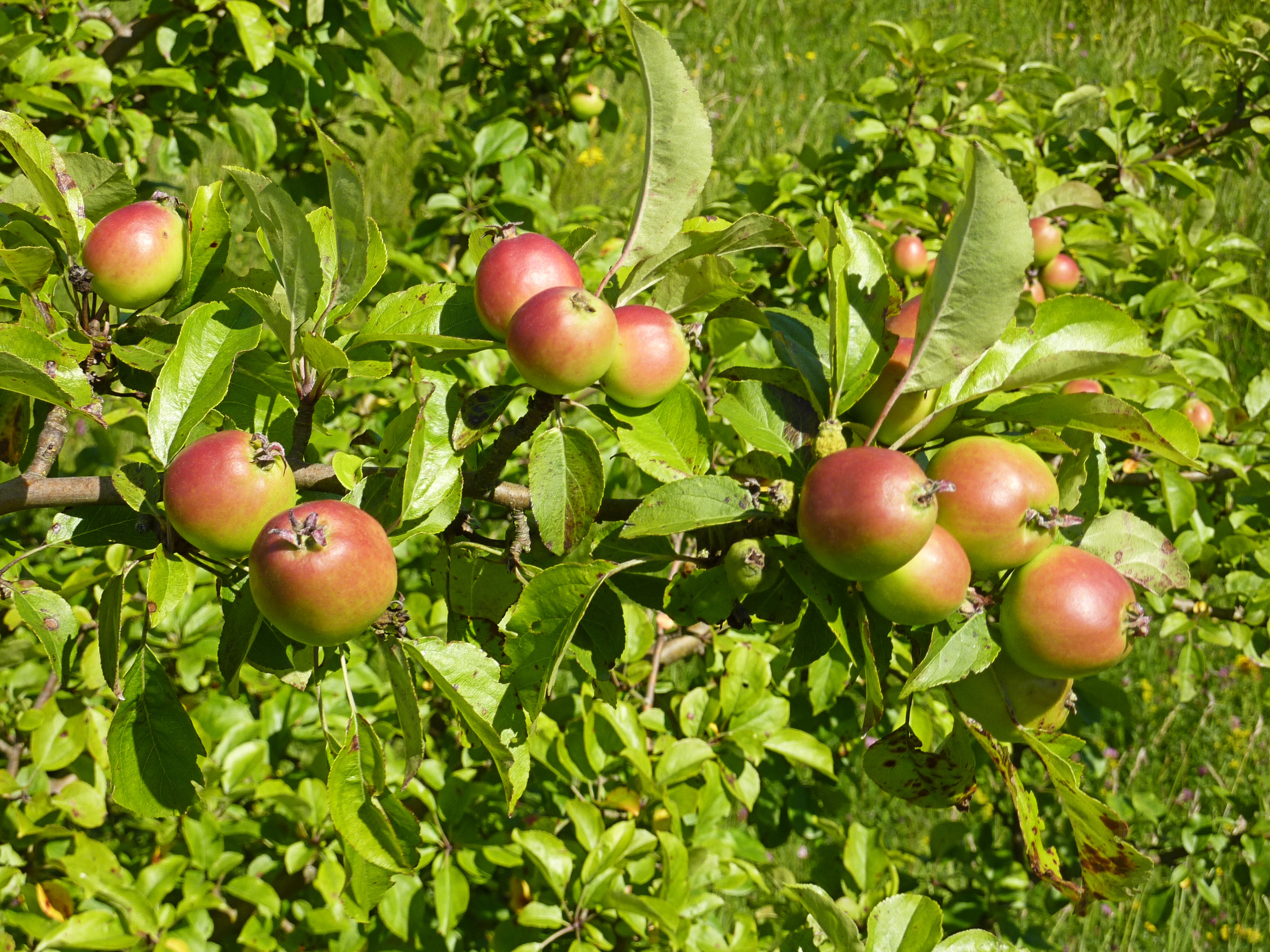

Crabapple fruit is not an important crop in most areas. The fruit is rarely eaten raw due to the sour taste resulting from high levels of malic acid. Some species have a woody texture. In some Southeast Asian cultures, they are valued as a sour condiment, sometimes eaten with salt and chilli or shrimp paste.
Some varieties of crabapple, such as the 'Chestnut' cultivar, are sweet.
Crabapples are an excellent source of pectin. Using sugar and spices such as ginger, nutmeg, cinnamon, and allspice, their juice can be made into ruby-coloured crab apple jelly with a full, spicy flavour. A small percentage of crabapples in cider makes a more interesting flavour. As Old English Wergulu, the crab apple is one of the nine plants invoked in the pagan Anglo-Saxon Nine Herbs Charm, recorded in the 10th century.
Applewood gives off a pleasant scent when burned, and smoke from an applewood fire gives an excellent flavour to smoked foods. It is easier to cut when green; dry applewood is exceedingly difficult to carve by hand.
References
References
- Cirrus Digital [http://www.cirrusimage.com/tree_Purple_Prince_Crabapple.htm Purple Prince Crabapple]
- "''Malus'' Mill.". Royal Botanic Gardens, Kew.
- ''Sunset Western Garden Book,'' 1995:606–607
- (1990). "A checklist of the subfamily Maloideae (Rosaceae)". Can. J. Bot..
- coreyrametta. (2019-06-11). "Are Apple Trees Self Pollinating?".
- Ken Wilson and D.C. Elfving. "Crabapple Pollenizers for Apples". Ontario Ministry of Agriculture and Food.
- (April 2023}} The oldest fossils of the genus date to the [[Eocene]] ([[Lutetian]]), which are leaves belonging to the species ''Malus collardii'' and ''Malus kingiensis'' from western North America (Idaho) and the [[Russian Far East]] ([[Kamchatka]]), respectively.{{Cite journal). "Phylogenomic conflict analyses in the apple genus Malus s.l. reveal widespread hybridization and allopolyploidy driving diversification, with insights into the complex biogeographic history in the Northern Hemisphere". Journal of Integrative Plant Biology.
- (2023-07-07). "Malus includes Docynia (Maleae, Rosaceae): evidence from phylogenomics and morphology". PhytoKeys.
- (2023-07-07). "Malus includes Docynia (Maleae, Rosaceae): evidence from phylogenomics and morphology". PhytoKeys.
- (2023-07-07). "Malus includes Docynia (Maleae, Rosaceae): evidence from phylogenomics and morphology". PhytoKeys.
- [https://www.gardening.cornell.edu/factsheets/ecogardening/appleroot.html Apple Tree Rootstocks Ecogardening Factsheet #21, Summer 1999]
- [http://www.dnr.state.ak.us/ag/21Applerootstocks.pdf Apple Rootstocks], Alaska Department of Natural Resources {{webarchive. link. (2008-07-19)
- "Collecting and Training Crab Apples {{!}} American Bonsai Society". American Bonsai Society.
- "Crabapple (Malus) - Bonsai Empire".
- "Crabapples for Bonsai".
- (July 2017). "AGM Plants - Ornamental". Royal Horticultural Society.
- "''Malus'' 'Comtesse de Paris'". RHS.
- "RHS Plantfinder - ''Malus'' Jelly King = 'Mattfru'".
- (2009). "The Complete Guide to Edible Wild Plants". [[Skyhorse Publishing]].
- "The Growing Guide". Stark Bro's Nurseries & Orchards Co..
- Rombauer, I.. (2002). "All About Canning & Preserving (The Joy of Cooking series)". Scribner.
- "The Science of Cidermaking". Andrew Lea.
- Fraser, Anna. (22 August 2005). "Properties of different trees as firewood".
- It is a good wood for cooking fires because it burns hot and slow, without producing much flame. Applewood is used to make handles of [[hand saw]]s; in the early 1900s, 2,000,000 board feet of applewood were used annually for this purpose.Burks, Jeff (2015). "Woods Used in Saw Handles". Lost Art Press, Traditional Hand-tool Skills. blog.lostartpress.com.
This article was imported from Wikipedia and is available under the Creative Commons Attribution-ShareAlike 4.0 License. Content has been adapted to SurfDoc format. Original contributors can be found on the article history page.
Ask Mako anything about Malus — get instant answers, deeper analysis, and related topics.
Research with MakoFree with your Surf account
Create a free account to save articles, ask Mako questions, and organize your research.
Sign up freeThis content may have been generated or modified by AI. CloudSurf Software LLC is not responsible for the accuracy, completeness, or reliability of AI-generated content. Always verify important information from primary sources.
Report