From Surf Wiki (app.surf) — the open knowledge base
Malmesbury Abbey
Abbey and parish church in Wiltshire, England
Abbey and parish church in Wiltshire, England
| Field | Value |
|---|---|
| name | Malmesbury Abbey |
| image | malmesbury.abbey.exterior.arp.jpg |
| caption | The main entrance (the south porch) seen from the churchyard, showing the truncated extent of the Abbey at left |
| pushpin map | Wiltshire#England |
| map caption | Location in Wiltshire##Location in England |
| coordinates | |
| osgraw | ST 93280 87320 |
| location | Malmesbury, Wiltshire |
| country | England |
| denomination | Church of England |
| previous denomination | Roman Catholic (until 1539) |
| website | |
| status | Parish church |
| founded date | |
| founder | Aldhelm |
| dedication | Saint Peter and Saint Paul |
| functional status | Active |
| heritage designation | Grade I listed |
| designated date | 1949 |
| architectural type | Abbey |
| groundbreaking | 7th century |
| length | |
| width | |
| width nave | |
| height | |
| diameter | |
| floor area | |
| dome height outer | |
| dome height inner | |
| dome dia outer | |
| dome dia inner | |
| spire height | |
| bells | |
| bell weight | |
| province | Province of Canterbury |
| diocese | Diocese of Bristol |
| diocese start | 1897 |
| archdeaconry | Malmesbury |
| deanery | North Wiltshire |
| benefice | Malmesbury and Upper Avon |
| parish | Malmesbury and Brokenborough |
| bishop | Right Rev. Vivienne Faull |
| vicar | Rev. Oliver Ross |
| archdeacon | Ven. Christopher Bryan |
| language(s) =
Malmesbury Abbey, at Malmesbury in Wiltshire, England, is a former Benedictine abbey dedicated to Saint Peter and Saint Paul. It was one of the few English religious houses with a continuous history from the 7th century through to the Dissolution of the Monasteries.
Monastic history
In the later seventh century, the site of the Abbey was chosen by Máel Dub, an Irish monk who established a hermitage, teaching local children. Towards the end of his life, in the late seventh century, the area was conquered by the Saxons. Malmesbury Abbey was founded as a Benedictine monastery around 676 by the scholar-poet Aldhelm, a nephew of King Ine of Wessex. The town of Malmesbury grew up around the expanding Abbey and under Alfred the Great was made a burh, with an assessment of 12 hides.
In October 939 Æthelstan, king of Wessex and of the English, died in Gloucester, and in the year 941 his remains were buried in the Abbey. The choice of Malmesbury over the New Minster in Winchester indicated that the king remained an outsider to the West Saxon court. A mint was founded at the Abbey around this time.
The Abbey developed an illustrious reputation for academic learning under the rule of abbots such as Aldhelm, John Scotus Eriugena, Alfred of Malmesbury and Aelfric of Eynsham.
The Abbey was the site of an early attempt at human flight when, during the early 11th century, the monk Eilmer of Malmesbury attached wings to his body and flew from a tower. Eilmer flew over 200 yards (182 m) before landing, breaking both legs. He later remarked that the only reason he did not fly further was the lack of a tail on his glider.
The Domesday Book of 1086 says of the Abbey: :In Wiltshire: Highway (11 hides), Dauntsey (10 hides), Somerford Keynes (5 hides), Brinkworth (5 hides), Norton, near Malmesbury (5 hides), Brokenborough with Corston (50 hides), Kemble (30 hides—now in Glos.), Long Newnton (30 hides), Charlton (20 hides), Garsdon (3 hides), Crudwell (40 hides), Bremhill (38 hides), Purton (35 hides); (fn. 127) in Gloucestershire: Littleton - upon - Severn (5 hides); (fn. 128) and in Warwickshire: Newbold Pacey (3 hides). These lands were valued at £188 14s. in all and were assessed as 3 knights' fees.
The 12th-century historian William of Malmesbury was a monk at the Abbey.
Construction and structural collapse
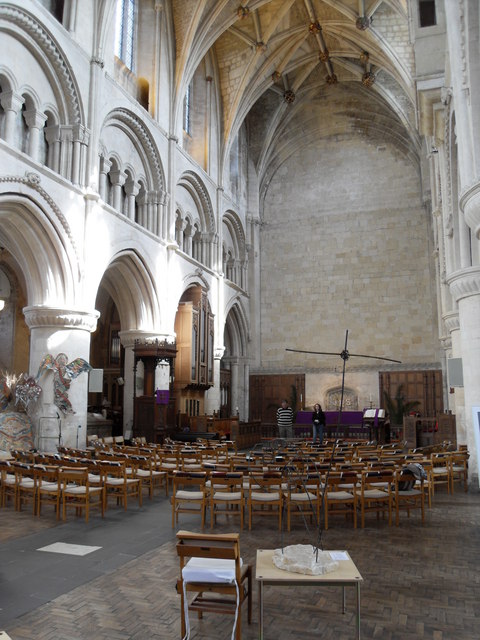
The current Abbey was substantially completed by 1180. The 431 feet (131 m) tall spire, and the tower it was built upon, collapsed in a storm around 1500 destroying much of the church, including two-thirds of the nave and the transept.
Abbots
| Name | Appointment | Died | Notes | |||||||||||||
|---|---|---|---|---|---|---|---|---|---|---|---|---|---|---|---|---|
| Maidulbh | 673 | Irish hermit and founder of Malmesbury | ||||||||||||||
| Aldhelm | 639 | 709 | first Old English writer in Latin, scholar and poet | |||||||||||||
| Eaba ??? | known only from a letter to Lullus | |||||||||||||||
| Ethelhard | a signatory to a charter of 749 | |||||||||||||||
| Cuthbert | attended the council of Clofeshoh in 803 | |||||||||||||||
| Alfred of Malmesbury | 999 | |||||||||||||||
| Ælfric of Crediton | 974 | 1010 | known for building work and his prophecy of the Viking sacking of Malmesbury | |||||||||||||
| Æthelweard | ||||||||||||||||
| B.M., Cott. MS.]] Vit. A. X. | ||||||||||||||||
| author=William of Malmesbury | title=Gesta Pontificum Anglorum | url=https://books.google.com/books?id=eIEYPsHuC18C | year=2002 | publisher=Boydell Press | isbn=978-0-85115-884-6 | page=683}} | ||||||||||
| Beorhtold | ||||||||||||||||
| url=https://www.british-history.ac.uk/vch/wilts/vol3/pp210-231 | series=Victoria County History | title=A History of the County of Wiltshire, Volume 3 | chapter=House of Benedictine monks: Abbey of Malmesbury | pages=210–231 | editor1-first=R.B. | editor1-last=Pugh | editor1-link=Ralph Pugh | editor2-first=Elizabeth | editor2-last=Crittall | date=1956 | via=British History Online | publisher=University of London | access-date=13 July 2022}} | sold off portions of the abbey lands | ||
| Eadric | c1012 | |||||||||||||||
| Wulfsine | 1034 | |||||||||||||||
| Æthelweard II | ||||||||||||||||
| Ælfwine | almost nothing is known of him | |||||||||||||||
| Beorhtwold II | 1053 | a man of bad character who collapsed and died during a drunken orgy in the town | ||||||||||||||
| Beorhtric appointed | 1053 | 1067 | removed by William the Conqueror | |||||||||||||
| 1067 | moved by William I to Peterborough in 1070 | |||||||||||||||
| Warin of Lyre (Évreux) | 1070 | 1087 | spent much of his time at court, squandering the abbey's resources | |||||||||||||
| Godfrey | ||||||||||||||||
| Eadwulf | a monk of Winchester, expelled by Roger of Salisbury | |||||||||||||||
| Roger of Salisbury | 1118 | 1139 | ||||||||||||||
| John of Malmsbury | 1139 | 1140 | appointed by King Stephen after he took the abbey during the Anarchy | |||||||||||||
| Peter Moraunt | 1141 | 1159 | obtained a bull of Pope Innocent II | |||||||||||||
| Gregory | 1159 | 1168 | ||||||||||||||
| Robert | 1172 | 1176 | a physician to Henry II | |||||||||||||
| Osbert Foliot | 1176 | 1182 | ||||||||||||||
| Nicholas | deposed for running into debt 218 | |||||||||||||||
| Robert of Melûn | 1189 | 1206 | ||||||||||||||
| Walter Loring | 1206 | 1222 | signed Magna Carta, received papal bull from Innocent III | |||||||||||||
| and gained permission from King John to demolish Malmesbury Castle. | ||||||||||||||||
| John Walsh | 1222 | 1246 | ||||||||||||||
| Geoffrey, sacristan | 1246 | 1260 | a monk of Malmesbury | |||||||||||||
| William of Colerne | 1260 | 1296 | ||||||||||||||
| William of Badminton | 1296 | |||||||||||||||
| Adam de la Hoke | a monk of Malmesbury | |||||||||||||||
| Adam by John of Tintern | 1349 | |||||||||||||||
| Simon de Aumeney | 1348 | 1361 | ||||||||||||||
| Walter de Camme | 1362 | 1396 | ||||||||||||||
| Thomas Chelworth | 1396 | 1424 | ||||||||||||||
| Roger Pershore | 1424 | 1434 | ||||||||||||||
| John Bristow | 1434 | 1456 | ||||||||||||||
| John Andever | 1456 | 1462 | ||||||||||||||
| John Ayly | 1462 | 1480 | ||||||||||||||
| Richard Frampton | 1480 | 1515 | ||||||||||||||
| Richard Camme | 1515 | 1533 | ||||||||||||||
| Richard Selwyn | surrendered the Abbey to Henry VIII in 1539 |
Parish church
The abbey, which owned 23,000 acre in the twenty parishes that constituted the Malmesbury Hundred, was closed at the Dissolution of the Monasteries in 1539 by Henry VIII and was sold, with all its lands, to William Stumpe, a rich merchant. He returned the abbey church to the town for continuing use as a parish church, and filled the abbey buildings with up to 20 looms for his cloth-weaving enterprise.
The west tower fell around 1550, demolishing the three westernmost bays of the nave. As a result of these two collapses, less than half of the original building stands today. During the English Civil War, Malmesbury suffered extensive damage evidenced by hundreds of pock-marks left by bullets and shot which can still be seen on the south, west and east sides of the building.
In 1949, the church was designated as a Grade I listed building. Historic England added it to their Heritage at Risk Register in 2022, stating that the roofs of the nave and aisles were leaking and in need of repair.
Today Malmesbury Abbey is in full use as the parish church of Malmesbury, in the Diocese of Bristol. The remains still contain a fine parvise (a room over the porch) which holds some examples of books from the abbey library. The Anglo-Saxon charters of Malmesbury, though extended by forgeries and improvements executed in the abbey's scriptorium, provide source material today for the history of Wessex and the West Saxon church from the seventh century.
Vicars of St Paul's and the Abbey Church, Malmesbury
From 1301 until the mid-16th century, the parish church of Malmesbury was St. Paul's. This stood in what is now Birdcage Walk (its tower and steeple remains, and is now the Abbey belltower). In 1539 Malmesbury Abbey ceased to exist as a monastic community and in August 1541 Thomas Cranmer licensed the abbey church to replace St Paul's as the parish church of Malmesbury. In 1837 the ancient chapelries of Corston and Rodbourne were made into a separate parish, called St Paul Malmesbury Without, and St Mary Westport was united to the abbey church.
- 1301 Reginald de Souple
- 1312 Roger Snell to Alynton
- 1332 Walter Drueys
- 1336 John de Ashebi
- 1348 Stephen de Tettebury
- 1353 Walter le Walker
- 1369 Richard de Lokenham
- 1379 John Oseborn
- 1387 Thomas Wibbe
- 1394 John Comeleygh
- 1428 William Butte
- 1439 Hugh Thomas
- 1462 William Sherewode
- 1497 Richard Chaunceller
- 1503 Thomas Long
- 1519 William Barlow
- 1535 Richard Turner
- 1544 John Aprice
- 1564 John Skinner
- 1565 James Procter
- 1566 Thomas Trinder
- 1567 John Sarney
- 1611 Matthew Watts
- 1616 Anthony Watson
- 1618 William Noble
- 1633 William Latimer
- 1649 Robert Harpur
- 1659 Simon Gawer
- 1664 John Hodges
- 1667 Nicholas Adee
- 1669 John Clarke
- 1676 John Binion
- 1701 Christopher Hanley
- 1705 Thomas Earle
- 1749 John Copson
- 1786 Henry Strong
- 1793 George Bisset
- 1829 Charles Pitt
- 1874 George Windsor Tucker
- 1920 Charles Paterson
- 1925 James Deade
- 1944 Arthur Beaghen
- 1975 Peter Barton
- 1994 David Littlefair
- 2004 Neill Archer
- 2018 Oliver Ross
Organ

The earliest organ was obtained in 1846 and had formerly stood in the church of St Benet Fink, Threadneedle Street, London; it had been manufactured in 1714 by Abraham Jordan. In 1938 a new organ was provided by Henry Willis, which had formerly been owned by Sir George Alfred Wills, Baronet of Bristol. Eventually it too was replaced.
The current organ dates from 1984 and was built by E.J. Johnson of Cambridge at a cost of £71,000 (). A specification of the organ can be found on the National Pipe Organ Register.
Notable burials

- Máel Dub, who founded the first monastic community in Malmesbury and gave his name to the town. His bones were cast out of the church of St. Peter and St. Paul by the Norman abbot Warin of Lyre, and relegated to a far corner of St. Michael's Church.
- Aldhelm, first Bishop of Sherborne and saint
- Æthelwine and Ælfwine, sons of Æthelweard (son of Alfred)
- Æthelstan, regarded as the first king of England. He was buried in the tower, under the altar of St. Mary. According to William of Malmesbury, Æthelstan's body was disinterred in the 11th century and reburied in the abbot's garden (now Abbey House Gardens) to avoid Norman desecration. He is commemorated by an empty 15th-century tomb in the north aisle.
- Daniel, Bishop of Winchester
- Hannah Twynnoy, supposedly the first person to be killed by a tiger in England, is buried in the churchyard, her gravestone inscribed with a poem. She was killed on 23 October 1703 after teasing a tiger in a menagerie stabled in the White Lion public house where she worked.
Legacy
In 2009, historian Michael Wood speculated that Malmesbury Abbey was the site of transcription of the Anglo-Saxon epic poem Beowulf.
Images
| File:Malmesbury Abbey Precinct Brakspear 1913 8.png|The abbey precinct | File:Malmesbury Abbey Ground Plan Brakspear 1913 58.png|Ground plan of the abbey | File:malmesbury.abbey.drawing.arp.jpg|The Abbey in the 14th century: only the brightened area is now used, following collapses of the spire and west tower | File:MalmesburyParvise.JPG|The fine parvise over the south porch | File:malmesbury.abbey.interior.2.arp.jpg|Interior of the Abbey, showing the unusual watching-loft projecting above the nave | File:malmesbury.abbey.interior.arp.jpg|The Abbey interior; the ruined area lies beyond the blank wall rising above the altar
Notes
Sources
- Smith, M Q: The Sculptures of the South Porch of Malmesbury Abbey: A Short Guide, 1975
References
- "Location information".
- "Leadership and Staff".
- Kelly, Susan. (2005). "Charters of Malmesbury Abbey". Oxford University Press.
- ''Blackwell Encyclopedia of Anglo Saxon England'', p. 209.
- [[Sarah Foot]], ‘Æthelstan (893/4–939)’, ''[[Oxford Dictionary of National Biography]]'', Oxford University Press, 2004; online edn, Sept 2011
- V.C.H. Wilts. ii, pp. 125-7.
- Dom. Bk. (Rec. Com.), i, 165.
- Meidulf, William of Malmesbury: 265.
- Maidulbh founded the [[monastery]] as a hermitage and taught local children including Aldhelm.
- [[De Gestis Pontificum Anglorum]].
- ''De gestis pontificum Anglorum'', ed. N(icholas) E. S. A. Hamilton, [[Rolls Series]], 1870, p406.
- William of Malmesbury: ''Gesta Pontificum Anglorum, The History of the English Bishops''; Vol. I: Text and Translation: Volume I: 411.
- [[Cotton manuscripts. B.M., Cott. MS.]] Vit. A. X.
- William of Malmesbury. (2002). "Gesta Pontificum Anglorum". Boydell Press.
- (1956). "A History of the County of Wiltshire, Volume 3". University of London.
- Cod. Dipl. ed. Kemble, no. 719.
- "vir efficax": Gest. Pont. 425.
- Ann. Mon. (Rolls Ser.), ii, 42.
- Leland, Collect. ii, 272.
- [https://www.archives.gov/exhibits/featured_documents/magna_carta/translation.html Magna Carta translation], Barons at [[Runnymede]], Magna Charta Period Feudal Estates, h2g2, [[John, King of England. King John]] and the [[Magna Carta]].
- Bernard Hodge, ''A History of Malmesbury'' (Friends of Malmesbury Abbey, 1990).
- B.M., Cott. MS. Faust. B. VIII, f. 142a.
- (1991). "A History of the County of Wiltshire, Volume 14". University of London.
- "Malmesbury Abbey Musket Damage". Atlas Obscura.
- {{National Heritage List for England
- "Abbey Church of St Mary and St Aldhelm, Market Cross, Malmesbury". Historic England.
- . (1 October 1846). ["Malmesbury Abbey"](http://www.britishnewspaperarchive.co.uk/viewer/bl/0000360/18461001/010/0003). *Devizes and Wiltshire Gazette*.
- . (5 September 1846). ["Malmesbury Abbey"](http://www.britishnewspaperarchive.co.uk/viewer/bl/0000361/18460905/011/0003). *Salisbury and Winchester Journal*.
- . (11 July 1938). ["Malmesbury Abbey Church Organ. Dedicated by the Bishop of Bristol"](http://www.britishnewspaperarchive.co.uk/viewer/bl/0000513/19380711/058/0008). *Western Daily Press*.
- {{National Pipe Organ Register. N15060
- Foot, S., 2011, ''Æthelstan: The First King of England'', pp.187–88,243.
- "Malmesbury Abbey".
- Plumb, C., 2015, ''The Georgian Menagerie: Exotic Animals in Eighteenth-Century London''.
This article was imported from Wikipedia and is available under the Creative Commons Attribution-ShareAlike 4.0 License. Content has been adapted to SurfDoc format. Original contributors can be found on the article history page.
Ask Mako anything about Malmesbury Abbey — get instant answers, deeper analysis, and related topics.
Research with MakoFree with your Surf account
Create a free account to save articles, ask Mako questions, and organize your research.
Sign up freeThis content may have been generated or modified by AI. CloudSurf Software LLC is not responsible for the accuracy, completeness, or reliability of AI-generated content. Always verify important information from primary sources.
Report