From Surf Wiki (app.surf) — the open knowledge base
Malaita Province
Province of Solomon Islands
Province of Solomon Islands
| Field | Value |
|---|---|
| name | Malaita Province |
| native_name | |
| settlement_type | Province |
| image_flag | Flag of Malaita.svg |
| image_map | Solomon Islands-Malaita.png |
| subdivision_type | Country |
| subdivision_name | Solomon Islands |
| subdivision_type1 | Capital |
| subdivision_name1 | Auki |
| leader_title | Premier |
| leader_name | Elijah Asilaua |
| area_total_km2 | 4225 |
| population_as_of | 2020 census |
| population_total | 160,583 |
| population_density_km2 | auto |
| timezone | +11:00 |
| utc_offset | +11:00 |
| coordinates |
Malaita Province is the most populous of the nine provinces of Solomon Islands. The population of the province is 122,620 (1999). The area of the province is 4225 km².
It is named after its largest island, Malaita (also known as "Big Malaita" or "Maramapaina"). Other islands include South Malaita Island (also called "Small Malaita" or "Maramasike"), Sikaiana Island, and Ontong Java Atoll. Britain defined its area of interest in the Solomons, including Malaita, and central government control of Malaita began in 1893, when Captain Gibson R.N., of , declared the southern Solomon Islands as a British Protectorate with the proclamation of the British Solomon Islands Protectorate.
The provincial capital and largest urban center is Auki, which was established as the Administrative center for Malaita Province in 1909. Tourism is largely underdeveloped in Malaita; Auki is near to the Langa Langa Lagoon, which provides opportunities for snorkeling, and the villagers provide shell making demonstrations.
The Melanesian population of Malaita has unique cultural traditions in social aspects of life. Brideprice is a tradition which is unique to Malaita compared to the other islands of the Solomon Islands. In this practice the groom's parents present customary money of shells and food to the bride's parents.
Ethnicity
The people of the main island are of Melanesian ethnicity. The outer islands of Ontong Java and Sikaiana are of a Polynesian ethnicity and are recognised as Polynesian outliers of Polynesian culture.
Traditional practices
Malaitan shell-money, manufactured in the Langa Langa Lagoon, is the traditional currency used in Malaita and throughout the Solomon Islands. The money consists of small polished shell disks which are drilled and placed on strings. It can be used as payment for bride price, funeral feasts and compensation, with the shell-money having a cash equivalent value. It is also worn as an adornment and status symbol. The standard unit, known as the tafuliae, is several strands 1.5 m in length. The shell money is still produced by the people of Langa Langa Lagoon, but much is inherited, from father to son, and the old traditional strings are now rare.
The violation of cultural taboos and practices as well as causing personal offence is considered a cultural affront. Malaita culture calls for the exchange of valuables to ease and resolve the alienation that may thus arise. This is called fa abua or fa okae (compensation).
Reef Islands
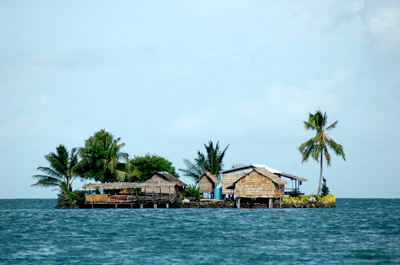
The people of Langa Langa Lagoon and Lau Lagoon in Malaita, Solomon Islands built about 60 artificial islands on the reef including Funaafou, Foueda, Sulufou, Saua, Ferasubua and Adagege.
The inhabitants of these lagoons call themselves wane i asi 'sea people' as distinct from wane i tolo 'inland people' who live in the interior of the island. There was a history of conflict between the bush people and the salt-water people. The people of Lau Lagoon build islands on the reef as these provided protection against attack. These islands were formed literally one rock at a time. A family would take their canoe out to the reef which protects the lagoon and then dive for rocks, bring them to the surface and then return to the selected site and drop the rocks into the water. Living on the reef was also healthier as the mosquitoes, which infested the coastal swamps, were not found on the reef islands. The Lau people continue to live on the reef islands.
Administrative divisions
Malaita Province is sub-divided into the following constituencies (or electoral districts), which are further sub-divided into wards (with populations at the 2009 and 2019 Censuses respectively):
| Name | Population (2009 census) | Population (2019 census) | Total | Male | Female | Total | Male | Female |
|---|---|---|---|---|---|---|---|---|
| 16. – North Malaita | 12,625 | 6,350 | 6,275 | 15,823 | 7,983 | 7,840 | ||
| 16.07. | Fo'ondo/Gwaiau | 5,532 | 2,779 | 2,753 | 6,588 | 3,336 | 3,252 | |
| 16.08. | Malu'u | 4,333 | 2,180 | 2,153 | 5,672 | 2,820 | 2,852 | |
| 16.09. | Matakwalao | 2,760 | 1,391 | 1,369 | 3,563 | 1,827 | 1,736 | |
| 17. – Lau/Mbaelela | 14,704 | 7,314 | 7,390 | 18,766 | 9,310 | 9,456 | ||
| 17.06. | Mandalua/Folotana | 2,749 | 1,383 | 1,366 | 3,940 | 1,965 | 1,975 | |
| 17.10. | Takwa | 10,070 | 5,002 | 5,068 | 12,445 | 6,164 | 6,281 | |
| 17.12. | Fouenda | 1,885 | 929 | 956 | 2,381 | 1,181 | 1,200 | |
| 18. – Baegu/Asifola | 5,647 | 2,790 | 2,857 | 9,531 | 4,697 | 4,834 | ||
| 18.11. | East Baegu | 4,781 | 2,370 | 2,411 | 6,784 | 3,344 | 3,440 | |
| 18.13. | Sulufou/Kwarande | 866 | 420 | 446 | 2,747 | 1,353 | 1,394 | |
| 19. – Fataleka | 7,571 | 3,851 | 3,720 | 10,670 | 5,315 | 5,355 | ||
| 19.05. | West Baegu/Fataleka | 2,477 | 1,270 | 1,207 | 6,220 | 3,075 | 3,145 | |
| 19.14. | Sububenu/Burianiasi | 5,094 | 2,581 | 2,513 | 4,450 | 2,240 | 2,210 | |
| 20. – West Kwara'ae | 15,053 | 7,675 | 7,378 | 18,048 | 9,226 | 8,822 | ||
| 20.03. | Buma | 6,223 | 3,275 | 2,948 | 8,122 | 4,191 | 3,931 | |
| 20.04. | Fauabu | 8,830 | 4,400 | 4,430 | 9,926 | 5,035 | 4,891 | |
| 21. – Central Kwara'ae | 17,273 | 8,773 | 8,500 | 20,355 | 10,408 | 9,947 | ||
| 21.02. | Aimela | 7,639 | 3,889 | 3,750 | 8,730 | 4,469 | 4,265 | |
| 21.29. | Keaimela/Radefasu | 9,634 | 4,884 | 4,750 | 11,621 | 5,939 | 5,682 | |
| 22. – East Malaita | 7,787 | 3,921 | 3,866 | 8,293 | 4,184 | 4,109 | ||
| 22.15. | Nafinua | 4,195 | 2,125 | 2,070 | 4,593 | 2,322 | 2,271 | |
| 22.16. | Faumamanu/Kwai | 3,592 | 1,796 | 1,796 | 3,700 | 1,862 | 1,838 | |
| 23. – Aoke/Langa Langa | 7,027 | 3,516 | 3,511 | 10,133 | 5,015 | 5,118 | ||
| 23.01. | Auki | 5,105 | 2,592 | 2,513 | 7,020 | 3,535 | 3,485 | |
| 23.30. | Langalanga | 1,922 | 924 | 998 | 3,113 | 1,480 | 1,633 | |
| 24. – East Kwaio | 9,509 | 4,720 | 4,789 | 12,291 | 6,131 | 6,161 | ||
| 24.17. | Gulalofou | 6,031 | 2,995 | 3,036 | 8,609 | 4,316 | 4,293 | |
| 24.18. | Waneagu/Taelanasina | 3,478 | 1,725 | 1,753 | 3,682 | 1,814 | 1,868 | |
| 25. – West Kwaio | 10,789 | 5,488 | 5,301 | 13,112 | 6,639 | 6,473 | ||
| 25.26. | Kwarekwareo | 1,921 | 961 | 960 | 2,785 | 1,394 | 1,391 | |
| 25.27. | Siesie | 3,747 | 1,883 | 1,864 | 4,508 | 2,296 | 2,212 | |
| 25.28. | Waneagu Silana Sina | 5,121 | 2,644 | 2,477 | 5,819 | 2,949 | 2,870 | |
| 26. – East Are Are | 7,099 | 3,567 | 3,532 | 8,199 | 4,042 | 4,157 | ||
| 26.19. | Aiaisi | 3,574 | 1,815 | 1,759 | 4,190 | 2,063 | 2,127 | |
| 26.20. | Areare | 3,525 | 1,752 | 1,773 | 4,009 | 1,979 | 2,030 | |
| 27. – West Are Are | 7,200 | 3,621 | 3,579 | 8,008 | 4,047 | 3,961 | ||
| 27.24. | Mareho | 2,550 | 1,237 | 1,313 | 2,820 | 1,407 | 1,413 | |
| 27.25. | Tai | 4,650 | 2,384 | 2,266 | 5,188 | 2,640 | 2,548 | |
| 28. – Small Malaita | 12,967 | 6,484 | 6,483 | 16,146 | 8,026 | 8,120 | ||
| 28.21. | Raroisu'u | 4,988 | 2,460 | 2,528 | 6,049 | 3,034 | 3,015 | |
| 28.22. | Aba/Asimeuru | 4,936 | 2,438 | 2,498 | 5,929 | 2,885 | 3,044 | |
| 28.23. | Asimae | 3,043 | 1,586 | 1,457 | 4,168 | 2,108 | 2,061 | |
| 29. – Malaita Outer Islands | 2,345 | 1,162 | 1,183 | 3,365 | 1,669 | 1,696 | ||
| 29.31. | Luaniua | 1,396 | 697 | 699 | 1,965 | 993 | 972 | |
| 29.32. | Pelau | 700 | 343 | 357 | 1,041 | 493 | 548 | |
| 29.33. | Sikaiana | 249 | 122 | 127 | 351 | 183 | 176 | |
| Total | 137,596 | 69,232 | 68,364 | 172,740 | 86,691 | 86,049 |
Islands
- Adagege
- Alite
- Anuta Paina
- Faore
- Ferasubua
- Foueda
- Funaafou
- Laulasi
- Maana'omba
- Malaita
- Matuavi
- Maramasike (South Malaita)
- Mbasakana
- Ndai
- Ontong Java
- Saua
- Sikaiana
- Sulufou
- Tehaolei
Notes
Footnotes
References
- Roger Keesing, Kwaio Religion: The Living and the Dead in a Solomon Island Society. New York: Columbia University Press, 1982.
- Roger M. Keesing and Peter Corris. Lightning Meets the West Wind: The Malaita Massacre. Melbourne: Oxford University Press, 1980.
- Janet Kent. The Solomon Islands. Harrisburg, PA: Stackpole Books, 1972.
- James Page, 'Education and Acculturation on Malaita: An Ethnography of Intraethnic and Interethnic Affinities'.The Journal of Intercultural Studies. 1988. #15/16:74-81; available on-line at http://eprints.qut.edu.au/archive/00003566/.
- Ples Blong Iumi: Solomon Islands: The Past Four Thousand Years. Honiara: University of the South Pacific, 1989.
- Harold M. Ross. Baegu: Social and Ecological Organization in Malaita, Solomon Islands. Chicago: University of Illinois Press, 1973.
References
- "Malaita Island". Solomon Islands Historical Encyclopaedia 1893-1978.
- (1999). "South Pacific Handbook". Moon South Pacific.
- ''Commonwealth and Colonial Law'' by [[Kenneth Roberts-Wray]], London, Stevens, 1966. P. 897
- "Auki". Solomon Islands Historical Encyclopaedia 1893-1978.
- [http://www.matthewprowse.com/mprowse90/malaitaland-feat-langa-langa-lagoon Matthew Prowse blog] {{Webarchive. link. (2 April 2015 . 18 June 2014. Retrieved on 22 March 2015.)
- Pei-yi Guo. (1 January 2006). ""Making Money": Objects, Productions, and Performances of Shell Money Manufacture in Langalanga, Solomon Island". The Frontiers of Southeast Asia and Pacific Studies.
- "Historical Photographs of Malaita". University of Queensland.
- Akimichi, Tomoya. (2009). "Sea Tenure and Its Transformation in the Lau of North Malaita, Solomon Island". South Pacific Study Vol. 12, No. 1, 1991.
- (1992). "The ecological aspect of Lau (Solomon Islands) ethnoichthyology". 87 (4) Journal of the Polynesian Society.
- "2009 Census Bulletin".
This article was imported from Wikipedia and is available under the Creative Commons Attribution-ShareAlike 4.0 License. Content has been adapted to SurfDoc format. Original contributors can be found on the article history page.
Ask Mako anything about Malaita Province — get instant answers, deeper analysis, and related topics.
Research with MakoFree with your Surf account
Create a free account to save articles, ask Mako questions, and organize your research.
Sign up freeThis content may have been generated or modified by AI. CloudSurf Software LLC is not responsible for the accuracy, completeness, or reliability of AI-generated content. Always verify important information from primary sources.
Report