From Surf Wiki (app.surf) — the open knowledge base
Makati
Highly urbanized city in Metro Manila, Philippines

Highly urbanized city in Metro Manila, Philippines
| Field | Value | |
|---|---|---|
| name | ||
| image_skyline | {{multiple image | |
| perrow | 1/2/2/2 | |
| border | infobox | |
| total_width | 260 | |
| caption_align | center | |
| image1 | Skylines of Makati City from The Beacon, Roces Tower.jpg | |
| caption1 | City skyline | |
| image2 | Ayala Avenue, Makati Avenue, PSE (Makati; 01-31-2021).jpg | |
| caption2 | Ayala Triangle | |
| image3 | 07978jfCarmona Globe Events Ground Circuit Lane Ayala Malls Alveo Makatifvf 21.jpg | |
| caption3 | Circuit Makati | |
| image4 | Makati Poblacion skyscrapers, Makati Avenue (Makati; 06-20-2021).jpg | |
| caption4 | Poblacion | |
| image5 | Rockwellcenter.jpg | |
| caption5 | Rockwell Center | |
| image6 | 09697jfMakati City Halls Quadrangle Complex Jose Rizal monumentfvf 14.jpg | |
| caption6 | Makati City Hall | |
| image7 | Guadalupe Church, Makati City.jpg | |
| caption7 | Nuestra Señora de Gracia Church | |
| image_caption | ||
| image_flag | Makati Flag.jpg | |
| image_seal | Makati City.svg | |
| image_blank_emblem | My_City_My_Makati.png | |
| blank_emblem_size | 120 | |
| blank_emblem_type | Logo | |
| seal_size | 100x80px | |
| image_map | ||
| map_caption | ||
| mapframe | yes | |
| pushpin_map | Philippines | |
| pushpin_label_position | left | |
| pushpin_map_caption | Location within the | |
| coordinates | ||
| settlement_type | ||
| subdivision_type | Country | |
| subdivision_name | Philippines | |
| subdivision_type1 | Region | |
| subdivision_name1 | ||
| subdivision_type2 | Province | |
| subdivision_name2 | none | |
| etymology | San Pedro [de] Macati | |
| named_for | ||
| nickname | Financial Capital of the Philippines | |
| motto | Makati, Mahalin Natin, Atin Ito | |
| ("Makati, let us love it, it is ours") | ||
| anthem | Himno ng Makati | |
| ("Makati Hymn") | ||
| Martsa ng Makati | ||
| ("Makati March") | ||
| subdivision_type3 | District | |
| subdivision_name3 | ||
| established_title | Founded | |
| established_date | June 1, 1670 | |
| (as San Pedro de Macati) | ||
| established_title2 | Renamed | |
| established_date2 | February 28, 1914 | |
| (as Makati) | ||
| established_title3 | Cityhood | |
| established_date3 | February 4, 1995 | |
| established_title4 | Recent territorial change | |
| established_date4 | November 9, 2023 | |
| parts_type | Barangays | |
| parts_style | para | |
| p1 | 23 | |
| leader_title | Mayor | |
| leader_name | Maria Lourdes Nancy S. Binay (UNA) | |
| leader_title1 | Vice Mayor | |
| leader_name1 | Romulo "Kid" V. Peña, Jr. (NPC) | |
| leader_title2 | Representatives | |
| leader_name2 | *Monique Lagdameo (1st District) (MKTZNU) | |
| leader_title3 | City Council | |
| leader_name3 | {{PH Town Council | |
| 1 | ||
| 2 | First District | |
| 3 | Martin John Pio Arenas | |
| 4 | Marie Alethea Casal-Uy | |
| 5 | Ferdinand Eusebio | |
| 6 | Virgilio Hilario Sr. | |
| 7 | Arlene Ortega | |
| 8 | Armando Padilla | |
| 9 | Fernando Felix Imperial | |
| 10 | Anna Alcina Yabut | |
| 11 | Second District | |
| 12 | Heinrich Thaddeus Angeles | |
| 13 | Maria Dolores Arayon | |
| 14 | Joel Ariones | |
| 15 | Levy Ramboyong | |
| 16 | Kristina Sarosa | |
| 17 | Bernadette Sese | |
| 18 | Maribel Vitales | |
| 19 | Nemesio Yabut Jr. | |
| 20 | *Liga ng mga Barangay President* | |
| 21 | Rolando Alvarez Jr. | |
| 22 | *Sangguniang Kabataan President* | |
| 23 | Jerome Tristan Pangilinan | |
| leader_title4 | Electorate | |
| leader_name4 | voters (electorate_point_in_time}} | ) |
| government_type | ||
| government_footnotes | ||
| elevation_m | ||
| elevation_max_m | 465 | |
| elevation_min_m | 0 | |
| elevation_footnotes | ||
| area_footnotes | ||
| area_total_km2 | ||
| population_footnotes | ||
| population_total | ||
| population_as_of | ||
| population_blank1_title | Households | |
| population_blank1 | 89,638 | |
| population_density_km2 | 16111 | |
| population_demonym | Makiteño; Makatizen | |
| timezone | PST | |
| utc_offset | +8 | |
| postal_code_type | ZIP code | |
| postal_code | 1200–1213, 1219–1235 | |
| postal2_code_type | ||
| postal2_code | ||
| area_code_type | ||
| area_code | ||
| website | ||
| demographics_type1 | Economy | |
| demographics1_title1 | ||
| demographics1_info1 | ||
| demographics1_title2 | Poverty incidence | |
| demographics1_info2 | % () | |
| demographics1_title3 | HDI | |
| demographics1_info3 | 0.903 () | |
| demographics1_title4 | Revenue | |
| demographics1_info4 | ||
| demographics1_title5 | Assets | |
| demographics1_info5 | ||
| demographics1_title6 | Assets rank | |
| demographics1_title7 | IRA | |
| demographics1_title8 | IRA rank | |
| demographics1_title9 | Expenditure | |
| demographics1_info9 | ||
| demographics1_title10 | Liabilities | |
| demographics1_info10 | ||
| demographics_type2 | Service provider | |
| demographics2_title1 | Electricity | |
| demographics2_info1 | ||
| demographics2_title2 | Water | |
| demographics2_title3 | Telecommunications | |
| demographics2_title4 | Cable TV | |
| blank_name_sec1 | ||
| blank_info_sec1 | ||
| blank1_name_sec1 | Native languages | |
| blank1_info_sec1 | Filipino | |
| blank2_name_sec1 | Crime index | |
| blank1_name_sec2 | Major religions | |
| blank1_info_sec2 | Roman Catholic Church | |
| blank2_name_sec2 | Feast date | |
| blank2_info_sec2 | December 12 | |
| blank3_name_sec2 | Catholic diocese | |
| blank3_info_sec2 | Roman Catholic Archdiocese of Manila | |
| blank4_name_sec2 | Patron saint | |
| blank4_info_sec2 | Saints Peter and Paul, Virgen de la Rosa |
("Makati, let us love it, it is ours") ("Makati Hymn") Martsa ng Makati ("Makati March") (as San Pedro de Macati) (as Makati)
- Dennis Almario (2nd District) (MKTZNU) Makati ( ; ), officially the City of Makati (), is one of the highly urbanized cities that make up Metro Manila, the capital region of the Philippines. Makati is a center for finance, commerce, culture, the arts and fashion, academics, and as the home to numerous diplomatic missions and embassies, is the center for the country's international diplomacy. With 432 high-rises and skyscrapers, Makati has the largest skyline in the Philippines, 138 of which exceed 100 m. According to the 2024 census, it has a population of 309,770 people.
The city covers about 18.17 sqkm, making it one of the smallest cities in the Philippines in terms of land area. It is bordered by Mandaluyong to the north, Taguig to the east, Pasay to the south, and the capital city of Manila to the west.
Because of people working in the central business district, Makati's daytime population swells to 3.2–4.2 million people.
As of 2023, Makati has an estimated GDP per capita of , making it the highest GDP per capita in the Philippines.
Etymology
The name of Makati originates from the Tagalog word kati, meaning "[of the] low tide" or "[of the] ebb tide", attributing to the tidal movements of the adjacent Pasig River. It originated from a misheard response in 1571 by locals to then-Governor-General Miguel López de Legazpi, who recorded the place's name as "Macati" after hearing them exclaim "Makati na! Kumakati na!" (). Used during the colonial eras, "Macati" was the historical Hispanized spelling of "Makati;" it was also spelled as "Macaty" or "Macali." Alternatively, the word may also mean "itchy", attributed to the lipang kalabaw plant (Dendrocnide meyeniana) that once grew in the area.
Until 1914, it was named San Pedro [de] Macati, a name stylized in Spanish after its patron saint, Saint Peter. The name was chosen by his namesake, Spanish captain Pedro de Brito, for his encomienda named Hacienda Pedro (now part of the present-day city), and in honor of Rev. Fr. Pedro de los Montes, who built the namesake church now known as Saints Peter and Paul Parish Church. Alternatively, it was wholly spelled in its Filipinized or Tagalized form, "San Pedro [de] Makati." The name was colloquially shortened to "Sampiro" by residents, referring to both the then-town and the church.
History
Early history

Parts of Makati were once subject to the pre-Hispanic Kingdom of Namayan, whose capital is now in the Santa Ana district of Manila.
Spanish colonial era

Parts of Makati became a visita of the then-town of Santa Ana de Sapa in 1578, during the Spanish colonial era. In 1589, Captain Pedro de Brito, then an aide to the Spanish Army chief of staff, purchased a land encompassing the present-day Poblacion with a public bid of 1,400 pesos, and established his encomienda named "Hacienda Pedro". In 1608, he and his wife Ana de Herrera donated half of land to the Jesuits, with the condition of building a church in honor of his namesake, Saint Peter the Apostle, and endowed 14,000 pesos for its construction. The church, later known as San Pedro Macati Church, was completed in 1620.
Establishment and early development
While under the jurisdiction of the Franciscan friars during the 17th century, it was established as a town on June 1, 1670, under the name San Pedro de Macati out of Santa Ana de Sapa. The nearby Nuestra Señora de Gracia Church, changed into the "Our Lady of Guadalupe" church, welcomed an image of the Virgin Mary and devotees from Mexico, and one person from a family in Makati, the Montes De Oca family, which produced Isidoro Montes de Oca, who became pivotal in the Mexican War of Independence against Spain. This parish had a large spiritual jurisdiction in the province of Tondo (later known as Manila), extending up to Muntinlupa.
In 1851, Don José Bonifacio Róxas, an ancestor of the Zóbel de Ayala family, purchased the estate from the Jesuits for 52,800 pesos and named it "Hacienda San Pedro de Macati". Since then, the development of Makati has remained linked with the family and their publicly-listed company, Ayala Corporation. In 1890, San Pedro de Macati was proclaimed as a public town of Manila province. During this period, aside from the poblacion, the town had four outer barrios: Guadalupe, Olympia, Tejeros, and Culi-Culi.
American occupation

In 1901, San Pedro Macati was incorporated into the newly established province of Rizal. On February 28, 1914, the name of the town was shortened to its present name of Makati, under Philippine Legislature Act No. 2390.

In 1934, Makati had grown to 14 barrios according to the Rizal provincial directory, namely: Poblacion, Comandante Carmona, Culiculi, Guadalupe, Fort McKinley, Malapadnabato (present-day West Rembo), Masilang (present-day South Cembo), Kasilawan, Olimpia (Olympia), Palanan, Pinagkaisajan (Pinagkaisahan), Rural, Sampalukan, and Tejeros. Fort McKinley, Malapadnabato, and Masilang were previously parts of Pateros.
Japanese occupation
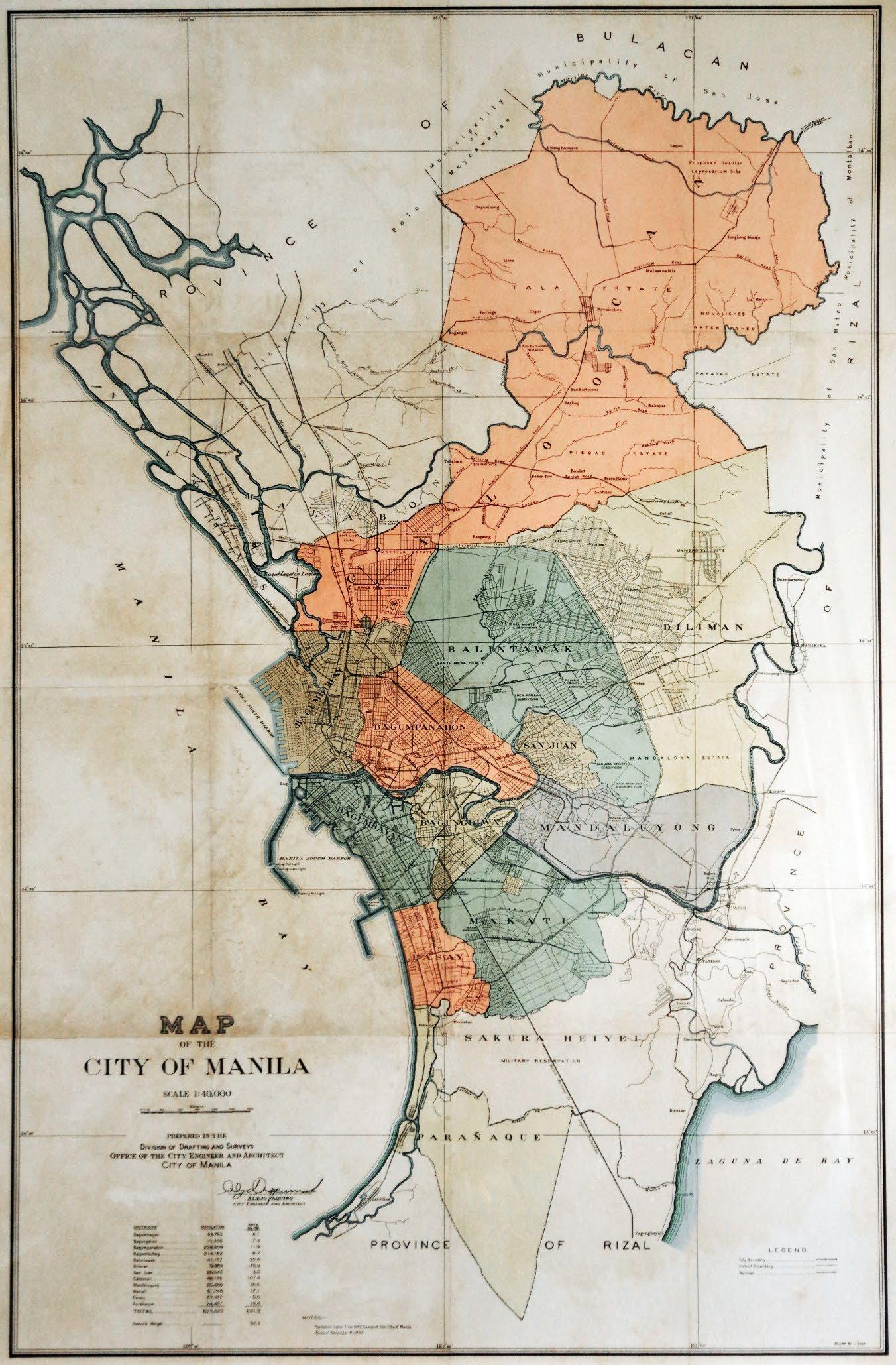
On January 1, 1942, Makati was one of the municipalities of Rizal merged alongside Manila and Quezon City to form the City of Greater Manila as an emergency measure by President Manuel L. Quezon. It regained its pre-war status as a municipality of Rizal when the City of Greater Manila was dissolved by President Sergio Osmeña effective August 1, 1945.
Post-war Era
After the destruction that the Second World War brought upon Manila, and the subsequent closure of Nielson Field, the town grew rapidly, and real estate values boomed. The first of the planned communities (in what are now the barangays Forbes Park, Urdaneta, San Lorenzo, and Bel-Air established during those times) were established in the 1950s with the efforts of its landowner, Ayala y Compañía. At the same time, Fort McKinley, then renamed Fort Bonifacio, and the then Philippine Army headquarters, became the starting point for the building up of seven more communities by military families who worked in the base area. New office buildings were built on what is now the Makati Central Business District (CBD). Since the late 1960s, Makati has transformed into the financial and commercial capital of the country. During this period, several barrios were converted into new independent barangays, while additional barangays were established by subdividing existing villages. In December 1972, two barrios (later barangay) of Makati were established at the Inner Fort Bonifacio area: Post Proper Northside and Post Proper Southside.
On November 7, 1975, Makati was separated from Rizal province to become part of the National Capital Region as a component municipality.
Martial Law and Corazon Aquino eras
Main article: Southern Tagalog 10, Martial law under Ferdinand Marcos, People Power Revolution
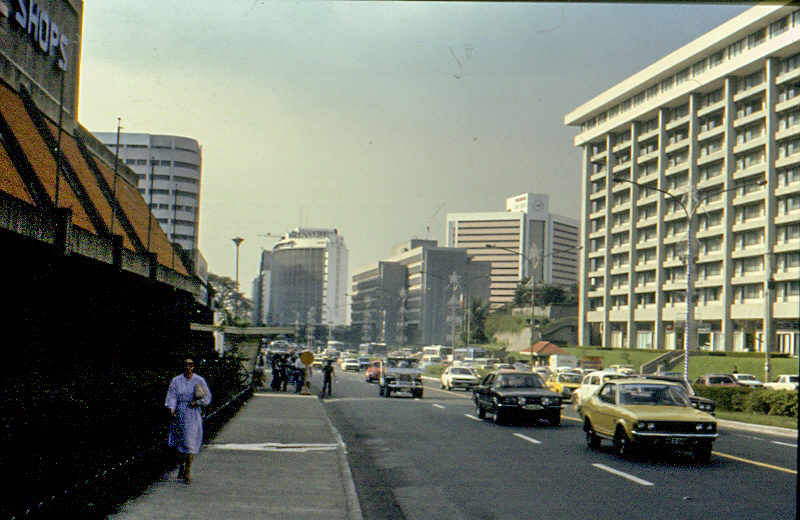
The beginning months of the 1970s marked a period of turmoil and change in the Philippines, particularly for the areas near the capital. A sudden glut of debt driven public works projects in the late 1960s led the Philippine economy to a sudden downward turn known as the 1969 Philippine balance of payments crisis, which in turn led to a period of economic difficulty and social unrest. With only a year left in his last constitutionally allowed term as president Ferdinand Marcos placed the Philippines under Martial Law in September 1972 and thus retained the position for fourteen more years. This period in Philippine history is remembered for the Marcos administration's record of human rights abuses, particularly targeting political opponents, student activists, journalists, religious workers, farmers, and others who fought against the Marcos dictatorship.
Makati was the setting of what is believed to be the single biggest case of involuntary disappearance during martial law – the case of the "Southern Tagalog 10" – ten activists from the nearby Southern Tagalog region, mostly in their twenties, who were abducted in late July 1977 at the Makati Medical Center.
Following the assassination of opposition senator Benigno Aquino Jr. on August 21, 1983, Makati became a nexus for protests against the dictatorship of President Ferdinand Marcos. Known as the Confetti Revolution, the demonstrations held in the central business district were led partly by employees of major corporations based in the area, culminating in the 1986 People Power Revolution that toppled Marcos' 20-year authoritarian regime. His political rival and successor, Corazon Aquino–the wife of the deceased senator Aquino–became the eleventh and first female president of the Philippines. After Mayor Nemesio Yabut succumbed to an illness on February 25, 1986, coinciding with the last day of the People Power Revolution, Aquino appointed Jejomar Binay as acting mayor of Makati two days later; he was subsequently elected as mayor in 1988.
In January 1986, by virtue of Presidential Proclamation No. 2475, s. 1986, the Fort Bonifacio Military Reservation, including the Embo barangays of Cembo, South Cembo, West Rembo, East Rembo, Comembo, Pembo and Pitogo were declared as part of Makati. The proclamation was contested by Taguig because it altered the municipality's boundaries unconstitutionally, which resulted in a three-decade long territorial dispute.
During the 1989 Philippine coup attempt, the Makati central business district was occupied by Reform the Armed Forces Movement forces seeking to overthrow President Corazon Aquino. The resulting standoff lasted from December 2 to 9 and contributed to massive financial losses incurred due to the paralysis in the economic hub.
Late 20th and early 21st centuries (1986–present)
On January 2, 1995, President Fidel V. Ramos signed Republic Act No. 7854, making Makati the seventh city in Metro Manila. The law was approved by a plebiscite one month later, on February 2, 1995, by majority of voters.
On May 17, 2000, at 5:02 p.m. PHT, Glorietta in Ayala Center was bombed, injuring 13 people. According to local authorities, the homemade bomb originated from the restroom of a restaurant and affected an adjacent video arcade. The bombing was believed to be the precursor of the May 21, 2000 SM Megamall bombing and the Rizal Day bombings. Another explosion occurred in the shopping mall complex on October 19, 2007, when a portion of Glorietta 2 exploded, killing 11 people and injuring more than a hundred. Initially, authorities said that it was caused by a liquefied petroleum gas explosion at a restaurant, but later began investigating the possibility that the explosion may have been a C-4 bomb.
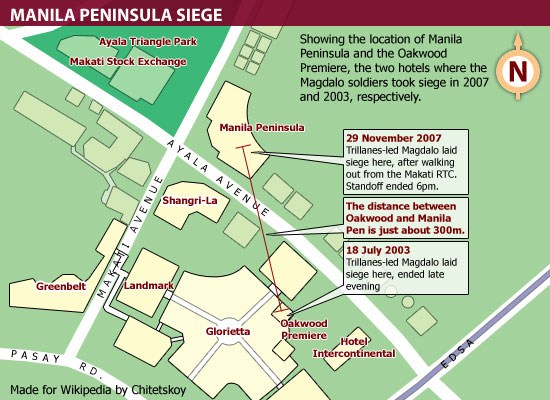
On July 2003, about 300 defectors of the Armed Forces of the Philippines and the Philippine National Police, known as the Magdalo Group, led by Army Capt. Gerardo Gambala and Navy Lt. Senior Grade Antonio Trillanes IV seized and occupied Oakwood Premier in Glorietta for 20 hours in what became known as the Oakwood mutiny. It is the first mutiny led by Trillanes against the Arroyo administration. The group attempted another unsuccessful rebellion in 2007 which became known as the Manila Peninsula siege.
On January 2011, a bus in Makati was bombed by Abu Sayyaf, killing five. In 2018, the Philippine Stock Exchange left its trading floor in Makati and moved to its new headquarters at the Philippine Stock Exchange Tower in Taguig.
In 2014, former Vice President Jejomar Binay and his son, former Makati Mayor Junjun Binay were involved in a graft case over the construction of the Makati Science High School Building in Cembo. The building was indicated to have cost (22.5 million) or per square meter, when it should have only been worth (9.2 million) or per square meter. In December 2024, however, the Sandiganbayan granted the demurrer and acquitted all the accused, including the Binays, in the case.

In April 2022, Makati lost in the three decades-long territorial dispute with Taguig, which was ruled with finality a year later in April 2023. The city was ordered to refrain from exercising jurisdiction over the ten Embo barangays, which were reintegrated to Taguig. Makati lost an estimated 300,000 people from its population following the lost of the Embo barangays. The city also lost its boundaries with Pasig and Pateros, while the city borders of Taguig were extended up to Mandaluyong. In May 2025, the court ordered Makati to cease obstructing Taguig's access to and exclusive full possession of public properties in the Embo barangays covered by Proclamation Nos. 518 and 1916. The order include health centers, multi-purpose buildings, covered courts, parks and other government properties. Taguig reopened the facilities after their takeover and the court granted Taguig's prayer for preliminary injunction, which effectively retains Taguig's possession of the facilities for the continued public services for the Embo barangays.
In the 2023 barangay and Sangguniang Kabataan elections, the Commission on Elections excluded the voters of Embo barangays from Makati, wherein they voted under Taguig instead. Meanwhile, the 2025 local elections is the first time that Makati's 2nd District voters is only composed of three barangays: Guadalupe Nuevo, Guadalupe Viejo, and Pinagkaisahan.
Geography
.jpg)
Makati is located within the circle of 14′40″ °N and 121′3″ °E right at the center of Metro Manila. The city is bounded on the north by the Pasig River, facing Mandaluyong, on the east by Taguig, on the southwest by Pasay, and on the northwest by the city of Manila. Creeks such as the Estero de Tripa de Gallina mostly on the west, Maricaban Creek on the south, and San Jose Creek on the east, form parts of Makati's city boundary. Makati has a total land area of 21.57 km2. Its territory also surrounds the Manila South Cemetery, an exclave of San Andres district of Manila.
Barangays
.svg)
Makati is politically subdivided into 23 barangays. These barangays are group into two congressional districts, with each district being represented by a congressman in the House of Representatives. The 1st Congressional District is composed of the barangays straddling EDSA, the barangays to the north and west of them, while excluding Guadalupe Viejo, while the 2nd Congressional District is to the south and east of the 1st District, including the aforementioned barangay. The districts elect the sixteen members of the city council, eight from each of the two councilor districts that are coextensive with the congressional districts.
From 1986 to 2023, Cembo, South Cembo, West Rembo, East Rembo, Comembo, Pembo, Pitogo, Post Proper Northside, Post Proper Southside, and Rizal, which collectively known as the Embo barangays, were declared as part of Makati by virtue of Proclamation No. 2475 issued by President Ferdinand Marcos in 1986. The Proclamation placed Fort Bonifacio and the Embo barangays as part of Makati, where they were represented by Makati's 2nd Congressional District until 2023. They were ceded to Taguig by the 2022 Supreme Court ruling regarding the territorial dispute between Makati and Taguig that was ruled with finality in 2023, declaring that the entirety of Fort Bonifacio, including the Embo barangays, are part of Taguig.
| Barangay | Population (2024) | Area | ZIP Code | Established | Bangkal | Bel-Air | Carmona | Dasmariñas | Forbes Park | Kasilawan | La Paz | Magallanes | Olympia | Palanan | Pio del Pilar | Poblacion | San Antonio | San Isidro | San Lorenzo | Santa Cruz | Singkamas | Tejeros | Urdaneta | Valenzuela | Barangay | Population (2024) | Area | ZIP Code | Established | Guadalupe Nuevo | Guadalupe Viejo | Pinagkaisahan | Total | 309,770 | 18.17 | 18.17 km2 |
|---|---|---|---|---|---|---|---|---|---|---|---|---|---|---|---|---|---|---|---|---|---|---|---|---|---|---|---|---|---|---|---|---|---|---|---|---|
| 0.74 km2 | 1233 | |||||||||||||||||||||||||||||||||||
| 1.71 km2 | 1209 | |||||||||||||||||||||||||||||||||||
| 0.34 km2 | 1207 | |||||||||||||||||||||||||||||||||||
| 1.90 km2 | 1221-1222 | |||||||||||||||||||||||||||||||||||
| 2.53 km2 | 1219-1220 | |||||||||||||||||||||||||||||||||||
| 0.09 km2 | 1206 | |||||||||||||||||||||||||||||||||||
| 0.32 km2 | 1204 | |||||||||||||||||||||||||||||||||||
| 1.20 km2 | 1232 | |||||||||||||||||||||||||||||||||||
| 1.20 km2 | 1207 | |||||||||||||||||||||||||||||||||||
| 0.65 km2 | 1235 | |||||||||||||||||||||||||||||||||||
| 1.20 km2 | 1230 | |||||||||||||||||||||||||||||||||||
| 1.03 km2 | 1210 | |||||||||||||||||||||||||||||||||||
| 0.89 km2 | 1203 | |||||||||||||||||||||||||||||||||||
| 0.50 km2 | 1234 | |||||||||||||||||||||||||||||||||||
| 2.09 km2 | 1223 | |||||||||||||||||||||||||||||||||||
| 0.47 km2 | 1205 | |||||||||||||||||||||||||||||||||||
| 0.13 km2 | 1204 | |||||||||||||||||||||||||||||||||||
| 0.29 km2 | 1204 | |||||||||||||||||||||||||||||||||||
| 0.74 km2 | 1225 | |||||||||||||||||||||||||||||||||||
| 0.24 km2 | 1208 | |||||||||||||||||||||||||||||||||||
| 0.57 km2 | 1212 | |||||||||||||||||||||||||||||||||||
| 0.62 km2 | 1211 | |||||||||||||||||||||||||||||||||||
| 0.16 km2 | 1213 |
Climate
Under the Köppen climate classification system, the city features a tropical monsoon climate. Together with the rest of the Philippines, Makati lies entirely within the tropics. Its proximity to the equator means that the temperature range is very small, rarely going lower than 20 °C or going higher than 38 °C. However, humidity levels are usually very high which makes it feel much warmer. It has a distinct, albeit relatively short dry season from January through May, and a relatively lengthy wet season from June through December.
Climate change
The Global Climate Risk Index 2021 lists the Philippines as one of countries most affected by catastrophes due to extreme weather events. Makati is a low-lying, coastal city vulnerable to natural calamities intensified by climate change, such as typhoons, floods, and landslides. The city's disaster risk reduction and management office noted a rise in rainfall experienced by the city over the years, particularly during the rainy season.
In August 2022, the city government declared a climate emergency, amid rising sea levels and global temperature changes.
Makati undertakes climate adaptation programs to address vulnerabilities to climate change, which include health services to residents, emergency response, and environmental management and protection. It intends to increase projects to address climate change, including a planned purchase of more electric vehicles, installation of solar panels in public schools and government offices, and improvement of public transport to lessen greenhouse gas emissions.
Cityscape
Demographics
As of the 2024 census, Makati had a population of 309,770. Makati currently ranks 14th in population size within Metro Manila. A majority of Makati residents identified their religious affiliation as Roman Catholic. Other groups having large number of members in the city are the Church of Jesus Christ of Latter-day Saints, Members Church of God International, Evangelical Christians, Iglesia ni Cristo, Protestantism, Islam, Hinduism, Buddhism and Judaism.
Based on the city's Transport and Traffic Improvement Plan 2004–2014, the city's daytime population is estimated to be 3.7 million during weekdays, owing to the large number of people who come to work, do business, or shop.
The daily influx of people into the city provides the skilled labor force that allows Makati to handle the service requirements of domestic as well as international transactions; it also serves as the base of a large consumer market that fuels the retail and service trade in the city. The large tidal population flows exert pressure on Makati's environment, services, and utilities, causing traffic congestions in major roads leading to the city, at the central business district, and the city's periphery.
Economy
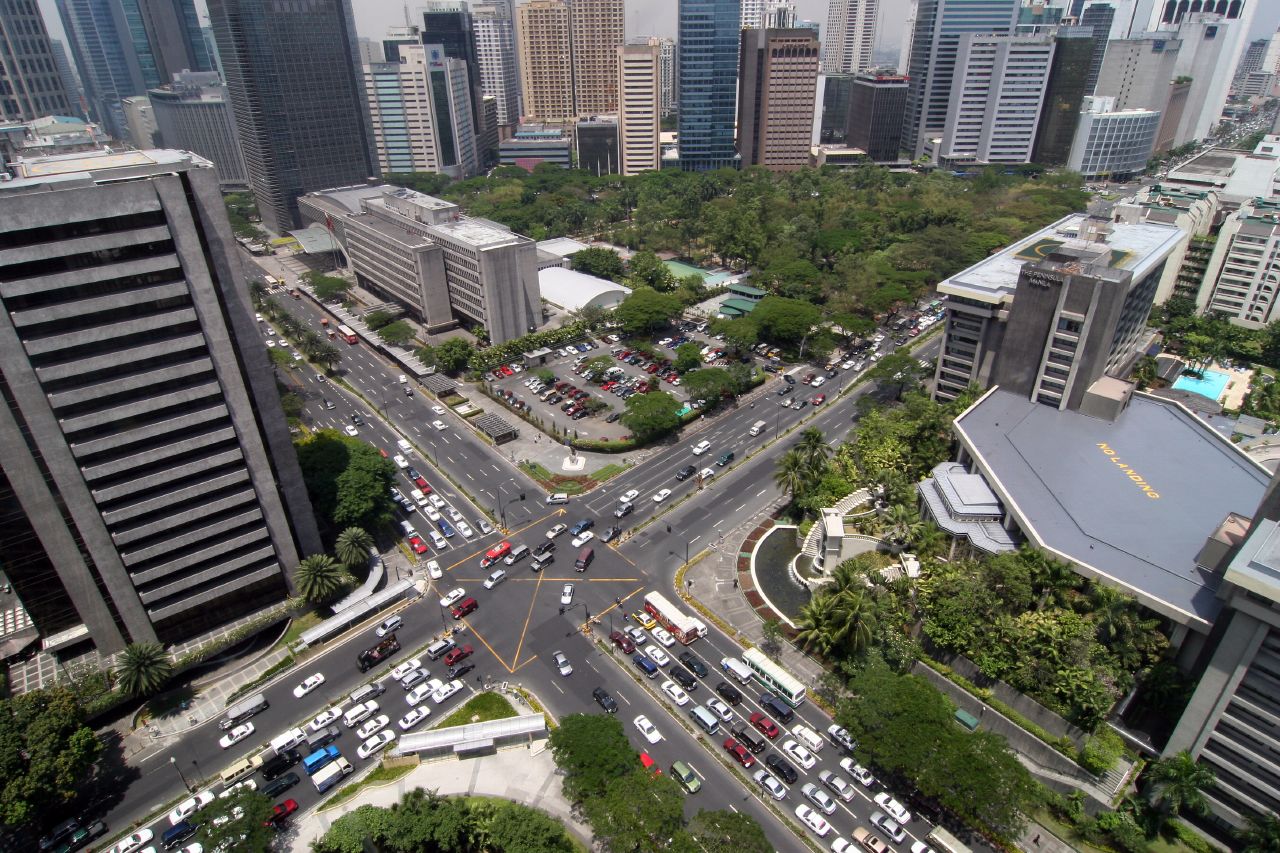
Makati has the highest per capita GDP of the country at (US$32,000). The economy of Makati is diverse and multifaceted. Makati is the home to the Ayala Triangle in the Makati Central Business District, which is home to many multinational companies, banks, and other major businesses. A few upscale boutiques, restaurants, and a park called Ayala Triangle Gardens are also located in the area. The Makati Business Club has over 800 chief executive officers and senior executives, which represents 450 of the country's biggest corporations. In 2024, Makati is the 2nd largest economy in the Philippines, with a 5.4% share to the national gross domestic product totaling ₱1.2 trillion.
The biggest trading floor of the Philippine Stock Exchange used to be situated along the city's Ayala Avenue, before the stock exchange moved their headquarters to the Bonifacio Global City in Taguig. The city has an office space supply of 2.8 e6sqm as of end-2021, making it a dominant office market in Metro Manila alongside Taguig and Pasig. As of 2023, Taguig had the highest share of existing office supply in Metro Manila at 26 percent, followed by Makati at 20 percent.
Makati is the second top revenue earner in the National Capital Region, following Quezon City at first place. The city has not increased its tax rates since its new Revenue Code took effect in 2006, and has been free of deficit for about three decades.
Most of the tallest skyscrapers in Metro Manila and the Philippines are located in Makati. Among them are the PBCom Tower, Trump Tower Manila and Gramercy Residences in Century City, Discovery Primea, Shang Salcedo Place, and G.T. International Tower. PBCom Tower along Ayala Avenue was the country's tallest office building from 2001 to 2017, with a total ground-to-architectural-top height of 259 m. It was surpassed in 2017 by the Metrobank Center in Taguig with a total architectural height of 318 m.
In addition, Evangelista Street in Barangay Bangkal is known for being the site of automobile repair shops, replacement automobile parts stores, tire and wheel stores, car air-conditioning unit repair shops, and car tint stores, almost similar to Banawe Street in Quezon City.
Shopping centers


Makati is one of the most well-known shopping hubs of Metro Manila. Various shopping centers, offering both international and local retail shops, high-end boutiques, dining outlets and entertainment facilities can be found around the city.
The Ayala Center is a major commercial development operated by Ayala Land located in the Makati CBD. The center is known for its wide array of shopping, entertainment, and cultural offerings, making it a premier shopping and cultural district in the metropolis. It is a vast walkable complex with high-end malls that houses cinemas, local and international shops, homegrown restaurants and international food chains. The shopping malls that are located at the Ayala Center include Greenbelt, Glorietta, Park Square, The Link, and Ayala Malls One Ayala. The Ayala Center is also home to three department stores, namely: SM Makati, Rustan's, and The Landmark.
Other shopping centers in Makati include Power Plant Mall at Rockwell Center, Century City Mall at Century City, Ayala Malls Circuit at Circuit Makati, Cash & Carry Mall, Walter Mart Makati, Makati Central Square (formerly Makati Cinema Square), Guadalupe Commercial Complex, Paseo de Magallanes, and pocket malls at various high-rise residential condominiums or office buildings in the city.
Government
Local government

Makati is classified as a highly urbanized city (HUC). The city government is based at the Makati City Hall complex in Poblacion, with the new Makati City Hall building serving as its main seat. The mayor is the chief executive and is a member of the Metro Manila Council. The mayor is assisted by the vice mayor, who presides over a legislative council consisting of 18 members: 8 councilors from the 1st district, 8 councilors from the 2nd district, the President of the Sangguniang Kabataan (Youth Council) Federation representing the youth sector, and the President of the Association of Barangay Chairmen (ABC) as barangay sectoral representative. The council is in charge of creating the city's policies in the form of Ordinances and Resolutions.
The incumbent mayor is Nancy Binay, the daughter of former mayor and former Vice President Jejomar Binay, of the United Nationalist Alliance. Romulo "Kid" Peña Jr., a member of the Nationalist People's Coalition, is the incumbent vice mayor. Current district representatives of the city to the House of Representatives are Monique Lagdameo for the 1st district, and Dennis Almario for the 2nd district, both members of the Makatizens United Party.
Mayors
Main article: Mayor of Makati
Seal of Makati

The current seal of Makati, adopted in August 1995, composes of the old outline map of Makati containing 33 rays, green buildings, a church, and a river. Those were first used on Makati's final municipal seal from 1990 to 1995.
The map of Makati is in golden yellow color which represents wealth and prosperity. The rays represent the 33 barangays of Makati (including the 10 Embo barangays ceded to Taguig in 2023) which are described to be "surging forward to a brighter future". The buildings are in green, symbolizing life which is described to reflect a "new progressive" Makati. The church represents the oldest church of Makati, the Nuestra Señora de Gracia, which was used by Filipino revolutionaries against the Spaniards in 1896 and the Americans in 1898. The waves represent the tide which came from the phrase "Makati na, Kumakati na" which means ebbing tide in Tagalog.
File:Makati seal until 1970s 80s.png|1901–1990 Former municipal seal of Makati.png|1990–1995 The first municipal seal of Makati, used from 1901 to 1990, features an escutcheon that resembles the Philippine coat of arms with scale of justice, two hands, and the images of José Rizal (as Makati was once part of Rizal province from 1901 to 1975) on the ovoid, Pio del Pilar (a Makati native) on the blue base, and a man holding a bolo with quill and mechanical gear on the red base. The hands represent the welfare of the people. BASED ON MUSEO DE MAKATI VISIT
Culture and sports


Makati is home to a number of fine art museums, colonial-era churches, and recreation areas. Along the south-eastern border of Makati in Forbes Park are the Manila Golf Club and the Manila Polo Club. The Manila Golf Club features an 18-hole golf course. The Manila Polo Club counts among its polo enthusiasts some of the country's wealthiest people. The Makati Sports Club in Salcedo Village is another popular place for sports. The Makati Coliseum is another famous sports landmark in the city, where some of the biggest sports gatherings are held. The city has also hosted some venues of the 1981, 2005 and 2019 Southeast Asian Games.
The city's only professional sports team was the Makati OKBet Kings, which joined the Maharlika Pilipinas Basketball League in its second season.
In the northwest, the Blue Pitch at Circuit Makati is a multi-use stadium, used not just for football games but since 2017 serves as the primary hub of the Philippine-American Football League. The site of Circuit Makati was also previously occupied by the Santa Ana Park, a racetrack whose operations were transferred to Naic, Cavite, in 2009. The University of Makati Stadium, now part of Taguig, was the home venue of Philippines Football League club Kaya F.C.–Makati until the team's move to Iloilo City.

The Ayala Museum is a private fine arts and history museum housing various exhibitions such as the "Gold of Ancestors," an exhibition of more than one thousand golden pre-Hispanic artifacts. Other popular museums also in Makati also include the Yuchengco Museum and the Museo ng Makati.
Makati has several Spanish-era churches, such as the Saints Peter and Paul Parish, Our Lady of Guadalupe Parish, and the Nuestra Señora de Gracia Church (Our Lady of Grace) in the old town. At the Greenbelt Park stands the modern domed Sto. Niño de Paz Greenbelt Chapel. Located in Forbes Park is the Santuario de San Antonio, a popular church for weddings in the Makati area. The National Shrine of the Sacred Heart is located in San Antonio Village. Makati also houses the country's only Jewish synagogue, Beth Yaacov.
There is a red-light district around Padre Burgos Street in Barangay Poblacion.
Transportation

Roads

Main article: List of roads in Metro Manila#Makati
Major roads in Metro Manila surround Makati, such as Epifanio de los Santos Avenue (EDSA), located in the southwestern part of the city, the Osmeña Highway and South Luzon Expressway (SLEX), collectively known as South Superhighway (SSH), and the Skyway, which is built on top of both roads.
Two of Metro Manila's main arteries pass through Makati. The Epifanio de los Santos Avenue (EDSA) pass along the city's southeast part and connects it with the cities of Mandaluyong and Pasay. The South Luzon Expressway (SLEX) starts in southwestern Makati and connects it with southern Metro Manila and Southern Luzon. The Skyway is an elevated expressway that connects with North Luzon Expressway (NLEX) and SLEX, providing residents coming from various parts of Luzon and Northern Metro Manila, a fast way to reach Makati. SLEX and EDSA intersect at the Magallanes Interchange, which is among the most complex systems of elevated roadways in the country.
Makati is known to enforce a significantly stricter implementation of the Unified Vehicular Volume Reduction Program (UVVRP), or Number Coding Scheme, than most other local government units in Metro Manila. Unlike the Metro Manila Development Authority's (MMDA) scheme, which includes "window hours" and covers national roads traversing Makati (i.e., EDSA and Osmeña Highway), No Window Hours is mandated across the city, enforcing a continuous restriction from 7:00 AM to 7:00 PM PHT, Monday to Friday except on holidays. This non-stop ban is aimed at managing severe traffic congestion, with exemptions mainly for senior citizen BluCard holders and official/emergency vehicles.
The areas of Guadalupe and of Ayala Center are considered as major transport hubs. Ayala Center hosts One Ayala, a complex with an intermodal transport hub, and various public transportation stops. The BGC Bus also connects the city to Bonifacio Global City, with a terminal at the McKinley Exchange Corporate Center in Barangay Dasmariñas, near Ayala Center. Provincial and city buses, including Premium Point-to-Point Bus Service, ply the city through EDSA, Osmeña Highway, Kalayaan Avenue, or the central business/financial district towards other parts of Metro Manila and Southern Luzon. Jeepneys ply Makati's inner roads and connect the city to its surrounding towns and cities. Tricycles are also used for shorter distances except at most of the Central Business District, exclusive villages, and some major roads.
The country's first-ever e-jeepney and hybrid bus services were piloted in Makati. The buses are parallel electric hybrids, powered by an electric motor and a Euro 3 diesel motor. The hybrid buses ply the route from Gil Puyat Avenue (Tramo area in Pasay) to Kalayaan Avenue (near C-5 in Taguig), which are considered among the busiest areas, cutting through other major roads like Osmeña Highway; Chino Roces, Ayala and Makati Avenues; Paseo de Roxas and EDSA.
Other major roads in the city include Gil Puyat Avenue, which connects EDSA and SLEX in the north; Ayala Avenue, an important street that runs through the Makati CBD; McKinley Road, which connects the city to Bonifacio Global City; Arnaiz Avenue, which connects the city to Pasay; Osmeña Highway, which connects SLEX to the city of Manila; Makati Avenue, which connects the Makati CBD to Poblacion, also extending north to the Makati–Mandaluyong Bridge; and J. P. Rizal Avenue, the oldest main thoroughfare of Makati which connects it to the cities of Manila and Taguig. At the center of Makati is the Ayala Triangle, a park built on the former Nielson Air Base. As of 2023, Makati has 176.615 km of concrete roads, and 105.264 km of asphalt roads.
Railways

The MRT Line 3 on EDSA has four stations located in Makati: Guadalupe, Buendia, Ayala and Magallanes. The city was formerly served by the PNR Metro Commuter Line, whose operations were discontinued and it will be superseded by the North–South Commuter Railway, which will have two stations in the city: Buendia and EDSA.
In 2013, the National Economic and Development Authority (NEDA) worked on a feasibility study for a monorail project which will be 12.56 km long. It plans to connect Makati, Bonifacio Global City and Pasay through MRT Line 3, as well as the Ninoy Aquino International Airport. The present alignment being considered starts from the Guadalupe MRT station, enters Bonifacio Global City through the north gate and ends at Ninoy Aquino International Airport Terminal 3. The SkyTrain is also proposed to be built in Makati and Taguig.
In 2015, NEDA approved the Public-Private Partnership project for the Makati-Pasay-Taguig Mass Transit System Loop which will have stations at key points in Makati. The project was later shelved and partially revived in 2018 as the Makati Intra-City Subway which inherits most of the stations in Makati. Instead of a national government project, it became a project of the Makati City Government and the line now only traverses within the city limits. Later on, the Subway project was later stalled in 2023 due to the transfer of the Embo barangays to Taguig, which won the territorial dispute with Makati. The Embo area was planned to contain its depot and two stations.
Water
The Pasig River Ferry Service has one station in Makati located in barangay Valenzuela. A separate, regular service plies between the Casa Hacienda Park in Poblacion and barangay Hulo in Mandaluyong.
Education
Main article: Category:Schools in Makati

The University of Makati, a public, non-profit university, is the city's flagship university located in West Rembo, its former barangay that is now part of Taguig. Other institutions of higher education located in the city include the Asian Institute of Management (AIM), iAcademy, Asian Seminary of Christian Ministries (ASCM), Don Bosco Technical Institute of Makati, Assumption College San Lorenzo, Saint Paul College of Makati, Our Lady of Guadalupe Minor Seminary, San Carlos Seminary, and Asia Pacific College.
Several higher education institutions headquartered outside the city have established branch or satellite campuses in Makati. These include the Ateneo de Manila University (Ateneo Professional Schools), De La Salle University, Far Eastern University, Mapúa University, Lyceum of the Philippines University, Centro Escolar University, and AMA Computer College Colleges, among others.
Australian Catholic University, a foreign institution, maintains an extension program in Makati.
As of 2024, the Schools Division Office (SDO) of Makati City oversees 23 public schools: 16 elementary schools and 7 high schools. In 2023, as a result of the Makati–Taguig boundary dispute ruling, 14 public elementary and high schools, including the Makati Science High School, were transferred from the SDO of Makati City to the SDO of Taguig City and Pateros. Makati later appealed to the national Department of Education to retain the management of Makati Science High School, Fort Bonifacio Elementary School, and Fort Bonifacio High School, but the city's appeal was denied, leaving the city without a science high school.
Rafael Palma Elementary School, which is under the jurisdiction of the neighboring city of Manila's Division of City Schools, is located in Barangay La Paz, near the Makati–Manila boundary.
Notable persons
Main article: Category:People from Makati
- Andrew Julian Romualdez, congressman
- Andres Muhlach, actor
- Atasha Muhlach, actress
- Mikey Arroyo, congressman
- Lino Cayetano, director; politician
- Donita Nose, stand-up comedian; comedian
- Bubbles Paraiso, actress
- Mark Leviste, politician
- Marco Gumabao, actor
- Pío del Pilar, revolutionary general
- Jejomar Binay, former vice president of the Philippines
- Elenita Binay, physician, former mayor
- Nancy Binay, former senator and incumbent mayor
- Abigail Binay, former city mayor and 2025 senatorial candidate
- Jejomar Binay Jr., former politician
- Michelle Dee, actress
- Vhong Navarro, TV host, actor and dancer
- Ciara Sotto, actress
- Julia Clarete, actress
- China Roces, actress
- Jhong Hilario, actor, dancer, TV host and former 1st district councilor
- Jun Lana, film director
- Teodoro Locsin Jr., journalist, lawyer, diplomat and former 1st district representative
- Monsour del Rosario, actor, athlete and former 1st district representative
- Joker Arroyo, lawyer, former 1st district representative and former senator
- Agapito Aquino, former senator and former 2nd district representative
- Rico J. Puno, singer and former 1st district councilor
- Chiquito, actor and former vice mayor
- Sandro Reyes, Philippines national football team player
- Rhian Ramos, actress
- Mike Arroyo, former first gentleman
- Bela Padilla, actress
- Heaven Peralejo, actress
- Albie Casiño, actor
- CJ Tañedo, painter
- Bettina Carlos, former actress; starred Tia Madel Salcedo in Temptation of Wife Philippines Adaptation
- Migz Zubiri, politician and businessperson
National and international relations
Diplomatic missions

Most of the diplomatic missions to Manila by foreign countries in the Philippines have their chanceries located in Makati:
- (Consulate)
- (Consulate)
- Czechia
- (Taipei Economic and Cultural Office)
- (Consulate)
Sister cities
Makati's sister city is Los Angeles, California. Makati is also twinned with Ramapo, New York and Vladivostok, Russia.
| International |
|---|
| Domestic |
|---|
References
References
- {{DILG detail
- (17 July 2025). "2024 Census of Population (POPCEN) Population Counts Declared Official by the President". Philippine Statistics Authority.
- (July 31, 2025). "Makati to work with DOTr to improve mass transportation systems". City of Makati.
- "City of Makati Records 6.3 Percent GDP Growth in 2023; Reaching the Highest Per Capita GDP.". Philippine Statistics Authority.
- "Poblacion Heritage District".
- (1936). "Official Road Map of the Philippine Islands: with Ports Indicated". Bureau of Public Works, Philippines.
- Tueller, James B.. (October 28, 2023). "Layers of Time and Place: San Pedro Macati, Metro Manila, the Philippines". World History Connected.
- Spain. Dirección de Hidrografía. (1807). "Carta Esférica de la Bahia de Manila".
- (1882). "Carta Itineraria de la Isla de Luzon por el Teniente Coronel de E. M. del Ejercito de Filipinas".
- Rodriguez, Mia. (February 17, 2024). "This Church Is a Marker of Poblacion's Centuries-Old Heritage". Spot.ph.
- Lantin, Jerome. (June 11, 2015). "Makati holds 'Sampiro' festival". ABS-CBN News.
- (2018). "Vergleichende Kolonialtoponomastik Strukturen und Funktionen kolonialer Ortsbenennung". De Gruyter.
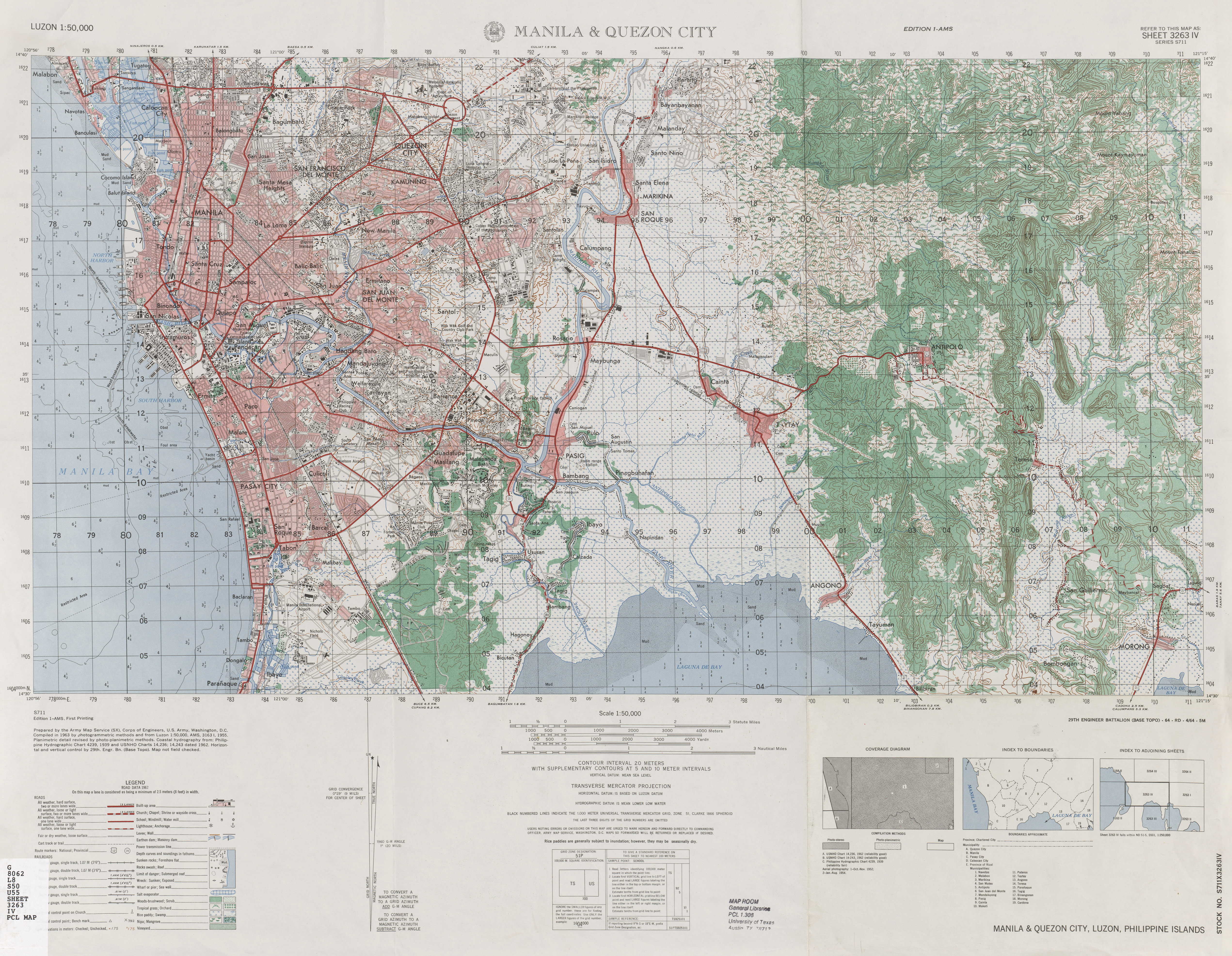
- (1964). "Manila & Quezon City - Sheet 3263 IV". U.S. Army Map Service.
- Alcazaren, Paulo. (November 12, 2016). "Makati City: The old and the new". The Philippine Star.
- "Barangay Poblacion". Makati Web Portal.
- Joaquin, Nick. (1990). "Manila, My Manila: A History for the Young". Republic of the Philippines, City of Manila.
- de Huerta, Felix. (1865). "Estado Geografico, Topografico, Estadistico, Historico-Religioso de la Santa y Apostolica Provincia de San Gregorio Magno". Imprenta de M. Sanchez y Compañia.
- Rodriguez, Mia. (February 17, 2024). "This Church Is a Marker of Poblacion's Centuries-Old Heritage". Spot.ph.
- "February 28, 1914". Filipinas Heritage Library.
- Medina, Marielle. (June 1, 2015). "Did you know: Makati Foundation Day". [[Philippine Daily Inquirer]].
- (May 27, 1967). "Declaring Thursday, June 1, 1967, as Makati Day and a special public holiday in Makati, Rizal". [[Official Gazette (Philippines).
- [https://pepealas.wordpress.com/tag/fr-juan-de-montes-de-oca/ Guadalupe Church: Macati City's undying watcher (El Filipinismo)]
- "ESTADISMO DE LAS ISLAS FILIPINAS TOMO PRIMERO By Joaquín Martínez de Zúñiga".
- "This week in Ayala history". www.filipinaslibrary.org.ph.
- "History – Pioneers". Ayala Group Official Website.
- (June 1905). "Population". UNITED STATES BUREAU OF THE CENSUS, WASHINGTON.
- "About Barangay Bangkal".
- de los Reyes, Anton. (August 3, 2022). "Makati Museum receives historical marker". Malaya Business Insight.
- (June 11, 1901). "An Act Extending the Provisions of the Provincial Government Act to the Province of Rizal". Lawyerly.
- (July 31, 1901). "An Act to Incorporate the City of Manila". Lawyerly.
- (February 28, 1914). "An Act Changing the names of the municipalities of Santo Niño and Mawanan, Province of Cagayan; San Isidro Labrador and San Isidro de Potot, Province of Pangasinan; San Francisco de Malabon and Santa Cruz de Malabon, Province of Cavite; Nagpartian and San Miguel, Province of Ilocos Norte; Langaran, Province of Misamis; San Pedro Tunasan, Province of Laguna; Cabagan Nuevo, Province of Isabela; Nueva Caceres, Province of Ambos Camarines; San Pedro Macati, Province of Rizal; San Juan de Bocboc, Province of Batangas; San Juan, Province of Nueva Ecija; township of Barrit - Luluno, Province of Ilocos Sur, and of the Barrios of Tublijon and Gibigaan, Municipality of Sorsogon, Province of Sorsogon". Lawyerly.
- "History". Makati Web Portal.
- Salonga, Isayas. (1934). "Rizal Province directory". [[University of Michigan]] Digital Collections.
- (January 1, 1942). "Creating the City of Greater Manila". [[Official Gazette (Philippines).
- (July 26, 1945). "Reducing the Territory of the City of Greater Manila". [[Official Gazette (Philippines).
- "History of Makati City". Manila Info Blogspot.
- "About Barangay Olympia".
- "Barangay Post Proper Northside". Makati Web Portal.
- "Barangay Post Proper Southside". Makati Web Portal.
- (November 7, 1975). "Creating the Metropolitan Manila and the Metropolitan Manila Commission and for Other Purposes".
- Robles, Raissa. (2016). "Marcos Martial Law: Never Again". Filipinos for a Better Philippines, Inc..
- Balbosa, Joven Zamoras. (1992). "IMF Stabilization Program and Economic Growth: The Case of the Philippines". Journal of Philippine Development.
- (2003). "The Philippine Economy: Development, Policies, and Challenges". Oxford University Press.
- Cororaton, Cesar B.. "Exchange Rate Movements in the Philippines". DPIDS Discussion Paper Series 97-05.
- Kessler, Richard J.. (1989). "Rebellion and repression in the Philippines". Yale University Press.
- Celoza, Albert F.. (1997). "Ferdinand Marcos and the Philippines: The Political Economy of Authoritarianism". Greenwood Publishing Group.
- Schirmer, Daniel B.. (1987). "The Philippines reader : a history of colonialism, neocolonialism, dictatorship, and resistance". South End Press.
- (1998). "Kasaysayan, The Story of the Filipino People Volume 9:A Nation Reborn.". Asia Publishing Company Limited.
- (September 20, 1999). "Alfred McCoy, Dark Legacy: Human rights under the Marcos regime". [[Ateneo de Manila University]].
- (2005). "State and society in the Philippines". Rowman & Littlefield Publishers.
- "Gone too soon: 7 youth leaders killed under Martial Law". Rappler.
- Ilagan, Bonifacio. (December 6, 2016). "Resonance: The Southern Tagalog 10". Manila Today.
- Enano, Jhesset O.. (September 20, 2017). "Martial law victims find no justice in 'moving on'". Inquirer.
- Boado, Krysten Mariann. (November 11, 2016). "Ground zero: Remembering truths of a past forgone". Tinig ng Plaridel.
- "The President's Day: December 10, 2002". [[Official Gazette (Philippines).
- (September 20, 2008). "The Cruelty of Enforced Disappearances: An Abhorrent Crime Against Humanity – Bulatlat". Bulatlat.
- (February 26, 1986). "Strongarm Philippine Mayor Dies". [[Associated Press]].
- Cayabyab, Mark Jayson. (February 25, 2016). "Candidates on Edsa 30 years ago: Binay". INQUIRER.net.
- (January 7, 1986). "Excluding from the operation of Proclamation No. 423, series of 1957 which established the Fort William Mckinley (now Fort Bonifacio) Military Reservation situated in the municipalities of Pasig, Taguig, Parañaque, Makati and Pasay City, Metro Manila, a certain portion of the land embraced therein situated in the municipality of Makati and declaring the same open to disposition under the provisions of Act No. 3038 and Republic Act No. 274 in relation the provisions of the Public Land Act, as amended.". [[Official Gazette (Philippines).
- Davide Commission. (October 3, 1990). "The Final Report of the Fact-Finding Commission: V: The Failed December 1989 Coup: Pre-Coup Events and Battle Zone Narratives". Official Gazette of the Republic of the Philippines.
- (July 19, 1994). "An Act Converting the Municipality of Makati into a Highly Urbanized City to be Known as the City of Makati". The Corpus Juris.
- (October 19, 2007). "A record of mall explosions in RP". GMA News.
- Gutierrez, Jason. (October 20, 2008). "Military explosives may have been used in bomb blast". Agence France-Presse.
- (October 20, 2007). "C-4 bomb component used in Glorietta blast – PNP chemist". GMA News.
- Aglionby, John. (July 28, 2003). "Hugs end Manila mutiny in mall".
- "Failed Putsch Attempt in the Philippines – DW – 11/29/2007".
- (November 28, 2007). "Afp.google.com, Philippine rebels seize hotel, demand Arroyo step down: witnesses".
- (February 10, 2011). "Makati City Bombing Brings Abu Sayyaf Terrorism to Manila". The Jamestown Foundation.
- (January 26, 2011). "Bishops condemn Makati bus bombing". CBCP News.
- "PSE starts trading in new headquarters".
- "Philippine Stock Exchange BGC: A Brand New Home for Stock Trading". KMC MAG Group.
- "Philippine Stock Exchange BGC | BGC Office for Rent".
- "The Philippine Stock Exchange Tower in BGC: 8 Things to Know".
- Cayabyab, Mark Jayson. (November 6, 2014). "Bondal: Makati Science High School building overpriced, too".
- Legaspi, Amita. (November 18, 2014). "Experts: Makati Science HS building construction should only cost P489M to P644M". GMA News Online.
- (January 9, 2025). "Sandiganbayan junks raps vs. Binays in Makati Science HS project". [[Philippine News Agency]].
- (May 6, 2025). "Court Orders Makati to Turn Over to Taguig Possession of EMBO facilities". I Love Taguig (City Government of Taguig official Facebook profile).
- (May 6, 2025). "Taguig City takes over government facilities in EMBO barangays". [[Rappler]].
- (May 23, 2025). "Court Grants Taguig Preliminary Injunction to Continue Services in EMBO Facilities". People's Tonight Online.
- (May 9, 2025). "Taguig court extends TRO vs. Makati over Embo facilities". Inquirer.net.
- (May 9, 2025). "Taguig RTC extends TRO vs. Makati over EMBO row". Philippine News Agency.
- (January 12, 1925). "Jacobo Zobel, et al. vs. the City of Manila". The Lawphil Project - Arellano Law Foundation, Inc..
- Hicap, Jonathan. (April 3, 2023). "Taguig LGU lauds SC decision over Fort Bonifacio ownership". Manila Bulletin.
- Cayabyab, Marc Jayson. (April 5, 2023). "Makati raises 'constitutional' issues in BGC land dispute". The Philippine Star.
- (8 November 2023). "DILG-Taguig to handle programs, projects in 10 former Makati barangays". Philippine Daily Inquirer.
- (July 22, 2023). "SC ruling opens issue on Taguig House seats". Philippine Daily Inquirer.
- "Makati City Climate".
- Mangaluz, Jean. (2022-08-06). "Makati City declares 'climate emergency'". Philippine Daily Inquirer.
- (January 1, 2009). "Climate Resilient Cities: A Primer on Reducing Vulnerabilities to Disasters: Makati City, Philippines". World Bank.
- Bagaoisan, Anjo. (August 7, 2022). "'Need to act fast': Makati City declares 'climate emergency'". ABS-CBN News.
- "Household Population by Religious Affiliation". City Government of Makati.
- "Daytime Population". City Government of Makati.
- "2023 Economic Performance of the Highly Urbanized Cities in the Philippines". [[Philippine Statistics Authority]].
- "Ayala Triangle Gardens". Make it Makati.
- (June 13, 2008). "Governance Reform Under Real-World Conditions: Citizens, Stakeholders, and Voice". World Bank Publications.
- (September 25, 2025). "Institutionalizing the Provincial Product Accounts: PSA Releases the 2024 Economic Performance of 82 Provinces and 33 Highly Urbanized Cities". Philippine Statistics Authority.
- "Makati Business Club".
- Francia, Arra B.. (February 19, 2018). "At new BGC office, PSE to finally open unified trading floor". BusinessWorld.
- (July 7, 2022). "Occupancy rate in MM's office spaces remain strong at 81%". Philippine Daily Inquirer.
- "Share of existing office space supply in Metro Manila in the Philippines as of 4th quarter 2023, by city". Statista.
- (May 30, 2024). "QC, Makati, Taguig are top NCR revenue earners in 2023". Philippine Daily Inquirer.
- (September 7, 2015). "Makati reports growth in January–August tax collection". The Philippine Star.
- Garcia, Leandre. (June 4, 2019). "Have you gone car-parts shopping on Evangelista St. already?". TopGear Philippines.
- "Makati Shopping". Make it Makati.
- "Ayala Center". Make it Makati.
- (March 25, 2014). "Rise of the 'pocket' malls". Century Properties.
- "City Government Directory". Makati Web Portal.
- (August 16, 1995). "Makati City council okays new seal". Kamahalan Publishing Corp..
- "Seals and Logos". City Government of Makati.
- "About the Museum". The Ayala Museum.
- "About Us". The Jewish Association of the Philippines.
- "Starter Guide To Manila Red Light District". A Farang Abroad.
- Zurbano, Joel. (July 15, 2021). "NCR's number coding still on hold; Makati modifies traffic scheme". [[Manila Standard]].
- Gonzales, Cathrine. (March 8, 2022). "'Normal' number coding scheme back in Makati starting March 16".
- (March 1, 2022). "Makati to resume full vehicle number coding scheme by March 16". BusinessWorld.
- "One Ayala". Visionarch.
- "Hybrid buses to roll out in Ph". Philippine Daily Inquirer.
- "Basic Facts and Figures 2023". Makati City Government.
- "Makati BGC NAIA monorail project". Philippine Daily Inquirer.
- "Fort bonifacio — Makati sky train".
- (January 15, 2015). "Philippines' first subway gets OK from NEDA-ICC". ABS-CBN Corporation.
- Cruz, James Patrick. (September 6, 2023). "$3.5-billion Makati subway project needs rework after Supreme Court ruling on land dispute". Rappler.
- (October 2021). "SDO-Makati - Public Schools and Division Office Directory". DepEd Makati.
- Sarao, Zacarian. (August 11, 2023). "Taguig LGU all systems go in opening of classes in schools formerly under Makati". Inquirer.net.
- (August 17, 2023). "DepEd takes supervision of EMBO schools in Makati-Taguig row". GMA Integrated News.
- (January 15, 2024). "DepEd: Taguig, Makati conclude 'orderly' transition of EMBO schools". CNN Philippines.
- Sarao, Zacarian. (February 15, 2024). "Abby Binay asks Sara Duterte to resolve issues in 3 public schools". Philippine Daily Inquirer.
- Sevillano, Stephanie. (February 16, 2024). "DepEd fast-tracks review of Makati's request to keep 3 EMBO schools". Philippine News Agency.
- Galvez, Daphnie. (July 29, 2024). "DepEd nixes Makati's request to manage 3 'embo' schools". Philippine Daily Inquirer.
- Argosino, Faith. (July 28, 2024). "DepEd denies Makati's request to manage 3 Embo schools". Inquirer.net.
- "Foreign Consulates". Department of Foreign Affairs.
- "Contact Us". Taipei Economic and Cultural Office.
This article was imported from Wikipedia and is available under the Creative Commons Attribution-ShareAlike 4.0 License. Content has been adapted to SurfDoc format. Original contributors can be found on the article history page.
Ask Mako anything about Makati — get instant answers, deeper analysis, and related topics.
Research with MakoFree with your Surf account
Create a free account to save articles, ask Mako questions, and organize your research.
Sign up freeThis content may have been generated or modified by AI. CloudSurf Software LLC is not responsible for the accuracy, completeness, or reliability of AI-generated content. Always verify important information from primary sources.
Report