From Surf Wiki (app.surf) — the open knowledge base
Major scale
Musical scale made of seven notes
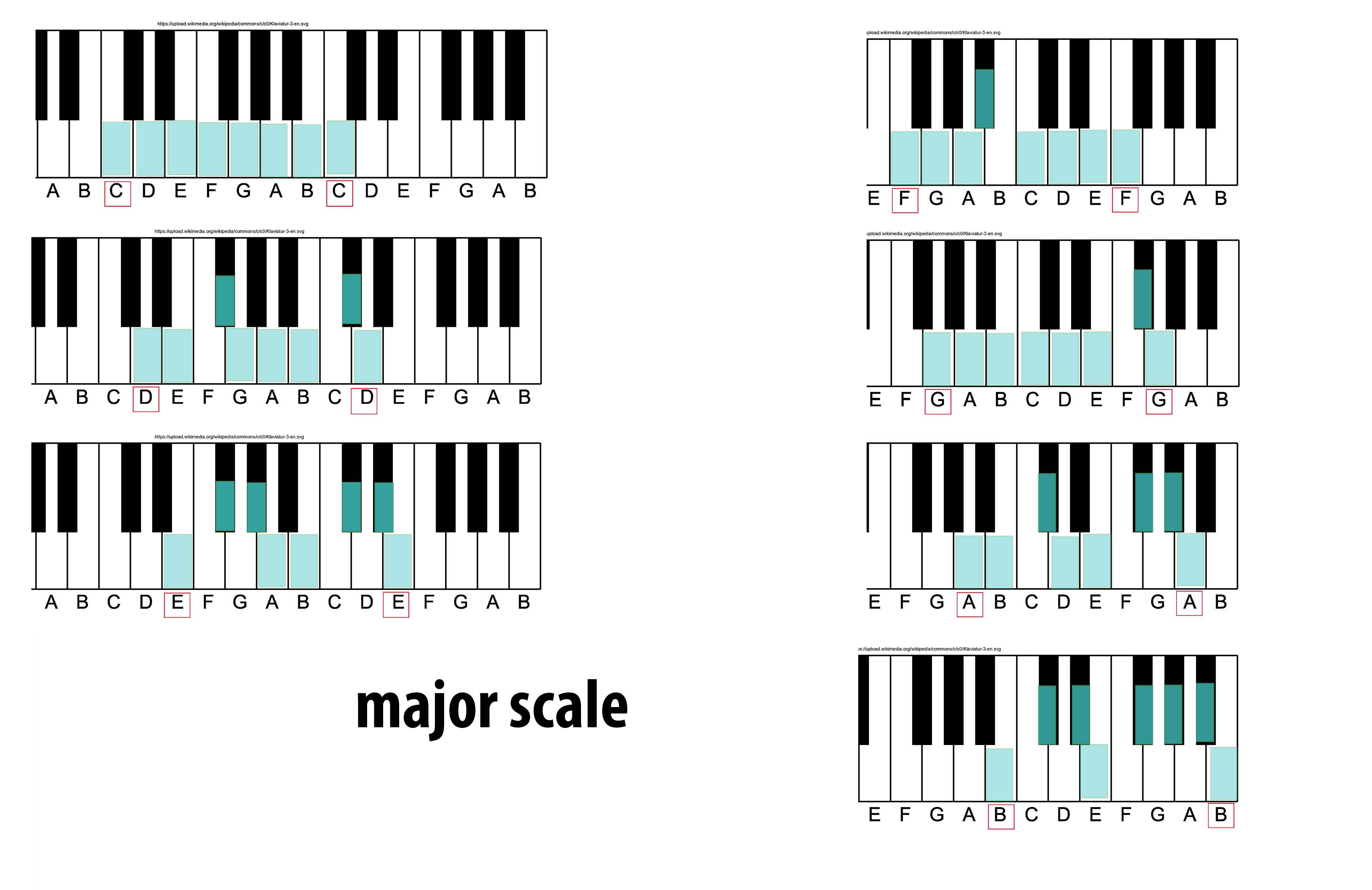
Musical scale made of seven notes
| Field | Value | |||||||
|---|---|---|---|---|---|---|---|---|
| name | Major scale | first_pitch=C | second_pitch=D | third_pitch=E | fourth_pitch=F | fifth_pitch=G | sixth_pitch=A | seventh_pitch=B |
| pitch_classes | 7 | modes=I, II, III, IV, V, VI, VII | ||||||
| Forte number | 7–35 | |||||||
| complement | 5–35 | qualities=Maximal evenness |
The major scale (or Ionian mode) is one of the most commonly used musical scales, especially in Western music. It is one of the diatonic scales. Like many musical scales, it is made up of seven notes: the eighth duplicates the first at double its frequency so that it is called a higher octave of the same note (from Latin "octavus", the eighth).
The simplest major scale to write is C major, the only major scale not requiring sharps or flats:
\override Score.TimeSignature #'stencil = ##f \relative c' { \clef treble \time 7/4 c4 d e f g a b c } }
The major scale has a central importance in Western music, particularly that of the common practice period and in popular music.
In Carnatic music, it is known as Sankarabharanam. In Hindustani classical music, it is known as Bilaval.
Structure

A major scale is a diatonic scale. The sequence of intervals between the notes of a major scale is:
: whole, whole, half, whole, whole, whole, half
where "whole" stands for a whole tone (a red u-shaped curve in the figure), and "half" stands for a semitone (a red angled line in the figure).
Whole steps and half steps are explained mathematically in a related article, Twelfth root of two. Notably, in terms of the sound frequency ratio in equal temperament, a whole tone has twice the sound frequency ratio of a semitone and an octave has twelve half steps (semitones) spaced equally. The sound frequency doubles for corresponding notes from one octave to the next. The ratio is 3/2 = 1.5 for a perfect fifth, for example from C to G on a major scale, and 5/4 = 1.25 for a major third, for example from C to E.
A major scale may be seen as two identical tetrachords separated by a whole tone. Each tetrachord consists of two whole tones followed by a semitone (i.e. whole, whole, half).
The major scale is maximally even.
Scale degrees
\override Score.TimeSignature #'stencil = ##f \relative c' { \clef treble \time 15/4 c4-1 d-2 e-3 f-4 g-5 a-6 b-7 c-8 b-7 a-6 g-5 f-4 e-3 d-2 c-1 } }
The scale degrees are:
- 1st: Tonic
- 2nd: Supertonic
- 3rd: Mediant
- 4th: Subdominant
- 5th: Dominant
- 6th: Submediant
- 7th: Leading tone
- 8th: Tonic
Triad qualities
\override Score.TimeSignature #'stencil = ##f \relative c' { \clef treble \time 7/1 1_\markup I _\markup ii _\markup iii _\markup IV _\markup V _\markup vi _\markup vii° } }
The triads built on each scale degree follow a distinct pattern. The roman numeral analysis is shown in parentheses.
- 1st: Major triad (I)
- 2nd: minor triad (ii)
- 3rd: minor triad (iii)
- 4th: Major triad (IV)
- 5th: Major triad (V)
- 6th: minor triad (vi)
- 7th: diminished triad (viio)
Seventh chord qualities
\override Score.TimeSignature #'stencil = ##f \relative c' { \clef treble \time 7/1 1_\markup IM7 _\markup ii7 _\markup iii7 _\markup IVM7 _\markup V7 _\markup vi7 _\markup viiø7}}
The seventh chords built on each scale degree follow a distinct pattern. The roman numeral analysis is shown in parentheses.
- 1st: Major seventh chord (IM7)
- 2nd: minor seventh chord (ii7)
- 3rd: minor seventh chord (iii7)
- 4th: Major seventh chord (IVM7)
- 5th: Dominant seventh chord (V7)
- 6th: minor seventh chord (vi7)
- 7th: half-diminished seventh chord (viiø7)
Relationship to major keys
If a piece of music (or part of a piece of music) is in a major key, then the notes in the corresponding major scale are considered diatonic notes, while the notes outside the major scale are considered chromatic notes. Moreover, the key signature of the piece of music (or section) will generally reflect the accidentals in the corresponding major scale.
For instance, if a piece of music is in E major, then the seven pitches in the E major scale (E, F, G, A, B, C and D) are considered diatonic pitches, and the other five pitches (E, F/G, A, B, and C/D) are considered chromatic pitches. In this case, the key signature will have three flats (B, E, and A).
The figure below shows all 12 relative major and minor keys, with major keys on the outside and minor keys on the inside arranged around the circle of fifths.
The numbers inside the circle show the number of sharps or flats in the key signature, with the sharp keys going clockwise, and the flat keys counterclockwise from C major (which has no sharps or flats.) The circular arrangement depends on enharmonic relationships in the circle, usually reckoned at six sharps or flats for the major keys of F = G and D = E for minor keys. Seven sharps or flats make major keys (C major or C major) that may be more conveniently spelled with five flats or sharps (as D major or B major).
Broader sense
The term "major scale" is also used in the names of some other scales containing a major triad on the tonic.
The harmonic major scale has a minor sixth. It differs from the harmonic minor scale only by raising the third degree.
\override Score.TimeSignature #'stencil = ##f \relative c' { \clef treble \time 7/4 c4^\markup { Harmonic major scale } d e f g aes b c } }
The melodic major scale is the combined scale that goes as Ionian ascending and as Aeolian dominant descending. It differs from melodic minor scale only by raising the third degree to a major third. \override Score.TimeSignature #'stencil = ##f \relative c' { \clef treble \time 7/4 c4^\markup { Melodic major (ascending and descending) } d e f g a b c bes aes g f e d c } }
The double harmonic major scale has a minor second and a minor sixth. It is the fifth mode of the Hungarian minor scale.
\override Score.TimeSignature #'stencil = ##f \relative c' { \clef treble \time 7/4 c4^\markup { Double harmonic major scale } des e f g aes b c } }
Non-heptatonic scales may also be called "major", such as the major pentatonic scale.
Other notations and usage
(As shown in this template), When expressing the names of major scale keys as abbreviations, the alphabet of the corresponding tonic note name can be written in upper case to indicate only the tonic note name. For example, when expressing the English notation of C major, It can be abbreviated as 'C'. Plus, when expressing the names of minor scale keys as abbreviations, the Roman alphabet of the corresponding tonic note is sometimes lower case to indicate only the tonic note name. For example, when expressing the English notation of A minor, It is abbreviated as 'a'.
References
References
- Benward, Bruce & Saker, Marilyn (2003). ''Music: In Theory and Practice, Vol. I'', p.52. Seventh Edition. {{ISBN. 978-0-07-294262-0.
- "Major scale | music".
- Drabkin, William. (2001). "The New Grove Dictionary of Music and Musicians". Macmillan Publishers.
- Rimsky-Korsakov, Nikolai. (2005). "Practical Manual of Harmony". Carl Fischer, LLC.
- Tymoczko, Dmitri. (2011). "A Geometry of Music". Oxford.
- "Musicstudents.com - Free Sheet Music and Play-Along Soundfiles".
- Stetina, Troy. (1999). "The Ultimate Scale Book". Hal Leonard.
- (Sep 2024). "StackExchange - Questions - Capitalization of key names (C Minor vs. c minor)".
This article was imported from Wikipedia and is available under the Creative Commons Attribution-ShareAlike 4.0 License. Content has been adapted to SurfDoc format. Original contributors can be found on the article history page.
Ask Mako anything about Major scale — get instant answers, deeper analysis, and related topics.
Research with MakoFree with your Surf account
Create a free account to save articles, ask Mako questions, and organize your research.
Sign up freeThis content may have been generated or modified by AI. CloudSurf Software LLC is not responsible for the accuracy, completeness, or reliability of AI-generated content. Always verify important information from primary sources.
Report