From Surf Wiki (app.surf) — the open knowledge base
Maithili language
Indo-Aryan language spoken in India and Nepal
Indo-Aryan language spoken in India and Nepal
| Field | Value | ||||||||
|---|---|---|---|---|---|---|---|---|---|
| name | Maithili | ||||||||
| pronunciation | |||||||||
| image | {{Photomontage | position=center | |||||||
| photo1a | Maithili in Tirhuta script.svg | ||||||||
| size | 200 | ||||||||
| spacing | 2 | ||||||||
| border | 0 | ||||||||
| foot_montage | }} | ||||||||
| imagecaption | Maithili | ||||||||
| states | India and Nepal | ||||||||
| nation | *India | ||||||||
| ** Jharkhand<ref>{{cite news | title | झारखंड : रघुवर सरकार कैबिनेट से मगही, भोजपुरी, मैथिली व अंगिका को द्वितीय भाषा का दर्जा | url=https://www.prabhatkhabar.com/news/ranchi/jharkhand-raghubar-das-cabinet-decision-maithili-bhojpuri-angika-magahi-second-language/1135878.html | url-status=dead | archive-url=https://web.archive.org/web/20180321180643/https://www.prabhatkhabar.com/news/ranchi/jharkhand-raghubar-das-cabinet-decision-maithili-bhojpuri-angika-magahi-second-language/1135878.html | archive-date=21 March 2018 | work=Prabhat Khabar | date=21 March 2018 | access-date=21 March 2018}} (additional) |
| region | Mithila | ||||||||
| ethnicity | Maithil | ||||||||
| speakers | million | ||||||||
| date | 2011–2021 | ||||||||
| ref | |||||||||
| map | Maithili language map.svg | ||||||||
| familycolor | Indo-European | ||||||||
| fam2 | Indo-Iranian | ||||||||
| fam3 | Indo-Aryan | ||||||||
| fam4 | Eastern | ||||||||
| fam5 | Bihari | ||||||||
| ancestor | Magadhi Prakrit | ||||||||
| ancestor2 | Magadhan Apabhraṃśa | ||||||||
| ancestor3 | Abahattha | ||||||||
| dia1 | Thēthi-Maithili | ||||||||
| script | *Devanagari (Official) | ||||||||
| *Newar script<ref>{{citation | url | http://lisindia.ciil.org/Maithili/Maith_script.html | title=Maithili Script and Spelling - LIS-India | publisher= Central Institute of Indian Languages | website=ciil.org/}} (Historical) | ||||
| *Kaithi script<ref>{{citation | url | http://lisindia.ciil.org/Maithili/Maith_script.html | title=Maithili Script and Spelling - LIS-India | publisher= Central Institute of Indian Languages | website=ciil.org/}} (Historical) | ||||
| iso2 | mai | ||||||||
| iso3 | mai | ||||||||
| glotto | mait1250 | ||||||||
| glottorefname | Maithili | ||||||||
| agency | Sahitya Akademi, Maithili Academy, Maithili - Bhojpuri Academy, Delhi, Nepal Academy | ||||||||
| mapcaption | Maithili-speaking region of India and Nepal in red. Language varieties like Angika and Bajjika are not included. | ||||||||
| dia2 | Eastern Maithili | ||||||||
| dia3 | Angika-Maithili (also known as Southern Standard Maithili) | ||||||||
| dia4 | Bajjika-Maithili | ||||||||
| dia5 | Sotipura-Maithili | ||||||||
| dia6 | Possibly Kochila Tharu |
- Jharkhand (additional)
- Nepal
- Koshi Province
- Madhesh Province
- Tirhuta script (Historical and Original Script of Maithili language)
- Newar script (Historical)
- Kaithi script (Historical)
Maithili ( , ) is an Indo-Aryan language spoken in parts of India and Nepal. It is native to the Mithila region, which encompasses parts of the eastern Indian states of Bihar and Jharkhand as well as Nepal's Koshi and Madhesh Provinces. It is one of the 22 scheduled languages of India. It is the second most commonly spoken native Nepalese language constitutionally registered as one of the fourteen provincial official languages of Nepal.
It is spoken by 21.7 million people. Of those, 3.2 million are Nepalese speakers.
Official status
In 2003, Maithili was included in the Eighth Schedule of the Indian Constitution as a recognised Indian language, which allows it to be used in education, government, and other official contexts in India. In March 2018, Maithili received the second official language status in the Indian state of Jharkhand.
Gopal Jee Thakur of the Bharatiya Janata Party is the first Member of Parliament, Lok Sabha who speaks in the Maithili language in the Parliament of India. He is currently the MP for Darbhanga.
The Nepalese Languages Commission has made Maithili an official Nepalese language used for administration in Koshi province and Madhesh Province.
On 26 November 2024, during the occasion of the Constitution Day, Maithili version of the Indian constitution was launched by the President of India Droupadi Murmu.
Distribution
In India, it is mainly spoken in Darbhanga, Madhubani, Tirhut, Kosi, Purnia, Bhagalpur and Munger divisions of Bihar and in Santhal Pargana division of Jharkhand.
In Nepal, Maithili is spoken in Madhesh Province and Koshi Province.
Darbhanga, Madhubani, and Janakpur constitutes important cultural and linguistic centers of Maithili language.
Classification
In 1870s, Beames considered Maithili a dialect of a Bengali. Hoernlé initially treated it as a dialect of Eastern Hindi, but after comparing it with the Gaudian languages, recognised that it shows more similarities with the Bengali language than with Hindi. Grierson recognised it as a distinct language, grouped under 'Bihari' and published its first grammar in 1881.
Chatterji grouped Maithili with the Magadhi Prakrit.
Dialects
Maithili varies greatly in dialects.
- The standard form of Maithili is Sotipura also called Central Maithili which is mainly spoken in Darbhanga, Madhubani, Supaul, Madhepura, Purnia, Samastipur, Araria and Saharsa districts of India and in Nepal it is spoken in Dhanusha, Mahottari, Siraha, Saptari, Sarlahi and Sunsari, and Morang districts.
- Bajjika dialect also known as Western Maithili is mainly spoken in Sitamarhi, Muzaffarpur, Vaishali and Sheohar districts of Bihar, India & Rautahat, and Sarlahi districts of Nepal. It is listed as a distinct language in Nepal and overlaps by 76–86% with Maithili dialects spoken in Dhanusa, Morang, Saptari and Sarlahi Districts.
- Thēthi dialect is spoken mainly in Kosi, Purnia and Munger divisions and Mokama in Bihar and some adjoining districts of Nepal.
- Angika dialect is mainly spoken in and around Bhagalpur, Banka, Munger districts of Bihar and Godda, Sahebganj, Dumka, districts of Jharkhand.
- Kochila Tharu, a language spoken by the Tharu people in the districts of Saptari and Siraha as well as the adjoining areas. Some linguists have described it as a variety of Maithili.
- Several other dialects of Maithili are spoken in India and Nepal, including Dehati, Deshi, Kisan, Bantar, Barmeli, Musar, Tati and Jolaha. All the dialects are intelligible to native Maithili speakers.
Origin and history
The name Maithili is derived from the word Mithila, an ancient kingdom of which King Janaka was the ruler (see Ramayana). Maithili is also one of the names of Sita, the wife of King Rama and daughter of King Janaka.
The beginning of Maithili language and literature can be traced back to the 'Charyapadas', a form of Buddhist mystical verses, composed during the period of 700-1300 AD. These padas were written in Sandhya bhasa by several Siddhas who belonged to Vajrayana Buddhism and were scattered throughout the territory of Assam, Bengal, Bihar and Odisha. Several of the Siddhas were from the Mithila region such as Kanhapa, Sarhapa etc. Scholars such as Rahul Sankrityanan, Subhadra Jha and Jayakant Mishra provided evidence and proved that the language of Charyapada has traces of ancient Maithili or proto Maithili. Apart from Charyapadas, there has been a rich tradition of folk culture, folk songs and which were popular among the common folks of the Mithila region.
After the fall of the Pala Empire, disappearance of Buddhism, establishment of the Karnat dynasty and patronage of Maithili under Harisimhadeva (1226–1324) of Karnāta dynasty dates back to the 14th century (around 1327 AD). Jyotirishwar Thakur (1280–1340) wrote a unique work Varna Ratnakara in Maithili prose. The Varṇa Ratnākara is the earliest known prose text, written by Jyotirishwar Thakur in Mithilakshar script, and is the first prose work not only in Maithili but in any modern Indian language.
In 1324, Ghyasuddin Tughluq, the emperor of Delhi invaded Mithila, defeated Harisimhadeva, entrusted Mithila to his family priest and a great Military Scholar Kameshvar Jha, a Maithil Brahmin of the Oiniwar Dynasty. But the disturbed era did not produce any literature in Maithili until Vidyapati Thakur (1360 to 1450), who was an epoch-making poet under the patronage of Shiva Simha Singh and his queen Lakhimadevi. He produced over 1,000 immortal songs in Maithili on the theme of love of Radha and Krishna and the domestic life of Shiva and Parvati as well as on the subject of suffering of migrant labourers of Morang and their families; besides, he wrote a number of treaties in Sanskrit. His love-songs spread far and wide in no time and enchanted saints, poets and youth. Chaitanya Mahaprabhu saw the divine light of love behind these songs, and soon these songs became themes of Vaishnavism in Bengal. As a young man, Rabindranath Tagore, driven by curiosity and a spirit of experimentation, composed a series of poems in imitation of these songs under the pseudonym Bhanusimha. Vidyapati influenced the religious literature of Assam, Bengal, and Utkala Kingdom. The blending of languages during the later period gave rise to artificial literary dialects like Brajabuli in Bengal, and Brajavali in Assam.
The earliest reference to Maithili or Tirhutiya is in Amaduzzi's preface to Beligatti's Alphabetum Brammhanicum, published in 1771. This contains a list of Indian languages among which is 'Tourutiana.' Colebrooke's essay on the Sanskrit and Prakrit languages, written in 1801, was the first to describe Maithili as a distinct dialect.
Many devotional songs were written by Vaisnava saints, including in the mid-17th century, Vidyapati and Govindadas. Mapati Upadhyaya wrote a drama titled Pārijātaharaṇa in Maithili. Professional troupes, mostly from dalit classes known as Kirtanias, the singers of bhajan or devotional songs, started to perform this drama in public gatherings and the courts of the nobles. Lochana (c. 1575 – c. 1660) wrote Rāgatarangni, a significant treatise on the science of music, describing the rāgas, tālas, and lyrics prevalent in Mithila.
During the Malla dynasty's rule Maithili spread far and wide throughout Nepal from the 16th to the 17th century. During this period, at least seventy Maithili dramas were produced. In the drama Harishchandranrityam by Siddhinarayanadeva (1620–57), some characters speak pure colloquial Maithili, while others speak Bengali language, Sanskrit or Prakrit. One notable Malla King who patronised Maithili was Bhupatindra Malla who composed 26 plays in the Maithili language during his lifetime.
After the demise of Maheshwar Singh, the ruler of Darbhanga Raj, in 1860, the Raj was taken over by the British Raj as regent. The Darbhanga Raj returned to his successor, Maharaj Lakshmishvar Singh, in 1898. The Zamindari Raj had a lackadaisical approach toward Maithili. The use of Maithili language was revived through personal efforts of MM Parameshvar Mishra, Chanda Jha, Munshi Raghunandan Das and others.
Publication of Maithil Hita Sadhana (1905), Mithila Moda (1906), and Mithila Mihir (1908) further encouraged writers. The first social organisation, Maithil Mahasabha, was established in 1910 for the development of Mithila and Maithili. It blocked its membership for people outside of the Maithil Brahmin and Karna Kayastha castes. Maithil Mahasabha campaigned for the official recognition of Maithili as a regional language. Calcutta University recognised Maithili in 1917, and other universities followed suit.
Babu Bhola Lal Das wrote Maithili Grammar (Maithili Vyakaran). He edited a book Gadya Kusumanjali and edited a journal Maithili. In 1965, Maithili was officially accepted by Sahitya Academy, an organisation dedicated to the promotion of Indian literature.
In 2002, Maithili was recognised on the VIII schedule of the Indian Constitution as a major Indian language; Maithili is now one of the twenty-two Scheduled languages of India.
The publishing of Maithili books in Mithilakshar script was started by Acharya Ramlochan Saran.
Demand of Classical Language status for Maithili
On 3 October 2024, the Union Government of India accorded additional five languages of India as the classical status. These additional five languages were Assamese, Bengali, Marathi, Pali and Prakrit. But due to the lack of proposal from the Bihar government, the Maithili language missed out the status of classical language in India. After the Union Cabinet's approval of classical language recognition for the additional five languages in India, the campaign for classical language status for Maithili gained renewed momentum. On 7 October 2024, JD(U) national working president cum Rajya Sabha MP Sanjay Jha raised the demand for classical language status to Maithili, through his social media handle.
Phonology
Main article: Maithili Grammar#Phonology
Vowels
| Front | Central | Back | short | long | short | long | short | long | Close | Mid | Open | Diphthongs |
|---|---|---|---|---|---|---|---|---|---|---|---|---|
| ~ | ||||||||||||
| ~ | ||||||||||||
| əɪ̯ əe̯ | əʊ̯ əo̯ |
- All vowels have nasal counterparts, represented by "~" in IPA and ँ on the vowels, like आँ ãː .
- All vowel sounds are realised as nasal when occurring before or after a nasal consonant.
- Sounds eː and oː are often replaced by diphthongs əɪ̯ and əʊ̯.
- ɔ is replaced by ə in northern dialects and by o in southernmost dialects.
- There are three short vowels that were described by Grierson, but are not counted by modern grammarians. But they could be understood as syllable break: ॳ , इ , उ . Or as syllable break ऺ in Devanagari and "." in IPA.
- ꣾ is a Unicode letter in Devanagari, (IPA ) which is not supported currently on several browsers and operating systems, along with its mātrā (vowel sign).
The following diphthongs are present: : अय़(ꣾ) - अय़सन (ꣾ सन) 'like this' : अव़(ॵ) - चव़मुख(चॏमुख) 'four faced' : अयॆ - अयॆलाः 'came' : अवॊ (अऒ) - अवॊताः 'will come' : आइ - आइ 'today' : आउ - आउ 'come please' : आयॆ (आऎ) - आयॆल 'came' : आवॊ (आऒ) - आवॊब 'will come' : यु (इउ) - घ्यु 'ghee' : यॆ (इऎ) - यॆः 'only this' : यॊ (इऒ) - कह्यो 'any day' : वि (उइ) - द्वि 'two' : वॆ (उऎ) - वॆ: 'only that'
A peculiar type of phonetic change is recently taking place in Maithili by way of epenthesis, i.e. backward transposition of final /i/ and /u/ in all sort of words. Thus:
Standard Colloquial - Common Pronunciation : अछि - अइछ 'is' : रवि - रइब 'Sunday' : मधु - मउध 'honey' : बालु - बाउल 'sand'
Consonants
Maithili has four classes of stops, one class of affricate, which is generally treated as a stop series, related nasals, fricatives and approximant.
| Labial | Dental/ | ||||||||||||||||||||
|---|---|---|---|---|---|---|---|---|---|---|---|---|---|---|---|---|---|---|---|---|---|
| Alveolar | Retroflex | Palatal | Velar | Glottal | Nasal | Plosive/ | |||||||||||||||
| Affricate | voiceless | unaspirated | aspirated | voiced | unaspirated | aspirated | Fricative | voiceless | voiced | Rhotic | unaspirated | aspirated | Lateral | Approximant | |||||||
| () | |||||||||||||||||||||
| (~) | () | () | () | -()* | |||||||||||||||||
| () | () | ||||||||||||||||||||
| ~ | () | ||||||||||||||||||||
| () | |||||||||||||||||||||
| (~) | () |
- Fricative sounds only occur marginally, and are typically pronounced as a dental fricative in most styles of pronunciation. ः is always added after a vowel.
Stops
There are four series of stops- bilabials, coronals, retroflex and velar, along with an affricate series. All of them show the four way contrast like most of the modern Indo-Aryan languages:
- tenuis, as , which is like ⟨p⟩ in English spin
- voiced, as , which is like ⟨b⟩ in English bin
- aspirated, as , which is like ⟨p⟩ in English pin, and
- murmured or aspirated voiced, as .
Apart from the retroflex series, all the rest four series show full phonological contrast in all positions. The retroflex tenius and show full contrast in all positions. and show phonological contrast mainly word-initially. Both are defective phonemes, occurring intervocalically and word finally only if preceded by a nasal consonant. Word finally and postvocalically, surfaces as . Non-initially, both are interchangeable with and respectively.
Fricatives
and are most common fricatives. They show full phonological opposition. , which is present in tatsama words, is replaced by most of the time, when independent, and prevocalic is replaced by , or . occurs before and before . and occurs in Perso-Arabic loanwords, generally replaced by and respectively. and also occurs in Sanskrit words (jihvamuliya and upadhmaniya), which is peculiar to Maithili.
Sonorants
and are present in all phonological positions. occurs only non-initially and is followed by a homorganic stop, which may be deleted if voiced, which leads to the independent presence of . occurs non-initially, followed by a homorganic stop, and is independent only in tatsama words, which is often replaced with . occurs only non-initially and is followed by a homorganic stop always. It is the only nasal which does not occur independently.
- In most styles of pronunciation, the retroflex flap occurs marginally. It is usually pronounced as an alveolar tap sound, and is often interchanged with .
- Approximant sounds and fricative sounds , mainly occur in words that are borrowed from Sanskrit or in words of Perso-Arabic origin. The conjunct ष्प (IAST ṣp) is pronounced in Maithili e.g. पुष्प . The conjunct ह्य (IAST hy) is pronounced as in ग्रऻह्य (grahya) .
There are four non-syllabic vowels in Maithili- i̯, u̯, e̯, o̯ written in Devanagari as य़, व़, य़ॆ, व़ॊ. Most of the times, these are written without nukta.
Morphology
Main article: Maithili grammar
Nouns
An example declension:
| Case name | Singular Inflection | Plural Inflection | Feminine | Masculine | Neuter | Feminine | Masculine | Neuter | Nominative | Accusative | Instrumental | Dative | Ergative | Ablative | Genitive | Locative | Vocative |
|---|---|---|---|---|---|---|---|---|---|---|---|---|---|---|---|---|---|
| -इ ɪ | -आ/अ꣱ aː/ɔ | -इन ɪn | -अन, -अनि | -अन, -अनि | |||||||||||||
| -ई iː | -ई iː | -आ aː | |||||||||||||||
| Postposition used | |||||||||||||||||
| -एँ ẽː | Postposition used | -अन्हि | |||||||||||||||
| Postposition used | |||||||||||||||||
| -इल ɪlə | -अल ələ | No forms | |||||||||||||||
| -इएँ ɪẽː | -एँ ẽː | ||||||||||||||||
| -इतः ɪtəh | -अतः | ||||||||||||||||
| -इक ɪk, इर ɪr | -अक ək, -अर ər | -ईंक ĩːk | -आँँक | ||||||||||||||
| Postposition used | -ए eː | Postposition used | -आँ | ||||||||||||||
| -इ ɪ/ई iː | -आ/अऽ aː/əː | -इन ɪn | -अन, -अनि |
Adjectives
The difference between adjectives and nouns is very minute in Maithili. However, there are marked adjectives there in Maithili.
| Masculine | Feminine | Neuter | Definite | Indefinite |
|---|---|---|---|---|
| -का/क꣱ kaː/kɔ | -कि/कि kɪ/kɪ̆ | का/कऽ kaː/kəː | ||
| -आ/अ꣱ aː/ɔ | -इ/इ ɪ/ɪ̆ | अ/अऽ ᵊ/əː |
Pronouns
Main article: Maithili grammar#Pronouns
Pronouns in Maithili are declined in similar way to nominals, though in most pronouns the genitive case has a different form. The lower forms below are accusative and postpositional. The plurals are formed periphrastically.
| Person | First Grade Honour | Honorofic | High Honorofic | First Person | Second Person | Third Person | Proximate | Non-Proximate |
|---|---|---|---|---|---|---|---|---|
| हम ɦəm | ||||||||
| हमरा ɦəmᵊraː | ||||||||
| तोँह tõːɦᵊ | अहाँ ɐɦãː | अपने ɐpᵊneː | ||||||
| तोँहरा tõːɦᵊraː | ||||||||
| ई iː | ए eː | |||||||
| ऎकरा ekᵊraː | हिनका ɦɪnᵊkaː | |||||||
| ए eː (Neuter) | ||||||||
| ऎहि, ऍ, अथि eɦɪ, æ, ɐtʰɪ (Neuter) | ||||||||
| ऊ, वा uː, ʋaː | ओ oː | |||||||
| ऒकरा okᵊraː | हुनका ɦʊnᵊkaː | |||||||
| ऒ o (Neuter) | ||||||||
| ऒहि, ॵ oɦɪ, əʊ (Neuter) |
Orthography
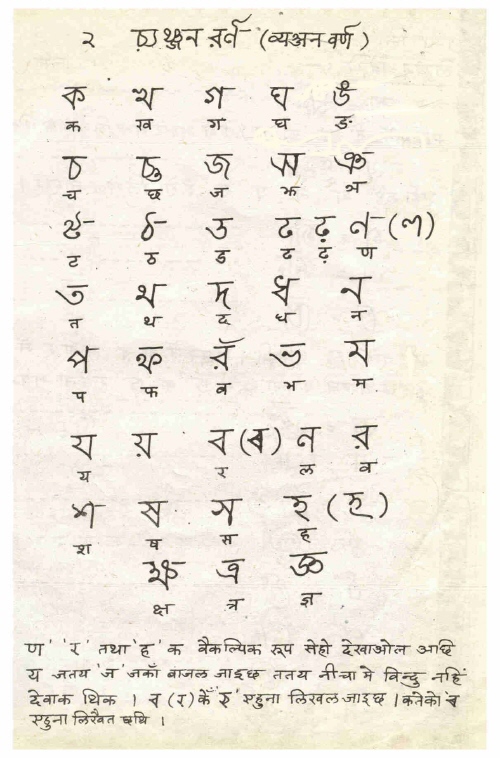
Beginning in the 14th century, the language was written in the Tirhuta script (also known as Mithilakshara or Maithili), which is related to the Bengali-Assamese script. By the early 20th century, this script was largely associated with the Mithila Brahmans, with most others using Kaithi, and Devanagari spreading under the influence of the scholars at Banaras. Throughout the course of the century, Devanagari grew in use eventually replacing the other two, and has since remained the dominant script for Maithili. Tirhuta retained some specific uses (on signage in north Bihar as well as in religious texts, genealogical records and letters), and has seen a resurgence of interest in the 21st century.
The Tirhuta and Kaithi scripts are both currently included in Unicode.
| Devanagari | Tirhuta | Transcription | Image | Text | IAST | IPA | |
|---|---|---|---|---|---|---|---|
| क | [[File:Тірхутська буква КА. Tirhuta letter КA.png | 23px]] | ka | /kə/ | |||
| ख | [[File:Тірхутська буква КHА. Tirhuta letter КHA.png | 19px]] | kha | /kʰə/ | |||
| ग | [[File:Тірхутська буква GА. Tirhuta letter GA.png | 19px]] | ga | /gə/ | |||
| घ | [[File:Тірхутська буква GHА. Tirhuta letter GHA.png | 19px]] | gha | /gʱə/ | |||
| ङ | [[File:Тірхутська буква NGА. Tirhuta letter NGA.png | 16px]] | ṅa | /ŋə/ | |||
| च | [[File:Тірхутська буква СА. Tirhuta letter CA.png | 19px]] | ca | /t͡ɕə/ | |||
| छ | [[File:Тірхутська буква CHА. Tirhuta letter CHA.png | 19px]] | cha | /t͡ɕʰə/ | |||
| ज | [[File:Тірхутська буква JА. Tirhuta letter JA.png | 22px]] | ja | /d͡ʑə/ | |||
| झ | [[File:Тірхутська буква JHА. Tirhuta letter JHA.png | 21px]] | jha | /d͡ʑʱə/ | |||
| ञ | [[File:Тірхутська буква NYА. Tirhuta letter NYA.png | 23px]] | ña | (/ɲə/) /nə/ or /ẽ/ | |||
| ट | [[File:Тірхутська буква TTА. Tirhuta letter TTA.png | 19px]] | ṭa | /ʈə/ | |||
| ठ | [[File:Тірхутська буква TTHА. Tirhuta letter TTHA.png | 19px]] | ṭha | /ʈʰə/ | |||
| ड | [[File:Тірхутська буква DDА. Tirhuta letter DDA.png | 22px]] | ḍa | /ɖə/ | |||
| ढ | [[File:Тірхутська буква DDHА. Tirhuta letter DDHA.png | 20px]] | ḍha | /ɖʱə/ | |||
| ण | [[File:Тірхутська буква NNА. Tirhuta letter NNA.png | 20px]] | ṇa | /ɳə/ or /nə/ | |||
| त | [[File:Тірхутська буква TА. Tirhuta letter TA.png | 21px]] | ta | /t̪ə/ | |||
| थ | [[File:Тірхутська буква THА. Tirhuta letter THA.png | 18px]] | tha | /t̪ʰə/ | |||
| द | [[File:Тірхутська буква DА. Tirhuta letter DA.png | 20px]] | da | /d̪ə/ | |||
| ध | [[File:Тірхутська буква DHА. Tirhuta letter DHA.png | 18px]] | dha | /d̪ʱə/ | |||
| न | [[File:Тірхутська буква NА. Tirhuta letter NA.png | 20px]] | na | /nə/ | |||
| प | [[File:Тірхутська буква PА. Tirhuta letter PA.png | 20px]] | pa | /pə/ | |||
| फ | [[File:Тірхутська буква PHА. Tirhuta letter PHA.png | 22px]] | pha | /pʰə/ | |||
| ब | [[File:Тірхутська буква BА. Tirhuta letter BA.png | 19px]] | ba | /bə/ | |||
| भ | [[File:Тірхутська буква BHА. Tirhuta letter BHA.png | 21px]] | bha | /bʱə/ | |||
| म | [[File:Тірхутська буква MА. Tirhuta letter MA.png | 20px]] | ma | /mə/ | |||
| य | [[File:Тірхутська буква YА. Tirhuta letter YA.png | 20px]] | ya | (/jə/) /d͡ʑə/ or /e̯/ | |||
| र | [[File:Тірхутська буква RА. Tirhuta letter RA.png | 20px]] | ra | /rə/ | |||
| ल | [[File:Тірхутська буква LА. Tirhuta letter LA.png | 20px]] | la | /lə/ | |||
| व | [[File:Тірхутська буква VА. Tirhuta letter VA.png | 20px]] | va | (/ʋə/) or /bə/ /o̯/ | |||
| श | [[File:Тірхутська буква SHА. Tirhuta letter SHA.png | 20px]] | śa | (/ɕə/) /sə/ | |||
| ष | [[File:Тірхутська буква SSА. Tirhuta letter SSA.png | 20px]] | ṣa | /ʂə/ or /sə/ or /kʰə/ | |||
| स | [[File:Тірхутська буква SА. Tirhuta letter SA.png | 21px]] | sa | /sə/ | |||
| ह | [[File:Тірхутська буква HА. Tirhuta letter HA.png | 19px]] | ha | /ɦə/ |
| Devanagari | Tirhuta | Devanagari | Tirhuta | Transcription | Independent | Dependent | Phonetic | Traditional | Image | Text | Phonetic | Traditional | Image | Text | Romanisation | IPA | ||
|---|---|---|---|---|---|---|---|---|---|---|---|---|---|---|---|---|---|---|
| अ | [[File:Тірхутська буква А. Tirhuta letter A.png | 25px]] | a/∅ | /ə/ or /ɐ/ or /ə̆/ or ∅ | ||||||||||||||
| अ꣱/अऽ/अ' | अऽ | ◌꣱/◌ऽ/◌' | ◌'/ ◌ऽ | å | /ɔ/ ~/ʌ/ | |||||||||||||
| ॴ | आ | [[File:Тірхутська буква АА. Tirhuta letter AА.png | 30px]] | ऻ | ा | [[File:Тірхутський залежний знак для голосної АА. Tirhuta vowel sign AA.png | 27px]] | a/ă | /a/ | |||||||||
| आ | ा | ā | /аː/ | |||||||||||||||
| इ | [[File:Тірхутська буква І. Tirhuta letter І.png | 25px]] | ि | [[File:Тірхутський залежний знак для голосної І. Tirhuta vowel sign І.png | 28px]] | і | /ɪ/ | |||||||||||
| not possible in initial position or independent (after vowel) | ि' | ि | ĭ/i | /ɪ̆/ | ||||||||||||||
| ई | [[File:Тірхутська буква ІІ. Tirhuta letter ІІ.png | 25px]] | ी | [[File:Тірхутський залежний знак для голосної ІІ. Tirhuta vowel sign ІІ.png | 25px]] | ī | /іː/ | |||||||||||
| उ | [[File:Тірхутська буква У. Tirhuta letter U.png | 18px]] | ु | [[File:Тірхутський залежний знак для голосної U. Tirhuta vowel sign U.png | 16px]] | u | /ʊ/ | |||||||||||
| not possible in initial position (after vowel) | ु' | ु | ŭ/u | /ʊ̆/ | ||||||||||||||
| ऊ | [[File:Тірхутська буква УУ. Tirhuta letter UU.png | 18px]] | ू | [[File:Тірхутський залежний знак для голосної UU. Tirhuta vowel sign UU.png | 18px]] | ū | /uː/ | |||||||||||
| ऋ | [[File:Тірхутська буква складове Р. Tirhuta letter vocalic R.png | 25px]] | ृ | [[File:Тірхутський залежний знак для голосної складове R. Tirhuta vowel sign vocalic R.png | 17px]] | ṛ | /r̩/ or /rɪ/ | |||||||||||
| ॠ | [[File:Тірхутська буква складове РР. Tirhuta letter vocalic RR.png | 25px]] | ॄ | [[File:Тірхутський залежний знак для голосної складове RR. Tirhuta vowel sign vocalic RR.png | 17px]] | ṝ | /r̩ː/ or /riː/ | |||||||||||
| ऌ | [[File:Тірхутська буква складове Л. Tirhuta letter vocalic L.png | 20px]] | ॢ | [[File:Тірхутський залежний знак для голосної складове L. Tirhuta vowel sign vocalic L.png | 17px]] | ḷ | /l̩/ or /lɪ/ | |||||||||||
| ऍ | ऍ/ऐ | ॅ | ॅ/ै | æ/ê | /æ/ ~/ɛ/ | |||||||||||||
| ऎ | ए | ॆ | े | [[File:Тірхутський залежний знак для голосної коротке E. Tirhuta vowel sign short E.png | 20px]] | e | /е/ | |||||||||||
| ए | [[File:Тірхутська буква Е. Tirhuta letter Е.png | 18px]] | े | [[File:Тірхутський залежний знак для голосної E. Tirhuta vowel sign E.png | 29px]] | ē | /еː/ | |||||||||||
| ꣾ | ऐ | [[File:Тірхутська буква АІ. Tirhuta letter AІ.png | 19px]] | ◌ꣿ | ै | [[File:Тірхутський залежний знак для дифтонга АІ. Tirhuta vowel sign АІ.png | 30px]] | ai | /ai/ | |||||||||
| ऐ | ै | āі | /аːі/ | |||||||||||||||
| ऒ | ओ | ॊ | ो | [[File:Тірхутський залежний знак для голосної коротке О. Tirhuta vowel sign short О.png | 25px]] | о | /о/ | |||||||||||
| ओ | [[File:Тірхутська буква О. Tirhuta letter О.png | 18px]] | ो | [[File:Тірхутський залежний знак для голосної О. Tirhuta vowel sign О.png | 37px]] | ō | /оː/ | |||||||||||
| ॵ | औ | [[File:Тірхутська буква АУ. Tirhuta letter AU.png | 20px]] | ॏ | ौ | [[File:Тірхутський залежний знак для дифтонга АU. Tirhuta vowel sign АU.png | 34px]] | au | /au/ | |||||||||
| औ | ौ | āu | /aːu/ |
Literature
Main article: Maithili literature
Sample Text
The following sample text is Maithili translation of Article 1 of the Universal Declaration of Human Rights:
Maithili in the Tirhuta alphabet Maithili in the Devanagari alphabet Roman transliteration of Maithili Translation
Notes
Citations
References
- (21 March 2018). "झारखंड : रघुवर सरकार कैबिनेट से मगही, भोजपुरी, मैथिली व अंगिका को द्वितीय भाषा का दर्जा". [[Prabhat Khabar]].
- Thakur, R. K.. (2022). "Historical Geography of Early Medieval Mithila: From Videha to Tirhut". International Journal of Humanities, Law and Social Sciences.
- {{e28. mai
- "Maithili Script and Spelling - LIS-India". Central Institute of Indian Languages.
- "Maithili Script and Spelling - LIS-India". Central Institute of Indian Languages.
- {{OED. Maithili
- "Constitutional provisions relating to Eighth Schedule".
- (21 March 2018). "मैथिली लिपि को बढ़ावा देने के लिए विशेषज्ञों की जल्द ही बैठक बुला सकते हैं प्रकाश जावड़ेकर". NDTV News.
- (6 March 2018). "मैथिली को भी मिलेगा दूसरी राजभाषा का दर्जा".
- Sah, K. K.. (2013). "Some perspectives on Maithili". Nepalese Linguistics.
- (2018). "झारखंड : रघुवर कैबिनेट से मगही, भोजपुरी, मैथिली व अंगिका को द्वितीय भाषा का दर्जा". Prabhat Khabar.
- The Hindu Net Desk. (18 November 2019). "Parliament proceedings updates: Chit Funds (Amendment) Bill under consideration in Lok Sabha". The Hindu.
- (2 September 2022). "Darbhanga Lok Sabha Election Results 2019 Live Updates: Bihar Lok Sabha Election (Polls) Results 2019, Winner, Runner-Up".
- Language Commission. (2021). "सरकारी कामकाजको भाषाका आधारहरूको निर्धारण तथा भाषासम्बन्धी सिफारिसहरू (पञ्चवर्षीय प्रतिवेदन- साराांश) २०७८". Government of Nepal.
- (26 November 2024). "President Murmu releases Maithili and Sanskrit versions of Constitution". National Herald.
- (2021). "बिहार में मैथिली भाषा आजकल सुर्खियों में क्यों है? त्रेता युग से अब तक मैथिली का सफर". NBT.
- (6 March 2018). "मैथिली को भी मिलेगा दूसरी राजभाषा का दर्जा". Hindustan.
- (1996). "A Reference Grammar of Maithili". Walter de Gruyter.
- Yadav, R.. (1979). "Maithili Phonetics and Phonology". Doctoral Dissertation, University of Kansas, Lawrence.
- Chatterji, S. K. (1926). The origin and development of the Bengali language. University Press, Calcutta.
- Brass, P. R. (2005). Language, Religion, and Politics in North India. iUniverse, Lincoln, NE.
- Yadav, R.. (1992). "The Use of the Mother Tongue in Primary Education: The Nepalese Context". Contributions to Nepalese Studies.
- Choudhary, P.K.. (2013). "Causes and Effects of Super-stratum Language Influence, with Reference to Maithili". Journal of Indo-European Studies.
- "''Bajjika'' a major dialect of Maithili Language.".
- "Nepal Language census 2021".
- (2018). "Maithili. Ethnologue: Languages of the World". SIL International.
- Ray, K. K. (2009). Reduplication in Thenthi Dialect of Maithili Language. Nepalese Linguistics 24: 285–290.
- (2011). "Census of India".
- "language {{!}} Munger District, Government of Bihar {{!}} India".
- "Languages spoken in Jharkhand, census 2011**".
- (2022). "Languages of the Himalayas". Brill.
- Mishra, J.. (1949). "A History Of Maithili Literature".
- (23 March 2020). "Madhubani Paintings: People's Living Cultural Heritage".
- Chatterji, S. K.. (1940). "Varna Ratnakara Of Jyotirisvara Kavisekharacarya".
- (2001). "Reading Asia : new research in Asian studies". Curzon.
- (1960). "The History and Culture of the Indian People". Bharatiya Vidya Bhavan.
- Morshed, A. K. M.. (2012). "Banglapedia: National Encyclopedia of Bangladesh". [[Asiatic Society of Bangladesh]].
- Masica, Colin P.. (9 September 1993). "The Indo-Aryan Languages". Cambridge University Press.
- Clementi Ded. St. Borgiae, XIV. Praef. J. Chr. Amadutii. (1771). "Alphabetum Brammhanicum Seu Indostanum Universitatis Kasi". Palala Press.
- Mishra, Amar Kant. (23 November 2018). "Ruling Dynasty Of Mithila: Dr.Sir Kameswar Singh". Notion Press.
- Ayyappappanikkar, K.. (1999). "Medieval Indian literature: an anthology". Sahitya Akademi.
- (2012). "Nationalism and Ethnicity in a Hindu Kingdom: The Politics and Culture of". Routledge.
- Rahmat, J.. (2004). "Comparative literature : a case of Shaw and Bharatendu". Sarup & Sons.
- (2011). "Medieval Maithili stagecraft in the Nepalamandala: the Bhaktapur school". Contributions to Nepalese Studies.
- Jha, P. K.. (1996). "Language and Nation : The Case of Maithili and Mithila in the First Half of Twentieth Century". Proceedings of the Indian History Congress.
- Tripathi, S.. (2010). "Moments for masses". The Hindu.
- Vijay Deo Jha, Mithila Research Society. (9 March 2019). "Maithil Mahasabha Ka Sankshipt Itihas ( Brief History Of Maithili Mahasabha) Pandit Chandranath Mishra Amar".
- Mishra, Jayakanta. (1977). "Social Ideals and Patriotism in Maithili Literature (1900-1930)". Indian Literature.
- Chatterjee, Ramananda. (1964). "The Modern Review". Prabasi Press Private, Limited.
- Jha, Ramanath. (1969). "The Problem of Maithili". Indian Literature.
- "Parliament of India".
- Singh, P. & Singh, A. N. (2011). Finding Mithila between India's Centre and Periphery. ''Journal of Indian Law & Society'' 2: 147–181.
- Horst, Kristen Nehemiah. (12 October 2011). "Acharya Ramlochan Saran". Dign Press.
- "Acharya Ramlochan Saran, born on 11 February 1889, in #Muzaffarpur district of Bihar, was a Hindi littérateur, grammarian and publisher.".
- Chakrabarty, Sreeparna. (29 October 2024). "Maithili language missed out on classical status for lack of proposal from Bihar government". The Hindu.
- Thakur, Ashutosh Kumar. (3 January 2025). "Why Maithili deserves classical language status". [[Hindustan Times]].
- Bhelari, Amit. (7 October 2024). "JD(U) demands classical language status for Maithili". The Hindu.
- Yadav, Ramawatar. (1996). "A Reference Grammar of Maithili". Mouton de Gruyter.
- "Maithili".
- Grierson, George Abraham. (1909). "An introduction to the Maithili dialect of the Bihari language as spoken in North Bihar". Asiatic Society of Bengal.
- Yadav, Ramawatar. (1996). "A Reference Grammar of Maithili". Mouton de Gruyter..
- Brass, P. R.. (2005). "Language, Religion and Politics in North India". iUniverse.
- Yadava, Y. P. (2013). Linguistic context and language endangerment in Nepal. [http://himalaya.socanth.cam.ac.uk/collections/journals/nepling/pdf/Nep_Ling_28.pdf Nepalese Linguistics 28] {{webarchive. link. (3 March 2016: 262–274.)
- Pandey, Anshuman. (2009). "Towards an Encoding for the Maithili Script in ISO/IEC 10646".
- Grierson, George Abraham. (1909). "An introduction to the Maithili dialect of the Bihari language as spoken in North Bihar". Asiatic Society of Bengal.
- Yadav, Ramawatar. (1996). "A Reference Grammar of Maithili". Mouton de Gruyter.
- "Universal Declaration of Human Rights: Maithili". Office of the United Nations High Commissioner for Human Rights.
This article was imported from Wikipedia and is available under the Creative Commons Attribution-ShareAlike 4.0 License. Content has been adapted to SurfDoc format. Original contributors can be found on the article history page.
Ask Mako anything about Maithili language — get instant answers, deeper analysis, and related topics.
Research with MakoFree with your Surf account
Create a free account to save articles, ask Mako questions, and organize your research.
Sign up freeThis content may have been generated or modified by AI. CloudSurf Software LLC is not responsible for the accuracy, completeness, or reliability of AI-generated content. Always verify important information from primary sources.
Report