From Surf Wiki (app.surf) — the open knowledge base
Mainichi Shimbun
Japanese newspaper

Japanese newspaper
| Field | Value | |
|---|---|---|
| name | Mainichi Shimbun | |
| logo | [[File:Mainichi Shimbun logo.svg | 250px]] |
| image | [[File:Mainichi-Shimbun-sample-p1.jpg | 240px]] |
| caption | Front page of Mainichi Shimbun from September 8, 2013 | |
| type | Daily newspaper | |
| format | Blanket (54.6 cm x 40.65 cm) | |
| founded | ||
| (as the Tokyo Nichi Nichi Shimbun) | ||
| political_position | Centre to centre-left | |
| Liberalism (Japanese) | ||
| owners | ||
| publisher | Masato Kitamura | |
| language | Japanese | |
| circulation | Morning edition: 1,349,000 (2024) | |
| Evening edition: 430,000 (2024) | ||
| headquarters | Chiyoda, Tokyo | |
| Osaka | ||
| Nagoya | ||
| Kitakyushu | ||
| website |
(as the Tokyo Nichi Nichi Shimbun) Liberalism (Japanese) Evening edition: 430,000 (2024) Osaka Nagoya Kitakyushu
The Mainichi Shimbun is one of the major newspapers in Japan, published by
In addition to the Mainichi Shimbun, which is printed twice a day in several local editions, Mainichi also operates an English-language news website called The Mainichi, and publishes a bilingual news magazine, Mainichi Weekly. It also publishes paperbacks, books and other magazines, including a weekly news magazine, Sunday Mainichi.
It is one of the four national newspapers in Japan; the other three are The Asahi Shimbun, the Yomiuri Shimbun and the Nihon Keizai Shimbun. The Sankei Shimbun and the Chunichi Shimbun are not currently in the position of a national newspaper despite a large circulation for both.
History
The history of the Mainichi Shimbun began with the founding of two papers during the Meiji period. The Tokyo Nichi Nichi Shimbun was founded first, in 1872. The Mainichi claims that it is the oldest existing Japanese daily newspaper with its 136-year history. The Osaka Mainichi Shimbun was founded four years later, in 1876. The two papers merged in 1911, but the two companies continued to print their newspapers independently until 1943, when both editions were placed under a Mainichi Shimbun masthead. In 1966, the Tokyo office was moved from Yurakucho to Takebashi, and in 1992, the Osaka office was moved from Dojima to Nishi-Umeda.
The Mainichi has 3,200 employees working in 364 offices in Japan and 26 bureaus overseas. It is one of Japan's three largest newspapers in terms of circulation and number of employees, and has 79 associated companies, including Tokyo Broadcasting System (TBS), Mainichi Broadcasting System (MBS) and the Sports Nippon Newspaper. (despite affiliation, the Mainichi does not have majority ownership in TBS nor in MBS)
The Mainichi is the only Japanese newspaper company to have won a Pulitzer Prize, for the 1960 photograph "Tokyo Stabbing", which captured the 1960 assassination of Inejirō Asanuma, chairman of the Japan Socialist Party. The Japan Newspapers Association, made up of 180 news organizations, has granted the Mainichi its Grand Prix award on 21 occasions, making the Mainichi the most frequent winner of the prize since its inception in 1957.
Partnership with MSN
On 15 January 2004, Mainichi Shimbun and MSN Japan announced they were to merge their websites. The partnership has been known as , effective since 1 April 2004. On 18 September 2007, Mainichi announced the launch of their new website, mainichi.jp, which would include "heavy use of social bookmarking, RSS and blog parts" and would "pay attention to bloggers". The new website began operations on 1 October 2007, marking the end of MSN-Mainichi Interactive, being replaced by mainichi.jp. The English-language Mainichi Daily News also moved to the new website. MSN-Japan switched to Sankei Shimbun.
Criticism and controversy
Sino-Japanese War coverage controversy
''WaiWai'' controversy and cancellation
The Mainichi Daily News column WaiWai, by Australian journalist Ryann Connell, featured often-sensationalist stories, principally translated from and based on articles appearing in Japanese tabloids. The column carried a disclaimer since September 19, 2002: "WaiWai stories are transcriptions of articles that originally appeared in Japanese language publications. The Mainichi Daily News cannot be held responsible for the content of the original articles, nor does it guarantee their accuracy. Views expressed in the WaiWai column are not necessarily those held by the Mainichi Daily News or the Mainichi Newspapers Co." "Analysis of the investigative team" Mainichi Newspapers, 2008-07-20. Nevertheless, WaiWai content was reported as fact in blogs and reputable foreign media sources.
In April and May 2008, an aggressive anti-WaiWai campaign appeared on internet forums including 2channel. Criticism included "contents are too vulgar" and "the stories could cause Japanese people to be misunderstood abroad." Critics had accused the WaiWai column of propagating a racist stereotype of Japanese women as sexual deviants with its sensationalist stories about incest, bestiality and debauchery. On June 20, a news site J-CAST reported on this issue. The Mainichi editorial board responded by deleting controversial WaiWai articles and limiting archive access, but the column remained in the Sunday Mainichi. Citing continuing criticism, Mainichi's Digital Media Division shut down WaiWai on June 21. Mainichi also announced it would "severely punish the head of the Digital Media Division, which is responsible for overseeing the site, the manager responsible for the column and the editor involved with the stories." On June 25, Mainichi apologized to MDN readers. Some advertisers responded to the campaign by pulling ads from *Mainichi'''s Japanese site.
On June 28, 2008, Mainichi announced punitive measures. Connell, who remained anonymous in the announcement, was suspended for three months ("issuing three months' disciplinary leave"). Other involved personnel were either docked 10%–20% salary or "stripped of their titles" for a period of one or two months.
On July 20, 2008, Mainichi released the results of an in-house investigation. Mainichi announced that it would re-organize the MDN Editorial Department on August 1 with a new chief editor, and re-launch the MDN on September 1 as a more news-oriented site. "Mainichi Daily News to start over again" Mainichi Daily News, 2008-07-20. Mainichi said, "We continued to post articles that contained incorrect information about Japan and indecent sexual content. These articles, many of which were not checked, should not have been dispatched to Japan or the world. We apologize deeply for causing many people trouble and for betraying the public's trust in the Mainichi Shimbun."
Japanese police racial profiling investigation
On April 30, 2024, an article was published by The Mainichi detailing how an investigation found that numerous police departments in Japan had a high rate of incidents involving racial profiling against foreigners. Since 2022, the number of people coming forward with police brutality complaints against Japan's National Police Agency had grown rapidly. One former officer inspector from a west Japan prefecture where local police were ordered by senior officers to target foreigners for questioning, ID checks and searches even claimed to the newspaper that "we were told to target foreigners." According to the former inspector, who used the pseudonym "Taro Yamada" when he spoke to The Mainichi, "Officers around me including my immediate superior often said things like, 'People with Black roots, Southeast Asians and so on study ways to kill people. So use your service revolver if you have to! You have no idea what they're going to do.'" Yamada also stated that officers in Japan "have to be careful patrolling" in an area with many Korean residents "because there's no telling what they'll do."
Yamada further stated that whites were not nearly as frequently targeted by Japanese police officers like people with "darker skin" are, stating that "I think that when police think of a 'foreigner,' they're not picturing someone (of European descent), but a person with darker skin, with Black or Southeast Asian roots and so on. I thought that way. Officers assume (light-skinned people) are tourists or have a Japanese partner. But with people with dark skin, they tend to assume they're visa overstayers."
Offices
_07.jpg)
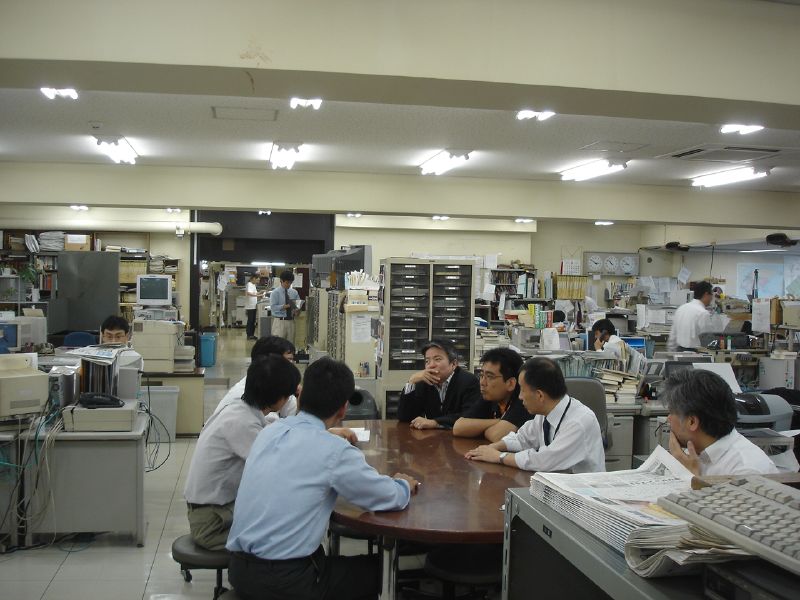
- Tokyo Head Office, corporate headquarters :1-1-1, Hitotsubashi, Chiyoda, Tokyo
- Osaka Head Office :3-4-5, Umeda, Kita-ku, Osaka
- Chubu Head Office :Midland Square, 4-7-1, Meieki, Nakamura-ku, Nagoya
- Seibu Head Office :13-1, Konya-machi, Kokura Kita-ku, Kitakyushu :1314 W. McDermott Dr, Allen (Dallas) Texas USA (Central Region)
Sponsorship
Like other Japanese newspaper companies, Mainichi hosts many cultural events such as art exhibitions and sporting events. Among them, the most famous are the Senbatsu High School baseball tournament held every spring at Koshien Stadium, and the non-professional baseball tournaments held every summer in the Tokyo Dome (formerly held in Korakuen Stadium) and the end of the fall in the Osaka Dome.
The company sponsors a number of prominent annual road running competitions in Japan, including the Lake Biwa Marathon and the Beppu-Ōita Marathon.
Notable contributors
- Yoshiko Miya
Notes
References
Sources
References
- (13 February 2017). "Relief in Japan After Shinzo Abe's Visit With Trump". [[The New York Times]].
- (1 January 2020). "Japan's media accuse Carlos Ghosn of 'cowardly act' after flight to Lebanon". [[The Guardian]].
- (17 April 2021). "Beijing will be watching Suga-Biden talks closely". [[The Japan Times]].
- [[Audit Bureau of Circulations (Japan). ABC]] Japan, average for In August 2024
- [[Sanseidō]]. (10 March 2025)
- "Corporate philosophy of the Mainichi Newspapers Co.".
- "The Mainichi".
- link. Mainichi Newspapers Group Holdings
- link. Sports Nippon Newspapers
- ''Nihon Shinbun Kyokai'', [http://www.pressnet.or.jp/newsb/0402b.html#Anchor-Mainich-18526 Mainichi announces its online news site merger with MSN] {{webarchive. link. (2007-12-17 News Bulletin No. 28 April 2004.)
- [http://mdn.mainichi.jp/national/archive/news/2007/09/18/20070918p2a00m0na033000c.html Reliability and openness key features of new Mainichi site] {{webarchive. link. (2007-10-04 ''Mainichi Daily News'', 2007-09-18.)
- {{in lang. ja [http://www.sankei.co.jp/keizai/it/070918/itt070918000.htm {{lang. ja. 産経Webは「MSN産経ニュース」に変わります, ''Sankei Shinbun'', 2007-09-18.]
- (2008-09-04). "Chronology of problems with English-language site - Mainichi Daily News".
- [https://www.telegraph.co.uk/news/newstopics/howaboutthat/2443937/Japanese-newspaper-admits-infamous-sex-column-was-untrue.html "Japanese newspaper admits infamous sex column was untrue"] {{webarchive. link. (2018-01-21 Telegraph.co.uk, ''[[The Daily Telegraph]]'', 2008-7-22)
- {{in lang. ja [http://sankei.jp.msn.com/economy/it/080624/its0806242018000-n1.htm {{lang. ja. 英語版サイトに「低俗」な日本紹介記事を掲載 毎日新聞がおわび] {{webarchive. link. (2008-06-27 SANSPO.COM, ''The Sankei Shinbun'', 2008-06-24.)
- [http://www.japaninc.com/node/3442 "WaiWai is dead"] {{webarchive. link. (2008-06-27 ''Japan Inc'', 2008-06-22.)
- {{in lang. ja [http://www.j-cast.com/2008/06/20022225.html {{lang. ja. 毎日新聞英語版サイト 「変態ニュース」を世界発信] {{webarchive. link. (2008-06-23 ''J-CAST'', 2008-06-20.)
- [http://mdn.mainichi.jp/20080720/0720_04.html "Chronology of problems with English-language site"] {{webarchive. link. (2008-09-04 ''Mainichi Newspapers'', 2008-07-20.)
- {{in lang. ja [http://www.47news.jp/CN/200806/CN2008062401000847.html {{lang. ja. 毎日が英文サイト一部閉鎖 「低俗」と抗議3百件] {{webarchive. link. (2012-07-21 47NEWS, ''Kyodo News'', 2008-06-24.)
- link. (2008-06-28 ''Japan Probe'', 2008-06-24.)
- {{in lang. ja [http://internet.watch.impress.co.jp/cda/news/2008/06/24/20041.html {{lang. ja. 「低俗過ぎる」毎日新聞英語版のゴシップサイトが批判受け閉鎖] {{webarchive. link. (2008-08-08 INTERNET Watch, ''Impress Watch'', 2008-06-24.)
- [http://mdn.mainichi.jp/20080720/0625.html "Apology to readers for WaiWai column"] {{webarchive. link. (2008-08-28 ''Mainichi Newspapers'', 2008-06-25.)
- {{in lang. ja [http://itpro.nikkeibp.co.jp/article/NEWS/20080708/310423/ {{lang. ja. 「毎日jp」が自社広告だらけに、ネット上に深いつめ跡残る] {{webarchive. link. (2016-11-03 ''Nikkei BP'', 2008-07-08.)
- [http://neojaponisme.com/2008/11/06/the-birth-of-blog-discourse-pt-1/ "The Birth of Blog Discourse"] {{webarchive. link. (2008-11-09 (translation of blog post in ''CNET Japan''), ''Néojaponisme'', November 6, 2008.)
- [http://mdn.mainichi.jp/20080720/0628.html "Punitive measures over Mainichi Daily News WaiWai column announced"] {{webarchive. link. (2008-09-04 ''Mainichi Newspapers'', 2008-06-28.)
- link. (2009-02-24 ''The Age'', 2008-07-05.)
- (April 30, 2024). "'We were told to target foreigners': Ex-officer on systematic racial profiling by Japan police". The Mainichi.
- (1983). "Japan Echo". Japan Echo Incorporated.
This article was imported from Wikipedia and is available under the Creative Commons Attribution-ShareAlike 4.0 License. Content has been adapted to SurfDoc format. Original contributors can be found on the article history page.
Ask Mako anything about Mainichi Shimbun — get instant answers, deeper analysis, and related topics.
Research with MakoFree with your Surf account
Create a free account to save articles, ask Mako questions, and organize your research.
Sign up freeThis content may have been generated or modified by AI. CloudSurf Software LLC is not responsible for the accuracy, completeness, or reliability of AI-generated content. Always verify important information from primary sources.
Report