From Surf Wiki (app.surf) — the open knowledge base
Maillard reaction
Chemical reaction that gives browned food flavor

Chemical reaction that gives browned food flavor
The Maillard reaction ( ; ) is a chemical reaction between amino acids and reducing sugars to create melanoidins, the compounds that give browned food its distinctive flavor. Seared steaks, fried dumplings, cookies and other kinds of biscuits, breads, toasted marshmallows, falafel and many other foods undergo this reaction. It is named after French chemist Louis Camille Maillard, who first described it in 1912 while attempting to reproduce biological protein synthesis.{{cite journal| last =Maillard |first = L. C. |author-link=Louis Camille Maillard| date = 1912
The reactive carbonyl group of the sugar reacts with the nucleophilic amino group of the amino acid and forms a complex mixture of poorly characterized molecules responsible for a range of aromas and flavors. This process is accelerated in an alkaline environment (e.g., lye applied to darken pretzels; see lye roll), as the amino groups () are deprotonated, and hence have an increased nucleophilicity. This reaction is the basis for many of the flavoring industry's recipes. At high temperatures, a probable carcinogen called acrylamide can form. This can be discouraged by heating at a lower temperature, adding asparaginase, or injecting carbon dioxide.
In the cooking process, Maillard reactions can produce hundreds of different flavor compounds depending on the chemical constituents in the food, the temperature, the cooking time, and the presence of air. These compounds, in turn, often break down to form yet more flavor compounds. Flavorists have used the Maillard reaction over the years to make artificial flavors, the majority of patents being related to the production of meat-like flavors. According to chemistry Nobel Prize winner Jean-Marie Lehn "The Maillard is, by far, the most widely practiced chemical reaction in the world".
History
In 1912, Louis Camille Maillard published a paper describing the reaction between amino acids and sugars at elevated temperatures. In 1953, chemist John E. Hodge with the U.S. Department of Agriculture established a mechanism for the Maillard reaction.{{cite journal| last = Hodge |first=J. E.| date = 1953| title = Dehydrated Foods, Chemistry of Browning Reactions in Model Systems| journal = Journal of Agricultural and Food Chemistry| volume = 1 |issue=15| pages=928–43 |doi=10.1021/jf60015a004
Foods and products


The Maillard reaction is responsible for many colors and flavors in foods, such as the browning of various meats when seared or grilled, the browning and umami taste in fried onions and coffee roasting. It contributes to the darkened crust of baked goods, the golden-brown color of French fries and other crisps, browning of malted barley as found in malt whiskey and beer, and the color and taste of dried and condensed milk, dulce de leche, black garlic, chocolate, toasted marshmallows, and roasted peanuts.
6-Acetyl-2,3,4,5-tetrahydropyridine is responsible for the biscuit or cracker-like flavor present in baked goods such as bread, popcorn, and tortilla products. The structurally related compound 2-acetyl-1-pyrroline has a similar smell and also occurs naturally without heating. The compound gives varieties of cooked rice and the herb pandan (Pandanus amaryllifolius) their typical smells. Both compounds have odor thresholds below 0.06 nanograms per liter.
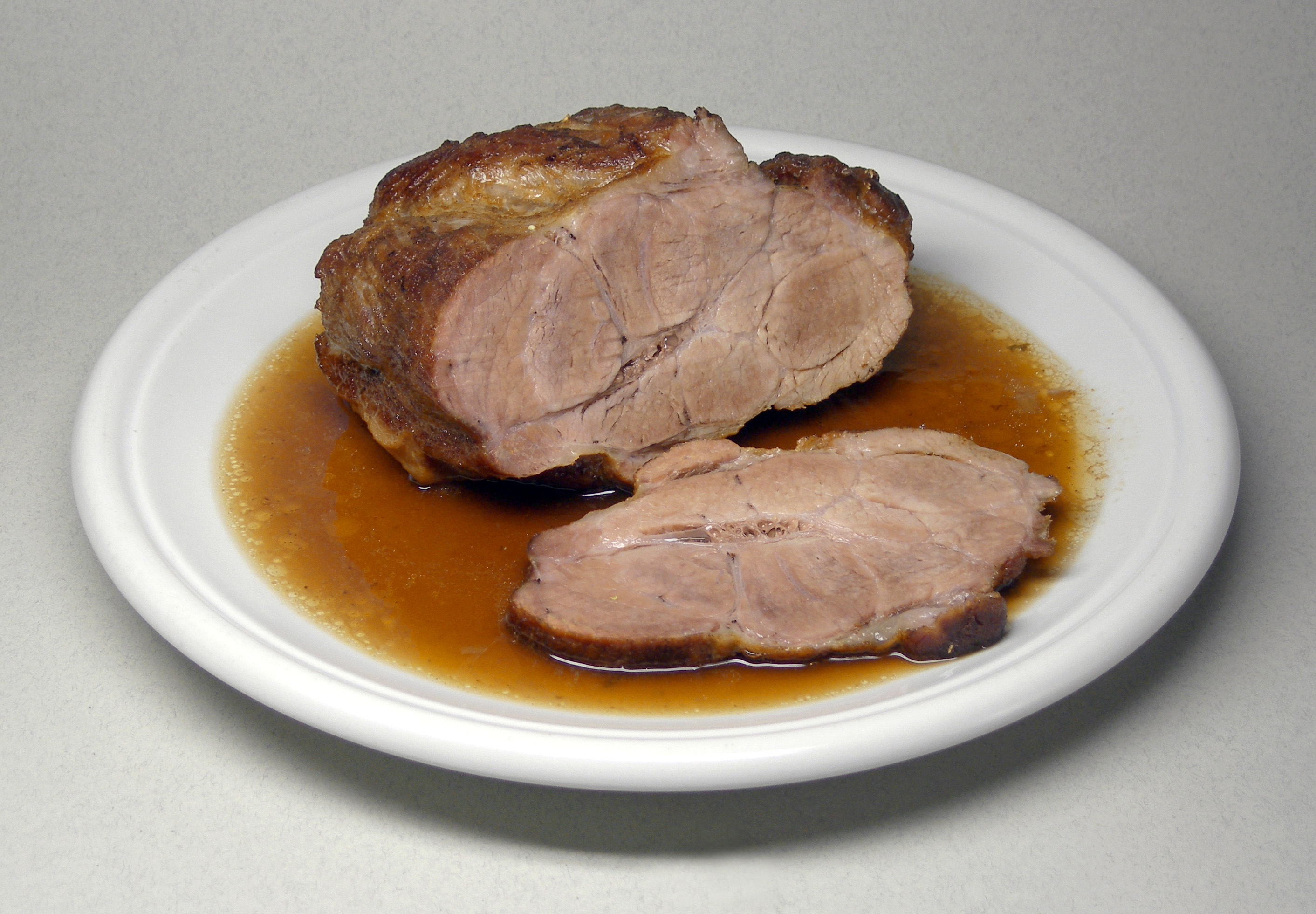

The browning reactions that occur when meat is roasted or seared are complex and occur mostly by Maillard browning with contributions from other chemical reactions, including the breakdown of the tetrapyrrole rings of the muscle protein myoglobin. Maillard reactions also occur in dried fruit and when champagne ages in the bottle.
Caramelization is an entirely different process from Maillard browning, though the results of the two processes are sometimes similar to the naked eye (and taste buds). Caramelization may sometimes cause browning in the same foods in which the Maillard reaction occurs, but the two processes are distinct. They are both promoted by heating, but the Maillard reaction involves amino acids, whereas caramelization is the pyrolysis of certain sugars.
In making silage, excess heat causes the Maillard reaction to occur, which reduces the amount of energy and protein available to the animals that feed on it.
Archaeology and paleontology
In archaeology, the Maillard process occurs when bodies are preserved in peat bogs. The acidic peat environment causes a tanning or browning of skin tones and can turn hair to a red or ginger tone. The chemical mechanism is the same as in the browning of food, but it develops slowly over time due to the acidic action on the bog body. It is typically seen on Iron Age bodies and is the result of the interaction of anaerobic, acidic, and cold (typically 4 °C) sphagnum acid on the polysaccharides.
The Maillard reaction also contributes to the preservation of paleofeces.{{cite web
Chemical mechanism
- The carbonyl group of the sugar reacts with the amino group of the amino acid, producing N-substituted glycosylamine and water
- The unstable glycosylamine undergoes Amadori rearrangement, forming ketosamines
- Several ways are known for the ketosamines to react further:
- Produce two water molecules and reductones
- Diacetyl, pyruvaldehyde, and other short-chain hydrolytic fission products can be formed.
- Produce brown nitrogenous polymers and melanoidins
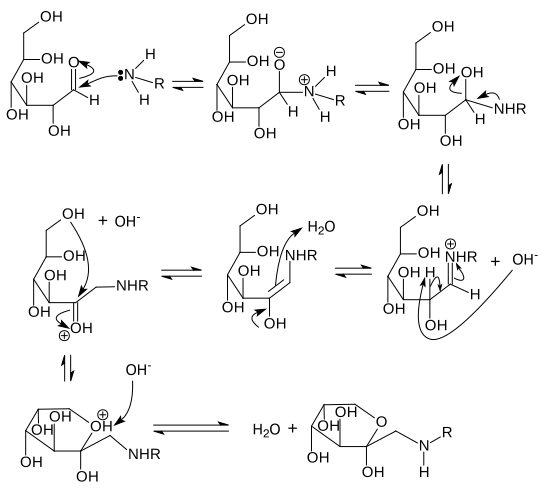
The open-chain Amadori products undergo further dehydration and deamination to produce dicarbonyls. This is a crucial intermediate.
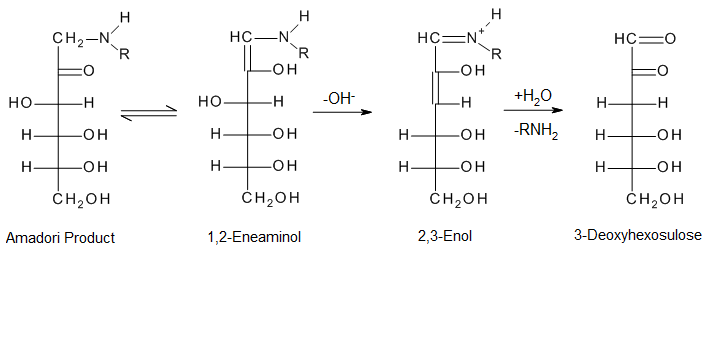
Dicarbonyls react with amines to produce Strecker aldehydes through Strecker degradation.
Acrylamide, a possible human carcinogen, can be generated as a byproduct of Maillard reaction between reducing sugars and amino acids, especially asparagine, both of which are present in most food products.

References
References
- (1986). "Advances in Food Research". Academic Press.
- (2017-09-29). "Why So Many Recipes Call for a 350-Degree Oven".
- (2021-09-06). "Here's How to Sear a Steak to Perfection".
- (2002). "Analysis of acrylamide, a carcinogen formed in heated foodstuffs". J. Agric. Food Chem..
- (2015). "Food Processing and Maillard Reaction Products: Effect on Human Health and Nutrition.". International Journal of Food Science.
- (May 19, 1986). "Maillard Reactions: Nonenzymatic Browning in Food Systems with Special Reference to the Development of Flavor". Academic Press.
- Everts, Sarah. (2025-01-21). "The Maillard Reaction Turns 100".
- Everts, Sarah. (October 1, 2012). "The Maillard Reaction Turns 100". Chemical & Engineering News.
- (2005). "An expeditious, high-yielding construction of the food aroma compounds 6-acetyl-1,2,3,4-tetrahydropyridine and 2-acetyl-1-pyrroline". [[J. Org. Chem.]].
- McGee, Harold. (2004). "On Food and Cooking: The Science and Lore of the Kitchen". Scribner.
- (4 February 2019). "Dried-Fruit Storage: An Analysis of Package Headspace Atmosphere Changes". Foods.
- Krystal, Becky. (2020-01-31). "The Maillard reaction: What it is and why it matters". [[The Washington Post]].
- (2 May 2017). "Grass Silage Stability and Maillard Silage".
- (2007). "The Maillard Reaction".
- (August 2004). "In-Depth Mechanistic Study on the Formation of Acrylamide and Other Vinylogous Compounds by the Maillard Reaction". Journal of Agricultural and Food Chemistry.
- [https://www.cancer.org/cancer/risk-prevention/chemicals/acrylamide.html Acrylamide]. Cancer.org. Retrieved on 2024-12-27.
- (29 May 2014). "Dietary Acrylamide and Human Cancer: A Systematic Review of Literature". Nutrition and Cancer.
- (October 2002). "Acrylamide is formed in the Maillard reaction". Nature.
This article was imported from Wikipedia and is available under the Creative Commons Attribution-ShareAlike 4.0 License. Content has been adapted to SurfDoc format. Original contributors can be found on the article history page.
Ask Mako anything about Maillard reaction — get instant answers, deeper analysis, and related topics.
Research with MakoFree with your Surf account
Create a free account to save articles, ask Mako questions, and organize your research.
Sign up freeThis content may have been generated or modified by AI. CloudSurf Software LLC is not responsible for the accuracy, completeness, or reliability of AI-generated content. Always verify important information from primary sources.
Report