From Surf Wiki (app.surf) — the open knowledge base
Magnapaulia
Extinct genus of dinosaurs

Extinct genus of dinosaurs
~ Morris, 1981
Magnapaulia is a genus of herbivorous lambeosaurine hadrosaurid dinosaurs known from the Late Cretaceous (Campanian) El Gallo Formation of Baja California, northwestern Mexico. It contains a single species, Magnapaulia laticaudus, which was first described in 1981 as a possible species of Lambeosaurus by William J. Morris, and was given its own genus in 2012 by Prieto-Márquez and colleagues.
Discovery and naming
Between 1968 and 1974, a team of the Natural History Museum of Los Angeles County headed by geologist William J. Morris excavated giant lambeosaurine remains from a site near El Rosario in Baja California. Morris named them Lambeosaurus laticaudus in 1981, based on type specimen LACM 17715, a partial skeleton with partial skull. Morris added a question mark to the front of the generic name to indicate its provisional nature: because no complete crest had been found for his species, and without it a definitive assignment could not be made. From what was known of the skull, he considered it to be most like Lambeosaurus. The specific name is derived from the Latin latus, "broad", and cauda, "tail". Morris interpreted this species as water-bound, due to features like its size, its tall and narrow tail (interpreted as a swimming adaptation), and weak hip articulations, as well as a healed broken thigh bone that he thought would have been too much of a handicap for a terrestrial animal to have survived long enough to heal. suggested it could instead be a species of Hypacrosaurus, or questioned its validity.
In 2012 it was named as a separate genus by Albert Prieto-Márquez, Luis Chiappe, and Shantanu Joshi. The generic name is a combination of the Latin magnus, "large", and the first name of Paul G. Haaga Jr., the president of the board of trustees of the Los Angeles County Museum of Natural History. The 2012 study indicated that the remains had been found in a layer of the El Gallo Formation, dating to the late Campanian, about 73.6 to 73 million years old. The study referred numerous other specimens to the species: LACM 17698, 17699, 17700, 17702–17713, 17716 and 17717; LACM 20873-20876; and LACM 20883-20885. These had been found within a distance of three metres to the holotype and consist of partial skeletons, separate bones and skin impressions from several individuals, varying in size. In 2012 a complete redescription of the body parts was given.
Description

Magnapaulia is noted for its great size and the tall profile of its tail, which had elongated chevrons and vertebral spines like those of Hypacrosaurus.
The redescription of 2012 established two autapomorphies, unique derived traits: the presence of chevrons at the tail base that were four times as long as the vertebral centra; and the possession at the tail base vertebrae of front joint processes, prezygapophyses, the inner bases of which formed a bowl-shaped depression that extended upwards into a deep trough on the front surface of the spine.
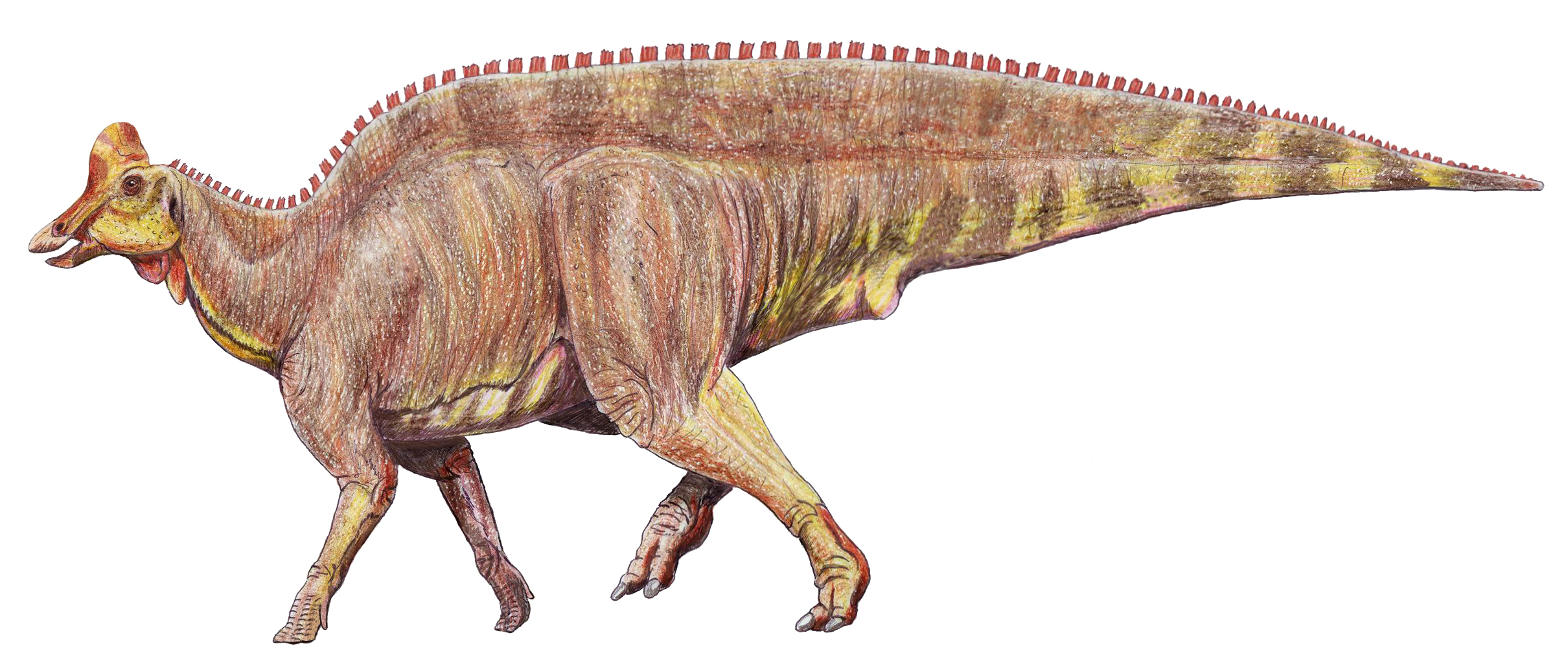
On the vertebral column, from at least the middle of the back to over the middle of the tail, a tall crest of almost continuous height was present formed by spines that were about four times as high as the vertebral centra.
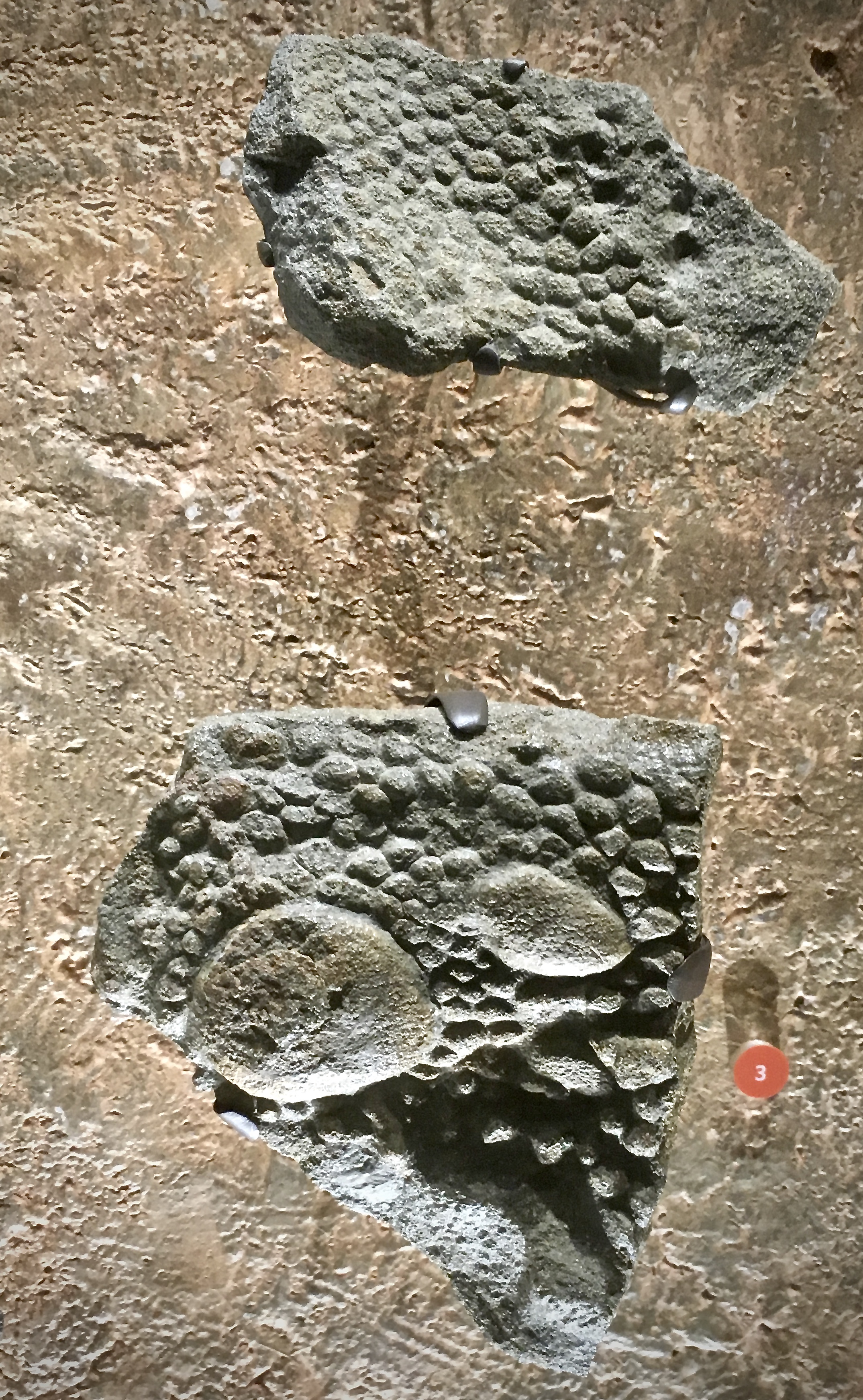
Magnapaulia is among the many hadrosaurids that have preserved skin impressions; the tail of specimen LACM 17712 had large scales up to four centimeters wide that were surrounded by one centimeter-wide hexagonal and rounded scales.
Classification
In 2012 Magnapaulia was assigned to the Lambeosaurinae. The 2012 study contained a cladistic analysis which found it to be closest to Velafrons, also from Mexico, with this sister species forming a separate southern clade, itself the sister group of a clade of more northern Asian and North-American forms, including Lambeosaurus, Corythosaurus, Hypacrosaurus and Olorotitan. The cladogram below follows this analysis.
References
References
- {{interlanguage link. David Fastovsky. de. David E. Fastovsky, Marisol Montellano-Ballesteros, Henry C. Fricke, Jahandar Ramezani, Kaori Tsukui, Gregory P. Wilson, Paul Hall, Rene Hernandez-Rivera & Geraldo Alvarez (2020). [https://pubs.geoscienceworld.org/gsa/geosphere/article/doi/10.1130/GES02207.1/587778/Paleoenvironments-taphonomy-and-stable-isotopic Paleoenvironments, taphonomy, and stable isotopic content of the terrestrial, fossil-vertebrate-bearing sequence of the El Disecado Member, El Gallo Formation, Upper Cretaceous, Baja California, México.] ''Geosphere.'' doi: https://doi.org/10.1130/GES02207.1
- (2012). "The lambeosaurine dinosaur ''Magnapaulia laticaudus'' from the Late Cretaceous of Baja California, Northwestern Mexico". PLOS ONE.
- Morris, William J.. (1981). "A new species of hadrosaurian dinosaur from the Upper Cretaceous of Baja California: ?''Lambeosaurus laticaudus''". Journal of Paleontology.
- Morris, William J.. (1967-03-24). "Baja California: Late Cretaceous Dinosaurs". Science.
- Morris, William J.. (1972). "A Giant Hadrosaurian Dinosaur from Baja California". Journal of Paleontology.
- Morris, William J.. (1973). "A Review of Pacific Coast Hadrosaurs". Journal of Paleontology.
- Morris, William J.. (1981). "A New Species of Hadrosaurian Dinosaur from the Upper Creataceous of Baja California: ?Lambeosaurus laticaudus". Journal of Paleontology.
- Horner, John R.. (2004). "The Dinosauria". University of California Press.
- Evans, David C.. (2007). "Anatomy and relationships of ''Lambeosaurus magnicristatus'', a crested hadrosaurid dinosaur (Ornithischia) from the Dinosaur Park Formation, Alberta". Journal of Vertebrate Paleontology.
- Gates, Terry A.. (2007). "''Velafrons coahuilensis'', a new lambeosaurine hadrosaurid (Dinosauria: Ornithopoda) from the Late Campanian Cerro del Pueblo Formation, Coahuila, Mexico". Journal of Vertebrate Paleontology.
This article was imported from Wikipedia and is available under the Creative Commons Attribution-ShareAlike 4.0 License. Content has been adapted to SurfDoc format. Original contributors can be found on the article history page.
Ask Mako anything about Magnapaulia — get instant answers, deeper analysis, and related topics.
Research with MakoFree with your Surf account
Create a free account to save articles, ask Mako questions, and organize your research.
Sign up freeThis content may have been generated or modified by AI. CloudSurf Software LLC is not responsible for the accuracy, completeness, or reliability of AI-generated content. Always verify important information from primary sources.
Report