From Surf Wiki (app.surf) — the open knowledge base
Madonna (album)
_(cropped).jpg)
| Field | Value |
|---|---|
| name | Madonna |
| type | studio |
| artist | Madonna |
| cover | Madonna, debut album cover.png |
| border | yes |
| alt | Madonna's image with her right hand placed on her right cheek and with the left hand, she holds on to a number of chains wound on her neck. |
| released | |
| recorded | April 1982 – May 1983 |
| studio | Sigma Sound, New York City |
| genre | |
| length | 40:47 |
| label | |
| producer | |
| next_title | Like a Virgin |
| next_year | 1984 |
| misc | {{Extra chronology |
| artist | Madonna |
| type | video |
| title | Madonna |
| year | 1984 |
| next_title | Madonna Live: The Virgin Tour |
| next_year | 1985 |
| name | Madonna |
| type | studio |
| single1 | Everybody |
| single1date | October 6, 1982 |
| single2 | Burning Up" / "Physical Attraction |
| single2date | March 9, 1983 |
| single3 | Holiday |
| single3date | September 7, 1983 |
| single4 | Lucky Star |
| single4date | September 9, 1983 |
| single5 | Borderline |
| single5date | February 15, 1984 |
Madonna is the debut studio album by American singer Madonna, released on July 27, 1983, by Sire Records. In the late 1970s, Madonna had established herself as a singer in downtown New York City; alongside her Michigan boyfriend Stephen Bray, she put together a demo tape with four dance tracks and began pitching it around local nightclubs. She managed to get Mark Kamins, the resident DJ at Danceteria, to play "Everybody"—one of the songs from the tape. The song drew positive reception from the crowd, and Kamins took Madonna to Sire Records, where label president Seymour Stein signed her on for three twelve-inch singles. Following its release on October 6, 1982, "Everybody" found success on the dance scene, and the label approved the recording of an album.
For the album, Madonna worked with Warner Bros. producer Reggie Lucas, who had worked with artists like Roberta Flack and Stephanie Mills. Soon, however, problems between the singer and Lucas arose, as she was not happy with his production outputs. Madonna then invited John "Jellybean" Benitez, her boyfriend at the time, to work and remix the rest of the album. Madonna is mostly a dance-pop post-disco album, and features the newest technology of the time, including the LinnDrum drum machine, Moog bass and Oberheim OB-X synthesizer. Its songs talk mostly about love and partying. Five singles were released from the album: "Everybody" and "Burning Up" were published months before it was completed; neither song made a major impact on the charts. "Holiday" was Madonna's big breakout single, followed by "Lucky Star" and "Borderline".
Upon release, Madonna received generally positive reviews from critics, who highlighted its dance-oriented nature and sound. In the United States, it peaked at number eight on the Billboard 200 and was certified five-times Platinum by the Recording Industry Association of America (RIAA). It reached the Top 10 of the charts in Australia, France, the Netherlands, New Zealand and the United Kingdom, and has sold an estimated 10 million copies worldwide. Between 1983 and 1984, Madonna promoted the album and singles through a series of live appearances in nightclubs and television programs across the United States and Europe. The singles were then performed on the Virgin Tour of 1985, Madonna's first concert tour. In retrospective reviews, Madonna has been referred to as one of the greatest debut albums of all time, and one of the best albums from the 1980s. Critics have also said that it helped to make dance music popular again, and "set the standard" of dance-pop for decades afterwards; its influence can be seen in the work of female artists such as Janet Jackson, Debbie Gibson, Kylie Minogue, and Lady Gaga.
Background
In 1979, Madonna was trying to establish her music career in New York City. She was the drummer of a band called Breakfast Club, which was headed by the Gilroy brothers, Dan and Ed. The following year, after a dispute with Dan, Madonna left the band. She then called her former Michigan boyfriend Stephen Bray, who "readily" agreed to join her on New York.
By 1982, the singer was living with Bray in an unused rehearsal studio. After coming to the realization that "funky dance records were in style on the radio and dance floor", they created a demo tape with four dance tracks, including "Everybody", "Burning Up", and "Ain't No Big Deal", which was described as a "bright Michael Jackson/Donna Summer confection".
Kamins then approached Sire Records president Seymour Stein, who at the time was at Lenox Hill Hospital recovering from a heart surgery. He signed the singer on for three twelve-inch singles with an option for albums; she would get $15,000 for each one, but would also have to pay for all recording costs. Since he had recorded the demo, Bray argued that he should be the producer for the single, but Stein decided to appoint Kamins, "for the sheer interest of seeing where it would go". "Everybody" was released as Madonna's debut single on October 6, 1982. It failed to enter the Billboard Hot 100, peaking at number 7 on the Bubbling Under Hot 100. It was more successful on Billboards Dance Club Songs chart, where it reached the third spot. Music promotor Boby Shaw recalled that, "['Everybody'] made noise enough to give her an album deal".
Development and recording
According to Michael Rosenblatt, he wanted the album to have an "R&B feel", hence he brought in Warner Bros. producer Reggie Lucas, who had worked with artists like Roberta Flack and Stephanie Mills. Rosenblatt also felt Madonna needed to work with someone who "could really help her with her vocals. Mark [Kamins]'s strength was grooves, not working with a girl who's never been in the studio before". Upon meeting her, Lucas wasn't impressed with the singer's "boho-punk style", and thought she didn't seem "particularly avant-garde". "Everybody" was recorded at the Bob Blank's Blank Tape Recording Studios in April 1982, in a span of three days. Barry Eastmond had been hired as the track's arranger, but left the project after getting into an argument with Madonna; she felt his work was "too slick", and lacked the "edge of the club-land grooves she was hankering after". Rosenblatt made the decision to replace Eastmond's keyboard parts, and it was Arthur Baker, an assistant to Kamins, who brought in Fred Zarr to redo all the keyboards.
John "Jellybean" Benitez]] talking about working with Madonna on the album.
The rest of the songs were recorded at the Sigma Sound Studios in New York. Prior to entering the studio, Madonna wrote three more songs for the album: "Lucky Star", "Think of Me" and "I Know It". The lyrics to "Lucky Star" were written on a yellow legal notepad, while the music was created on a Casiotone keyboard with a cassette player Kamins had given Madonna. The latter was the first song where Lucas used a drum machine instead of a drummer; he and Madonna worked on the track while she was staying at artist Jean-Michel Basquiat's apartment.
Another issue arose after Madonna learned Bray had sold "Ain't No Big Deal" to disco act Barracuda, thus rendering it unavailable for her album. Benitez approached Curtis Hudson and Lisa Stevens-Crowder from band Pure Energy, and asked them for a song. Titled "Holiday", the track was written by Hudson and Stevens-Crowder for Pure Energy, but their label Prism Records decided not to record it. "Holiday" had been previously offered to Mary Wilson from The Supremes, and Phyllis Hyman. After she was given the demo, Madonna quickly recorded the vocals. Benitez assembled the musicians, hummed the music to them, and asked the singer to sing in a "very soulful approach". Hudson played guitar, and his brother Raymond the bass; Madonna herself played the cowbell that can be heard towards the beginning, while background vocals were provided by Norma Jean Wright and Tina Baker. Just before it was completed, Benitez and Madonna took the tape to Zarr, so he could add what the singer referred to as "Zarrisms": "creative flourishes" that would provide the "finishing touches", which ended up being a piano solo towards the end.
Composition
AllMusic's Stephen Thomas Erlewine and Sal Cinquemai from Slant Magazine noted that Madonna is a dance-pop post-disco album. Most of its songs talk about "love, heartbreak and hedonism in general". In his book The Complete Guide to the Music of Madonna, author Rikky Rookbsy wrote that the record's overall sound is "dissonant, upbeat synthetic disco". Instrumentation includes Linn drum machine, Moog bass and the OB-X synthesizer, some of the newest technology from the time. Opening track "Lucky Star" begins with the sound of a "shimmering, programmed" glissando, which is followed by "clanging rhythm guitars, synth atmospherics, and [a] chugging bass"; the lyrics are a double-entendre and compare a lover's "heavenly body" with the stars in the sky, while the "simple" refrain refers the nursery rhyme "Star Light, Star Bright". Second track "Borderline" has Madonna singing in a more "refined and expressive" way, and lyrically finds a woman complaining of her lover's chauvinism. Its sound has been compared to Stephanie Mills "Never Knew Love Like This Before" (1980), while the chord progression evokes Bachman-Turner Overdrive's "You Ain't Seen Nothing Yet" (1974); the inversions are similar to the sound of the 1970s, specifically disco, Philadelphia soul, and the work of Elton John.
"Burning Up" is a "yearning" New wave-influenced dance track, with lyrics that conflate sex with ambition. It has a "starker" arrangement brought about by bass, single guitar and drum machine. Also present are tom-tom drum beats ―similar to the ones used on the work of Phil Collins― and electric guitars. The refrain is a repetition of the same three lines of the lyrics, while the bridge consists of a series of double entendres that describe what she is prepared to do for her lover, showcasing that she "has no shame" and is "not like the others". Fourth track "I Know It" features "shades of ’60s girl-group melodrama", with instrumentation from piano and saxophone. Present throughout the song are "Chic-styled" guitar flickers, electronic clapping, and synthesized strings.
Sixth track "Think of Me" opens with high staccato piano notes, which are followed by the sound of drums. The R&B influenced song features a "slinky" saxophone solo towards the middle, and has Madonna warning her lover to pay attention to her or else she'll leave him. Billboards Joe Lynch pointed out that the track "drops the bright, buoyant vibes that characterized the rest of the album and closes it on a dark, sensuous note".
Artwork and release
According to Mary Cross, Lucky Star was the album's original title, but Madonna decided to change it, sensing a singular name could have more "star power". Her mother was also an inspiration, as she's "the only other person I have ever heard of named Madonna [...] It's pretty glamorous". According to Seymour Stein, however, Madonna dismissed this cover as it "just wasn't iconic enough". The official cover was shot by photographer Gary Heery and directed by Carin Goldberg. The image shows Madonna with short-cropped platinum hair, wearing a number of black rubber bangles on her hands and a dog chain around her throat. A journalist from Radio & Records described the singer as looking like "Marilyn Monroe crossed with Jean Harlow" in the image. The singer's navel is also prominent on the inner sleeve; she commented: "The picture inside the dust of sleeve of my first album has me, like, in this Betty Boop pose with my belly button showing. Then when people reviews the album, they kept talking about my cute belly button. [...] I think there are other unobvious places on the body that are sexy and the stomach is kind of innocent." Regarding the album photoshoot, Heery recalled:
[Madonna] arrived at my Broadway studio in New York with a small bag of clothes and jewelry, and no entourage. Then, in front of the camera she was explosive, like a great model, but with her own unique style. She came over the next day to see some prints and the proofs, and there was shot after shot to choose from. We agreed on every choice and whittled it down to the album cover images. I had no idea what I had just been a party to.
Madonna was released by Sire Records on July 27, 1983. The singer dedicated the album to her father, Tony Ciccone, with whom her relationship had not been good up until the release. In an interview with Time magazine, Madonna explained: "My father had never believed that what I was doing here [in New York] was worthwhile, nor did he believe that I was up to any good. [...] It wasn't until my first album came out and my father started hearing my songs on the radio that he stopped asking the questions". In 1985, in the "midst of 'Madonnamania'", the album was re-released in Europe, Australasia and certain Asian and Latin American territories as Madonna: The First Album, with a different cover created by George Holy. This image shows the singer with crucifixes as earrings. Of this, she said that, "[wearing a crucifix] is kind of offbeat and interesting. I mean, everything I do is sort of tongue-in-cheeks. Besides, [they] seem to go with my name". On May 22, 2001, Warner Bros. released a remastered version of the album with its original artwork and additional remixes of "Burning Up" and "Lucky Star". It was reissued on crystal clear vinyl on November 8, 2019.
Promotion
Live performances and tour
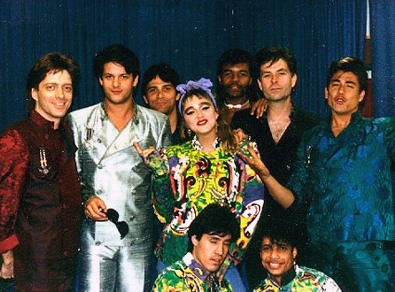
Prior to the album's release, Madonna promoted the singles through a series of live appearances in nightclubs and television programs across the United States and Europe. She performed "Everybody" as part of Haoui Montaug's No Entiendes cabaret revue on December 18, 1982, on the second-floor stage of Danceteria. In 1983, she travelled to the United Kingdom and presented "Everybody" and "Burning Up" at London's Camden Palace, and Manchester's The Haçienda. "Holiday" was sung on June 4 at New York's Studio 54, and on October 13 at the Camden Palace. The following year, Madonna performed "Holiday" on British television program Top of the Pops, where she was joined by her brother Christopher Ciccone; she also sang it on Discoring, The Tube, The Haçienda, and on American television series American Bandstand and Solid Gold. Finally, in February 1984, Madonna appeared on The Dance Show and performed "Borderline", joined by her brother, and dancer Erika Belle.
The album's singles were included on the Virgin Tour, Madonna's first concert tour, which visited cities in the US and Canada from April to June 1985. Warner Bros. wanted to cash in on the success of Madonna's second studio album Like a Virgin (1984) and officially announced the tour on April 6. Despite mixed critical reviews, the tour was a commercial success, with Billboard reporting a gross of $3.3 million ($ million in dollars); all 17,672 tickets for the concert at New York City's Radio City Music Hall sold out in a record-breaking 34 minutes. On top of that, young girls would show up to the concerts dressed in a style similar to Madonna's. One of the Detroit concerts was filmed and released in VHS as Madonna Live: The Virgin Tour.
Singles
_(cropped).jpg)
The twelve-inch single of "Everybody" was released on October 6, 1982. Due to its R&B elements and not including Madonna's image on the cover artwork, marketing for the song gave the impression that she was a black artist. That misconception was cleared with the song's music video, which was directed by Ed Steinberg, and shows the singer and two backup dancers performing at New York's Paradise Garage. "Burning Up" was released in a double-sided single with "Physical Attraction" on March 9, 1983. It was Madonna's first top twenty hit in Australia and, like its predecessor, peaked at number three on the Dance Club Songs chart. The music video was directed by Steve Barron and shows the singer writhing submissively in the middle of the street. Some authors noted that the visual was an introduction to the singer's "sexual politics". The double-sided release of "Lucky Star" and "Holiday" was issued on mid August 1983, and became Madonna's first number one on Billboards Dance Club Songs chart.
On September 7, "Holiday" was released as the album's third stand-alone single. Considered Madonna's breakthrough, it was her first entry on the Hot 100, where it reached the 16th position. "Holiday" also reached the top ten in the United Kingdom, where it remains one of Madonna's best selling singles. In Europe and the United Kingdom, "Lucky Star" was first published on September 9, whereas in the United States it was released almost one year later, on August 8, 1984. "Lucky Star" peaked at number four on the Hot 100, becoming the singer's first top-five hit. The music video was directed by Arthur Pierson, and shows the singer, her brother Christopher, and Belle dancing in front of a white backdrop. Following the clip's release, the singer's fashion and style became a trend among the young generation of the time.
In the United States, "Borderline" was released on February 15, 1984, as the fourth single from the album; in the United Kingdom, it was published as the album's fifth single on June 2, 1984. To "keep the Madonna mania going on", a second European release was done in January 1986. It was commercially successful: in 1984, it gave Madonna her first top-ten hit on the Hot 100. The 1986 release saw success across Europe - it became the singer's second number one in Ireland, and reached the top 3 in the United Kingdom, Belgium and The Netherlands. In the music video, which was directed by Mary Lambert, Madonna portrays the girlfriend of a Hispanic man, to whom she returns after being enticed to pose and model for a white British photographer. Author Douglas Kellner pointed out that with the visual, the singer broke the taboo of interracial relationships.
Video compilation
A VHS video compilation titled Madonna was made available in December 1984; it included the videos for "Borderline", "Burning Up", "Like a Virgin", and a "special extended dance mix" of "Lucky Star". The release topped Billboards Music Videocassette chart from April 13 to November 9, 1985, and was the year's best selling music videocassette. Additionally, Madonna was certified platinum by the Recording Industry Association of America (RIAA) for shipments of 100,000 units, and was recognized as the "Best Selling Video Cassette Merchandised as Music Video" by the National Association of Recording Merchandisers. According to The Saturday Evening Post, the video has sold over one million copies. To promote the release, a party was held on Chicago's Cabaret Metro on February 9, 1985. Dubbed "The Virgin Party", it drew a crowd of around 1,200 people; attendees were encouraged to wear white, and for $5 admission fees, were able to view the Madonna videocassette and the music video of the then-upcoming "Material Girl". The event was organized as a drive to promote music videos, which at that point did not have a large market.
Critical reception
Contemporaneous
Madonna received generally positive reviews. Billboard and Rolling Stone, among other sources, praised Madonna's voice. It was distinctive, made the "pretty standard dance tunes" "a bit special", and included an addicting "distinguishing feature" of a "girlish hiccup".
Jeff Simon, music critic for The Buffalo News, predicted Madonna would overtake Debbie Harry as "blonde dance-rock queen". The production was also considered high-quality and pristine, its dance style "music-and-motion" and "will go down a storm in discos." Explained Simon, "she debuts by veering between the electric and pop sides of electro-pop and sounds good either way." As Marcia Smith opened her review for The Boston Globe, "combine Madonna's vocal energy with a strong, driving beat and you have the makings of this hot dance album." Less positively, Dave Rimmer of magazine Smash Hits argued Madonna's music suffered from attempting to be "Madonna Summer". Richard Defendorf, music critic for Orlando Sentinel, opined: "Madonna not only turns out some decent tunes (...) in a straight and clean musical style, but her lyrics – usually simple disco fare – twist neatly around the perpetually gyrating sounds produced by her backup musicians". However, he criticited her "tiny" voice.
An extremely unfavorable review came from The Arizona Republics Woody Wilson. He derogatorily categorized the genre as "Chipmunks in Discoland", with a "cross between Brenda Lee and Alvin and the Chipmunks" over an extremely simple drum-machine-and-synth arrangement. When it came to the lyrics, no critic thought they detracted from the experience, but were not Shakespeare-level and could have been better.
Retrospective
For Matthew Rettenmund, author of Encyclopedia Madonnica, Madonna is "one of the most auspicious musical debuts of the 80s". While the staff of The Advocate highlighted the singles, they felt album cuts such as "I Know It" and "Think of Me", "sound like B-sides for a Lisa Lisa single". The album's overall tone was reported to be energetic and joyful.
Sal Cinquemani said Madonna sounds "just as fresh today as it did almost two decades ago", while some Madonna book authors thought its production was a "trifle flat" and "now sound rather harsh". Some 2010s reviews found its 1980 synthpop tropes simultaneously futuristic. Erlewine described its instrumental and vocal elements as "utterly irresistible" combined despite being uninteresting on their own. Also of common discussion was the dance style, which was occasionally categorized as either post-disco, "club-disco" and disco-influenced. Phrases such as "infectiously kinetic" and "really fucking fun" also described it. Jim Farber from Entertainment Weekly wrote that Madonna's ability to mix it with "peerless pop" had been established on the album and set her apart from other post-disco acts. Vice called it "bright, sexy, and unfussy pop [that] doesn't falter once". Rikky Rooksby, author of The Complete Guide to the Music of Madonna, dismissed it as "musical candyfloss - okay in the right spot at the right time".
The vibes of New York City were also felt by critics. One stated it "feels wrenched straight out of Danceteria" and another noticed the "grit" of the city's art scene. According to Daryl Easley, in his book Madonna: Blond Ambition, "[Madonna] represents the heat and rush of a city [New York] and marks the last time [she] would be writing directly at street level". Portland Mercurys Mark Lore also perceived a punk rock attitude and a similarity to Devo and Gary Numan in its synthesizers.
Commercial performance
In the United States, the album debuted on the Billboard 200 chart at number 190 on the week of September 3, 1983. It had a slow and steady climb, ultimately peaking at number eight the week ending October 20, 1984, more than a year after its release. Madonna also reached the 20th position of the Top R&B/Hip-Hop Albums chart. Within a year, the album had sold 2.8 million copies in the United States. By the end of 1985, it ranked 25th on the Hot 100. After 17 years since its release, the album was certified five-times Platinum by the Recording Industry Association of America (RIAA) for shipment of five million copies across United States. With the advent of the Nielsen SoundScan era in 1991, the album sold a further 450,000 copies as of August 2010. In Canada, the album debuted at number 87 on the RPM chart on March 10, 1984. After 6 weeks, on April 14, it reached number 57. Madonna re-entered the chart at number 95 on August 4; it reached its peak at 16 during its 29th week on the chart, where it remained for a total of 47 weeks. Madonna was 1984's 50th best selling album in Canada.
In the United Kingdom, the record debuted at the 85th position of the albums chart on the week ending February 11, 1984; almost two months later, on the week April 20, it reached number 37. On July 13, 1985, following the Madonna: The First Album re-release, it re-entered the chart at number 91, eventually peaking at 6 five weeks later. On December, the album was certified Platinum by the British Phonographic Industry (BPI) for shipment of 300,000 copies. Throughout Europe, the record saw a moderate success; in Spain, despite not charting during its inicial release, it was certified Gold by the Productores de Música de España (PROMUSICAE) association for shipments of 50,000 copies. It wasn't until November 2019 that Madonna entered the Spanish album charts at number 35. The album reached the top ten of the charts in the Netherlands and France; it saw less success in Sweden and Italy, where it barely cracked the top 50. Madonna went on to reach the 14th spot on the European Top 100 Albums chart.
In Australia, the album peaked at the 10th spot of the Kent Music Report albums chart, and received a Triple Platinum certification by the Australian Recording Industry Association (ARIA). In New Zealand, it reached the chart's sixth spot and was certified Platinum by the Recording Industry Association of New Zealand (RIANZ). In Japan, Madonna reached the 20th position of the Oricon albums chart. In Hong Kong, it was granted a Platinum certification for shipments of 20,000 copies. Worldwide, Madonna has sold over 10 million copies.
Legacy
Madonna has been referred to as one of the greatest debut albums of all time. It has also been mentioned among the best albums from the 1980s. With the album, the singer has been credited with "revolutionizing" dance music. Stephen Thomas Erlewine wrote: "[Madonna's] eponymous debut isn't simply good, it set the standard for dance-pop for the next 20 years". Erlewine went on to explain that the album was released in an era where disco was seen as an "anathema" to mainstream music; by incorporating "great pop songs with stylish, state-of-the-art beats", Madonna had a "huge role in popularizing dance music as popular music again", Erlewine concluded. Similarly, Spins Michaelangelo Matos said that it "reinvigorated disco for a generation that wanted nothing to do with polyester suits, ending an era and birthing a new one". Rosenblatt himself went on to explain: "There was disco, and there was new wave. And there was nothing in the middle [...] Madonna was really coming out of the new wave clubs in a way that never really happened before. Nobody was doing the disco/new wave thing, [the] R&B thing the way Madonna did". Joey Guerra from the Houston Chronicle elaborated:
The album's blend of pop, disco, New Wave and R&B is ubiquitous today. But at the time, it was a revelation. Disco had been metaphorically demolished a few years earlier. New Wave was still seen by many as eccentric and weird. Madonna, who came up in New York City's club scene, tempered those sounds with her fierce ambition and desire to be a superstar.
Santiago Fouz-Hernández and Freya Jarman-Ivens, authors of Madonna's Drowned Worlds, wrote that the album features "several key trends that have continued to define [Madonna's] success [...] a strong dance-based idiom, catchy hooks [and] highly polished arrangements". They came to the conclusion that the singer introduced a style of "upbeat dance music" that would prove "particularly appealing" to gay audiences. Pastes Matt Michell declared: "Without Madonna, the landscape of dance music suffers greatly. It’s the best debut album of the 1980s by a woman, and, perhaps, one of the greatest debuts of all time". Both Andrew Morton and Martin Charles Strong agreed that the album helped to make Madonna a household name and to establish her base as an artist. According to some publications, the singer and album's influence can be seen in the work of other female artists such as Janet Jackson, Debbie Gibson, Britney Spears, Beyoncé, Lady Gaga and Kylie Minogue. Marcus Wratten from PinkNews added: "Her music is, and always will be, the blueprint for the best pop records of our generation. And it all began with Madonna".
For Entertainment Weekly, Kyle Anderson wrote: "Madonna’s sound, and of course her look, would be heavily copied for years to come, but [the album] heralded something much bigger: the arrival of the pop diva as a singular force who put personality above all else". Mark Lore added that, "[Madonna] had a confidence and sexuality that hadn't been captured since Donna Summer. It was just what pop music needed". Finally, for Rolling Stone, the album's biggest achievement was "introducing the most important female voice in the history of modern music".
Track listing
Notes
- Signifies a remixer/additional producer.
- The original LP version of "Burning Up", running 4:48, was replaced on later reissues of the album.
- The 2001 remastered edition of the album features the full-length version of "Everybody", running 6:02.
Personnel
Adapted from the album's liner notes.
Musicians
- Madonna – lead vocals, background vocals, cowbell (5)
- Dean Gant – synthesizers, acoustic piano, electric piano
- Ed Walsh – synthesizers
- Fred Zarr – synthesizers, electric piano, acoustic piano (5), Fender Rhodes (5), Oberheim OB-X (5), Moog bass (5), drums (5), co-arrangements (5)
- Paul Pesco – guitars (1, 3)
- Reggie Lucas – guitars, LinnDrum programming
- Ira Siegel – guitars
- Russ Powell - guitar
- Curtis Hudson – guitars (5), arrangements (5)
- Anthony Jackson – electric bass (2)
- Raymond Hudson – bass (5)
- Leslie Ming – LinnDrum programming
- Bashiri Johnson – percussion (5)
- Bob Malach – tenor saxophone
- Chrissy Faith – background vocals
- Gwen Guthrie – background vocals
- Brenda White – background vocals
- Norma Jean Wright – background vocals
- Tina B. – background vocals (5)
Production
- Reggie Lucas – producer (1–4, 6, 7)
- John "Jellybean" Benitez – producer (5), remixing (1, 3, 7)
- Mark Kamins – producer (8)
- Jim Dougherty – sound engineer (1–4, 6, 7)
- Jay Mark – remix engineer (1, 3, 7), mixing engineer (5)
- Michael Hutchinson – sound engineer (5)
- Butch Jones – sound engineer (8)
- Ted Jensen – audio mastering at Sterling Sound (New York City)
- Freddy DeMann – management
- Ron Weisner – management
Design
- Carin Goldberg – art direction
- Gary Heery – photography
- George Holy – photography (Madonna: The First Album)
Charts
Weekly charts
| Chart (1983–2019) | Peak | ||||||||||
|---|---|---|---|---|---|---|---|---|---|---|---|
| position | Australia (Kent Music Report) | Croatian International Albums (HDU) | Danish Albums (Hitlisten) | European Top 100 Albums (Eurotipsheet) | French Albums (SNEP) | Finnish Albums (Suomen virallinen lista) | Greek Albums (IFPI Greece) | Japanese LP Albums (Oricon) | South African Albums (RiSA) | UK Dance Albums (Music Week) | |
| 10 | |||||||||||
| 2 | |||||||||||
| 57 | |||||||||||
| 14 | |||||||||||
| 8 | |||||||||||
| 38 | |||||||||||
| 29 | |||||||||||
| 20 | |||||||||||
| 65 | |||||||||||
| 8 |
| Chart (1985) | Position | UK Music Videos (Music Week) | US Top Music Videocassette (Billboard) | US Top 15 Music Videocassettes (Cash Box) |
|---|---|---|---|---|
| 1 | ||||
| 1 | ||||
| 1 |
Monthly charts
| Chart (2018) | Position | Croatian International Albums (HDU) |
|---|---|---|
| 3 |
Year-end charts
| Chart (1984) | Position | Australia (Kent Music Report) | Canada Top Albums/CDs (RPM) | US Top R&B/Hip-Hop Albums (Billboard) | US Top 100 Albums (Cash Box) |
|---|---|---|---|---|---|
| 10 | |||||
| 50 | |||||
| 15 | |||||
| 41 |
| Chart (1985) | Position | Dutch Albums (MegaCharts) | New Zealand Albums (RMNZ) | US Billboard 200 |
|---|---|---|---|---|
| 95 | ||||
| 28 | ||||
| 25 |
| Chart (1986) | Position | Dutch Albums (MegaCharts) | UK Albums (OCC) |
|---|---|---|---|
| 12 | |||
| 55 |
| Chart (1985) | Position | UK Music Videos (Gallup) | US Videocassette Sales (Billboard) |
|---|---|---|---|
| 2 | |||
| 28 |
Certifications and sales
Notes
References
Bibliography
- {{Cite book
- {{Cite book |author-link=Mark Bego |url-access=registration
- {{Cite book
- {{Cite book
- {{Cite book
- {{Cite book
- {{Cite book |author-link=Maury Dean
- {{Cite book |url-access=registration
- {{Cite book
- {{Cite book
- {{Cite book
- {{Cite book
- {{Cite book |author-link=Douglas Kellner
- {{cite book
- {{Cite book
- {{Cite book |author-link=Andrew Morton (writer)
- {{Cite book |author-link=Lucy O'Brien |url-access=registration
- {{Cite book |author-link=Matthew Rettenmund
- {{Cite book |url-access=registration
- {{Cite book |author-link=Martin C. Strong
- {{Cite book |author-link=Seymour Stein
- {{Cite book
- {{Cite book |author-link=J. Randy Taraborrelli
References
- Mitchell, Matt. (July 21, 2023). "The 50 Greatest Synth-Pop Albums of All Time".
- Vice Staff. (14 July 2015). "The 99 Greatest Dance Albums of All Time".
- {{harvnb. Taraborrelli. 2008
- {{harvnb. Cross. 2007
- Gnojewski. 2008
- {{harvnb. Cross. 2007
- Morton. 2001
- (June 14, 2018). "How I met Madonna, by Seymour Stein, the man who signed her". [[Variety (magazine).
- (January 27, 2013). "Everything from 'Everybody'". [[Record Collector]].
- (December 25, 1982). "Bubbling Under the Hot 100".
- (July 27, 2016). "Madonna's 50 greatest songs: 'Borderline' (from ''Madonna'', 1983)".
- (July 26, 2023). "40 years of Madonna: The Queen of Pop's greatest songs, ranked". [[The A.V. Club]].
- (February 1, 2012). "Interview: Curtis Hudson & Lisa Stevens, songwriters of Madonna's "Holiday" (Part 1)". [[Blogcritics]].
- {{harvnb. O'Brien. 2008
- {{harvsp. Morton. 2001
- (July 26, 2023). "Madonna's debut album at 40: Every track ranked". [[Slant Magazine]].
- (November 2, 2013). "[#Vintage909] Madonna — ''Madonna'' (1983)". [[XHUIA-FM.
- (July 27, 2016). "Madonna's 50 greatest songs: 'Lucky Star' (from 'Madonna', 1983)".
- (1983). "Lucky Star by Madonna". AllMusic.
- (July 30, 2013). "Madonna's self-titled debut, 30 years later". [[Metro Weekly]].
- {{harvnb. Rooksby. 2004
- (1983). "Madonna > "Holiday" > Overview". AllMusic.
- (July 27, 2024). "Ranking all the songs on Madonna's iconic debut: 'Holiday', 'Borderline' & beyond".
- (November 13, 2013). "Gay of the day: Martin Burgoyne". [[Xtra Magazine]].
- {{harvnb. Stein. Murphy. 2018
- {{harvnb. Metz. Benson. 1999
- (September 2, 1983). "Futures: Hear today, hear tomorrow". [[Radio & Records]].
- Heery, Gary. "Non Fiction: Photographs & Stories". Gary Heery Office.
- {{harvnb. Clerk. 2002
- {{harvnb. Rettenmund. 1995
- {{harvnb. Andrews. 2022
- (August 18, 2001). "Reviews & Previews: Vital Reissues".
- {{harvnb. Katz. Kott. 2018
- {{harvnb. Morton. 2001
- (October 15, 1983). "From the archive: Madonna at Camden Palace". The Guardian.
- (February 7, 2014). "Official Charts Flashback: 30 years since Madonna's first Top 10 hit". [[Official Charts Company]].
- (July 27, 2022). "Holiday: Behind the song that started Madonna's lifelong chart stay". This Is Dig!.
- {{harvnb. Tassoni. 1993
- (March 9, 2021). "The night Madonna played at The Hacienda". Manchester's Finests.
- (April 19, 2012). "Dick Clark, thank you for introducing Madonna to the world". [[MTV]].
- {{harvnb. Morgan. 2015
- "Madonna.com > Tours > The Virgin Tour". Icon: Official Madonna website.
- {{harvnb. Grayer Moore. 2015
- (September 9, 2015). "Madonna's 9 tours: Ranked". [[The Advocate (LGBT magazine).
- {{harvnb. Taraborrelli. 2008
- (April 6, 1985). "Madonna's first major US tour to begin April 10".
- {{harvnb. Metz. Benson. 1999
- {{harvnb. Claro. 2000
- (June 25, 1985). "Our lady of Rock video". [[Lawrence Journal-World]].
- {{harvnb. Morton. 2001
- (1985). "[[Madonna Live: The Virgin Tour]]". [[Warner Home Video]].
- "Madonna.com > Discography > Everybody". Icon: Official Madonna Website.
- (July 29, 2013). "How Madonna became Madonna: An oral history".
- "Madonna.com > Discography > Burning Up". Icon: Official Madonna website.
- Kent, David. (1993). "[[Kent Music Report". Australian Chart Book, St Ives, N.S.W.
- (June 13, 2013). "Lucky Star: Madonna's debut album, 35 years on". [[The Quietus]].
- "Madonna.com > Discography > Holiday". Icon: Official Madonna Website.
- (July 27, 2023). "Four decades of ''Madonna'': A look back at the Queen of Pop's debut album on the charts".
- (September 3, 1983). "New Singles". [[Music Week]].
- "Madonna.com > Discography > Lucky Star". Icon: Official Madonna Website.
- (August 16, 2017). "Madonna's 40 biggest Billboard hits".
- {{harvnb. Ciccone. Leigh. 2008
- (February 15, 2023). "Borderline: The story behind Madonna's breakout hit song". This is Dig!.
- {{harvsp. Bego. 2000
- (February 1, 1986). "Highlights". [[Music & Media]].
- {{harvnb. Dean. 2003
- {{harvnb. Fouz-Hernández. Jarman-Ivens. 2004
- {{harvnb. Kellner. 1995
- (December 8, 1984). "A Vision of Madonna".
- (November 23, 1985). "Music Videocassette Chart Review".
- (December 28, 1985). "Top Music Videocassettes".
- (March 22, 1986). "Bruce tops NARM best-seller awards".
- (July 31, 2023). "By the numbers: Madonna debuted 40 years ago". [[The Saturday Evening Post]].
- (March 23, 1985). "Chicago nightclub launches music cross-promotion".
- "Consumer Guide Album - Madonna: ''Madonna'' [Sire, 1983]". [[Christgau's Record Guide: The '80s]].
- (September 21, 1983). "Madonna, ''Madonna'' (Sire 23867-1)". [[Orlando Sentinel]].
- Rimmer, Dave. (September 29 – October 12, 1983). "Madonna: Madonna (Sire)".
- Lindores, Mark. (February 26, 2015). "Classic Album: Madonna – ''Madonna''". [[Classic Pop (magazine).
- Mitchell, John. (August 16, 2011). "Happy Birthday, Madonna!". [[MTV News]].
- Jacobs, Matthew. (July 27, 2013). "Madonna's Most Controversial Moments: A Look Back At The Singer's 30-Year Legacy". [[HuffPost]].
- Donovan, Mike. (November 4, 1983). "Music and motion of Madonna". [[The London Gazette.
- (August 27, 1983). "Top Album Picks".
- (September 19, 1983). "Home > Music > Album Reviews > ''Madonna''".
- Simon, Jeff. (August 26, 1983). "Pop". [[The Buffalo News]].
- Smith, Marcia. (April 12, 1984). "Madonna ''Madonna'' Sire". [[The Boston Globe]].
- Wilson, Woody. (December 21, 1983). "Madonna, Madonna (Sire Records 238671)". [[The Arizona Republic]].
- "Madonna, ''Madonnna''". [[Blender (magazine).
- (1999). "MusicHound Rock: The Essential Album Guide". Visible Ink Press.
- "Madonna: Album Guide".
- Sheffield, Rob. (1995). "Spin Alternative Record Guide". [[Vintage Books]].
- Hull, Tom. (2022). "Grade List: Madonna". Official Tom Hull website.
- Larkin, Colin. (2000). "The Virgin Encyclopedia of Nineties Music". [[Virgin Books]].
- (April 23, 2020). "Virgins, prayers and lots of sex: All 14 Madonna albums, ranked from worst to best". [[Junkee]].
- (January 23, 2015). "Madonna's 13 studio albums ranked". [[The Advocate (LGBT magazine).
- (August 30, 2013). "30 years of Madonna: How the Queen of Pop used controversy, MTV and a talent for reinvention to craft one of the most successful careers in music history (with slideshow)". [[The Plain Dealer]].
- (March 9, 2015). "Madonna's albums ranked from worst to best".
- (September 9, 2001). "Review: Madonna, ''Madonna (Remaster)''". [[Slant Magazine]].
- {{harvnb. Easlea. 2012
- (August 16, 2017). "Madonna - ''Madonna''". [[Pitchfork (website).
- "Madonna > ''Madonna'' > Overview". [[AllMusic]].
- (July 27, 2001). "The girl material".
- (June 17, 2019). "We ranked every single Madonna album from worst to best". [[Gay Times]].
- {{harvnb. Rooksby. 2004
- (October 12, 2023). "Don't go for second best, baby: All Madonna's albums, ranked". [[Evening Standard]].
- {{harvnb. Easlea. 2012
- (October 14, 2015). "Madonna's monumental first album". [[Portland Mercury]].
- (July 27, 2013). "''Madonna'' Turns 30: A look back at the Queen of Pop's debut album".
- {{harvnb. Metz. Benson. 1999
- (December 28, 1985). "1985: The year in music & video - Top Pop Albums / Top Videocassette Sales".
- (August 11, 2010). "Week Ending Aug. 8, 2008: Taylor Swift Returns". [[Yahoo! Music]].
- (March 10, 1984). "Top Albums/CDs - Volume 40, No. 1 Mar 10, 1984". [[Library and Archives Canada]].
- (April 14, 1984). "Top Albums/CDs - Volume 40, No. 6, April 14 1984". Library and Archives Canada.
- (August 4, 1984). "Top Albums/CDs - Volume 40, No. 22, August 04 1984". Library and Archives Canada.
- (November 17, 1984). "Top Albums/CDs - Volume 41, No. 11, November 17 1984". Library and Archives Canada.
- (March 30, 1985). "Top Albums/CDs - Volume 42, No. 3, March 30 1985". Library and Archives Canada.
- "Official Albums Chart Top 100: 05 February 1984 - 11 February 1984". [[Official Charts Company]].
- "Official Albums Chart Top 100: 15 April 1984 - 21 April 1984". Official Charts Company.
- "Official Albums Chart Top 100: 07 July 1985 - 13 July 1985". Official Charts Company.
- Salaverri, Fernando. (September 2005). "Sólo éxitos: año a año, 1959–2002". Fundación Autor-SGAE.
- (October 25, 1985). "European Top 100 Albums". [[Eurotipsheet]].
- Scapolo, Dean. (2007). "The Complete New Zealand Music Charts 1966–2006". Maurienne House.
- Okamoto, Satoshi. (2006). "Oricon Album Chart Book: Complete Edition 1970–2005". [[Oricon]] Entertainment.
- (October 10, 2007). "Madonna remaking the brand". [[E!.
- (September 24, 2019). "Madonna's first four albums to be reissued on stunning crystal clear vinyl". [[NME]].
- (March 22, 2013). "100 best debut albums of all time: 16. ''Madonna''".
- (November 6, 2023). "The 100 greatest debut albums of all time". [[Paste (magazine).
- (March 19, 2021). "Best debut albums: 20 must-hear early works of genius". This is Dig!.
- (December 19, 2021). "Top 40 80s debut albums". [[Classic Pop (magazine).
- (March 5, 2012). "Best albums of the 1980s". Slant Magazine.
- (March 16, 2020). "The 10 Best Albums of 1983". Slant Magazine.
- (December 2005). "The definitive guide to classic Disco". [[Spin (magazine).
- (July 14, 2015). "The 99 greatest dance albums of all time". [[Vice (magazine).
- {{harvnb. Fouz-Hernández. Jarman-Ivens. 2004
- {{harvnb. Strong. 2004
- (November 16, 1989). "100 Best albums of the eighties: Madonna, ''Madonna''".
- (July 27, 2023). "Back to the future: Madonna's debut album, released 40 years ago today, is still pop perfection". [[Houston Chronicle]].
- (July 27, 2023). "40 years of Madonna: Ranking every track on the Queen of Pop's iconic debut album". [[PinkNews]].
- (July 26, 2013). "30 Year ago, the world met Madonna".
- (1983). "Madonna". [[Sire Records]].
- (2001). "Madonna (Remastered Edition)". Sire Records. Warner Bros..
- (May 2, 2018). "Lista prodaje 16. tjedan 2018. (16.04.2018. - 22.04.2018.)". [[Top of the Shops.
- (September 4, 2006). "13 Madonna-album på top 100 efter koncert". [[Gaffa (magazine).
- "Tous les Album Classé – select 'Madonna'". Infodisc.
- (2021). "Sisältää hitin: 1 January 1960 – 30.6.2021". [[:fi:Musiikkiarkisto.
- "Εβδομάδα: 16/2018". [[IFPI Greece]].
- (May 2, 2002). "Music Divas & Rock Bands Top South African Certifications". Music Industry News Network.
- (February 8, 1984). "Diisco & Dance! Top Albums". [[Music Week]].
- (October 5, 1985). "Music on Video". Music Week.
- (July 13, 1985). "Top 15 Music Videos". [[Cashbox (magazine).
- (December 6, 2019). "Top lista vinila - Strana - 11/2019". HDU.
- (November 9, 1985). "Australia's Top 10 Albums of 1984".
- (January 5, 1985). "Top 100 Albums of 1984". Library and Archives Canada.
- (December 22, 1984). "Top Black Albums".
- (December 29, 1984). "The Cash Box Year-End Charts: 1984". Cash Box.
- "Jaaroverzichten - Album 1985". Dutch Top 40.
- "End of Year charts: Albums 1985". NZ Music Charts.
- "Jaaroverzichten: Alben 1986". Dutch Top 40.
- (January 24, 1987). "Top 100 Albums: January to December 1986". Music Week.
- (January 11, 1986). "Year-end Music Video". [[Record Mirror]].
- (1992). "LA NUEVA MADONNA". [[Editorial Atlántida]].
- (September 15, 1985). "How Madonna straddles innocence and decadence". [[The Canberra Times]].
- Garcia, Sérgio. (October 31, 1993). "No banco com Madonna". [[Jornal do Brasil]].
- (February 16, 1985). "Geffen's Vision Quest features Madonna cuts".
- "Certification Definitions". [[Music Canada]].
- (August 13, 2001). "אלבומים ומכירות בארץ".
- (December 26, 1987). "Gold & Platinum Awards 1987".
- Ferraris, Gabriele. (June 9, 1991). "Curva in discesa". [[La Stampa]].


This article was imported from Wikipedia and is available under the Creative Commons Attribution-ShareAlike 4.0 License. Content has been adapted to SurfDoc format. Original contributors can be found on the article history page.
Ask Mako anything about Madonna (album) — get instant answers, deeper analysis, and related topics.
Research with MakoFree with your Surf account
Create a free account to save articles, ask Mako questions, and organize your research.
Sign up freeThis content may have been generated or modified by AI. CloudSurf Software LLC is not responsible for the accuracy, completeness, or reliability of AI-generated content. Always verify important information from primary sources.
Report