From Surf Wiki (app.surf) — the open knowledge base
Madison Avenue
North–south avenue in Manhattan, New York
North–south avenue in Manhattan, New York
| Field | Value |
|---|---|
| name | Madison Avenue |
| image | Madison Ave NYC looking nor.jpg |
| caption | Looking north from 40th Street seen in 2005 |
| postal_code | 10010, 10016, 10017, 10022, 10065, 10021, 10075, 10028, 10128, 10029, 10035, 10037 |
| namesake | Madison Square, named after James Madison |
| length_mi | 6.0 |
| length_ref | |
| location | Manhattan, New York City |
| owner | City of New York |
| maint | New York City Department of Transportation |
| direction_a | South |
| terminus_a | 23rd Street in Flatiron |
| junction | in East Harlem |
| direction_b | North |
| terminus_b | in Harlem |
| commissioning_date | 1836 |
| inauguration_date | |
| east | Park Avenue |
| west | Fifth Avenue |
Madison Avenue is a north–south avenue in the borough of Manhattan in New York City, New York, that carries northbound one-way traffic. It runs from Madison Square (at 23rd Street) to meet the southbound Harlem River Drive at 142nd Street, passing through Midtown, the Upper East Side (including Carnegie Hill), East Harlem, and Harlem. It is named after and arises from Madison Square, which is itself named after James Madison, the fourth president of the United States.
Madison Avenue was not part of the original Manhattan street grid established in the Commissioners' Plan of 1811, and was carved between Park Avenue (formerly Fourth) and Fifth Avenue in 1836, due to the effort of lawyer and real estate developer Samuel B. Ruggles, who had previously purchased and developed New York's Gramercy Park in 1831, and convinced the authorities to create Lexington Avenue and Irving Place between Fourth Avenue (now Park Avenue South) and Third Avenue in order to service it.
The street's name has been metonymous with the American advertising industry since the 1920s. Thus, the term "Madison Avenue" refers specifically to the agencies and methodology of advertising. "Madison Avenue techniques" refers, according to William Safire, to the "gimmicky, slick use of the communications media to play on emotions."
Route
Madison Avenue carries one-way traffic uptown (northbound) from East 23rd Street to East 135th Street, with the changeover from two-way traffic taking place on January 14, 1966, at which time Fifth Avenue was changed to one-way downtown (southbound). This changeover was accelerated by seven weeks due to the transit strike which began on January 1. Between East 135th Street and East 142nd Street, Madison Avenue carries southbound traffic only and runs parallel to the Harlem River Drive.
Landmarks
There are numerous structures designated as New York City Landmarks (NYCL), National Historic Landmarks (NHL), and National Register of Historic Places (NRHP) on Madison Avenue. From south to north (in increasing address order), they include:
- Metropolitan Life Insurance Company Tower (NYCL, NHL, NRHP)
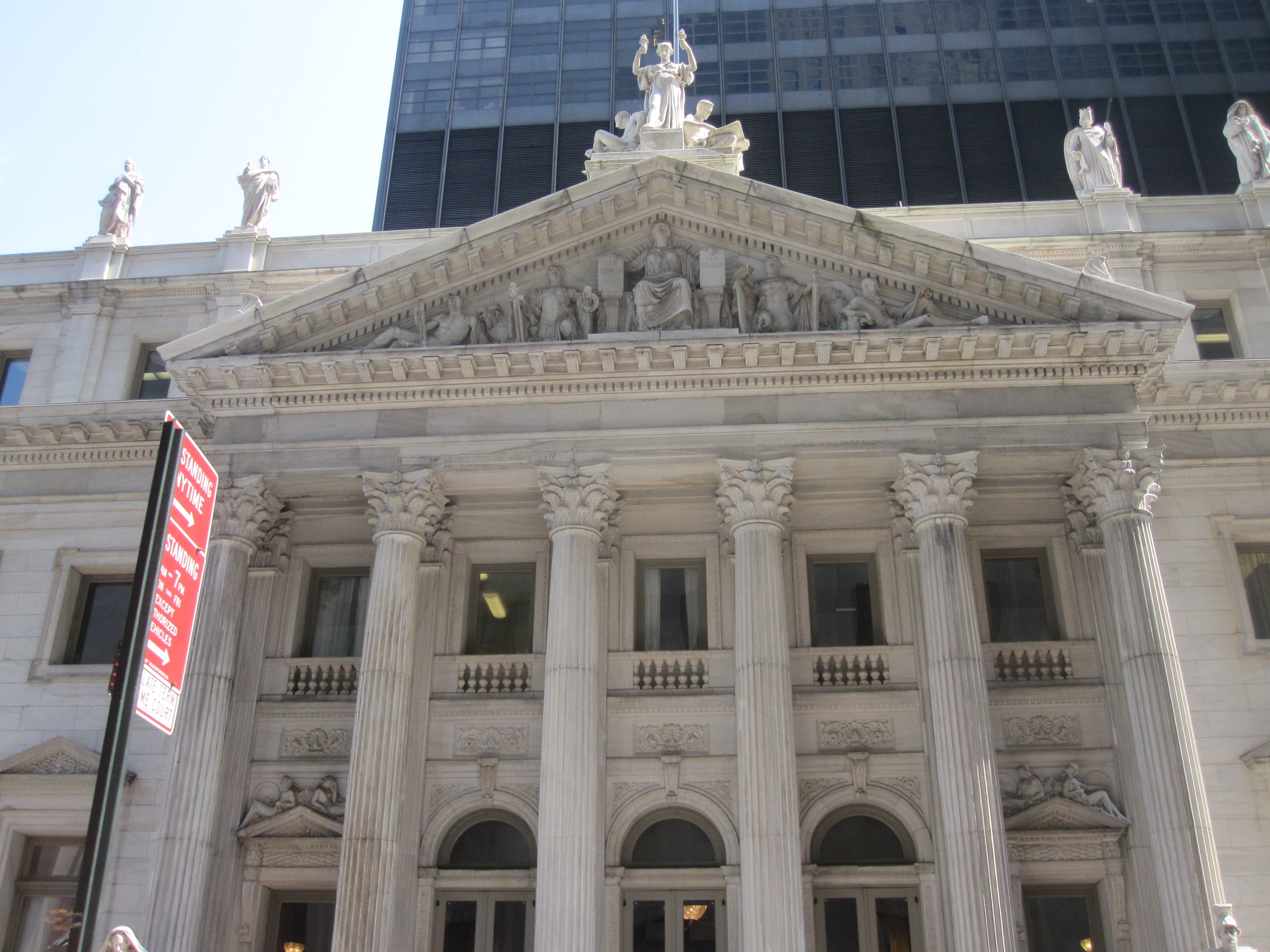
- Appellate Division Courthouse of New York State (NYCL, NRHP)
- New York Life Building (NYCL, NHL, NRHP)
- Hotel Seville (NYCL)
- Emmet Building (NYCL)
- Colony Club (NYCL, NRHP)
- Madison Belmont Building (NYCL)
- B. Altman and Company Building (NYCL)
- Church of the Incarnation, Episcopal (NYCL, NRHP)
- Morgan Library & Museum (NYCL, NHL, NRHP)
- Joseph Raphael De Lamar House (NYCL, NRHP)
- 275 Madison Avenue (NYCL)
- 400 Madison Avenue (NYCL)
- St. Patrick's Cathedral (NYCL, NHL, NRHP)
- Villard Houses (NYCL, NRHP)
- Look Building (NYCL, NRHP)
- 550 Madison Avenue (NYCL)
- Fuller Building (NYCL)
- 45 East 66th Street (NYCL, NRHP)
- Gertrude Rhinelander Waldo House (NYCL, NRHP)
- 1261 Madison Avenue (NYCL, NRHP)
- 1321 Madison Avenue (NYCL)
- Squadron A Armory (NYCL, NRHP)
- All Saints Church (NYCL)
Role in advertising industry
The term "Madison Avenue" is often used metonymically to stand for the American advertising industry. Madison Avenue became identified with advertising after that sector's explosive growth in this area in the 1920s.
According to "The Emergence of Advertising in America", by the year 1861, there were 20 advertising agencies in New York City, and the New York City Association of Advertising Agencies was founded in 1911, predating the establishment of the American Association of Advertising Agencies by several years.
Among various depictions in popular culture, the portion of the advertising industry which centers on Madison Avenue serves as a backdrop for the AMC television drama Mad Men, which focuses on industry activities during the 1960s.
In the late 20th century, many agencies left Madison Avenue, with some moving further downtown and others moving west. The continued presence of large agencies in the city made New York the third-largest job market per capita in the U.S. in 2016, according to a study by marketing recruitment firm MarketPro. Today, several agencies are still located in the old business cluster on Madison Avenue, including StrawberryFrog, TBWA Worldwide, Organic, Inc., and DDB Worldwide. However, the term is still used to describe the agency business as a whole and large, New York–based agencies in particular.
Madison Square Park and Madison Square Garden
Main article: Madison Square Park, Madison Square Garden
Madison Square Park is a 6.2 acre public park which runs along Madison Avenue from East 26th Street to East 23rd Street. It is bordered on the west by Fifth Avenue and Broadway as they cross. The park was named for James Madison, fourth President of the United States.
Madison Square Garden took its name from the location of the first building of that name, located on the northeast corner of Madison Avenue at 26th Street, across from the Park. The first Garden was a former railroad terminal for the Park Avenue main line, which was converted into an open-air circus venue by P. T. Barnum in 1871 and was renamed "Madison Square Garden" in 1879. (The New York Life Insurance Building now occupies that entire city block.) The original Garden was demolished in 1889 and replaced by a new indoor arena designed by Stanford White that opened the following year. The second Garden had a bronze statue of the Roman goddess Diana on the tower of the sports arena. When it moved to a new building at 50th Street and Eighth Avenue in 1925 it kept its old name. Madison Square Garden is now located at Eighth Avenue between 31st and 33rd Street; however, it still retains the name.
Economy
Retail brands with locations on Madison Avenue include:
- Alexander McQueen,
- Anne Fontaine,
- Baccarat,
- Brooks Brothers,
- Burberry,
- Calvin Klein,
- Manrico Cashmere,
- Hermès,
- Tom Ford,
- Céline,
- Proenza Schouler,
- Lanvin,
- Valentino,
- Stuart Weitzman,
- Damiani,
- Emporio Armani,
- Prada,
- Chloé,
- Roberto Cavalli,
- Davidoff,
- Dolce & Gabbana,
- Gucci,
- Cartier,
- Christian Louboutin,
- La Perla,
- Jimmy Choo,
- Jacadi,
- Mulberry,
- Victoria's Secret,
- ISAIA,
- Cesare Attolini,
- Coach,
- Rolex,
- Giorgio Armani,
- Oliver Peoples,
- Vera Wang,
- Mackage,
- Missoni,
- Carolina Herrera,
- Ralph Lauren and others.
Transportation
Transit
Madison Avenue is served by the following routes uptown. All crosstown service is eastbound unless specified below. Downtown service runs along 5th Avenue:
- The local New York City Transit buses are the primary servers, running from East 25th to East 110th Streets, with M1 service extended to East 135th Street.
- The join in north of East 32nd Street, running to East 110th and East 59th Streets, respectively.
- From East 65th Street, the run to East 68th and East 72nd Streets, respectively.
- The runs from East 84th to East 86th Streets.
- From East 96th Street, the runs to East 106th Street, and the westbound runs to East 97th Street.
- The runs in both directions north of East 135th Street and crosses the Madison Avenue Bridge.
- Express routes along Madison include the New York City Transit buses and the BxM4C express Bee Line bus.
Although no New York City Subway stations are named after Madison Avenue, the Fifth Avenue/53rd Street station on the has an entrance on Madison Avenue.
There is a double exclusive bus lane between 42nd and 59th Streets, which comprise the only exclusive bus lane along the avenue. In January 2026, the administration of Mayor Zohran Mamdani announced plans to extend the double bus lane south to the beginning of the avenue at 23rd Street. Pursuant to Section 4-12(m) of the New York City Traffic Rules, driving a vehicle other than a bus on the Madison Avenue bus lanes, with the intent to turn right, is prohibited during the restricted hours specified by signage. Vehicles may turn right at 60th Street, and a taxicab carrying a passenger may use the bus lane to turn right at 46th Street. Bikes are excluded from this prohibition.
Overturned midtown bike ban
In July 1987, then-New York City Mayor Edward Koch proposed banning bicycling on Fifth, Park and Madison Avenues during weekdays, but many bicyclists protested and had the ban overturned. When the trial was started on Monday, August 24, 1987, for 90 days to ban bicyclists from these three avenues from 31st Street to 59th Street between 10 a.m. and 4 p.m. on weekdays, mopeds would not be banned.
References
References
- {{google maps. link
- Martin Mayer, ''Whatever happened to Madison Avenue?: Advertising in the '90s'' (Little, Brown, 1991).
- William Safire, ''Safire's new political dictionary: The definitive guide to the new language of politics'' (Random House, 1993) p 428
- Kihss, Peter. [https://select.nytimes.com/gst/abstract.html?res=FA0815F83A5F1A7493C0A8178AD85F428685F9 "5th and Madison Avenues Become One-Way Friday; Change to Come 7 Weeks Ahead of Schedule to Ease Strike Traffic 5th and Madison to Be Made One-Way Friday"], ''[[The New York Times]]'', January 12, 1966. Accessed December 6, 2007. "The long-argued conversion of Fifth and Madison Avenues to one-way streets will start at 6 A.M. Friday seven weeks ahead of schedule to ease congestion caused by the transit strike."
- "Discover New York City Landmarks". New York City Landmarks Preservation Commission.
- {{NRISref. 2013
- "... named for one of its first tenants — Look magazine, which folded in 1971. Other tenants have included Esquire magazine and Pocket Books." [https://cityroom.blogs.nytimes.com/2010/07/27/look-building-is-named-a-landmark/]
- (1997). "Advertising Ephemera Collection - Database #A0160". Advertising & Marketing History, John W. Hartman Center for Sales, David M. Rubenstein Rare Book & Manuscript Library, [[Duke University]].
- Rothenberg, Randall. (February 2, 1989). "Madison Ave. Quits Madison Ave.". The New York Times.
- Deborah Leslie, "Abandoning Madison Avenue: the relocation of advertising services in New York City." ''Urban Geography'' (1997) 18#7 pp: 568-590.
- (2016-08-16). "The 10 Hottest Job Markets for Digital Marketing Careers Right Now".
- ''Event Horizon: Mad. Sq. Art.: Antony Gormley'' [http://eventhorizonnewyork.org installation guide] published by the [[Madison Square Park Conservancy]]
- Mendelsohn, Joyce. "Madison Square" in {{cite enc-nyc
- nycgo.com Christina Parrella, [http://www.nycgo.com/slideshows/mad-about-shopping/1 Mad About Shopping: Madison Avenue] {{Webarchive. link. (May 29, 2016 09/11/2013)
- nyc.com [http://www.nyc.com/best-of-new-york/madison_avenue_shopping.s4225/ Madison Avenue shopping] {{Webarchive. link. (December 23, 2012)
- {{NYCS const. exits
- "Bus Lanes in New York City". [[New York City Department of Transportation]].
- Jacobson, Roni. (January 12, 2026). "Mamdani admin jumpstarts stalled Madison Ave. Manhattan bus lane project".
- Oamek, Paige. (January 11, 2026). "NYC to extend Madison Avenue bus lanes to speed up trips for nearly 100K riders".
- [http://www.nyc.gov/html/dot/downloads/pdf/trafrule.pdf New York City Traffic Rules], [[New York City Department of Transportation]].
- Dunham, Mary Frances. [http://www.transalt.org/files/resources/blueprint/features/parkandmad.html "Bicycle Blueprint – Fifth, Park and Madison"] {{Webarchive. link. (March 4, 2016 , [[Transportation Alternatives]]. Accessed April 27, 2009.)
- Yee, Marilynn K. [https://www.nytimes.com/1987/08/25/nyregion/ban-on-bikes-could-bring-more-mopeds.html "Ban on Bikes Could Bring More Mopeds"], ''The New York Times'', Tuesday, August 25, 1987. Accessed April 27, 2009.
This article was imported from Wikipedia and is available under the Creative Commons Attribution-ShareAlike 4.0 License. Content has been adapted to SurfDoc format. Original contributors can be found on the article history page.
Ask Mako anything about Madison Avenue — get instant answers, deeper analysis, and related topics.
Research with MakoFree with your Surf account
Create a free account to save articles, ask Mako questions, and organize your research.
Sign up freeThis content may have been generated or modified by AI. CloudSurf Software LLC is not responsible for the accuracy, completeness, or reliability of AI-generated content. Always verify important information from primary sources.
Report