From Surf Wiki (app.surf) — the open knowledge base
Madimba Territory
| Field | Value |
|---|---|
| name | Madimba |
| native_name | |
| native_name_lang | |
| settlement_type | Territory |
| image_skyline | Entr%C3%A9e_du_jardin_du_p%C3%A8re_Gillet_%C3%A0_Kisantu,_Bas-Congo.JPG |
| mapframe | yes |
| mapframe-custom | {{maplink |
| frame-coordinates | SWITCH:### |
| zoom | SWITCH:7,6 |
| frame | yes |
| plain | yes |
| frame-align | left |
| type | line |
| stroke-width | 2 |
| id | Q65131010 |
| title | Map of Territory |
| type2 | shape-inverse |
| fill2 | #AAAAAA |
| stroke-color2 | #777777 |
| stroke-width2 | 0 |
| id2 | Q1043494 |
| title2 | Location within Kongo Central Province |
| switch | territory, province |
| pushpin_map | Democratic Republic of the Congo |
| pushpin_map_caption | Location in DR Congo |
| coordinates | |
| subdivision_type | Country |
| subdivision_name | DR Congo |
| subdivision_type1 | Province |
| subdivision_name1 | Kongo Central |
| seat_type | Capital |
| seat | Madimba |
| leader_title | Administrator |
| leader_name | Alphonsine Ngombe |
| unit_pref | Metric |
| area_urban_footnotes | |
| area_rural_footnotes | |
| area_metro_footnotes | |
| area_blank2_title | |
| area_total_km2 | 8260 |
| area_blank2_km2 | |
| population_total | 463132 |
| population_density_km2 | auto |
| timezone1 | WAT |
| utc_offset1 | +1 |
| area_codes | |
| website | |
| official_name | Territoire de Madimba |
| blank_name_sec1 | Official language |
| blank_info_sec1 | French |
| blank1_name_sec1 | National language |
| blank1_info_sec1 | Kikongo |
| blank_name_sec2 | Climate |
| blank_info_sec2 | Cfa |
| mapframe-custom = {{maplink |frame-coordinates=SWITCH:### | frame-align = left | stroke-width=2 | stroke-color2= #777777 | stroke-width2=0 | mapframe-caption = tags --| area_footnotes =
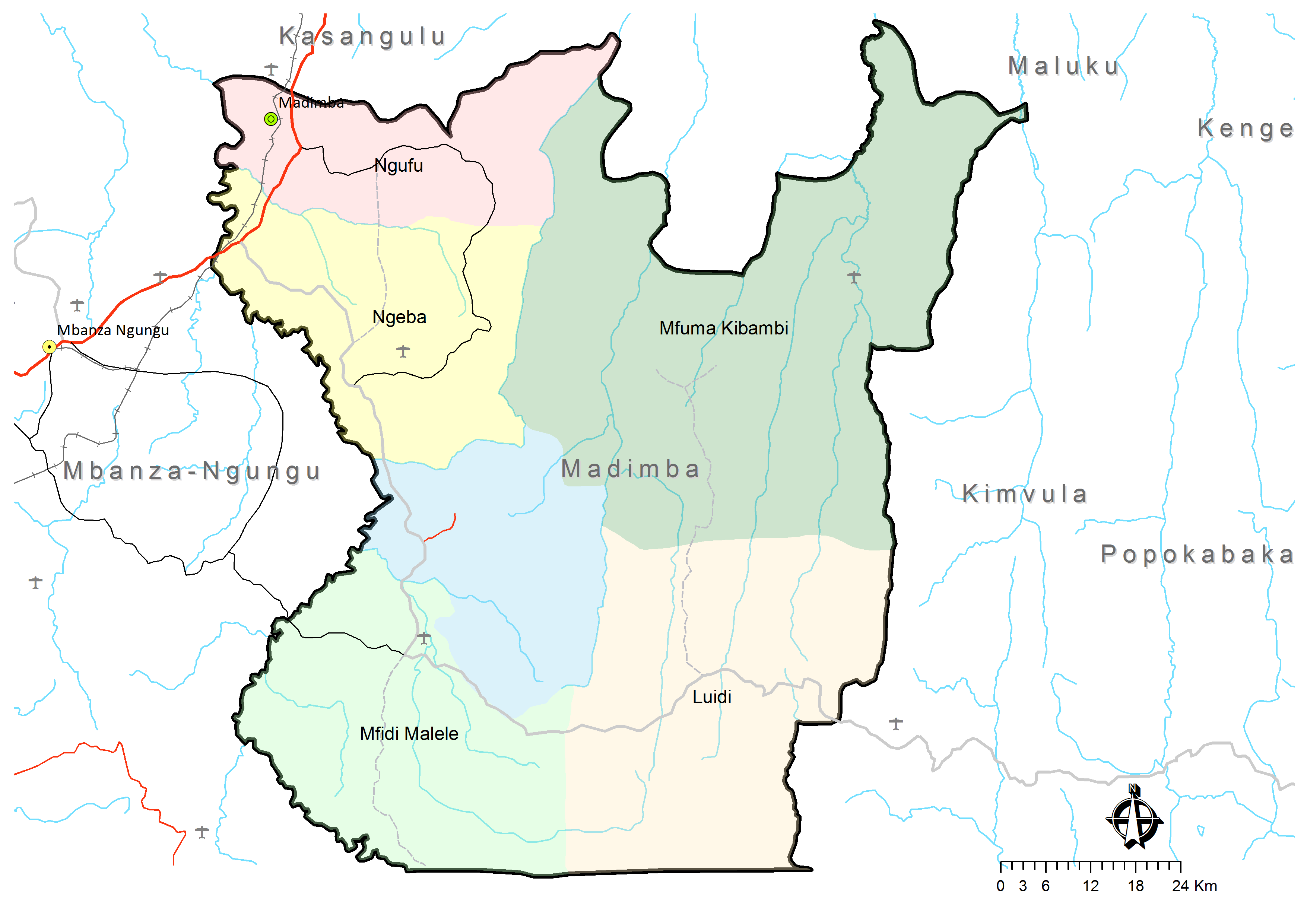
Madimba Territory is a territory in the Kongo Central Province of the Democratic Republic of the Congo (DRC). Its seat is the town of Madimba. The region covers an area of 8,260 square miles and is situated 100 km from Kinshasa. It spans from the Lukusu River in the north to Kintano in the west, and from the Inkisi River in the west to Kinkosi-Luidi in the southeast. The territory borders Kasangulu Territory to the northeast, Kimvula Territory to the southeast, Mbanza-Ngungu Territory to the west, and Angola to the south. Madimba Territory is home to an approximate population of 463,132 residents.
Madimba Territory is home to the Kisantu Botanical Garden (Jardin botanique de Kisantu), one of the largest botanical gardens in Central Africa. The Hôpital Saint-Luc, situated on the Nkandu plateau in Inkisi, is the region's first established medical facility. Madimba Territory houses several higher-educational institutions, including Kubama College (Collège Kubama), Institut Technique Industriel de Kisantu (ITI-Kisantu), and Institut Luymas. The territory is also home to Mbuela-Lodge, a holiday resort located near the town of Kisantu.
Geography
Madimba Territory is located at a latitude of 4°9 and a longitude of 15°2, with an altitude of 210 meters above sea level. Madimba Territory experiences a humid subtropical climate with distinct seasons. The rainy season spans seven months, including September, October, November, December, January, April, and May. Conversely, the dry season lasts five months, encompassing February, March (small season), June, July, and August. Temperature oscillations within the range of 20°C to 30°C are readily apparent, complemented by an annual precipitation ranging between 1200 mm and 1600 mm.
Madimba's terrestrial composition predominantly comprises two primary types: sandy-clayey and clayey-sandy. The region's topography is characterized by low hills, valleys, and high plateaus. Hydrographically, the Inkisi River dominates the territory. Incidentally, it is bordered by the Congo River to the north and is intersected by numerous watercourses and rivers, including Lukusu, Luidi, Mfidi, Ngufu, Geba, Wungu, Nsele, Tau, Luvu, and Lukunga. The territory is well-connected with waterways, facilitating transportation and trade. Furthermore, the subsoil of Madimba is rich in valuable minerals like zinc ores, iron, copper, and mineral water, representing a source of potential economic wealth.
History
Madimba Territory is one of the earliest administrative territories established in the Democratic Republic of the Congo. It was created through the Ordinance of February 1, 1913, under the auspices of the colonial governor-general. Initially, the territory was demarcated into six discrete sectors, denominated as Luidi, Ngeba, Mfidi-Malele, Ngufu, Mfuma, and Gungu.
2007 torrential rainfall
In April 2007, torrential downpours led to the destruction of approximately thirty houses and affected two primary schools in the Ngufu sector, causing a humanitarian crisis in the surrounding villages, including Kipaku, Kituengi, Kisundi, and Kilemfu. Sébastien Ndomba, supervisor of the ONGD (National Council of Non-Governmental Development Organisations), a German organization, reports the incident rendered 196 people homeless, comprising 65 adults and 131 children.
2011 traffic accident
On March 25, 2011, two people died, and 14 others were injured following a traffic accident in Kisantu. The accident occurred on the Kisantu–Simula road when a large truck from Madimba Territory overturned not far from Kisantu, more than 200 kilometers east of Matadi.
2022 fuel tank explosion
On September 14, 2022, eight people lost their lives, and twenty others sustained burns in an explosion involving a tanker truck in Mbuba, Madimba Territory. The incident occurred around 5 p.m. when the tanker overturned due to a collision with a heavy-duty vehicle. Subsequently, the gasoline tank began to leak, prompting the local population to rush and attempt to collect the fuel. The tanker exploded, resulting in the immediate loss of eight lives, including a soldier from the Republican Guard tasked with safeguarding the SEP-Congo pipeline. The death toll later increased to ten by September 17.
Administrative divisions
Madimba Territory is administratively divided into six sectors:
- Luidi
- Mfidi Malele
- Mfuma Kibambi
- Ngeba
- Ngufu
- Wungu (south of Ngeba, north of Mfidi Malele)
Economy
The region's economy is predominantly driven by agriculture, which serves as the central economic activity and vital source of livelihoods, sustenance, and economic stability. The region's main agricultural commodities include maize, cassava, peanuts, yams, plantains, and market garden products, while cocoa, coffee, and oil palm are the primary cash crops. The area also engages in livestock raising, which includes cattle, poultry, and goats.
References
References
- "Territoire de Madimba: Fiche du territoire". Cellule d'Analyses des Indicateurs de Développement (CAID).
- (September 17, 2014). "Bas-Congo: le territoire de Madimba va souffler sur ses cent bougies".
- (March 2020). "Enquête sur les conditions d'hygiène dans les écoles de la sous-division de Madimba (Province de Kongo-Central) en République Démocratique du Congo".
- "Territoire de Madimba: Fiche du territoire: Données géographiques et culturelles". Cellule d'Analyses des Indicateurs de Développement (CAID).
- Silu, Cynthia Pululu. (2017). "Problématique de l'entrepreneuriat informel dans la cite de Kisantu. Typologie basée sur le modèle des 3e". Kongo University.
- "Le Territoire de Madimba".
- (2023-06-05). "Kongo-Central : une tête d'érosion menace la route reliant la RDC à l'Angola".
- (2020-02-09). "Hôpital Général de Référence St Luc, Kisantu".
- (2022-01-05). "Kongo-Central : la morgue de l'hôpital Saint Luc de Kisantu est saturée".
- (2021-11-24). "Kisantu : un enseignant meurt craie à la main dans une salle de classe".
- "Accueill".
- "Institut Technique industriel de kisantu (I.T.I-KISANTU)".
- Mayala, Kimpozo. (June 1, 2004). "Congo-Kinshasa: Diomi: une natte et une lampe pour un long voyage". AllAfrica.
- (2022-11-17). "Kisantu : ouverture ce jeudi de « Kimvuama », le forum économique sur le développement du Kongo-Central".
- (1913). "Bulletin Officiel du Congo Belge, Volume 6". Princeton University.
- (2007-10-04). "Madimba : saison de pluie, 10 villages dans une situation humanitaire préoccupante".
- (2011-03-26). "Accident de circulation à Kisantu: 2 morts et 14 blessés".
- (2022-09-15). "Kongo-Central : des morts et des brulés graves à la suite de l'explosion d'un camion-citerne".
- (2022-09-18). "Kongo-Central : le bilan de l'explosion du camion-citerne passe de 7 à 10".
- "Territoire de Madimba: Carte administrative". Cellule d'Analyses des Indicateurs de Développement (CAID).
- (2022-08-25). "Kongo-Central: lancement de la campagne de culture du manioc pour farine panifiable".
- (2023-04-20). "Kongo Central : présence des éleveurs des vaches à Kimayala, l'éclairage des autorités du territoire de Madimba - Kongo Média".
- Mwimbi, Delvard. (April 21, 2023). "Madimba: loin d'appartenir aux Mbororos, des éleveurs des vaches à Kimayala viennent de Kinshasa (AT)".
This article was imported from Wikipedia and is available under the Creative Commons Attribution-ShareAlike 4.0 License. Content has been adapted to SurfDoc format. Original contributors can be found on the article history page.
Ask Mako anything about Madimba Territory — get instant answers, deeper analysis, and related topics.
Research with MakoFree with your Surf account
Create a free account to save articles, ask Mako questions, and organize your research.
Sign up freeThis content may have been generated or modified by AI. CloudSurf Software LLC is not responsible for the accuracy, completeness, or reliability of AI-generated content. Always verify important information from primary sources.
Report