From Surf Wiki (app.surf) — the open knowledge base
Mackerel as food
None
None
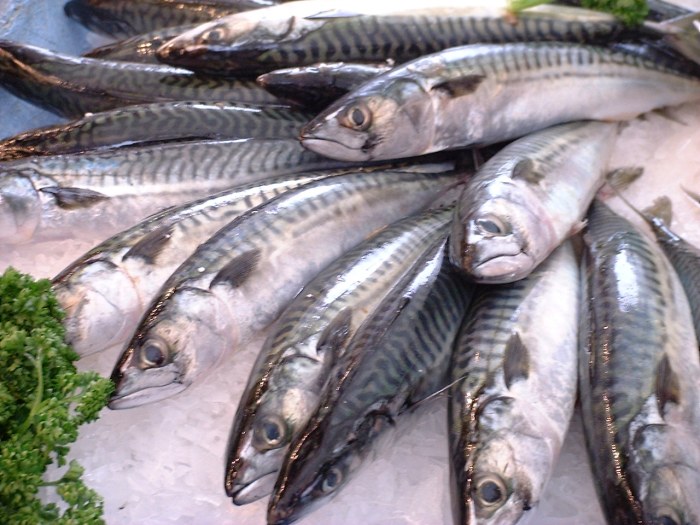
Mackerel is an important food fish that is consumed worldwide.{{cite book |title=The California mackerel fishery
Preservation

Mackerel is highly perishable and was historically difficult to preserve. Before the 19th-century development of canning and the widespread availability of refrigeration, salting and smoking were the principal preservation methods available. Historically in England, this fish was not preserved, but was consumed only in its fresh form. Spoilage was common, leading the authors of The Cambridge Economic History of Europe to remark: "There are more references to stinking mackerel in English literature than to any other fish!"
In Japan, mackerel is called saba, and is commonly cured with salt and vinegar to make a type of sushi known as saba-zushi. Historically, saba-zushi originated in Kyoto as a solution for transporting mackerel to the inland city, which otherwise would not have made the journey from the coast still fresh. The road linking Obama bay and Kyoto is now also called "mackerel road" (saba-kaido).
Modern canning allowed mackerel, like many other fish, to be safely stored for long periods without refrigeration, and packed in a variety of sauces. This is due to high temperature processing, where fresh cleaned mackerel is first immersed in a liquid such as a brine, water or vinegar solution, and sauces can be added before sealing off the mixture in an airtight container. The fish then undergoes heat sterilisation at high temperatures to eliminate micro-organisms and bacteria that causes spoilage and the container is later cooled, which creates a vacuum seal that prevents air from entering and spoiling the fish. As a result, canned mackerel can be stored safely at room temperature for months or years. The bones in canned mackerel fillets are generally safe to consume as they soften significantly during the curing and are a good source of calcium. It is also high in omega-3, in which tends to be better preserved when the mackerel is packed in oil, rather than spring water.
Appeal
For many years, mackerel was regarded as unclean in the UK and elsewhere due to folklore which suggested that the fish fed on the corpses of dead sailors. A 1976 survey of housewives in Britain undertaken by the White Fish Authority indicated a reluctance to departing from buying the traditional staples of cod, haddock or salmon. Less than 10% of the survey's 1,931 respondents had ever bought mackerel and only 3% did so regularly. As a result of this trend many UK fishmongers during the 1970s did not display or even stock mackerel.
According to a survey conducted in April 2024 by the Korea Maritime Institute (KMI), mackerel was ranked the "most popular seafood product" among South Koreans (14%), surpassing squid (12.9%). The institute also found in earlier surveys, mackerel was the nation's most preferred seafood species in 2017, 2018 and 2019.
Mercury
There is a large variation in the mercury levels found in mackerel. These levels differ markedly for different species, and even for the same species in different locations; however, the strongest positive correlation seems to be connected to the species' size (the larger species being higher on the food chain).{{cite journal Atlantic mackerel however is categorized as "Best Choice" for consumption by the FDA, as it is low in mercury and high in Omega-3.
Gallery
File:Mackerel fish fry - Kolkata - West Bengal - 1.jpg|Indian mackerel deep-fried with salt and turmeric in mustard oil File:Ayala Meen Curry by Preeti Tamilarasan.jpg|Indian mackerel curry File:Flickr - cyclonebill - Rugbrød med røget pebermakrel.jpg|Danish mackerel on rye bread File:Auer Dult Jakobidult 2018 6129.jpg|German grilled mackerel at Auer Dult File:Escabeche de Caballa-10.jpg|Spanish mackerel escabeche File:Kaeng som plathu thot.jpg|Thai mackerel kaeng som File:Sabazushi Hanaore.jpg|Japanese mackerel sushi File:Saba don by LWY in Fukuoka.jpg|Japanese mackerel donburi File:Oyaji lunch (31297933477).jpg|Japanese teishoku meal with grilled mackerel and miso soup
References
Citations
Sources
- Keay JN (2001) Handling and processing mackerel Torry advisory note 66.
References
- "Jersey Seafood Nutrition and Health". State of New Jersey Department of Agriculture.
- (November 2007). "Scombrotoxin (Histamine)". Food Safety Watch.
- Croker (1933), pages 104–105
- 978-0-521-08710-0.
- (2006). "Changes of proximate composition and extractive components in narezushi, a fermented mackerel product, during processing". Fisheries Science.
- "Handling and Processing Mackerel".
- "Fish & Seafood Preservation & Storage {{!}} Grainshed".
- Pastron, Alex. (2019-08-20). "The Canned Fish That Beats Tuna Any Day of the Week".
- Burrell, Susie. (2025-03-23). "A dietitian’s guide to the best tinned fish to fill your basket with – and what to watch out for".
- (2024-09-19). "Why Tinned Fish is Trending". Right as Rain by UW Medicine.
- McFarlane, Andrew. (2010-08-24). "Why is Britain braced for a mackerel war?".
- "Seafood Media Group - Worldnews - The mackerel has become South Korea's most popular fish - most of it is Norwegian".
- (2024-04-28). "The most favorite fishery product of the Korean people is mackerel, the "national fish," according t.. - MK".
- (2019-04-21). "Mackerel Remains Korean's Favorite Seafood".
- FDA. "Mercury Levels in Commercial Fish and Shellfish (1990-2010)".
- Program, Human Foods. (2024-09-05). "Advice about Eating Fish". FDA.
This article was imported from Wikipedia and is available under the Creative Commons Attribution-ShareAlike 4.0 License. Content has been adapted to SurfDoc format. Original contributors can be found on the article history page.
Ask Mako anything about Mackerel as food — get instant answers, deeper analysis, and related topics.
Research with MakoFree with your Surf account
Create a free account to save articles, ask Mako questions, and organize your research.
Sign up freeThis content may have been generated or modified by AI. CloudSurf Software LLC is not responsible for the accuracy, completeness, or reliability of AI-generated content. Always verify important information from primary sources.
Report