From Surf Wiki (app.surf) — the open knowledge base
Mackerel
Pelagic fish

Pelagic fish
Mackerel is a common name applied to a number of different species of pelagic fish, mostly from the family Scombridae. They are found in both temperate and tropical seas, mostly living along the coast or offshore in the oceanic environment.
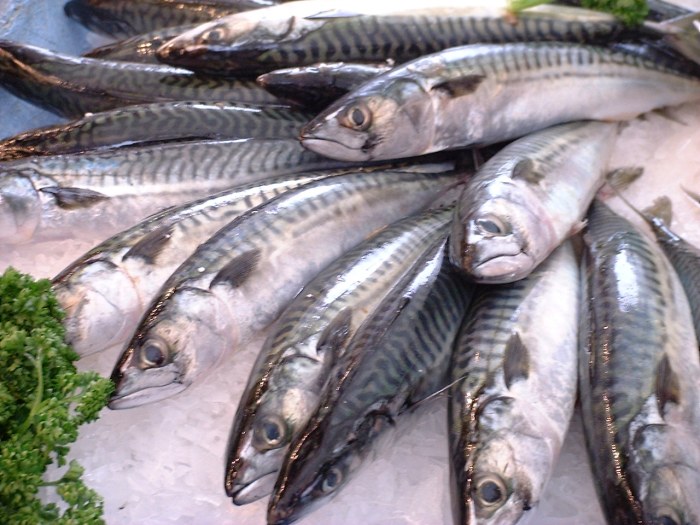
Mackerel species typically have deeply forked tails and vertical "tiger-like" stripes on their backs with an iridescent green-blue quality. Many are restricted in their distribution ranges and live in separate populations or fish stocks based on geography. Some stocks migrate in large schools along the coast to suitable spawning grounds, where they spawn in fairly shallow waters. After spawning they return the way they came in smaller schools to suitable feeding grounds, often near an area of upwelling. From there they may move offshore into deeper waters and spend the winter in relative inactivity. Other stocks migrate across oceans.
Smaller mackerel are forage fish for larger predators, including larger mackerel and Atlantic cod. Flocks of seabirds, whales, dolphins, sharks, and schools of larger fish such as tuna and marlin follow mackerel schools and attack them in sophisticated and cooperative ways. Mackerel flesh is high in omega-3 oils and is intensively harvested by humans. In 2009, over 5 million tons were landed by commercial fishermen. Sport fishermen value the fighting abilities of the king mackerel.
Species
Over 30 different species, principally belonging to the family Scombridae, are commonly referred to as mackerel. The term "mackerel" is derived from Old French and may have originally meant either "marked, spotted" or "pimp, procurer". The latter connection is not altogether clear, but mackerel spawn enthusiastically in shoals near the coast, and medieval ideas on animal procreation were creative.
Scombroid mackerels
About 21 species in the family Scombridae are commonly called mackerel. The type species for the scombroid mackerel is the Atlantic mackerel, Scomber scombrus. Until recently, Atlantic chub mackerel and Indo-Pacific chub mackerel were thought to be subspecies of the same species. In 1999, Collette established, on molecular and morphological considerations, that these are separate species.
Scombrini, the true mackerels
True mackerels
The true mackerels belong to the tribe Scombrini. The tribe consists of seven species, each belonging to one of two genera: Scomber or Rastrelliger.
| True Mackerels (tribe Scombrini) | Common name | Scientific name | Maximum | |||||||
|---|---|---|---|---|---|---|---|---|---|---|
| length | Common | |||||||||
| length | Maximum | |||||||||
| weight | Maximum | |||||||||
| age | Trophic | |||||||||
| level | FishBase | FAO | IUCN status | |||||||
| Short mackerel | Rastrelliger brachysoma | |||||||||
| (Bleeker, 1851) | 34.5 cm | 20 cm | 2.72 | [[File:VU IUCN 3 1.svg | VU IUCN 3 1.svg]] Vulnerable | |||||
| Island mackerel | R. faughni | |||||||||
| (Matsui, 1967) | 20 cm | 0.75 kg | 3.4 | [[File:VU IUCN 3 1.svg | VU IUCN 3 1.svg]] Vulnerable | |||||
| Indian mackerel | R. kanagurta | |||||||||
| (Cuvier, 1816) | 35 cm | 25 cm | 4 years | 3.19 | [[File:LC IUCN 3 1.svg | LC IUCN 3 1.svg]] Least concern | ||||
| Blue mackerel | Scomber australasicus | |||||||||
| (Cuvier, 1832) | 44 cm | 30 cm | 1.36 kg | 4.2 | [[File:LC IUCN 3 1.svg | LC IUCN 3 1.svg]] Least concern | ||||
| Atlantic chub mackerel | S. colias | |||||||||
| (Gmelin, 1789) | 65 cm | 2.9 kg | 20 years | 3.91 | [[File:LC IUCN 3 1.svg | LC IUCN 3 1.svg]] Least concern | ||||
| Chub mackerel | S. japonicus | |||||||||
| (Houttuyn, 1782) | 64 cm | 30 cm | 2.9 kg | 18 years | 3.09 | [[File:LC IUCN 3 1.svg | LC IUCN 3 1.svg]] Least concern | |||
| Atlantic mackerel | S. scombrus | |||||||||
| (Linnaeus, 1758) | 66 cm | 30 cm | 3.4 kg | 12 years west | ||||||
| 18 years east | 3.65 | [[File:LC IUCN 3 1.svg | LC IUCN 3 1.svg]] Least concern |
Spanish mackerels
Scomberomorini, the Spanish mackerels
The Spanish mackerels belong to the tribe Scomberomorini, which is the "cousin tribe" of the true mackerels. This tribe consists of 21 species in all—18 of those are classified into the genus Scomberomorus, two into Grammatorcynus, and a single species into the monotypic genus Acanthocybium.
| Spanish Mackerels (tribe Scomberomorini) | Common name | Scientific name | Maximum | |||||||
|---|---|---|---|---|---|---|---|---|---|---|
| length | Common | |||||||||
| length | Maximum | |||||||||
| weight | Maximum | |||||||||
| age | Trophic | |||||||||
| level | FishBase | FAO | IUCN status | |||||||
| Wahoo | Acanthocybium solandri | |||||||||
| (Cuvier in Cuvier and Valenciennes, 1832) | 250 cm | 170 cm | 83 kg | 9 years | 4.4 | [[File:LC IUCN 3 1.svg | LC IUCN 3 1.svg]] Least concern | |||
| Shark mackerel | Grammatorcynus bicarinatus | |||||||||
| (Quoy & Gaimard, 1825) | 112 cm | 13.5 kg | 4.5 | [[File:LC IUCN 3 1.svg | LC IUCN 3 1.svg]] Least concern | |||||
| Double-lined mackerel | G. bilineatus | |||||||||
| (Rüppell, 1836) | 100 cm | 50 cm | 3.5 kg | 4.18 | [[File:LC IUCN 3 1.svg | LC IUCN 3 1.svg]] Least concern | ||||
| Serra Spanish mackerel | Scomberomorus brasiliensis | |||||||||
| (Collette, Russo & Zavala-Camin, 1978) | 125 cm | 65 cm | 6.7 kg | 3.31 | [[File:LC IUCN 3 1.svg | LC IUCN 3 1.svg]] Least concern | ||||
| King mackerel | S. cavalla | |||||||||
| (Cuvier, 1829) | 184 cm | 70 cm | 45 kg | 14 years | 4.5 | [[File:LC IUCN 3 1.svg | LC IUCN 3 1.svg]] Least concern | |||
| Narrow-barred Spanish mackerel | S. commerson | |||||||||
| (Lacepède, 1800) | 240 cm | 120 cm | 70 kg | 4.5 | [[File:NT IUCN 3 1.svg | NT IUCN 3 1.svg]] Near threatened | ||||
| Monterrey Spanish mackerel | S. concolor | |||||||||
| (Lockington, 1879) | 87 cm | 3.6 kg | 4.24 | [[File:NT IUCN 3 1.svg | NT IUCN 3 1.svg]] Near threatened | |||||
| Indo-Pacific king mackerel | S. guttatus | |||||||||
| (Bloch & Schneider, 1801) | 81.5 cm | 55 cm | 4.5 kg | 16 years | 4.28 | [[File:DD IUCN 3 1.svg | DD IUCN 3 1.svg]] Data deficient | |||
| Korean mackerel | S. koreanus | |||||||||
| (Kishinouye, 1915) | 150 cm | 60 cm | 15 kg | 4.2 | [[File:LC IUCN 3 1.svg | LC IUCN 3 1.svg]] Least concern | ||||
| Streaked Spanish mackerel | S. lineolatus | |||||||||
| (Cuvier, 1829) | 80 cm | 70 cm | 4.1 kg | 4.5 | [[File:LC IUCN 3 1.svg | LC IUCN 3 1.svg]] Least concern | ||||
| Atlantic Spanish mackerel | S. maculatus | |||||||||
| (Mitchill, 1815) | 91 cm | 5.89 kg | 5 years | 4.5 | [[File:LC IUCN 3 1.svg | LC IUCN 3 1.svg]] Least concern | ||||
| Papuan Spanish mackerel | S. multiradiatus | |||||||||
| Munro, 1964 | 35 cm | 0.5 kg | 4.0 | [[File:LC IUCN 3 1.svg | LC IUCN 3 1.svg]] Least concern | |||||
| Australian spotted mackerel | S. munroi | |||||||||
| (Collette & Russo, 1980) | 104 cm | 10.2 kg | 4.3 | [[File:NT IUCN 3 1.svg | NT IUCN 3 1.svg]] Near threatened | |||||
| Japanese Spanish mackerel | S. niphonius | |||||||||
| (Cuvier, 1832) | 113 cm | 10.5 kg | 4.5 | [[File:NT IUCN 3 1.svg | NT IUCN 3 1.svg]] Near threatened | |||||
| Queen mackerel | S. plurilineatus | |||||||||
| Fourmanoir, 1966 | 120 cm | 12.5 kg | 4.2 | [[File:DD IUCN 3 1.svg | DD IUCN 3 1.svg]] Data deficient | |||||
| Queensland school mackerel | S. queenslandicus | |||||||||
| (Munro, 1943) | 100 cm | 80 cm | 12.2 kg | 10 years | 4.5 | [[File:LC IUCN 3 1.svg | LC IUCN 3 1.svg]] Least concern | |||
| Cero mackerel | S. regalis | |||||||||
| (Bloch, 1793) | 183 cm | 8.2 kg | 4.5 | [[File:LC IUCN 3 1.svg | LC IUCN 3 1.svg]] Least concern | |||||
| Broadbarred king mackerel | S. semifasciatus | |||||||||
| (Macleay, 1883) | 120 cm | 10 kg | 10 years | 4.5 | [[File:LC IUCN 3 1.svg | LC IUCN 3 1.svg]] Least concern | ||||
| Pacific sierra | S. sierra | |||||||||
| (Cuvier, 1832) | 99 cm | 60 cm | 8.2 kg | 4.5 | [[File:LC IUCN 3 1.svg | LC IUCN 3 1.svg]] Least concern | ||||
| Chinese mackerel | S. sinensis | |||||||||
| (Cuvier, 1832) | 247 cm | 100 cm | 131 kg | 4.5 | [[File:NT IUCN 3 1.svg | NT IUCN 3 1.svg]] Near threatened | ||||
| West African Spanish mackerel | S. tritor | |||||||||
| (Cuvier, 1832) | 100 cm | 75 cm | 6 kg | 4.26 | [[File:LC IUCN 3 1.svg | LC IUCN 3 1.svg]] Least concern |
Other mackerel
In addition, a number of species with mackerel-like characteristics in the families Carangidae, Hexagrammidae and Gempylidae are commonly referred to as mackerel. Some confusion had occurred between the Pacific jack mackerel (Trachurus symmetricus) and the heavily harvested Chilean jack mackerel (T. murphyi). These have been thought at times to be the same species, but are now recognized as separate species.
| Other mackerel species | Family | Common name | Scientific name | Maximum | ||||||||
|---|---|---|---|---|---|---|---|---|---|---|---|---|
| length | Common | |||||||||||
| length | Maximum | |||||||||||
| weight | Maximum | |||||||||||
| age | Trophic | |||||||||||
| level | FishBase | FAO | IUCN status | |||||||||
| Scombridae | ||||||||||||
| Gasterochisma | Butterfly mackerel | Gasterochisma melampus Richardson, 1845 | 164 cm | 50 kg | 4.4 | [[File:LC IUCN 3 1.svg | LC IUCN 3 1.svg]] Least concern | |||||
| Carangidae | ||||||||||||
| Jack mackerel | Mackerel Scad | Decapterus macarellus (Culiver, 1833) | 46 cm | 30 cm | 4.0 | [[File:LC IUCN 3 1.svg | LC IUCN 3 1.svg]] Least concern | |||||
| Atlantic horse mackerel | Trachurus trachurus (Linnaeus, 1758) | 70 cm | 22 cm | 2.0 kg | 3.64 | [[File:VU IUCN 3 1.svg | VU IUCN 3 1.svg]] Vulnerable | |||||
| Blue jack mackerel | T. picturatus (Bowdich, 1825) | 60 cm | 25 cm | 18 years | 3.32 | [[File:LC IUCN 3 1.svg | LC IUCN 3 1.svg]] Least concern | |||||
| Cape horse mackerel | T. capensis (Castelnau, 1861) | 60 cm | 30 cm | 3.47 | [[File:LC IUCN 3 1.svg | LC IUCN 3 1.svg]] Least concern | ||||||
| Chilean jack mackerel | T. murphyi (Nichols, 1920) | 70 cm | 45 cm | 16 years | 3.49 | [[File:DD IUCN 3 1.svg | DD IUCN 3 1.svg]] Data deficient | |||||
| Cunene horse mackerel | T. trecae (Cadenat, 1950) | 35 cm | 2.0 kg | 3.49 | [[File:LC IUCN 3 1.svg | LC IUCN 3 1.svg]] Least concern | ||||||
| Greenback horse mackerel | T. declivis (Jenyns, 1841) | 64 cm | 42 cm | 25 years | 3.93 | [[File:LC IUCN 3 1.svg | LC IUCN 3 1.svg]] Least concern | |||||
| Japanese horse mackerel | T. japonicus (Temminck & Schlegel, 1844) | 50 cm | 35 cm | 0.66 kg | 12 years | 3.4 | [[File:NT IUCN 3 1.svg | NT IUCN 3 1.svg]] Near threatened | ||||
| Mediterranean horse mackerel | T. mediterraneus (Steindachner, 1868) | 60 cm | 30 cm | 3.59 | [[File:LC IUCN 3 1.svg | LC IUCN 3 1.svg]] Least concern | ||||||
| Pacific jack mackerel | T. symmetricus (Ayres, 1855) | 81 cm | 55 cm | 30 years | 3.56 | [[File:LC IUCN 3 1.svg | LC IUCN 3 1.svg]] Least concern | |||||
| Yellowtail horse mackerel | T. novaezelandiae (Richardson, 1843) | 50 cm | 35 cm | 25 years | 4.5 | [[File:LC IUCN 3 1.svg | LC IUCN 3 1.svg]] Least concern | |||||
| Gempylidae | ||||||||||||
| Snake mackerel | Black snake mackerel | Nealotus tripes (Johnson, 1865) | 25 cm | 15 cm | 4.2 | [[File:LC IUCN 3 1.svg | LC IUCN 3 1.svg]] Least concern | |||||
| Blacksail snake mackerel | Thyrsitoides marleyi (Fowler, 1929) | 200 cm | 100 cm | 4.19 | Not assessed | |||||||
| Snake mackerel | Gempylus serpens (Cuvier, 1829) | 100 cm | 60 cm | 4.35 | [[File:LC IUCN 3 1.svg | LC IUCN 3 1.svg]] Least concern | ||||||
| Violet snake mackerel | Nesiarchus nasutus (Johnson, 1862) | 130 cm | 80 cm | 4.33 | [[File:LC IUCN 3 1.svg | LC IUCN 3 1.svg]] Least concern | ||||||
| White snake mackerel | Thyrsitops lepidopoides (Cuvier, 1832) | 40 cm | 25 cm | 3.86 | Not assessed | |||||||
| Hexagrammidae | Okhotsk atka mackerel | Pleurogrammus azonus (Jordan & Metz, 1913) | 62 cm | 1.6 kg | 12 years | 3.58 | Not assessed | |||||
| Atka mackerel | P. monopterygius (Pallas, 1810) | 56.5 cm | 2.0 kg | 14 years | 3.33 | Not assessed |
The term "mackerel" is also used as a modifier in the common names of other fish, sometimes indicating the fish has vertical stripes similar to a scombroid mackerel:
- Mackerel icefish—Champsocephalus gunnari
- Mackerel pike—Cololabis saira
- Mackerel shark—several species
- Shortfin mako shark—Isurus oxyrinchus
- Mackerel tuna—Euthynnus affinis
- Mackerel tail goldfish—Carassius auratus
By extension, the term is applied also to other species such as the mackerel tabby cat, and to inanimate objects such as the altocumulus mackerel sky cloud formation.
Characteristics (Scombridae)

Most mackerel belong to the family Scombridae, which also includes tuna and bonito. Generally, mackerel are much smaller and slimmer than tuna, though in other respects, they share many common characteristics. Their scales, if present at all, are extremely small. Like tuna and bonito, mackerel are voracious feeders, and are swift and manoeuvrable swimmers, able to streamline themselves by retracting their fins into grooves on their bodies. Like other scombroids, they lack a swim bladder, and their bodies are cylindrical with numerous finlets on the dorsal and ventral sides behind the dorsal and anal fins, but unlike the deep-bodied tuna, they are slim.
The type species for scombroid mackerels is the Atlantic mackerel, Scomber scombrus. These fish are iridescent blue-green above with a silvery underbelly and near-vertical wavy black stripes running along their upper bodies.
The prominent stripes on the back of mackerels seemingly are there to provide camouflage against broken backgrounds. That is not the case, though, because mackerel live in midwater pelagic environments which have no background. However, fish have an optokinetic reflex in their visual systems that can be sensitive to moving stripes. For fish to school efficiently, they need feedback mechanisms that help them align themselves with adjacent fish, and match their speed. The stripes on neighbouring fish provide "schooling marks", which signal changes in relative position. The lateral line also helps with orderly schooling.

A layer of thin, reflecting platelets is seen on some of the mackerel stripes. In 1998, E J Denton and D M Rowe argued that these platelets transmit additional information to other fish about how a given fish moves. As the orientation of the fish changes relative to another fish, the amount of light reflected to the second fish by this layer also changes. This sensitivity to orientation gives the mackerel "considerable advantages in being able to react quickly while schooling and feeding."
Mackerel range in size from small forage fish to larger game fish. Coastal mackerel tend to be small. The king mackerel is an example of a larger mackerel. Most fish are cold-blooded, but exceptions exist. Certain species of fish maintain elevated body temperatures. Endothermic bony fishes are all in the suborder Scombroidei and include the butterfly mackerel, a species of primitive mackerel.
Mackerel are strong swimmers. Known in the latin family as "punctualis piscis" which translates to "punctual fish." This is due to its punctuality of migration during mating season as it moves from warm to cold waters. Atlantic mackerel can swim at a sustained speed of 0.98 m/sec with a burst speed of 5.5 m/sec, while chub mackerel can swim at a sustained speed of 0.92 m/sec with a burst speed of 2.25 m/sec. The Wahoo (Acanthocybium solandri) has been known to reach speeds of up to 78 kph.
Distribution
Most mackerel species have restricted distribution ranges, while others, like the Wahoo, are found in all oceans between 59°N and 48°S.
In combination, these fish (Scombroids) can be found worldwide in all oceans of the world, excluding the Southern and Arctic Oceans. However, the Atlantic chub mackerel has been spotted near Greenland in the Arctic Ocean on rare occasions as global warming makes the Arctic more habitable for them.
Some mackerel species, especially pelagic and filter feeding one such as chub mackerel, migrate vertically, staying at certain depths depending on the time of day and food availability.
For example, adult snake mackerel, conduct a diel vertical migration, staying in deeper water during the day and rising to the surface at night to feed. The young and juveniles also migrate vertically, but in the opposite direction, staying near the surface during the day and moving deeper at night.
Lifecycle and ecology (Scombroids)

Mackerel are prolific broadcast spawners, and must breed near the surface of the water because the eggs of the females float. Individual females lay between 300,000 and 1,500,000 eggs.
Off Madagascar, spinner sharks follow migrating schools of mackerel. Bryde's whales feed on mackerel when they can find them. They use several feeding methods, including skimming the surface, lunging, and bubble nets.
Fisheries

Chub mackerel, Scomber japonicus, are the most intensively fished scombroid mackerel. They account for about half the total capture production of scombroid mackerels.
The remaining catch of scombroid mackerels is divided equally between the Atlantic mackerel and all other scombroid mackerels. Just these two species (Chub mackerel and Atlantic mackerel) account for about 75% of the total catch of scombroid mackerels.
Chilean jack mackerel are the most commonly fished non-scombroid mackerel, fished as heavily as chub mackerel. The species has been overfished, and its fishery may now be in danger of collapsing.
Smaller mackerel behave like herrings, and are captured in similar ways. Fish species like these, which school near the surface, can be caught efficiently by purse seining. Huge purse-seine vessels use spotter planes to locate the schooling fish. Then they close in using sophisticated sonar to track the shape of the school, which is then encircled with fast auxiliary boats that deploy purse seines as they speed around the school.
Suitably designed trollers can also catch mackerels effectively when they swim near the surface. Trollers typically have several long booms which they lift and drop with "topping lifts". They haul their lines with electric or hydraulic reels. Fish aggregating devices are also used to target mackerel.
| Images and videos |
|---|
| {{multiple image |
Management and conservation
The North Sea has been overfished to the point where the ecological balance has become disrupted and many jobs in the fishing industry have been lost.
The Southeast US region spans the Gulf of Mexico, the Caribbean Sea, and the US Southeast Atlantic. Overfishing of king and Spanish mackerel occurred in the 1980s. Regulations were introduced to restrict the size, fishing locations, and bag limits for recreational fishers and commercial fishers. Gillnets were banned in waters off Florida. By 2001, the mackerel stocks had recovered.
As food

Main article: Mackerel as food
Mackerel is an important food fish that is consumed worldwide. As an oily fish, it is a rich source of omega-3 fatty acids. The flesh of mackerel spoils quickly, especially in the tropics, and can cause scombroid food poisoning. Accordingly, it should be eaten on the day of capture, unless properly refrigerated or cured.
Mackerel preservation is not simple. Before the 19th-century development of canning and the widespread availability of refrigeration, salting and smoking were the principal preservation methods available. Historically in England, this fish was not preserved, but was consumed only in its fresh form. However, spoilage was common, leading the authors of The Cambridge Economic History of Europe to remark: "There are more references to stinking mackerel in English literature than to any other fish!"
For many years mackerel was regarded as 'unclean' in the UK and other places due to folklore which suggested that the fish fed on the corpses of dead sailors. A 1976 survey of housewives in Britain undertaken by the White Fish Authority indicated a reluctance to departing from buying the traditional staples of cod, haddock or salmon. Less than 10% of the survey's 1,931 respondents had ever bought mackerel, and only 3% did so regularly. As a result of this trend, many UK fishmongers during the 1970s did not display or even stock mackerel.
References
References
- Based on data sourced from the relevant [http://www.fao.org/fishery/species/search/en FAO Species Fact Sheets]
- "Mackerel. Scientific name: Scomber scombrus".
- "Mackerel: to fish or not to fish?".
- Daan, N.. (December 1973). "A quantitative analysis of the food intake of North Sea cod, Gadus Morhua". [[Elsevier B.V.]].
- (2008). "King mackerel". Merriam Webster.
- "Mackerel".
- (2011). "Global population trajectories of tunas and their relatives". Proceedings of the National Academy of Sciences.
- (2012-02-08). "Tuna and mackerel populations have reduced by 60% in the last century". ScienceDaily.
- {{ITIS
- {{ITIS
- {{ITIS
- {{FishBase. (2012)
- "Species Fact Sheet: ''Rastrelliger brachysoma'' (Bleeker, 1851)". [[FAO]].
- Collette, B.. (2022). ""Rastrelliger brachysoma"".
- {{FishBase. (2012)
- Collette, B.. (2023). ""Rastrelliger faughni"".
- {{FishBase. (2012)
- "Species Fact Sheet: ''Rastrelliger kanagurta'' (Cuvier, 1817)". [[FAO]].
- Collette, B.. (2023). ""Rastrelliger kanagurta"".
- {{FishBase. (2012)
- Collette, B.. (2011). "''Scomber australasicus''".
- {{FishBase. (2012)
- ["Maximum size of Atlantic mackerel (Scomber scombrus) and Atlantic chub mackerel (Scomber colias) in the Northeast Atlantic {{!}} French Ichthyological Society - Cybium"](https://sfi-cybium.fr/en/node/76#:~:text=The%20most%20recent%20(2000-2005,these%20species%20in%20this%20area.).
- Collette, B.. (2011). "''Scomber colias''".
- {{FishBase. (2012)
- "Species Fact Sheet: ''Scomber japonicus'' (Houttuyn, 1782)". [[FAO]].
- Collette, B.. (2011). "''Scomber japonicus''".
- {{FishBase. (2012)
- "Species Fact Sheet: ''Scomber scombrus'' (Linnaeus, 1758)". [[FAO]].
- Collette, B.. (2011). "''Scomber scombrus''".
- {{ITIS
- {{ITIS
- {{ITIS
- {{ITIS
- {{FishBase. (2012)
- Collette, B.. (2011). "''Acanthocybium solandri''".
- {{FishBase. (2012)
- Collette, B.. (2011). "''Grammatorcynus bicarinatus''".
- {{FishBase. (2012)
- Collette, B.. (2011). "''Grammatorcynus bilineatus''".
- {{FishBase. (2012)
- Collette, B.. (2011). "''Scomberomorus brasiliensis''".
- {{FishBase. (2012)
- "Species Fact Sheet: ''Scomberomorus cavalla'' (Cuvier, 1829)". [[FAO]].
- Collette, B.. (2011). "''Scomberomorus cavalla''".
- {{FishBase. (2012)
- "Species Fact Sheet: ''Scomberomorus commerson'' (Lacepède, 1800)". [[FAO]].
- Collette, B.. (2011). "''Scomberomorus commerson''".
- {{FishBase. (2012)
- "Gulf Sierra {{!}} Mexican Fish.com".
- Collette, B.. (2024). ""Scomberomorus concolor"".
- {{FishBase. (2012)
- "Species Fact Sheet: ''Scomberomorus guttatus'' (Bloch & Schneider, 1801)". [[FAO]].
- Collette, B.. (2011). "''Scomberomorus guttatus''".
- {{FishBase. (2012)
- "Big Macks: Eleven monster mackerel from the IGFA World Record vault – International Game Fish Association".
- Collette, B.. (2011). "''Scomberomorus koreanus''".
- {{FishBase. (2012)
- Collette, B.. (2011). "''Scomberomorus lineolatus''".
- {{FishBase. (2012)
- "Species Fact Sheet: ''Scomberomorus maculatus'' (Mitchill, 1815)". [[FAO]].
- Collette, B.. (2011). "''Scomberomorus maculatus''".
- {{FishBase. (2012)
- Collette, B.. (2011). "''Scomberomorus multiradiatus''".
- {{FishBase. (2012)
- Collette, B.. (2011). "''Scomberomorus munroi''".
- {{FishBase. (2012)
- "Species Fact Sheet: ''Scomberomorus niphonius'' (Cuvier, 1831)". [[FAO]].
- Collette, B.. (2023). ""Scomberomorus niphonius"".
- {{FishBase. (2012)
- Collette, B.. (2011). "''Scomberomorus plurilineatus''".
- {{FishBase. (2012)
- Collette, B.. (2011). "''Scomberomorus queenslandicus''".
- {{FishBase. (2012)
- Collette, B.. (2011). "''Scomberomorus regalis''".
- {{FishBase. (2012)
- Collette, B.. (2011). "''Scomberomorus semifasciatus''".
- {{FishBase. (2012)
- Collette, B.. (2011). "''Scomberomorus tritor''".
- {{FishBase. (2012)
- Collette, B.. (2022). ""Scomberomorus sinensis"".
- {{FishBase. (2012)
- (2004). "Resolution of the taxonomic status of Chilean and Californian jack mackerels using mitochondrial DNA sequence". Journal of Fish Biology.
- {{FishBase. (2012)
- Collette, B.. (2011). "''Gasterochisma melampus''".
- "Decapterus macarellus summary page".
- Smith-Vaniz, W.F.. (2015). ""Decapterus macarellus"".
- {{FishBase. (2012)
- "Species Fact Sheet: ''Trachurus trachurus'' (Linnaeus, 1758)". [[FAO]].
- Smith-Vaniz, W.F. (2015). ""Trachurus trachurus"".
- {{FishBase. (2012)
- Smith-Vaniz, W.F.. (2025). ""Trachurus picturatus"".
- {{FishBase. (2012)
- "Species Fact Sheet: ''Trachurus capensis'' (Castelnau, 1861)". [[FAO]].
- Smith-Vaniz, W.F.. (2018). ""Trachurus capensis"".
- {{FishBase. (2012)
- "Species Fact Sheet: ''Trachurus murphyi'' (Nichols, 1920)". [[FAO]].
- {{FishBase. (2012)
- "Species Fact Sheet: ''Trachurus trecae'' (Cadenat, 1949)". [[FAO]].
- Smith-Vaniz, W.F.. (2015). ""Trachurus trecae"".
- {{FishBase. (2012)
- "Species Fact Sheet: ''Trachurus declivis'' (Jenyns, 1841)". [[FAO]].
- Smith-Vaniz, W.F.. (2018). ""Trachurus declivis"".
- {{FishBase. (2012)
- "Species Fact Sheet: ''Trachurus japonicus'' (Temminck & Schlegel, 1844)". [[FAO]].
- Carpenter, K.E.. (2018). ""Trachurus japonicus"".
- {{FishBase. (2012)
- "Species Fact Sheet: ''Trachurus mediterraneus'' (Steindachner, 1868)". [[FAO]].
- William F. Smith-Vaniz (??). (2013-05-10). "IUCN Red List of Threatened Species: Trachurus mediterraneus". IUCN Red List of Threatened Species.
- {{FishBase. (2012)
- Smith-Vaniz, B.. (2010). "''Trachurus symmetricus''".
- {{FishBase. (2012)
- Smith-Vaniz, W.F.. (2018). ""Trachurus novaezelandiae"".
- {{FishBase. (2012)
- (2012-08-22). "IUCN Red List of Threatened Species: Nealotus tripes". IUCN Red List of Threatened Species.
- {{FishBase. (2012)
- {{FishBase. (2012)
- (2012-08-23). "IUCN Red List of Threatened Species: Gempylus serpens". IUCN Red List of Threatened Species.
- {{FishBase. (2012)
- (25 August 2014). "IUCN Red List of Threatened Species: Nesiarchus nasutus".
- {{FishBase. (2012)
- {{FishBase. (2012)
- "Species Fact Sheet: ''Pleurogrammus azonus'' (Jordan & Metz, 1913)". [[FAO]].
- {{FishBase. (2012)
- "Glossary of definitions of cat terms for the breeder". Cats online.
- Downing, L. L.. (2013). "Metereology of Clouds". AuthorHouse.
- (2015). "Metereology Today". Cengage Learning.
- (2007-05-01). "Species Fact Sheet: Atlantic mackerel ''(Scomber scombrus)''". Nova Scotia Fisheries and Aquaculture.
- "Atlantic mackerel". National Oceanic and Atmospheric Administration.
- (1998). "Bands against stripes on the backs of mackerel, ''Scomber scombrus'' L.". Proc. R. Soc. Lond. B.
- (1965). "The optomotor reaction of schooling carangid fishes". Animal Behaviour.
- (2008). "Biology of Fishes". Taylor & Francis Group.
- Terpstra, Styze. (September 27, 2010). "The role of the lateral line in schooling".
- (2025-01-25). "Different functions for the lateral line in schooling behavior in three fish species".
- (1997). "The physical basis of reflective communication between fish, with special reference to the horse mackerel, ''Trachurus trachurus''". Phil. Trans. R. Soc. Lond. B.
- (2000). "The Pacific Islands: An encyclopedia". University of Hawaii Press.
- (1993). "Endothermy in fishes: a phylogenetic analysis of constraints, predispositions, and selection pressures". Environmental Biology of Fishes.
- (1988). "Burst swimming speeds of mackerel, ''Scomber scombrus''". Journal of Fish Biology.
- (1988). "Endurance at intermediate swimming speeds of Atlantic mackerel, ''Scomber scombrus'' L., herring, ''Clupea harengus'' L., and saithe, ''Pollachius virens'' L". Journal of Fish Biology.
- "FAO Fact Sheet: Biological characteristics of tuna".
- "Top 5 Fastest Fish in the Ocean {{!}} The Speedsters of the Sea".
- Katz, Cheryl. (May 10, 2018). "Alien Waters: Neighboring Seas Are Flowing into a Warming Arctic Ocean".
- (2023-04-01). "Vertical migration patterns linked to body and environmental temperatures in chub mackerel". Progress in Oceanography.
- Burton, R.. (2002). "International Wildlife Encyclopedia". Marshall Cavendish.
- Compagno, L.J.V.. (1984). "Sharks of the World: An Annotated and Illustrated Catalogue of Shark Species Known to Date". Food and Agricultural Organization.
- "Bryde's Whale ''(Balaenoptera edeni)''". Noaa Fisheries, Office of Protected Resources.
- "Chub mackerel". Sicilian Fish on the Road.
- "Fishing Vessel type: Trollers". [[FAO]].
- "The FAD FAQ".
- (2004). "The End of the Line: How overfishing is changing the world and what we eat". Ebury Press.
- "FISHERY COUNTRY PROFILE: THE UNITED STATES OF AMERICA". [[FAO]].
- (1933). "The California mackerel fishery". Division of Fish and Game of California.
- "Jersey Seafood Nutrition and Health". State of New Jersey Department of Agriculture.
- (November 2007). "Scombrotoxin (Histamine)". Food Safety Watch.
- {{harvp. Croker. 1933
- (1941). "The Cambridge economic history of Europe". CUP Archive.
- McFarlane, Andrew. (2010-08-24). "Why is Britain braced for a mackerel war?".
This article was imported from Wikipedia and is available under the Creative Commons Attribution-ShareAlike 4.0 License. Content has been adapted to SurfDoc format. Original contributors can be found on the article history page.
Ask Mako anything about Mackerel — get instant answers, deeper analysis, and related topics.
Research with MakoFree with your Surf account
Create a free account to save articles, ask Mako questions, and organize your research.
Sign up freeThis content may have been generated or modified by AI. CloudSurf Software LLC is not responsible for the accuracy, completeness, or reliability of AI-generated content. Always verify important information from primary sources.
Report