From Surf Wiki (app.surf) — the open knowledge base
Mack the Knife
1928 song by Bertolt Brecht and Kurt Weill

1928 song by Bertolt Brecht and Kurt Weill
| Field | Value |
|---|---|
| name | Mack the Knife |
| composer | Kurt Weill |
| text | Bertolt Brecht |
| image | |
| native_name | Die Moritat von Mackie Messer |
| native_name_lang | de |
| genre | Moritat |
| language | German |
| published |
"Mack the Knife" or "The Ballad of Mack the Knife" () is a song composed by Kurt Weill with lyrics by Bertolt Brecht for their 1928 music drama The Threepenny Opera (). The song tells of a knife-wielding criminal of the London underworld named Macheath, the "Mack the Knife" of the title.
The song has become a popular standard recorded by many artists after it was recorded by Louis Armstrong in 1955 with translated lyrics by Marc Blitzstein. The most popular version of the song was by Bobby Darin in 1959, whose recording became a number one hit in the US and UK and earned him two Grammys at the 2nd Annual Grammy Awards. Ella Fitzgerald also received a Grammy for her performance of the song in 1961.
''The Threepenny Opera''
A Moritat is a medieval version of the murder ballad performed by strolling minstrels. In The Threepenny Opera, the Moritat singer with his street organ introduces and closes the drama with the tale of the deadly Mackie Messer, or Mack the Knife, a character based on the dashing highwayman Macheath in John Gay's The Beggar's Opera (who was in turn based on the historical thief Jack Sheppard). The Brecht-Weill version of the character was far more cruel and sinister whose crimes included rape and murder, transforming him into a modern antihero.
The song was a last-minute addition that was inserted before its premiere in 1928 because Harald Paulsen, the actor who played Macheath, demanded that Brecht and Weill add another number that would more effectively introduce his character. However, Weill and Brecht decided the song should not be sung by Macheath himself, opting instead to write the song for a street singer in keeping with the Moritat tradition. At the premiere, the song was sung by Kurt Gerron, who played Police Chief Brown. Weill intended the Moritat to be accompanied by a barrel organ, which was to be played by the singer. At the premiere, though, the barrel organ failed, and the pit orchestra (a jazz band) had to quickly provide the accompaniment for the street singer. \header { tagline = ##f } \paper { #(set-paper-size "a4") } \layout { indent = 0 \context { \Score \remove "Bar_number_engraver" } }
global = { \key c \major \time 2/2 \partial 2 \tempo "Blues Tempo" 2=66 }
tenorVoice = \relative c { \global \set midiInstrument = "trombone" \repeat volta 2 { e4. g8 | a2 a | r2 e4. g8 | a2 a | r2 d,4. f8 | a2 a | r2 d,4. f8 | a1 | r2 g4. b8 | d2 c2~ | c b4. a8 | c2 d, | r2 e4. f8 | c'2 d, | r2 c'4 b | a2 } }
verseI = \lyricmode { \set stanza = "1." Und der Hai -- fisch, der hat Zäh -- ne, und die trägt er im Ge -- sicht, und Ma -- cheath, der hat ein Mes -- ser, doch das Mes -- ser sieht man nicht. } verseII = \lyricmode { \set stanza = "2." An 'nem schö -- nen blau -- en Sonn -- tag liegt ein to -- ter Mann am Strand und ein Mensch geht um die Ek -- ke, den man Mak -- kie Mes -- ser nennt. }
right = \relative c' { \global \set midiInstrument = "accordion" \repeat volta 2 { r2\pp | 4 q q q | q q q q | 4 q q q | q q q q | q q q | q q | q q q | q q q | q q | q q q | q q | q q q q | q q | q q | q } }
left = \relative c { \global \set midiInstrument = "accordion" \repeat volta 2 { r2 | c2 g | c g | c g | c g | d' g, | d' g, | c g | c g | a e | a e | d' a | d a | d g, | d' g, | c } }
pianoPart = \new PianoStaff \new Staff = "right" \right \new Staff = "left" { \clef bass \left }
\score { \new Staff { \clef "treble_8" \new Voice = "tenor" \tenorVoice } \addlyrics { \verseI } \addlyrics { \verseII } \pianoPart \layout { } } \score { \unfoldRepeats { } \midi { \context { \Score midiChannelMapping = #'instrument } \context { \Staff \remove "Staff_performer" } \context { \Voice \consists "Staff_performer" } } } The Moritat singer introduces the play, first comparing Macheath to a shark: |Und der Haifisch, der hat Zähne, Und die trägt er im Gesicht. Und Macheath, der hat ein Messer, Doch das Messer sieht man nicht. |And the shark, it has teeth, And it wears them in the face. And Macheath, he has a knife, But the knife can't be seen. This is followed by tales of his crimes including a murder on the Strand, the disappearance of a wealthy man and theft of his money, a fatal stabbing of a woman, an arson that killed seven children in Soho, and the rape of a young widow.
The final stanza – not included in the original play, but added by Brecht for the 1931 film – expresses the theme and compares the glittering world of the rich and powerful with the dark world of the poor: |Denn die einen sind im Dunkeln Und die andern sind im Licht Und man siehet die im Lichte Die im Dunkeln sieht man nicht. |There are some who are in darkness And the others are in light And you see the ones in brightness Those in darkness drop from sight.
The original German lyrics and music of the song entered the public domain in the United States in 2024.
French translation
The song was translated into French as "La complainte de Mackie" by André Mauprey and Ninon Steinhoff and popularized by Catherine Sauvage.
1954 Blitzstein translation
The song was introduced to American audiences in 1933 in the first English-language production of The Threepenny Opera. The English lyrics were by Gifford Cochran and Jerrold Krimsky. That production, however, was not successful, closing after a run of only ten days. The best-known English translation of the song comes from Marc Blitzstein's 1954 version of The Threepenny Opera, which played off-Broadway for over six years. The opening stanza reads: Oh, the shark has pretty teeth, dear, And he shows them pearly white Just a jack-knife has Macheath, dear And he keeps it out of sight
Blitzstein's version is a loose translation of the German lyrics; some lines on the crimes of Macheath have been omitted, and he included a verse not in the original, giving a list of female characters in the drama. The lyrics were further sanitized in the original Broadway cast recording (with Gerald Price as the ballad singer) with two stanzas on Macheath's assaults on women replaced.
Blitzstein's translation forms the basis of most of the popular versions heard today, including those by Louis Armstrong (1955) and Bobby Darin (1959), and most subsequent swing versions. Some further changes were made to Blitzstein's lyrics, for example, in Armstrong's recording, the name of Weill's widow, Lotte Lenya, who was the star of both the original 1928 German production and the 1954 Blitzstein Broadway version, was added to the lyrics "(Look out, Miss Lotte Lenya)".
{{anchor|Manheim-Willett}}1976 Manheim–Willett extension ("{{lang|de|Moritat|italic=no}}")
In 1976, a brand-new interpretation of "Mack the Knife" by Ralph Manheim and John Willett was used in the New York Shakespeare Festival's production of The Threepenny Opera, starring Raul Julia as Macheath. This version, simply known as "Moritat", is an extension of the story with completely new lyrics that expound upon the tales of Macheath's trail of activity. Here is an excerpt: See the shark with teeth like razors. All can read his open face. And Macheath has got a knife, but Not in such an obvious place.
This version was performed by Lyle Lovett on the soundtrack of the 1994 film Quiz Show. Darin's version plays over the opening credits and Lovett's over the closing credits. This interpretation was performed by Sting on Hal Willner's 1985 Weill tribute album Lost in the Stars and also recorded by Nick Cave for the 1997 tribute album September Songs – The Music of Kurt Weill.
1994 translation
A much darker translation by Robert David MacDonald and Jeremy Sams into English was used for the 1994 Donmar Warehouse theatrical production in London. The new translation attempted to recapture the original tone of the song: Though the shark's teeth may be lethal Still you see them white and red But you won't see Mackie's flick knife Cause he slashed you and you're dead.
Popular recordings
| B-side = Back O'Town Blues 28 September 1955 Bertolt Brecht Marc Blitzstein (English lyrics) Turk Murphy (arranger)
Louis Armstrong version
A number of early artists recorded the song, including the cast recording and a jazz version by Sidney Bechet, but it was Louis Armstrong who first introduced the vocal version of "Mack the Knife" to the United States hit parade. George Avakian, a producer at Columbia Records, whose wife Anahid Ajemian gave a recital of Weill's Violin Concerto in 1954, became interested in Weill's music, in particular the song from the off-Broadway production of Three Penny Opera that he had seen. He spent a few months trying to interest various jazz artists from his label to record "Mack the Knife", eventually persuading Turk Murphy to record. Murphy also suggested Armstrong to Avakian for the recording,
Armstrong recorded an instrumental together with a vocal version on 28 September 1955, while Murphy also recorded both instrumental version and vocal versions himself as well as one in German with Lotte Lenya on 22 September 1955. The lyrics of Armstrong's version were based on the Broadway cast recording, but Avakian suggested changing Blitzstein's lyrics by using the word "drooping" instead of "dropping", as well as including the name of Lotte Lenya in the recording. but was released posthumously in 1982.
The version released by Armstrong was spliced together from the instrumental and the vocal recordings. The song, titled "A Theme from The Threepenny Opera (Mack the Knife)", was released in late 1955 together with an instrumental version by Murphy, both by Columbia. The song, however, faced an initial ban on the song by radio stations for lyrics perceived as glorification of a criminal, although it sold well. An instrumental version released by Dick Hyman charted higher. Armstrong's version also reached No. 8 in the UK.
In 1997, the 1955 recording of the song by Louis Armstrong & His All-Stars on Columbia Records was inducted into the Grammy Hall of Fame.
Armstrong's recording was inducted by the Library of Congress in the National Recording Registry in 2016.
Charts
| Chart (1956) | Peak |
|---|---|
| position | |
| US The Top 100 (Billboard) | 20 |
Bobby Darin version
| B-side = Was There a Call for Me
- Traditional pop
- jazz
- lounge 3:04 (single version) London Records (UK) Marc Blitzstein (English version)
The song, however, is most closely associated with Bobby Darin, who recorded his version on 19 December 1958 for his album That's All. Darin had performed the song in his act before, and wanted to include the song in an album of standards. The song was arranged by Richard Wess. Musicians who played on the song included Don Lamond on drums, Milt Hinton on bass, and Doc Severinsen on trumpet. Tom Dowd engineered the recording. Darin's version has similar lyrics to Armstrong's but with small changes, such as using the word "babe" instead of "dear", and he ended the song with a reprise of the sixth verse instead of the first. Darin recorded the song in around three takes, performing the song with an up-tempo bouncy beat and modulating up a semitone every verse starting with the third verse, from B-flat to B to C to D-flat to E-flat.
The song was released as a single in August 1959, even though Darin was reluctant to release the song as a single. Dick Clark had advised Darin not to record the song because of the perception that, having come from an opera, the song might not appeal to a rock and roll audience; he subsequently acknowledged his error. The song reached number one on the Billboard Hot 100, Darin's only number 1 hit on that chart. It was listed as a Cash Box Top 100 number one single in 1959 for eight weeks.
Reception
Frank Sinatra (who would record his own version in the 1980s with Quincy Jones for his L.A. Is My Lady album) called Darin's the "definitive" version.
Billboard ranked this version as the No. 2 song for 1959. In 2003, the Darin version was ranked No. 251 on Rolling Stones "500 Greatest Songs of All Time" list. Darin's version of the song was featured in the films Quiz Show and What Women Want.
The song earned Darin two Grammy Awards in 1959, for Record of the Year and first ever Best New Artist. Darin's version was also inducted by the Library of Congress in the National Recording Registry at the same time as Armstrong's in 2016.
In 1999, the 1959 release of the song by Bobby Darin on the Atco Records label was inducted into the Grammy Hall of Fame.
Charts
| Chart (1959) | Peak |
|---|---|
| position | |
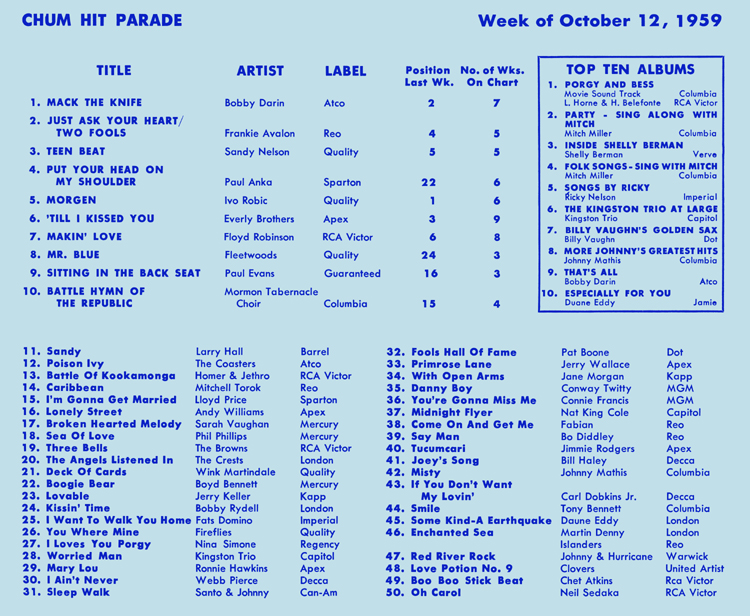
| Canada (CHUM Hit Parade) | 1 |
| US Cash Box | 1 |
All-time charts
| Chart | Position | US Billboard Hot 100 |
|---|---|---|
| 4 |
Certifications
Ella Fitzgerald version
| B-side = Lorelei
- Jazz Marc Blitzstein (English version)
On 13 February 1960, Ella Fitzgerald performed the song live for the first time in a concert at Deutschlandhalle in Berlin. Fitzgerald, however, forgot the lyrics after the first stanza, and she improvised new lyrics, including name-checking Louis Armstrong and Bobby Darin. The song was included on the album Ella in Berlin: Mack the Knife released in July.
The song was released as a single in April 1960. This version made the US Hot 100, peaking at No. 27 in June 1960. This song was Fitzgerald's best performing song in the 1960s, and she included the song in all her subsequent shows.
The performance earned Fitzgerald a Grammy Award for Best Female Pop Vocal Performance at the 3rd Annual Grammy Awards.
Charts
| Chart (1960) | Peak |
|---|---|
| position | |
| US Cash Box | 31 |
Instrumental versions
An instrumental version of "Mack the Knife" titled "Moritat – A Theme From "The Three Penny Opera"" was recorded by Dick Hyman, It also reached No. 9 on the Cashbox chart, as well as No. 9 on the UK chart in 1956. A number of other instrumental versions also appeared on The Top 100 at the same time: Richard Hayman and Jan August (No. 12), Lawrence Welk (No. 31), Billy Vaughn (No. 37), and Les Paul and Mary Ford (No. 49). Billy Vaughn also reached No. 12 in the UK.
Jazz saxophonist Sonny Rollins recorded an instrumental version titled simply "Moritat" for his album Saxophone Colossus, recorded in 1956. A 1959 instrumental performance by Bill Haley & His Comets was the final song the group recorded for Decca Records. Ray Conniff recorded a version for orchestra and chorus in 1962 for the album, The Happy Beat. Liberace performed the song in five styles: as originally written, in the style of the "Blue Danube Waltz", as a music box, in a bossa nova rhythm, and in boogie-woogie.
Other versions
Frank Sinatra added the song to his repertoire in 1984 in an arrangement by Frank Foster; In the performance included on his album L.A. Is My Lady, Sinatra similarly name-checked Armstrong and Darin, as well as adding members of his backing band. Sinatra and Jimmy Buffett recorded a duet of the song for Sinatra's final album Duets II (1994).
Nick Cave and Spanish Fly performed the song for the video September Songs – The Music of Kurt Weill in 1994, released as an album in 1997. while Sting and Dominic Muldowney recorded it for the 1985 tribute album Lost in the Stars: The Music of Kurt Weill.
Other notable versions include performances by Lisa Stansfield, Mark Lanegan, Kenny Ball, Dave Van Ronk, Jimmie Dale Gilmore, Tony Bennett, Anita O'Day (in an arrangement by Jimmy Giuffre), Marianne Faithfull, Brian Setzer, Dr. John, Ute Lemper, King Kurt, Bing Crosby, Eartha Kitt, The Psychedelic Furs, David Cassidy (in At the Copa), Westlife, The Doors, and Michael Bublé. Swiss band The Young Gods radically reworked the song in industrial style on their 1991 album The Young Gods Play Kurt Weill as "Mackie Messer", Deana Martin recorded "Mack the Knife" on her second studio album, Volare, released in 2009 by Big Fish Records. Robbie Williams recorded the song on his 2001 album Swing When You're Winning. Hildegard Knef recorded a German version, "Mackie Messer".
Salsa musician Rubén Blades recorded an homage entitled "Pedro Navaja" (Razor Pete). Brazilian composer Chico Buarque, in his loose adaptation of Threepenny Opera (Ópera do Malandro), made two versions called "O Malandro" and "O Malandro No. 2", with lyrics in Portuguese.
1950s comedic legend Ernie Kovacs used a German-translated version of the song throughout his television series.
References
Sources
References
- Farneth, David. (2000). "Kurt Weill: A Life in Pictures and Documents". Overlook Press.
- Bernard N. Lee Jr. (2017). "A Look Back in Time: Memoir of a Military Kid in the 50s". Bernard N. Lee Jr.
- "Public Domain Day 2024 {{pipe}} Duke University School of Law".
- "Song: La complainte de Mackie".
- {{IBDB title. 11750. Threepenny Opera. (Cochran/Krimsky)
- {{IBDB title. 13510. Threepenny Opera. (Blitzstein)
- [https://www.lyricsfreak.com/l/louis+armstrong/mack+the+knife_20085339.html Louis Armstrong – Mack The Knife Lyrics], lyricsfreak.com
- McLamore, Alyson. (2016). "Musical Theater: An Appreciation". Taylor & Francis.
- Pollack, Howard. (2012). "Marc Blitzstein: His Life, His Work, His World". Oxford University Press USA.
- Bambarger, Bradley. (23 August 1997). "Sony Classical Tribute Taps into the Legacy of Kurt Weill".
- (19 November 1955). "Reviews of New Pop Records".
- Jos Willems. (2006). "All of Me: The Complete Discography of Louis Armstrong". Scarecrow Press.
- Gleason, Ralph J.. (2016). "Music in the Air: The Selected Writings of Ralph J. Gleason". Yale University Press.
- {{harvnb. Pollack. 2012
- The Kurt Weill Foundation for Music. (2021-09-28). "#OnThisDay Lotte Lenya attends Louis Armstrong's recording session for "Mack the Knife" in 1955".
- (29 October 1955). "Unorthodox Events Lead to 2 Disks".
- Collier, James Lincoln. (1983). "Louis Armstrong, an American Genius". Oxford University Press.
- "GRAMMY Hall of Fame {{!}} Hall of Fame Artists".
- "New Entries to National Recording Registry". [[Library of Congress]].
- (17 March 1956). "The Top 100".
- (10 August 1959). "Reviews of This Week's Singles".
- Burke, Ken. (1 January 1998). "MusicHound Lounge: The Essential Album Guide". [[Visible Ink Press]].
- ""Mack the Knife"—Bobby Darin (1959). Added to the National Registry: 2015. Essay by Jimmy Scalia".
- Starr, Michael Seth. (2011). "Bobby Darin: A Life". Taylor Trade Publishing.
- "Tom Dowd & the Language of Music". Language of Music Films.
- "Big Rock Candy Mountain: Rock 'n' roll in the late fifties. [Part 3]: Track 2: Bobby Darin". [[Pop Chronicles]].
- "Bobby Darin & Dick Clark".
- "''That's All'' – Bobby Darin".
- [https://www.songfacts.com/facts/bobby-darin/mack-the-knife {{"'Mack the Knife' by Bobby Darin"], songfacts.com
- [http://www.cashboxmagazine.com/archives/50s_files/1959.html "Cash Box Pop Singles – 1959"] {{Webarchive. link. (18 August 2011 , ''[[Cashbox (magazine)). Cashbox]]''
- Cheal, David. (15 January 2016). "The Life of a Song: 'Mack the Knife'". [[Financial Times]].
- "Billboard Top 100 – 1959".
- (11 December 2003). "500 Greatest Songs of All Time".
- (28 November 2017). "2nd Annual GRAMMY Awards".
- (7 March 2001). "Songs of the Century". [[CNN]].
- "GRAMMY Hall Of Fame".
- "CHUM Hit Parade, week of October 12, 1959".
- "The Cash Box Best-Selling Singles: Week ending October 10, 1959".
- "Greatest of All Time Hot 100 Songs".
- Johnson, J. Wilfred. (2010). "Ella Fitzgerald: An Annotated Discography; Including a Complete Discography of Chick Webb". McFarland.
- Perone, James E.. (2016). "Smash Hits: The 100 Songs That Defined America". ABC-CLIO.
- (4 July 1960). "Reviews of This Week's LP's".
- (4 April 1960). "This Week's New Money Records".
- Whitburn, Joel. (2013). "Joel Whitburn's Top Pop Singles, 14th Edition: 1955-2012". Record Research.
- Nicholson, Stuart. (2014). "Ella Fitzgerald: A Biography of the First Lady of Jazz, Updated Edition". Taylor & Francis.
- (23 November 2020). "Ella Fitzgerald".
- "The Cash Box Best-Selling Singles: Week ending June 2, 1960".
- "The Cash Box Best-Selling Singles: Week ending February 25, 1956".
- "Dick Hyman Trio". The Official Charts Company.
- (24 March 1956). "The Top 100".
- (17 March 1956). "The Top 100".
- "Billy Vaughn". The Official Charts Company.
- (23 June 2018). "Moritat (Mack The Knife) (Sonny Rollins's version)". Steemit.
- Gioia, Ted. (2021). "The Jazz Standards: A Guide to the Repertoire". Oxford University Press.
- Eder, Bruce. "The Decca Years & More – Bill Haley & His Comets".
- {{YouTube. 6wZ-nbU76rk. Liberace performs "Mack the Knife" on ''The Ed Sullivan Show'' (note: this performance omits the music box version).
- [https://www.steynonline.com/7344/mack-the-knife "Mack the Knife – Sinatra Song of the Century #95"] by [[Mark Steyn]], 8 December 2015
- Viglione, Joe. "Lost in the Stars: The Music of Kurt Weill".
- {{Discogs release. 633562. King Kurt – Mack the Knife (1984)
- {{Discogs master. 494140. The Fabulous Eartha Kitt (1959)
- McDowell, Jay. (1 February 2024). "Behind the Violent Origins and Chart-Topping Success of "Mack the Knife" by Bobby Darin". American Songwriters.
- {{AllMusic
- (24 February 2020). ""Mack the Knife" Lyrics in German". ThoughtCo.
- "Pedro Navaja".
- {{Discogs release. 1455532. The Ernie Kovacs Record Collection (1997)
This article was imported from Wikipedia and is available under the Creative Commons Attribution-ShareAlike 4.0 License. Content has been adapted to SurfDoc format. Original contributors can be found on the article history page.
Ask Mako anything about Mack the Knife — get instant answers, deeper analysis, and related topics.
Research with MakoFree with your Surf account
Create a free account to save articles, ask Mako questions, and organize your research.
Sign up freeThis content may have been generated or modified by AI. CloudSurf Software LLC is not responsible for the accuracy, completeness, or reliability of AI-generated content. Always verify important information from primary sources.
Report