From Surf Wiki (app.surf) — the open knowledge base
Machete
Type of broad and heavy knife
.jpg)
Type of broad and heavy knife


A machete (; ) is a broad blade originating from Central America. It is used either as an agricultural implement similar to an axe, or in combat like a long-bladed knife. The blade is typically 30 to long and usually under 3 mm thick. In the Spanish language, the word is possibly a diminutive form of the word macho, which was used to refer to sledgehammers. Alternatively, its origin may be machaera, the name given by the Greeks and Romans to the falcata. It is the origin of the English language equivalent term matchet, though this is rarely used. In much of the English-speaking Caribbean, such as Jamaica, Barbados, Guyana, Grenada, and Trinidad and Tobago, the term cutlass is used for these agricultural tools.
Uses
Agriculture
In various tropical and subtropical countries, the machete is frequently used to cut through rainforest undergrowth and for agricultural purposes (e.g. cutting sugar cane). Besides this, in Latin America a common use is for such household tasks as cutting large foodstuffs into pieces—much as a cleaver is used—or to perform crude cutting tasks, such as making simple wooden handles for other tools. It is common to see people using machetes for other jobs, such as splitting open coconuts, yard work, removing small branches and plants, chopping food, and clearing bushes.
Machetes are often considered tools and used by adults. However, many hunter–gatherer societies and cultures surviving through subsistence agriculture begin teaching babies to use sharp tools, including machetes, before their first birthdays.
Warfare
People in uprisings sometimes use these weapons. For example, the Boricua Popular Army are unofficially called macheteros because of the machete-wielding laborers of sugar cane fields of past Puerto Rico.
Many of the killings in the 1994 Rwandan genocide were performed with machetes, and they were the primary weapon used by the Interahamwe militias there. Machetes were also a distinctive tool and weapon of the Haitian Tonton Macoute.
In 1762, the British captured Havana in a lengthy siege during the Seven Years' War. Volunteer militiamen led by Pepe Antonio, a Guanabacoa councilman, were issued with machetes during the unsuccessful defense of the city. The machete was also the most iconic weapon during the independence wars in Cuba, although it saw limited battlefield use. Carlos Manuel de Céspedes, owner of the sugar refinery La Demajagua near Manzanillo, freed his slaves on 10 October 1868. He proceeded to lead them, armed with machetes, in revolt against the Spanish government. The first cavalry charge using machetes as the primary weapon was carried out on 4 November 1868 by Máximo Gómez, a sergeant born in the Dominican Republic, who later became the general in chief of the Cuban Army.
The machete is a common side arm and tool for many ethnic groups in West Africa. Machetes in this role are referenced in Chinua Achebe's Things Fall Apart.
Some countries have a name for the blow of a machete; the Spanish machetazo is sometimes used in English. In the British Virgin Islands, Grenada, Jamaica, Saint Kitts and Nevis, Barbados, Saint Lucia, and Trinidad and Tobago, the word planass means to hit someone with the flat of the blade of a machete or cutlass. To strike with the sharpened edge is to "chop". Throughout the English-speaking islands of the Caribbean, the term "cutlass" refers to a laborers' cutting tool.
The Brazilian Army's Instruction Center on Jungle Warfare developed a machete-style knife with a blade 10 in in length and a very pronounced clip point. This machete is issued with a 5 in Bowie knife and a sharpening stone in the scabbard, collectively called a "jungle kit" (Conjunto de Selva in Portuguese); it is manufactured by Indústria de Material Bélico do Brasil (IMBEL).
The machete was used as a weapon during the Mau Mau rebellion, in the Rwandan Genocide, and in South Africa, particularly in the 1980s and early 1990s when the former province of Natal was wracked by conflict between the African National Congress and the Zulu-nationalist Inkatha Freedom Party.
Manufacture

Good machetes rely on the materials used and the shape. In the past, the most famous manufacturer of machetes in Latin America and the Spanish-speaking Caribbean was Collins Company of Collinsville, Connecticut. The company was founded as Collins & Company in 1826 by Samuel W. Collins to make axes. Its first machetes were sold in 1845 and became so famous that a machete was called un collin. In the English-speaking Caribbean, Robert Mole & Sons of Birmingham, England, was long considered the manufacturer of agricultural cutlasses of the best quality. Some Robert Mole blades survive as souvenirs of travellers to Trinidad, Jamaica, and, less commonly, St. Lucia.
Colombia is the largest exporter of machetes worldwide.
Cultural influence
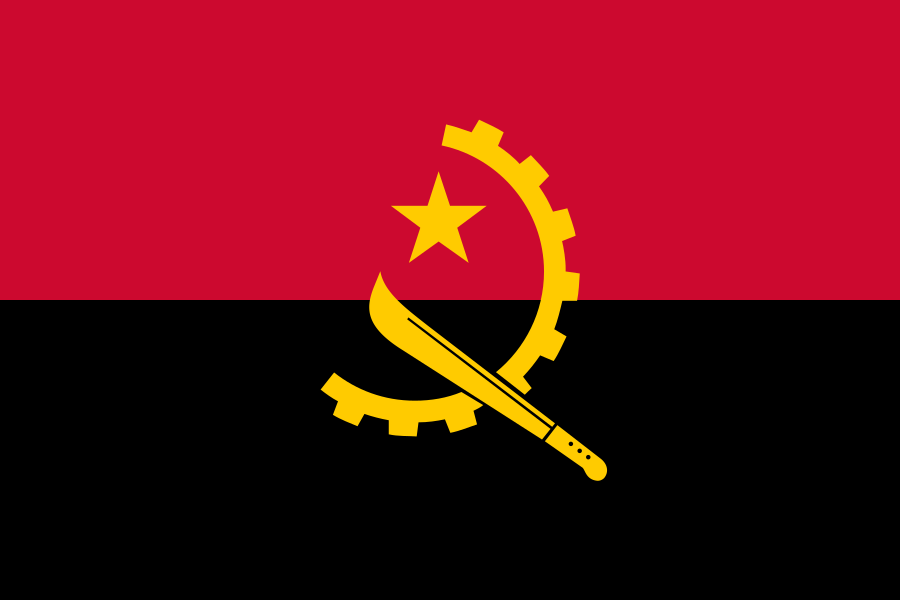
The flag of Angola features a machete, along with a cog-wheel as communist symbols.
The southern Brazilian state of Rio Grande do Sul has a dance called the dança dos facões (machetes' dance) in which the dancers, who are usually men, bang their machetes against various surfaces while dancing, simulating a battle. Maculelê, an Afro-Brazilian dance and martial art, can also be performed with facões. This practice began in the city of Santo Amaro, Bahia, in the northeastern part of the country.
In the Jalisco region of Mexico, Los Machetes is a popular folk dance. This dance tells the story of cutting down sugar cane during the harvest. Los Machetes was created by Mexican farm workers who spent a great amount of time perfecting the use of the tool, the machete, for harvesting. Traditionally, real machetes are used while performing this dance.
Similar tools
The panga or tapanga is a variant used in East and Southern Africa. This name may be of Swahili etymology; not to be confused with the panga fish. The panga blade broadens on the backside and has a length of 16 to. The upper inclined portion of the blade may be sharpened.

In the Philippines, the various indigenous swords and knives (known under the general term bolo) are commonly incorrectly described as a type of machete (as "bolo machete"). But bolos are unrelated to the machete. They are pre-colonial and hand-forged (unlike mass-produced machetes), with distinct types that differ by ethnic group. The most obvious difference is the shape of the cutting edge, which is typically curved in bolos and more or less straight in machetes. Bolos are also usually shorter than machetes, at around 25 to long, and are adapted to a wider range of uses.
Other similar tools include the parang and the golok (from Malaysia and Indonesia); however, these tend to have shorter, thicker blades with a primary grind, and are more effective on woody vegetation.
The tsakat is a similar tool used in Armenia for clearing land of vegetation.
Other similar tools include:
- Billhook
- Dusack
- Golok
- Kopis
- Kukri
- Seax
- Sorocaban Knife
References
References
- "Online Etymology Dictionary". etymonline.com.
- (8 April 2020). "La falcata ¿mito romántico o realidad? - Archivos de la Historia".
- "El Machete: Abriéndose paso en jungla y combate - Mundo Armas".
- "matchet". The Free Dictionary.
- [https://books.google.com/books?isbn=1481752359 Blair, Teresa P. ''A-Z of Jamaican Patois (Patwah),'' Page 49, Google Books Result]
- Klein, John. (21 October 2013). "What Is a Machete, Anyway?".
- (2012). "The People's Guide to Mexico". Avalon Travel.
- Day, Nicholas. (9 April 2013). "Give Your Baby a Machete". [[Slate (magazine).
- Martin, Gus. (15 June 2011). "The SAGE Encyclopedia of Terrorism, Second Edition". SAGE Publications.
- (2006). "Machetes and Firearms: the Organization of Massacres in Rwanda". Journal of Peace Research.
- Braid, Mary. (3 March 1999). "The Jungle Massacre: African rebels who revel in their machete genocide". [[The Independent]].
- "Tonton Macoute". Haitian Media.
- Ponce, Mildrey. (2007). "Why Did The English Take Over Havana?". Cuba Now.
- Tone, John Lawrence. (2006). "War and Genocide in Cuba, 1895–1898". [[University of North Carolina Press]].
- Gravette, A G. (28 September 2007). "Cuba". New Holland Publishers.
- "Major General Máximo Gómez Báez". Gobierno de la Republica de Cuba.
- "Plot Overview". [[SparkNotes]].
- Sturges, James Walter. (August 2010). "Machetes in the Trunk: Three Weeks in Panama". James Sturges.
- Allsopp, Richard. (2003). "Dictionary of Caribbean English Usage". [[University of the West Indies Press]].
- "Conjunto de Selva". [[IMBEL.
- Cavaleri, David P.. (2005). "The Law of War: Can 20th Century Standards Apply to the Global War on Terrorism?". DIANE Publishing.
- Jones, Chester Lloyd. (1906). "The Consular Service of the United States: Its History and Activities". [[University of Pennsylvania Press]].
- Kauffman, Henry J.. (1994). "American Axes: A Survey of Their Development and Their Makers". Masthof Press.
- Henry, Daniel Edward. (1995). "Collins' Machetes and Bowies, 1845-1965". Krause Publications.
- La Farge, Oliver. (1956). "A Pictorial History of the American Indian". Crown Publishers.
- "1566: Vintage Trinidad Machete in Leather Sheath : Lot 1566". liveauctioneers.com.
- (12 April 2014). "Colombia líder – La Prensa".
- Lewis, John Lowell. (1992). "Ring of Liberation: Deceptive Discourse in Brazilian Capoeira". University of Chicago Press.
- . ["Los Machetes - Folk Dance Fun!"](https://www.sallysseaofsongs.com/2015/05/los-machetes-folk-dance-fun.html).
- Mothander, Björn. (1989). "Farm Implements for Small-scale Farmers in Tanzania". Nordic Africa Institute.
- "Forged Filipino Bolo Knives".
- (1982). "Sharpening Hand Tools: Storey's Country Wisdom Bulletin A-66". Storey Publishing, LLC.
- "Machete vs Bolo: Decoding Common Word Mix-Ups".
- "Bolo: Filipino survival blade".
- Stone, George Cameron. (1999). "A Glossary of the Construction, Decoration, and Use of Arms and Armor in All Countries and in All Times: In All Countries and in All Times". Courier Dover Publications.
- Stone, George Cameron. (1999). "A Glossary of the Construction, Decoration, and Use of Arms and Armor in All Countries and in All Times: In All Countries and in All Times". Courier Dover Publications.
This article was imported from Wikipedia and is available under the Creative Commons Attribution-ShareAlike 4.0 License. Content has been adapted to SurfDoc format. Original contributors can be found on the article history page.
Ask Mako anything about Machete — get instant answers, deeper analysis, and related topics.
Research with MakoFree with your Surf account
Create a free account to save articles, ask Mako questions, and organize your research.
Sign up freeThis content may have been generated or modified by AI. CloudSurf Software LLC is not responsible for the accuracy, completeness, or reliability of AI-generated content. Always verify important information from primary sources.
Report