From Surf Wiki (app.surf) — the open knowledge base
Macedonian diaspora
Community of Macedonian emigrants
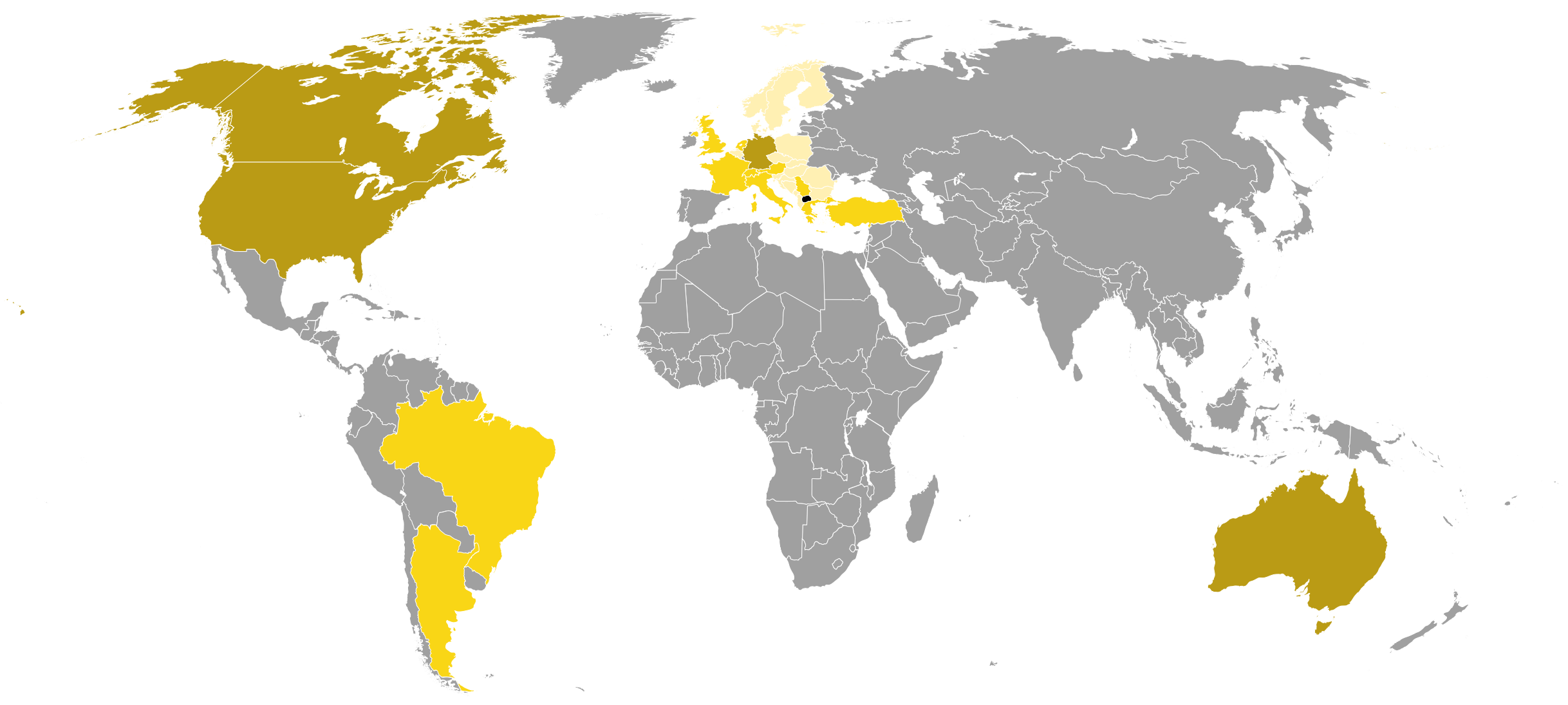
Community of Macedonian emigrants
]] The Macedonian diaspora () consists of ethnic Macedonian emigrants and their descendants in countries such as Australia, Italy, the United Kingdom, Germany, New Zealand, Canada, the United States and others. A 1964 estimate put the number of Macedonian emigrants at over 580,000.*{{Citation
History
The Macedonian diaspora is the consequence of either voluntary departure or forced migration over the past 100 years. It is claimed that there were six major waves of emigration. The Macedonian Slavic-speaking immigrants in the first half of 20th century were considered and identified as Bulgarians or Macedonian Bulgarians. Many Macedonian Bulgarians came to the United States. Several immigrants identified also as Macedonians, however the designation was used then mainly regionally. The sense of belonging to a separate Macedonian nation gained credence after World War II, following the establishment of the People's Republic of Macedonia within the Socialist Federal Republic of Yugoslavia and the codification of a distinct Macedonian language.
The first wave occurred after the failure of the Ilinden Uprising in 1903. Many people fled to other parts of Ottoman Empire, Bulgaria, Russia, the United States and Canada.
The "Pečalba" (seasonal work) tradition was common across the Macedonian region. Many people settled in the host countries. The pečalbari emigrated from the 1880s to the 1920s, mainly to Greece. Large settlements occurred in Canada, Brazil, Argentina, Turkey and the United States.
The period from World War I to the Great Depression, when Macedonians fled Serbian rule and moved to Western Europe for industrial labor jobs, mainly in such countries as France, West Germany, Belgium and the Netherlands, which was repeated in the early 1950s to late 1970s.
After World War II and the Greek Civil War, thousands of Macedonians fled, were evacuated or emigrated. Thousands of people fled from Greece after the failure of the DSE, the National Liberation Front and the Communist Party of Greece (KKE) to win the Greek Civil War, including a number of Slavic speakers of Greek Macedonia.{{Cite book
During the 1960s, Yugoslavia lifted restrictions on emigration. Hundreds of thousands of Macedonians emigrated. Internal Yugoslav migration (Serbia) was also very prevalent, by 1991 an estimated 80,000 Macedonians were living throughout Yugoslavia. Primary destinations were Australia, Chile, France, Germany, Italy, New Zealand, Norway, Spain, Sweden, Switzerland and the United States.
After the Breakup of Yugoslavia thousands of Macedonians emigrated. Many went to Germany, Italy, Switzerland, the UK and North America.
Number of ethnic Macedonians around the world
| Country | Number of Ethnic Macedonians | Main Article | Description | Summary | ~ 619.905 | ~ 1 325.413 | The number of Macedonians in Greece, Bulgaria, Albania and Serbia is not clear due to politics. They might represent a larger or smaller number within their borders. | ||||||
|---|---|---|---|---|---|---|---|---|---|---|---|---|---|
| 1 | Albania Albania | 4,697 (1989 census) – 35,000 (est.) | Macedonians in Albania | Although not necessarily classified as being a part of the "Macedonian diaspora", the Macedonians in Albania constitute a minority group in Albania. | |||||||||
| 2 | Argentina Argentina | 30,000 (est.) | Macedonian Argentine | Many Macedonians of Argentina are the descendants of the "pečalbari" (seasonal workers) who came to Argentina in the early 20th century. Many decided to stay in Argentina, setting up Macedonian colonies in the Pampas and other regions. Most Macedonians can be found in Buenos Aires, the Pampas and Córdoba. An estimated 30,000 Macedonians can be found in Argentina. | |||||||||
| 3 | Australia Australia | 111,352 (2021 census) -200.000 (est.) | Macedonian Australians | The Macedonians in Australia comprise many refugees from the Greek Civil War. Although the majority are from the Republic of Macedonia having migrated to Australia from the 1960s to the early 1990s. The Republic of Macedonia claims that there are 200,000 Macedonians in Australia. Demographer Charles Price puts the number of Macedonians in Australia at over 150,000 people. | |||||||||
| 4 | Austria Austria | 13,696 (2001 census)1 – 25,000 (est.) | Macedonians in Austria | Thousand of Macedonians emigrated to Austria during the years of the Yugoslav federation. Many were temporary workers. After the Breakup of Yugoslavia many returned to Macedonia but a large proportion of the minority remained. In recent years migration to Austria has increased. By 2001 there were 13,696 Macedonian citizens in Austria, however the Macedonian government puts the figure at 15,000. | |||||||||
| 5 | Belgium Belgium | 3,4191 – 15,406 | |||||||||||
| 6 | Brazil Brazil | 45,000 (est.) | Macedonians in Brazil | date=September 2010}} Many Pečalbari (seasonal workers) came to Brazil in the early 1900s looking for work. Many of them stayed and established themselves in Brazil. The Macedonians in Brazil can be found in Porto Alegre, Rio de Janeiro and Curitiba. Many of the descendants no longer speak the Macedonian language. | |||||||||
| 7 | Bulgaria Bulgaria | 1,143 people (2021 census) | Ethnic Macedonians in Bulgaria or Pirin Macedonians | ||||||||||
| 8 | Canada Canada | 37,705 (2006 census) – 200,000 (est.) | Macedonian Canadians | The Macedonian Community of Canada is one of the largest and oldest Macedonian diaspora groups in the world. Many refugees from the Balkan Wars and World War I emigrated to Canada in the early 20th century. They were joined by Aegean Macedonians in the 1920s and 1930s. Another wave of refugees arrived after World War II. Many emigrants from Aegean Macedonia began to arrive in the 1950s and 1960s joined by Yugoslav Macedonians. | |||||||||
| 9 | Czech Republic Czech Republic | 2,068 citizens of RM (2009 census), 13–15,000 (2001 estimate ) | Macedonians in the Czech Republic | The Macedonians in the Czech Republic are mainly descended from the refugee children who were resettled in the former Czechoslovakia. It was estimated that 11,623 people were resettled in Czechoslovakia. Many later decided to return to the Socialist Republic of Macedonia, which shaprly reduced the community's numbers. Although Many decided to stay in the Czech Republic. | |||||||||
| 10 | Denmark Denmark | 3,349 (2008 census)1 – 12,000 (est.) | Macedonians in Denmark | ||||||||||
| 11 | Finland Finland | url=http://www.un.org/en/development/desa/population/migration/data/estimates2/estimates17.shtml | title=United Nations Population Division | Department of Economic and Social Affairs | website=un.org | access-date=29 June 2018}} | ||||||||
| 12 | France France | 2,300 – 15,000(est.) | Macedonians in France | The French government estimates the number of Macedonians in France to be 2,300 while Macedonian figures put the number at over 15,000 persons. | |||||||||
| 13 | Germany Germany | 62,295 (2006 figures)1 –117,969(est.) | Macedonians in Germany | url=https://web.archive.org/web/20110930042306/http://www.mfa.gov.mk//Upload/ContentManagement/Files/Broj%20na%20makedonski%20iselenici%20vo%20svetot.doc | date=30 September 2011 }} | ||||||||
| 14 | Greece Greece | url=http://migrantsingreece.org/transpartner/Tables.pdf | title=Data on immigrants in Greece, from Census 2001 | work=Migrants in Greece | access-date=12 January 2009 | archive-url=https://web.archive.org/web/20081218110856/http://www.migrantsingreece.org/transpartner/Tables.pdf | archive-date=18 December 2008 }} to 10,000–30,000 (1999 est.) | Slavic speakers of Greek Macedonia | As of 1 January 2010, there are 1,705 citizens from the Republic of Macedonia with a residency permit in Greece. | ||||
| 15 | Hungary Hungary | 5,000 (est.) | Macedonians in Hungary | After the Greek Civil War many Macedonians were evacuated to Hungary. Many left for the Socialist Republic of Macedonia in the 1950s and 1960s. Although a substantial minority remained of the 7,253 who fled Greece. An estimated 5,000 Macedonians resided in Hungary in 1995. | |||||||||
| 16 | Italy Italy | 78,090 (2007 figures)1 | The largest population of Macedonian Muslims in the Macedonian diaspora can be found Italy. Many of them are from the Debar, Gostivar, Struga and Mavrovo regions of Macedonia. Next to the Macedonian Muslims there is also a large population of Macedonian Christians. The total number of Macedonian citizens in Italy has risen from 34,019 in 2003 to 78,090 in 2007. | ||||||||||
| 17 | Luxembourg Luxembourg | 200 | |||||||||||
| 18 | Netherlands Netherlands | 10,000 – 15,000 (est.) | Many Macedonians entered the Netherlands during the 1960s and 1970s. Most of these returned to Macedonia while a minority remained. They were joined by business migrants and students after the breakup of Yugoslavia. It is estimated that over between 10,000 and 15,000 Macedonians can be found in the Netherlands. | ||||||||||
| 19 | New Zealand New Zealand | 807 2006 census1 – 1,500 (est.) | |||||||||||
| 20 | Norway Norway | 2,000 | |||||||||||
| 21 | Poland Poland | 2,000 | Macedonians in Poland | Most of the Macedonians of Poland originate from the Child Refugees of the Greek Civil War. Estimates put the number of Macedonian refugees settled in Poland at 11,458. Most Macedonians are settled in Southern and Central Poland. Many Macedonians immigrated to Poland after the breakup of Yugoslavia. | |||||||||
| 22 | Portugal Portugal | 310 | UN 2020 estimate, Macedonian-born only | ||||||||||
| 23 | Romania Romania | 731 – 6,000 | Macedonians of Romania | A large group of Macedonians has been present in Romania since the end of the Greek Civil War when thousands of refugees were transferred there. Many chose to remain in Romania. Today the Macedonians in Romania are a fully recognised minority group. | |||||||||
| 24 | Russia Russia | 1,000 (est.) | By the 21st century an estimated 1000 Macedonians remained in Russia. | ||||||||||
| 25 | Slovakia Slovakia | 4,600 (est.)1 | |||||||||||
| 26 | Spain Spain | 200 (est.) | |||||||||||
| 27 | Sweden Sweden | 6,000 – 15,000 (est.) | Macedonians in Sweden | Macedonians began to immigrate to Sweden after World War II. Many of these were originally Slavic speakers of Greek Macedonia who were later joined by Macedonians from Yugoslavia, a large proportion of these were Macedonian Muslims. The Macedonian population settled heavily in the south-western region of Sweden. The Swedish Government officially recognizes the Macedonian minority present in Sweden. Macedonians in Sweden are well organized through many associations and they are recognized as a Macedonian minority through law. Throughout Sweden there are over 20 registered Macedonian associations. There are several Macedonian Orthodox Churches and Macedonian language newspapers in Sweden. In 2006 there were 3,669 Macedonian born in Sweden. The Swedish immigrant center puts the number of Macedonians at 6,000. Macedonian sources put the number of Macedonians in Sweden at over 15,000. | |||||||||
| 28 | Switzerland Switzerland | 61,304 (2006 figures)1 – 63,000 (est.) | Immigration from the former Yugoslavia to Switzerland | Thousand of Macedonians emigrated to Switzerland during the years of the Yugoslav federation. Many were temporary workers. After the breakup of Yugoslavia thousands more came to Switzerland. In 1992 an association of Macedonian clubs and groups was founded, the "Združenie na Makedonskite Društva" (ZMD) has member from every Macedonian society in Switzerland. By 2000 large concentrations had been established in Biel/Bienne, Bern, Geneva and Zürich. By 2005 there were 61,304 Macedonian citizens in Switzerland. | |||||||||
| 29 | United Kingdom United Kingdom | 10,000 (est.) | Macedonians in the United Kingdom | An estimated 10,000 Macedonians live in the United Kingdom. The majority of them are concentrated in the Greater London region. | |||||||||
| 30 | United States United States | 51,733 (2006 figures) – 200,000 (est.) | Macedonian Americans | Macedonians emigrated to America as "Pečalbari" (seasonal workers) in the late 19th and early 20th century. It is estimated that after the failure of the Ilinden Uprising, over 50,000 Macedonians came to America. The first immigrants were primarily from the Lerin, Kostur, and Bitola regions. After World War I, many Macedonians returned to Europe only to be joined by Macedonians who were fleeing persecution under the Metaxas regime. By 1945, an estimated 40,000 to 50,000 Macedonians were in the United States. Post-war immigration was limited until the Breakup of Yugoslavia. Large Macedonian concentrations can be found in Detroit (20,000), Gary, Chicago, and northern New Jersey. The 1990 census recorded 20,365 Macedonians. By 2006, this number had increased to 42,812. The United Macedonian Diaspora was established by Macedonian Americans real Macedonians who live and work in USA with their establishment are also present in the United States | |||||||||
| Yugoslavia Former Yugoslavia | 65,000 (est.) | url=http://www.ucm.es/BUCM/revistas/ghi/0214400x/articulos/CHCO9393110171A.PDF | title=UCM-Universidad Complutense de Madrid | publisher=Ucm.es | access-date=7 August 2014 | archive-url=https://web.archive.org/web/20090219052449/http://www.ucm.es/BUCM/revistas/ghi/0214400x/articulos/CHCO9393110171A.PDF | archive-date=19 February 2009 }} Over 60,000 Macedonians were scattered throughout the rest of Yugoslavia by 1991. | ||||||
| 31 | Bosnia and Herzegovina Bosnia and Hercegovina | 2,278 (2005 census) – 10,000 (est.) | Many Macedonians emigrated to Bosnia and Herzegovina during the 1960s and 1970s. Many Macedonians such as Branko Crvenkovski and Stevo Teodosievski were born in Bosnia and Herzegovina. Their numbers have fluctuating from 657 in 1948, 2,297 in 1953, 3,642 in 1961 and 3,764 in 1971. In 1981 there were 2,753 Macedonians in Bosnia, this number fell to 2,278 in 2005. Most Macedonians left Bosnia and Herzegovina during the Bosnian War, many returned after the War. | ||||||||||
| 32 | Croatia Croatia | 4,270 (2001 census) – 15,000 (est.) | Macedonians of Croatia | Macedonians have been emigrating to Croatia since the end of World War II. Their numbers have fluctuating from 1,387 in 1948, 2,385 in 1953, 4,381 in 1961 and 5,625 in 1971. In 1981 there were 6,362 Macedonians in Croatia, this number fell to 4,270 in 2001. They are an officially recognized ethnic minority in Croatia. It is claimed that up to 15,000 Macedonians live in Croatia. | |||||||||
| 33 | Montenegro Montenegro | 819 (2003 census) – 2,500 (est.) | Macedonians in Montenegro | A small Macedonian population had existed in Montenegro since the early 1900s. By 1948 only 133 Macedonians remained in Montenegro, this number rose to 875 in 1981. 1,072 Macedonians were counted in the 1991 Yugoslav Census, this number had fallen to 819 by 2003. Macedonian was the mother language of 507 people. The Macedonians were concentrated in Podgorica, Herceg Novi and Tivat. | |||||||||
| 34 | Serbia Serbia | 25,847 (2002 census) – 50,000 (est.)Poulton, Hugh (1993) The Balkans: Minorities and States in Conflict, 2nd edition | Macedonians in Serbia | Thousand of Macedonian joined the Partisans and fought in Serbia and the rest of Yugoslavia. Many decided to remain in Serbia. Tens of thousands of Macedonian migrants emigrated to Serbia during the years of the Yugoslav federation. Their numbers have fluctuating significantly from 17,917 in 1948, 27,277 in 1953, 36,288 in 1961 and 42,675 in 1971. In 1981 there were 48,986 Macedonians in Serbia, this number fell to 46,046 in 1991. In 2002 there were 25,847 Macedonians in Serbia. | |||||||||
| 35 | Slovenia Slovenia | url=http://www.stat.si/popis2002/si/rezultati/rezultati_red.asp?ter=SLO&st=7 | title=Slovenian Census | publisher=Stat.si | access-date=7 August 2014}} – 12,000 (est.) | Macedonians in Slovenia | During the years of the Yugoslav federation, many Macedonians migrated to the Socialist Republic of Slovenia. Most of them came from the east of the Socialist Republic of Macedonia and they settled mainly in the town of Kranj and the capital Ljubljana. Macedonian communities can be also found in larger towns such as Jesenice, Nova Gorica, Maribor and Celje. Around 450 Macedonians reside in the Celje region. The Macedonians are well established in Slovenia and currently have newspapers, churches, folkloric groups and many other Macedonian institutions in operation. The 1951 Yugoslav census recorded 640 Macedonians while the 1961 census recorded 1,009 Macedonians. By 1971 the number had grown to 1,613 and to 3,288 by 1981. The 1991 Yugoslav census recorded 4,371 Macedonians. The 2002 census recorded 3,972 Macedonians, while 4,760 Macedonian diaspora organization claim that the number of Macedonians in Slovenia exceeds 12,000. |
1; This figure refers to country of birth only.
Cities with the most Macedonians
- Melbourne, Australia: 46,233
- Sydney, Australia: 28,916
- Toronto, Canada: 25,245
- Vienna, Austria: 14,074
Diaspora organizations and political parties
Organizations representing ethnic Macedonians in the broader region of Macedonia outside of North Macedonia have been established. In Albania, the Macedonian Alliance for European Integration is a political party of ethnic Macedonians in Albania that has succeeded in getting Macedonians elected to local and national positions. In Bulgaria, United Macedonian Organization Ilinden–Pirin focuses on achieving human rights for ethnic Macedonians. It is part of the European Free Alliance. In Greece, Rainbow is a political party representing ethnic Macedonians. It has been participating in elections since 1994 and is also part of the European Free Alliance.
The Democratic Party of the Macedonians was established in Kosovo to represent the Macedonians of Gora. There is also an organization of Macedonian Gorani in Kosovo, led by Avnija Rahte and Ace Dimoski. The group has met with leadership from North Macedonia including Stevo Pendarovski and Zoran Zaev.
Several organizations have been established by ethnic Macedonians in the diaspora. The Macedonian Patriotic Organization (MPO) is the oldest association of Macedonian Americans and Macedonian Canadians, founded in 1922 by Macedono-Bulgarians. Its initial objective was the creation of an independent Macedonian state and now focuses on preserving the customs and traditions of Macedonians in North America. MPO's Mission Statement states "The mission of the Macedonian Patriotic Organization is to: Continue to work for human, civil and economic rights for all Macedonians of the world promote and preserve the ethnic traditions, customs and history of our people promote and develop the cultural and social growth of our youth promote and strengthen our Organization." MPO maintains a "Works for Macedonia" "The Gotse Delcheff Fund," which "allows the MPO to channel its charitable fund raising efforts into results for those in need of humanitarian assistance in Macedonia."
The Macedonian-Australian People's League existed from 1946 to 1957, reaching 53 branches in Australia. It decentralized its operations in 1957.
The United Macedonia Diaspora (UMD), the largest Macedonian diaspora organization, is an advocacy group in Washington, DC, founded in 2004. It has a global network and organizes initiatives in support of North Macedonia's constitutional name at independence, the ethnic Macedonian minorities throughout Southeast Europe, and NATO and EU integration, among other issues. It has been described as nationalist and also as ultra-nationalist.
The World Macedonian Congress (WMC) is a political organization is set up to be a parliament for ethnic Macedonians globally. Established in 1990, it is based in Skopje.
References
References
- Peter Hill, ''The Macedonians in Australia'', Victoria Park: Hesperian Press, 1989
- [[Emily Greene Balch]], ''Our Slavic fellow citizens'', Charities Publication Committee, New York, 1910, p. 275.
- [http://promacedonia.org/en/gp2/gp_18.htm Prpic, George. South Slavic immigration in America, Boston: Twayne, 1978, p. 212-222].
- 0-521-80789-1, p. 573
- 0-8020-2938-8.
- [https://books.google.com/books?id=ZmesOn_HhfEC&dq=MPO++Bulgarian+Macedonian&pg=PA88 ''The Macedonian Conflict: Ethnic Nationalism in a Transnational World''], pp. 85–89, by Loring M. Danforth.
- Chris Kostov, Contested Ethnic Identity: The Case of Macedonian Immigrants in Toronto, 1900-1996, Peter Lang, 2010, {{ISBN. 3034301960, p. 117.
- "Macedonian Bulgarians in the United States".
- Victor Roudometof, Collective Memory, National Identity, and Ethnic Conflict: Greece, Bulgaria, and the Macedonian Question, Greenwood Publishing Group, 2002, {{ISBN. 0275976483, p. 109
- Barbara Jelavich, History of the Balkans, Vol. 2: Twentieth Century. Cambridge University Press, 1983, {{ISBN. 0521274591, pp. 320-321.
- [https://scholarworks.umass.edu/anthro_faculty_pubs/58/ ''The Pecalba Tradition in Macedonia, A Case Study''], Joel and Barbara K. Halpern, University of Massachusetts Amherst, January 1975
- [https://books.google.com/books?id=ZmesOn_HhfEC&dq=MPO++Bulgarian+Macedonian&pg=PA88 ''The Macedonian Conflict: Ethnic Nationalism in a Transnational World''], p. 54, by Loring M. Danforth
- John S. Koliopoulos. Plundered Loyalties: World War II and Civil War in Greek West Macedonia. Foreword by C. M. Woodhouse. New York: New York University Press. 1999. p. 304. 0814747302
- "MINA Breaking News – Macedonians in Chile – work as miners, live as capitalists".
- Peter Hill, ''The Macedonians in Australia'', Victoria Park: Hesperian Press, 1989.
- [http://www.fes.hr/E-books/pdf/Local%20Self%20Government/09.pdf "LOCAL SELF-GOVERNMENT AND DECENTRALIZATION: CASE OF ALBANIA. HISTORY, REFORMES AND CHALLENGES"] {{webarchive. link. (25 October 2012 Artan Hoxha and Alma Gurraj.)
- "Albania : 4.2 Specific policy issues and recent debates: 4.2.2 Heritage issues and policies". Culturalpolicies.net.
- Nasevski, Boško; Angelova, Dora. Gerovska, Dragica (1995). Македонски Иселенички Алманах '95. Skopje: Матица на Иселениците на Македонија.
- [http://www.mfa.gov.mk//Upload/ContentManagement/Files/Broj%20na%20makedonski%20iselenici%20vo%20svetot.doc Population Estimate from the MFA] {{webarchive. link. (30 September 2011)
- (19 December 2022). "2021 Census Table: Country of Birth Quickstats". Censusdata.abs.gov.au.
- (19 December 2013). "2006 Census Table: Ancestry (full classification list) by Sex". Censusdata.abs.gov.au.
- (19 December 2013). "2006 Census Table: Language Spoken at Home by Sex". Censusdata.abs.gov.au.
- (2014). "The People of Australia: Statistics from the 2011 Census". Australian Government.
- "2001 Austrian Census".
- [ftp://www.statistik.at/pub/neuerscheinungen/vzaustriaweb.pdf 2001 census ]{{dead link. (May 2025)
- [http://www.mfa.gov.mk//Upload/ContentManagement/Files/Broj%20na%20makedonski%20iselenici%20vo%20svetot.doc] {{webarchive. link. (26 June 2008)
- "Untitled 1".
- [http://ecodata.mineco.fgov.be/mdn/Vreemde_bevolking.jsp 2007 Belgian figures] {{webarchive. link. (8 October 2002)
- (2 April 2008). "2006 census". 2.statcan.ca.
- "2008 census". Statbank.dk.
- "United Nations Population Division | Department of Economic and Social Affairs".
- "French Ministry of Foreign Affairs". Diplomatie.gouv.fr.
- "French 2005 Estimates". Diplomatie.gouv.fr.
- [http://www.mfa.gov.mk//Upload/ContentManagement/Files/Broj%20na%20makedonski%20iselenici%20vo%20svetot.doc Estimates from the MFA] {{webarchive. link. (30 September 2011)
- "Data on immigrants in Greece, from Census 2001". Migrants in Greece.
- (18 September 1999). "Greece – Report about Compliance with the Principles of the Framework Convention for the Protection of National Minorities (along guidelines for state reports according to Article 25.1 of the Convention)". Greek Helsinki Monitor (GHM) & Minority Rights Group – Greece (MRG-G).
- "taxalia Θεσσαλονικη: 532.898 οι νόμιμοι μετανάστες στην Ελλάδα". Taxalia.blogspot.com.
- "Statistics Italy". Demo.istat.it.
- "República de Macedonia - Emigrantes totales 2020 {{!}} Datosmacro.com".
- "OECD Statistics".
- [http://www.immi.se/alfa/m.htm Immi Sweden] {{webarchive. link. (20 March 2008)
- Regeringskansliet Justitiedepartamentet, 10333 Stockholm En sammanfattning av regeringens minoritetpolitik
- "Tabeller över Sveriges befolkning 2006 Folkmängd – översikt".
- [http://www.immi.se/alfa/m.htm Invandringens elektroniska encyklopedi] {{webarchive. link. (18 December 2008)
- "2006 Community Survey". [[United States Census Bureau]].
- "Macedonian Americans". Everyculture.com.
- "United Macedonian Diaspora".
- "UCM-Universidad Complutense de Madrid". Ucm.es.
- "Матица на иселениците – Македонија". Maticanaiselenici.com.
- "Slovenian Census". Stat.si.
- "Napaka 404".
- "Napaka 404".
- "ABS Statistics".
- "ABS Statistics".
- (8 February 2017). "Census Profile, 2016 Census - Toronto [Population centre], Ontario and Canada [Country]".
- "Bevölkerung nach Herkunft und Geschlecht 2019 und 2020 - Offizielle Statistik der Stadt Wien".
- "Member Parties".
- (22 February 2023). "Пендаровски разговараше со Гораните од Косово по пропагандите на Јотова". Nezavisen.
- "Meeting of Prime Minister Zaev with representatives of the Macedonian Gorani community in Kosovo". Sloboden Pečat.
- "Mission Statement".
- "MPO Works For Macedonia".
- Sinisa Jakov Marusic. (4 July 2022). "Opposition to 'French Proposal' Mounts in North Macedonia". Balkan Insight.
- Bruno Mascitelli. (11 May 2016). "The European Diaspora in Australia". Cambridge Scholars Publishing.
- Mascitelli, Mycak, Papalia, Bruno, Sonia, Gerardo. (2016). "The European Diaspora in Australia". Cambridge Scholars.
- DeCorse, Christina J. (2019), ''Diasporic Macedonians: Transnational Communities and National Identity Development in Los Angeles County''. California State University p. 19
- Papavizas, George C.. (2012-06-01). "Fyrom: A Source of Balkan Instability". Mediterranean Quarterly.
This article was imported from Wikipedia and is available under the Creative Commons Attribution-ShareAlike 4.0 License. Content has been adapted to SurfDoc format. Original contributors can be found on the article history page.
Ask Mako anything about Macedonian diaspora — get instant answers, deeper analysis, and related topics.
Research with MakoFree with your Surf account
Create a free account to save articles, ask Mako questions, and organize your research.
Sign up freeThis content may have been generated or modified by AI. CloudSurf Software LLC is not responsible for the accuracy, completeness, or reliability of AI-generated content. Always verify important information from primary sources.
Report