From Surf Wiki (app.surf) — the open knowledge base
Maastrichtian
Sixth and last age of the Late Cretaceous

Sixth and last age of the Late Cretaceous
| Field | Value |
|---|---|
| name | Maastrichtian |
| color | Maastrichtian |
| time_start | 72.2 |
| time_start_uncertainty | 0.2 |
| time_end | 66.0 |
| image_map | Opening of western Indian Ocean 70 Ma.png |
| caption_map | Opening of the western Indian Ocean in the Maastrichtian |
| timeline | Cretaceous |
| name_formality | Formal |
| celestial_body | earth |
| usage | Global (ICS) |
| timescales_used | ICS Time Scale |
| chrono_unit | Age |
| strat_unit | Stage |
| timespan_formality | Formal |
| lower_boundary_def | Mean of 12 biostratigraphic criteria |
| lower_gssp_location | Grande Carrière quarry, Landes, France |
| lower_gssp_coords | |
| lower_gssp_accept_date | February 2001 |
| upper_boundary_def | Iridium enriched layer associated with a major meteorite impact and subsequent K-Pg extinction event. |
| upper_gssp_location | El Kef Section, El Kef, Tunisia |
| upper_gssp_coords | |
| upper_gssp_accept_date | 1991 |
The Maastrichtian ( ) is, in the International Commission on Stratigraphy (ICS) geologic timescale, the latest age (uppermost stage) of the Late Cretaceous Epoch or Upper Cretaceous Series, the Cretaceous Period or System, and of the Mesozoic Era or Erathem. It spanned the interval from . The Maastrichtian was preceded by the Campanian and succeeded by the Danian (part of the Paleogene and Paleocene). It is named after the city of Maastricht, the capital and largest city of the Limburg province in the Netherlands.
The Cretaceous–Paleogene extinction event (formerly known as the Cretaceous–Tertiary extinction event) occurred at the end of this age. colliding with Earth, ending the Cretaceous.
Stratigraphic definitions
Definition
The Maastrichtian was introduced into scientific literature by Belgian geologist André Hubert Dumont in 1849, after studying rock strata of the Chalk Group close to the Dutch city of Maastricht. These strata are now classified as the Maastricht Formation – both the formation and stage derive their names from the city. The Maastricht Formation is known for its fossils from this age, most notably those of the giant sea reptile Mosasaurus, which in turn derives its name from the nearby river Maas (mosa being Latin for the river Maas).
The base of the Maastrichtian Stage is at the first appearance of ammonite species Pachydiscus neubergicus. At the original type locality near Maastricht, the stratigraphic record was later found to be incomplete. A reference profile for the base was then appointed in a section along the Ardour river called Grande Carrière, close to the village of Tercis-les-Bains in southwestern France. The top of the Maastrichtian Stage is defined to be at the iridium anomaly at the Cretaceous–Paleogene boundary (K–Pg boundary), which is also characterised by the extinction of many groups of life.
Subdivision
The Maastrichtian is commonly subdivided into two substages (Upper and Lower) and three ammonite biozones. The biozones are (from young to old):
- zone of Anapachydiscus terminus
- zone of Anapachydiscus fresvillensis
- zone of Pachydiscus neubergicus till Pachydiscus epiplectus
The Maastrichtian is roughly coeval with the Lancian North American Land Mammal Age.
Palaeogeography
The breakup of Pangaea was nearly complete in the Maastrichtian, with Australia beginning to break away from Antarctica and Madagascar breaking away from India. However, Arabia had not yet rifted away from Africa. North America was separated from Europe by rift basins, but seafloor spreading had not yet commenced between the two continents.
The Pacific Plate was rapidly growing in size as the surrounding oceanic plates were consumed by subduction, and the Pacific-Izanagi Ridge was rapidly approaching Asia.
Eruption of the Deccan Traps large igneous province began during the Maastrichtian, at around 67 million years ago. This is thought to be a consequence of India drifting over the Réunion hotspot.
Climate
During the Maastrichtian, the global climate began to shift from the warm and humid climate of the Mesozoic to the colder and more arid climate of the Cenozoic. Variation of climate with latitude also became greater. This was likely caused by a major reorganization of oceanic circulation that took place at the boundary between the early and late Maastrichtian. This reorganization was triggered by the breach of tectonic barriers in the South Atlantic, permitting deep ocean water to begin circulating from the nascent North Atlantic to the south. This initiated thermohaline circulation similar to that of the modern oceans. At the same time, the Laramide orogeny drained the Western Interior Seaway of North America, further contributing to global cooling. Nonetheless, the latest Maastrichtian featured a sharp, pronounced warming, which was caused by the activity of the Deccan Traps.
South-central Alaska had a mean annual temperature of , a warm monthly mean temperature of , and a cold monthly mean temperature of .
Paleontology

Dinosaurs remained the dominant large terrestrial animals throughout the Maastrichtian, though mammals with internal organs similar to modern mammals were also present. Both ammonites and pterosaurs were in serious decline during the Maastrichtian.
Dinosaurs
Birds
Several archaic clades of birds, such as Enantiornithes, Ichthyornithes, and Hesperornithes, persisted to the latest Maastrichtian but became extinct during the Cretaceous-Paleogene extinction event.
Pterosaurs
Traditionally, pterosaur faunas of the Maastrichtian were assumed to be dominated by azhdarchids, with other pterosaur groups having become extinct earlier on. However, more recent findings suggest a fairly composite pterosaur diversity: at least six ("Nyctosaurus" lamegoi, a Mexican humerus, a Jordan humerus, and several taxa from Morocco) nyctosaurs date to this period, as do a few pteranodontids, and Navajodactylus, tentatively assigned to Azhdarchidae, lacks any synapomorphies of the group. This seems to underscore a higher diversity of terminal Cretaceous pterosaurs than previously thought.
Flora
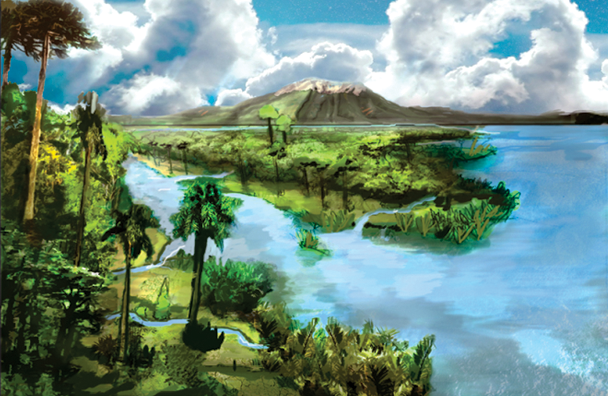
The radiation of angiosperms (flowering plants) was well under way in the Maastrichtian. From 50% to 80% of all genera of land plants were angiosperms, though gymnosperms and ferns still covered larger areas of the land surface.
Notes
References
References
- Odin, Gilles S.. (2001). "The global Campanian-Maastrichtian stage boundary". Episodes.
- (2004). "A geologic time scale 2004". Cambridge University Press.
- (9 April 2014). "Scientists reconstruct ancient impact that dwarfs dinosaur-extinction blast". [[American Geophysical Union]].
- Amos, Jonathan. (15 May 2017). "Dinosaur asteroid hit 'worst possible place'".
- (2012). "Stratigraphy of the type Maastrichtian – a synthesis". Scripta Geologica.
- Hallie P. Street. (2016). "A re-assessment of the genus ''Mosasaurus'' (Squamata: Mosasauridae)". University of Alberta.
- Mike Everhart. (May 14, 2010). "''Mosasaurus hoffmanni''-The First Discovery of a Mosasaur?".
- (2001). "Chapter E5c Numerical age calibration of the Campanian-Maastrichtian succession at Tercis les Bains (landes, france) and in the Bottaccione Gorge (Italy)". Developments in Palaeontology and Stratigraphy.
- (1993). "Maastrichtian Ammonites from the Biscay Region (France, Spain)". Memoir (The Paleontological Society).
- (2017). "Earth history and palaeogeography". Cambridge University Press.
- (April 1999). "Tectonic forcings of Maastrichtian ocean-climate evolution". Paleoceanography.
- Olsson, R. K.. (1 July 2001). "Paleobiogeography of Pseudotextularia Elegans During the Latest Maastrichtian Global Warming Event". The Journal of Foraminiferal Research.
- (July 2003). "Planktonic foraminiferal response to the latest Maastrichtian abrupt warm event: a case study from South Atlantic DSDP Site 525A". Marine Micropaleontology.
- (30 March 2017). "Latest Cretaceous climatic and environmental change in the South Atlantic region: LATEST CRETACEOUS CHANGE SOUTH ATLANTIC". [[Paleoceanography and Paleoclimatology]].
- (15 September 2010). "Paleofloristic and paleoenvironmental information from a Late Cretaceous (Maastrichtian) flora of the lower Cantwell Formation near Sable Mountain, Denali National Park, Alaska". [[Palaeogeography, Palaeoclimatology, Palaeoecology]].
- (1 January 2016). "Crayfish burrows from the latest Cretaceous lower Cantwell Formation (Denali National Park, Alaska): Their morphology and paleoclimatic significance". [[Palaeogeography, Palaeoclimatology, Palaeoecology]].
- (13 September 2011). "Mass extinction of birds at the Cretaceous–Paleogene (K–Pg) boundary". Proceedings of the National Academy of Sciences.
- Wilton, Mark P. (2013). Pterosaurs: Natural History, Evolution, Anatomy. Princeton University Press. {{ISBN. 0691150613.
- Barrett, P. M., Butler, R. J., Edwards, N. P., & Milner, A. R. (2008). Pterosaur distribution in time and space: an atlas. Zitteliana: 61–107.[1].
- Carroll, N. REASSIGNMENT OF MONTANAZHDARCHO MINOR AS A NON-AZHDARCHID MEMBER OF THE AZHDARCHOIDEA, SVP 2015.
- (2012). "Systematic reinterpretation of ''Piksi'' barbarulna ''Varricchio'', 2002 from the Two Medicine Formation (Upper Cretaceous) of Western USA (Montana) as a pterosaur rather than a bird". Geodiversitas.
- (2018). "Late Maastrichtian pterosaurs from North Africa and mass extinction of Pterosauria at the Cretaceous-Paleogene boundary". PLOS Biology.
This article was imported from Wikipedia and is available under the Creative Commons Attribution-ShareAlike 4.0 License. Content has been adapted to SurfDoc format. Original contributors can be found on the article history page.
Ask Mako anything about Maastrichtian — get instant answers, deeper analysis, and related topics.
Research with MakoFree with your Surf account
Create a free account to save articles, ask Mako questions, and organize your research.
Sign up freeThis content may have been generated or modified by AI. CloudSurf Software LLC is not responsible for the accuracy, completeness, or reliability of AI-generated content. Always verify important information from primary sources.
Report