From Surf Wiki (app.surf) — the open knowledge base
M8 motorway (Scotland)
Busiest motorway in Scotland
Busiest motorway in Scotland
| Field | Value | ||
|---|---|---|---|
| country | SCT | ||
| type | M | ||
| route | 8 | ||
| map | |||
| map_custom | yes | ||
| map_notes | M8 highlighted in blue | ||
| photo | The M8 motorway in Glasgow - geograph.org.uk - 3604193.jpg | ||
| photo_notes | The M8 motorway looking towards Glasgow's West End | ||
| maint | Transport Scotland | ||
| length_mi | 60.3 | ||
| direction_a | East | ||
| terminus_a | Sighthill | ||
| counties | Edinburgh, West Lothian, North Lanarkshire, Glasgow, Renfrewshire | ||
| destinations | Edinburgh | ||
| Edinburgh Airport | |||
| Livingston | |||
| Glasgow | |||
| Paisley | |||
| Glasgow Airport | |||
| Greenock | |||
| direction_b | West | ||
| terminus_b | Langbank | ||
| established | 1965 | ||
| history | Opened: 1965 | ||
| Completed: 2017 | |||
| junction | [[File:Junction 2.svg | 1000x20px]] [[File:UK-Motorway-M9.svg | 1000x20px]] |
| J2 → M9 motorway | |||
| [[File:Junction 8.svg | 1000x20px]] [[File:UK-Motorway-M73.svg | 1000x20px]]/[[File:UK-Motorway-A8(M).svg | 1000x20px]] |
| J8 → M73 motorway/A8(M) motorway | |||
| [[File:Junction 13.svg | 1000x20px]] [[File:UK-Motorway-M80.svg | 1000x20px]] | |
| J13 → M80 motorway | |||
| [[File:Junction 21.svg | 1000x20px]] [[File:UK-Motorway-M74.svg | 1000x20px]] | |
| J21 → M74 motorway | |||
| [[File:Junction 22.svg | 1000x20px]] [[File:UK-Motorway-M77.svg | 1000x20px]] | |
| J22 → M77 motorway | |||
| [[File:Junction 30.svg | 1000x20px]] [[File:UK-Motorway-M898.svg | 1000x20px]] | |
| J30 → M898 motorway | |||
| e-road | and | ||
| previous_type | M | ||
| previous_route | 6 Toll | ||
| next_type | M | ||
| next_route | 9 | ||
| next_dab | Scotland |
Edinburgh Airport Livingston Glasgow Paisley Glasgow Airport Greenock
Completed: 2017 J2 → M9 motorway J8 → M73 motorway/A8(M) motorway J13 → M80 motorway J21 → M74 motorway J22 → M77 motorway J30 → M898 motorway |e-road= and The M8 is the busiest motorway in Scotland. It connects the country's two largest cities, Glasgow and Edinburgh, and serves other large communities including Airdrie, Coatbridge, Greenock, Livingston and Paisley. The motorway is 60 mi long. A major construction project to build the final section between Newhouse and Baillieston was completed on 30 April 2017. The motorway has one service station, Heart of Scotland Services, previously named Harthill due to its proximity to the village.
History
With the advent of motorway-building in the United Kingdom in the late 1950s, the M8 was planned as one of a core of new motorways, designed to replace the A8 road as a high-capacity alternative for intercity travel. The motorway was constructed piecemeal in several stages bypassing towns, beginning in 1965 with the opening by Minister of State for Scotland George Willis of the bypass of Harthill. In 1968 the Renfrew Bypass was opened as the A8(M), becoming part of the M8 when the motorway to the west was connected. The Glasgow inner city section was constructed between 1968 and 1972, using a scheme outlined in the Bruce Report, which was published as the Second World War was closing, and which set out a series of initiatives to regenerate the city. Bruce's scheme evolved into what would become the Glasgow Inner Ring Road, a motorway "box" which would encircle the city centre, connected to the Renfrew Bypass at its south western corner, and the Monkland Motorway (built over the former route of the Monkland Canal) towards Edinburgh at its north eastern corner. Together, these three sections of motorway make up the present day M8.
Most of the motorway's length was complete by 1980. Since then, there has been a new interchange with the M80 motorway added in 1992, a 4 mi eastern extension from Newbridge to the then-new Edinburgh City Bypass in 1995, and the new junction on the approach to the Kingston Bridge in Glasgow connecting to the new M74 extension in 2011. As part of the Scottish Government's 'M8 M73 M74 Motorway Improvements programme', on which construction began in early 2015, the remaining unfinished section between Baillieston (J8) and Newhouse (J6) was built, alongside other major improvements enhancing connectivity to the local road network, M73, and M74. The new section was fully opened on 30 April 2017. On 6 December 2019, the Southbar interchange (J29a) was reopened to facilitate new housing in the Bishopton area, having been previously closed during the 1970s.
Route
From the Edinburgh City Bypass, the road runs west to junction with the M9 motorway (for the Forth Road Bridge), bypassing to the north of Livingston and south of Bathgate. It continues across Scotland's Central Belt. The next section – originally designated the Monkland Motorway – begins on the boundary of the Glasgow City council area at the M73 motorway junction (the main interchange for all routes south via the M74 motorway) before passing through the districts of Barlanark, Riddrie, Dennistoun and Townhead (following the route of the abandoned Monkland Canal) on the way directly into the city centre. The central section – the uncompleted Glasgow Inner Ring Road – contains numerous junctions serving local communities including Cowcaddens, Garnethill, Kelvingrove and Anderston. It then crosses the River Clyde on the Kingston Bridge, runs west through Kinning Park, Bellahouston and Hillington before leaving Glasgow. Continuing west, it bypasses Renfrew and Paisley (carrying traffic directly over what was the main runway at Renfrew Airport, closed in 1966) before serving Glasgow International Airport, running to the south of Erskine, and terminating at Langbank, around 10 mi east of Greenock.
The M8 nominally comprises sections of the international E-road network, namely E05 (Langbank-Baillieston) and E16 (Baillieston-Edinburgh), although neither is signposted – no such roads are in the United Kingdom.
Criticism
The central Glasgow section of the M8 is unusual amongst UK motorways (and more similar to many US Interstates) in that it directly bisects an urban city centre, whereas most other motorways bypass such centres. This section is mainly elevated on a concrete viaduct, lowering pollution concentrations but exposing some public spaces, roof terraces and other parts of buildings to noise and shading.
Some slip roads in the Glasgow section unusually enter and exit from the overtaking (right-hand) lane.
The motorway includes one of the busiest river crossings in Europe, Glasgow's Kingston Bridge.
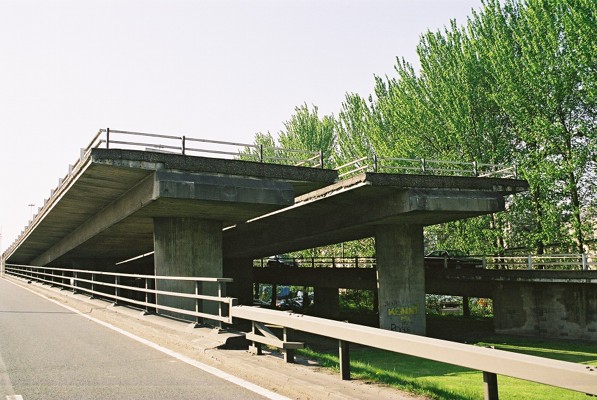
Several incomplete structures were built around the motorway - at least 3 have been demolished or reused from the 1960s dubbed Bridges to Nowhere. A few incomplete structures remain.
The cause of most traffic congestion on the urban section is traffic from the M73 and M80 routes onto the eastern section of M8 which within 2 mi reduces from five lanes to two on the Kingston Bridge approaches. Prior to the construction of the M74 extension, attempts were made to minimise delays on this section; these included restricting exits around the Kingston Bridge, a ramp metering programme, and expanded use of electronic signing above and beside the motorway as part of the CITRAC (Centrally Integrated TRAffic Control) system.
The M8 is also criticised as a barrier to wildlife access (for example the reintroduced beaver) from the north of Scotland to the Southern Uplands.
Problems solved
Successive failed attempts were made to build the southern flank of the Glasgow Inner Ring Road envisaged by the Bruce Report of the late 1940s. The eastern section had been planned to run north–south close to the High Street of Glasgow, through or under Glasgow Green to the southside of the Clyde. Public opinion was strongly against this and the eastern section was shelved, with a much later M74 connecting the far-eastern areas of Glasgow. This section, which is an extension of the M74 was built to a different route, intended to funnel long-distance traffic from the north and south which is bound for the southern Clyde Coast and allow it to bypass the urban section of the M8. Following many years of intensive political discussion and legal battles, the M74 completion began in 2008 and opened in June 2011. Indications are that the new road has been successful in reducing traffic levels on the urban section of the M8.
Junctions
| No Access Limited Access Low Emission Zone Multiple Independent Exits |
|---|
Gallery
M8 Motorway and Union Canal.JPG|The M8 south of Broxburn, West Lothian Wfm kingston bridge.jpg|Kingston Bridge M8 Motorway, Charing Cross (geograph 4791827).jpg|M8 motorway from Charing Cross, Glasgow Clyde from M8, Dumbarton.jpg|M8 nearing the west terminus of the motorway at Langbank, with views over the Clyde M8_motorway_(Great_Britain)_map.svg|alt=M8 Route map|M8 route in relation to UK motorway network
References
References
- "Road traffic estimates in Great Britain: 2021 tables". Department for Transport.
- [https://www.theglasgowstory.com/image/?inum=TGSS00002&t=2 Townhead, c 1970], The Glasgow Story
- [http://www.cbrd.co.uk/motorway/m8/timeline.shtml M8 motorway construction timeline] {{webarchive. link. (9 October 2006 , CRBD.co.uk)
- "Keeping communities informed". transportscotland.gov.uk.
- "M8 M73 M74 Motorway Improvements". transportscotland.gov.uk.
- [https://www.dailyrecord.co.uk/news/local-news/new-aerial-footage-m8-m73-9563413 New aerial footage as M8 M73 M74 project nears completion], Daily Record, 5 January 2017
- (30 April 2017). "M8 'missing link' opens fully to traffic". BBC News.
- "M8 J29A Southbar Interchange". Roads.org.uk.
- [http://www.cbrd.co.uk/motorway/m8/exitlist.shtml M8 motorway exit list] {{webarchive. link. (9 October 2006 , CBRD.co.uk)
- [http://www.elbruz.org/eroads/E05.htm E05 route descriptor], elbruz.com
- [http://www.elbruz.org/eroads/E16.htm E16 route descriptor], elbruz.com
- (25 August 2009). "Living in Glasgow – CITRAC". Glasgow.gov.uk.
- "Traffic Scotland > Variable Message Signs". trafficscotland.org.
- (March 2015). "Effects on Flora and Fauna". transport.gov.scot.
- "Glasgow Low Emission Zone Homepage".
This article was imported from Wikipedia and is available under the Creative Commons Attribution-ShareAlike 4.0 License. Content has been adapted to SurfDoc format. Original contributors can be found on the article history page.
Ask Mako anything about M8 motorway (Scotland) — get instant answers, deeper analysis, and related topics.
Research with MakoFree with your Surf account
Create a free account to save articles, ask Mako questions, and organize your research.
Sign up freeThis content may have been generated or modified by AI. CloudSurf Software LLC is not responsible for the accuracy, completeness, or reliability of AI-generated content. Always verify important information from primary sources.
Report